Why an Australian price-comparison app has a real market (context — real, cited)
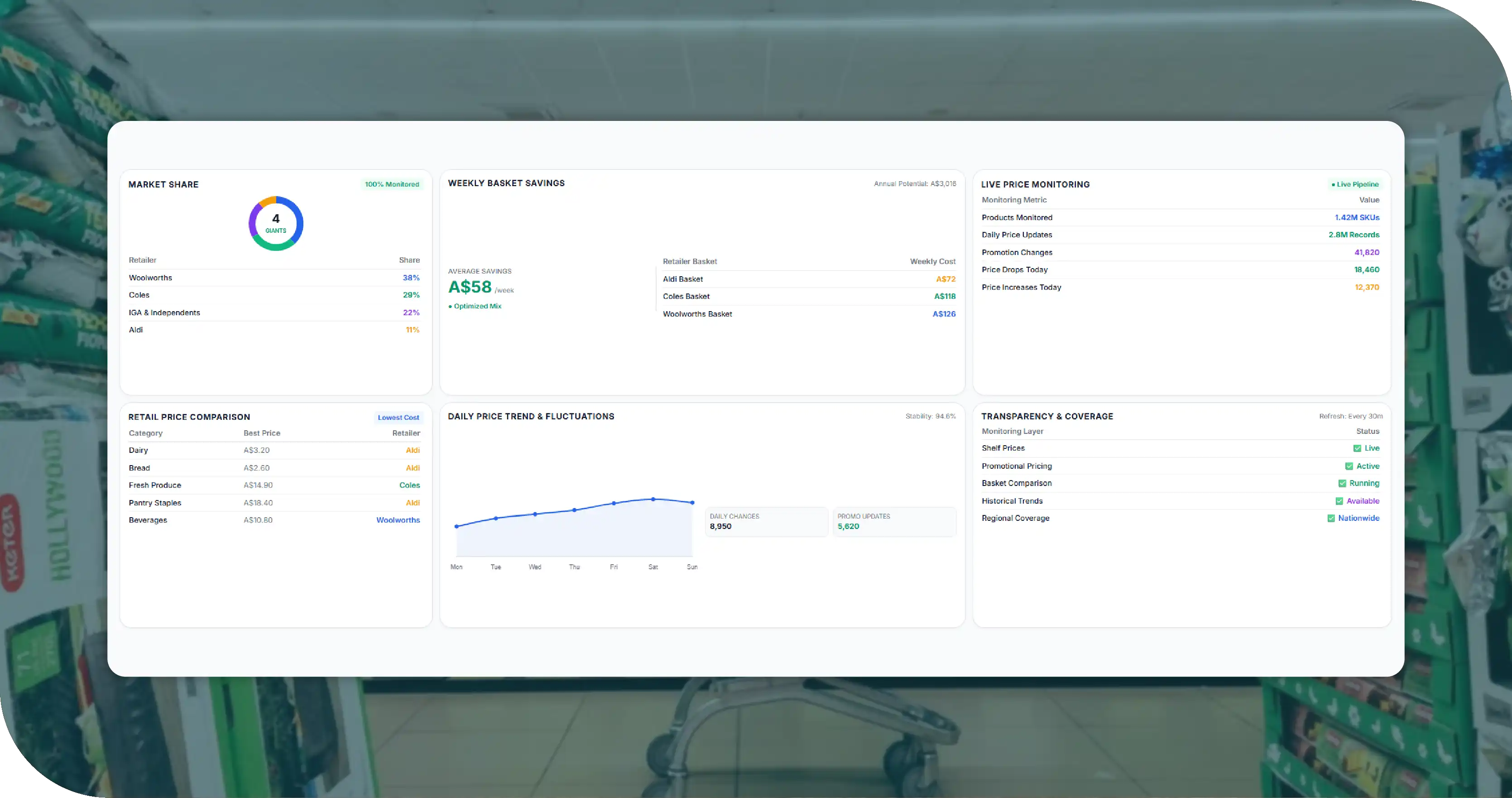
Australian grocery is a concentrated duopoly, which is exactly why shoppers hunt for the cheapest basket. Woolworths holds ~37–38% and Coles ~28–29% — together about two-thirds of the market — with Aldi around 9–12% and Metcash-supplied independents (IGA) making up the rest (ACCC Supermarkets Inquiry, Mar 2025; Morningstar, May 2026; ShopBack, 2026).
The savings gap is quantified: a household shopping exclusively at Woolworths or Coles typically spends A$40–70/week more than a comparable Aldi-primary basket, and Aldi's 20-item basket has been benchmarked cheapest at ~A$72 (ScrapeHero, Jun 2026; ShopBack, 2026). Crucially, Aldi still does not offer national home delivery in 2026 — so a comparison app that stitches shelf prices together fills a genuine gap.
Two more tailwinds: the ACCC's 2024–25 inquiry put promotional-pricing transparency under scrutiny, and independent trackers suggest underlying pricing dynamics haven't fundamentally changed (Roopon, May 2026). That mistrust drives users to a neutral price-comparison product.
The founder's problem
A solo technical founder shipped an MVP that let users build a shopping list — then hit the wall every app-builder hits: users asked “which store is cheapest for my list?”, and answering meant scraping four retailers. Six weeks vanished into anti-bot walls, postcode gating and layout changes while the roadmap froze.
What we deployed
- Matched-SKU catalog across Woolworths, Coles, Aldi, IGA (UPC-first matching, confidence score per record)
- Postcode-level pricing + promo + availability fields (answers “cheapest for my location”)
- Webhook delivery: only changed prices pushed — keeps ingestion cheap for a pre-revenue team
- Sample-first onboarding: 1,000-record free sample against the founder's own SKU list in 48 hours
What changed
The public beta shipped 7 weeks after the first sample. The differentiating feature went live — “total your exact basket at each store and show the cheapest,” powered by matched, postcode-level prices — and the founder reclaimed ~15 hours a week previously lost to scraper maintenance.