The Client
The client is a data-driven retail intelligence organization focused on optimizing pricing strategies across global grocery ecommerce markets. It works closely with major retail ecosystems to improve visibility into competitor pricing, assortment changes, and promotional behavior. By leveraging advanced analytics, the client supports brands and retailers in making faster, more informed pricing decisions across multiple digital platforms.
Its core capability lies in helping businesses Monitor Grocery Competitor Prices in Real Time to respond quickly to market fluctuations and maintain competitive positioning.
The organization also enables Grocery SKU Price Monitoring Across Platforms to ensure consistent tracking of identical products across Walmart, Amazon, Kroger, and Instacart.
In addition, it delivers strong Grocery E-Commerce Competitive Intelligence that helps clients identify pricing gaps, optimize margins, and enhance category performance.
Overall, the client plays a key role in transforming raw grocery data into actionable insights that drive smarter retail strategies and sustained competitive advantage in the US ecommerce grocery sector.
Key Challenges
- Inconsistent Pricing Structures Across Retailers
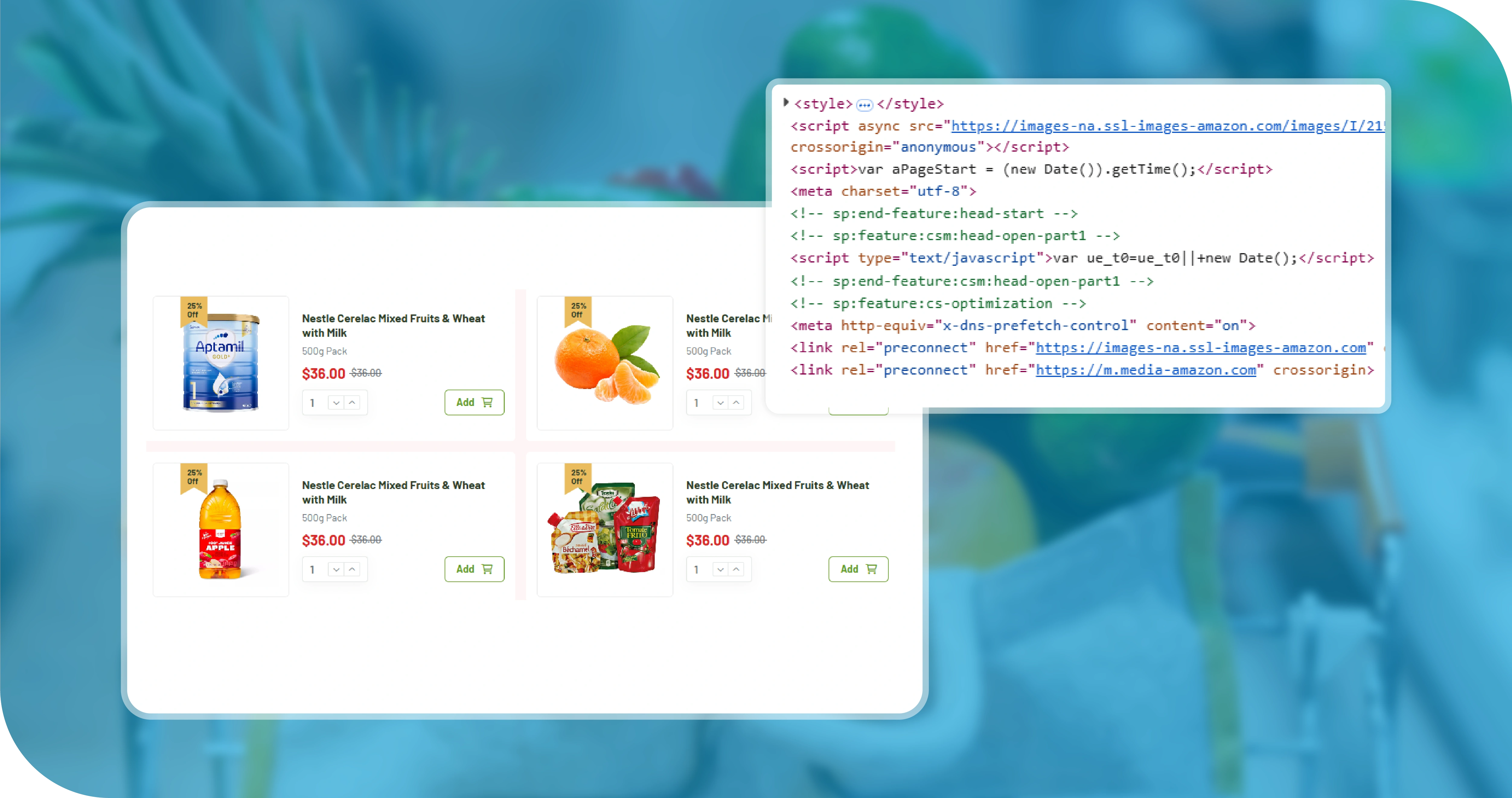
The client faces difficulty standardizing pricing data because Walmart, Amazon, Kroger, and Instacart each follow different listing formats, discount logic, and update frequencies. This creates mismatches in SKU alignment and comparison accuracy. Even identical grocery items often appear with varying attributes, making cross-platform analysis complex and slowing down decision-making for pricing intelligence teams. - Data Accessibility and Real-Time Freshness Gaps
Another key challenge is limited access to continuously updated and reliable grocery datasets, especially for large-scale analytics. Pricing changes occur frequently, but capturing them in real time remains difficult due to platform restrictions and dynamic content loading. This directly impacts the accuracy of insights derived from Walmart Grocery Delivery Dataset, affecting forecasting and competitive tracking reliability. - Technical Barriers in Large-Scale Extraction Systems
The client also struggles with maintaining stable, high-volume data pipelines because ecommerce platforms enforce strict anti-scraping measures and throttling rules. Ensuring uninterrupted extraction across thousands of SKUs requires advanced engineering and resilience. Integrating Walmart Grocery Delivery Scraping API at scale becomes complex, particularly when balancing speed, compliance, and data accuracy across multiple grocery ecosystems.
Key Solutions
- Cross-Platform Data Standardization System
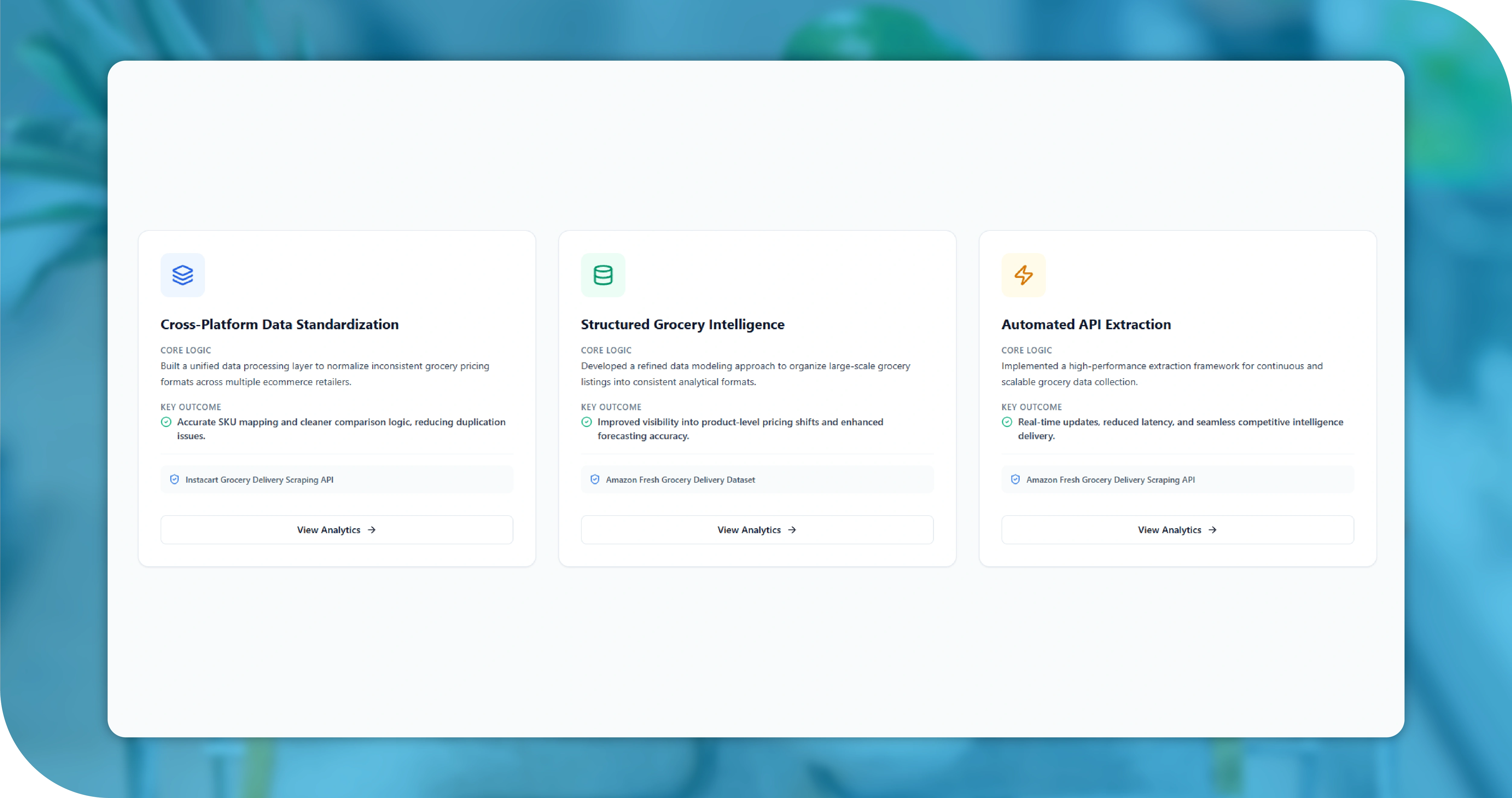
We built a unified data processing layer to normalize inconsistent grocery pricing formats across multiple ecommerce retailers, enabling accurate SKU mapping and cleaner comparison logic. Instacart Grocery Delivery Scraping API helped the client reduce duplication issues and improve reliability of competitive pricing insights across fragmented datasets for better retail decision-making workflows. - Structured Grocery Intelligence for Amazon Ecosystem
We developed a refined data modeling approach to organize large-scale grocery listings into consistent analytical formats, improving visibility into product-level pricing shifts. The Amazon Fresh Grocery Delivery Dataset was used to enhance forecasting accuracy, category tracking, and benchmark analysis for retail pricing optimization across fast-moving grocery segments. - Automated Multi-Platform API Extraction System
We implemented a high-performance extraction framework to enable continuous and scalable grocery data collection across major platforms. The system integrated Amazon Fresh Grocery Delivery Scraping API, ensuring real-time updates, reduced latency, and seamless competitive intelligence delivery for pricing and assortment monitoring.
Sample Data
| Platform | Product Category | Scraped Price ($) | Discount (%) | Availability Status | Update Frequency |
|---|---|---|---|---|---|
| Walmart | Fresh Fruits | 3.49 | 12% | In Stock | Every 15 mins |
| Amazon Fresh | Dairy Products | 4.29 | 8% | In Stock | Every 10 mins |
| Kroger | Packaged Snacks | 2.99 | 15% | Limited Stock | Every 20 mins |
| Instacart | Beverages | 5.19 | 10% | In Stock | Real-time |
| Walmart | Frozen Foods | 6.79 | 9% | In Stock | Every 15 mins |
| Amazon Fresh | Bakery Items | 3.89 | 7% | In Stock | Every 10 mins |
| Kroger | Meat & Poultry | 8.49 | 11% | In Stock | Every 20 mins |
| Instacart | Household Essentials | 7.25 | 13% | In Stock | Real-time |
Methodologies Used
- Automated Retail Data Collection Methodology
We implemented a high-frequency extraction framework to capture grocery prices, discounts, availability, and SKU variations across ecommerce platforms. Advanced automation workflows improved consistency, reduced manual intervention, and enabled scalable Web Scraping Grocery Data processes for accurate competitive analysis and faster retail intelligence generation across multiple grocery ecosystems. - API-Driven Real-Time Synchronization Framework
Our team deployed a scalable ingestion architecture that continuously synchronized grocery pricing updates from multiple retailer systems into centralized analytics pipelines. The Grocery Delivery Extraction API enabled low-latency data acquisition, ensuring timely access to product-level pricing insights, promotion tracking, and stock availability intelligence across dynamic ecommerce environments. - Centralized Visualization and Reporting Structure
We created interactive analytics environments to organize real-time grocery pricing intelligence into clear, actionable business reports. The Grocery Price Dashboard allowed retail teams to monitor competitor price movements, promotional trends, category performance, and SKU-level fluctuations while improving strategic pricing decisions through visualized market intelligence insights. - Continuous Competitive Benchmarking Workflow
A dedicated monitoring framework was designed to compare pricing changes across Walmart, Amazon, Kroger, and Instacart throughout the day. The Grocery Price Tracking Dashboard enabled automated benchmarking, helping retail teams identify pricing gaps, discount inconsistencies, and regional variations that directly influenced profitability and competitive positioning. - Data Modeling and Intelligence Enhancement Approach
We applied structured normalization, enrichment, and validation techniques to convert raw grocery datasets into decision-ready analytics assets. This methodology strengthened Grocery Data Intelligence capabilities by improving forecasting accuracy, category-level visibility, demand analysis, and operational planning for enterprise retail clients operating in highly competitive grocery ecommerce markets.
Advantages of Collecting Data Using Food Data Scrape
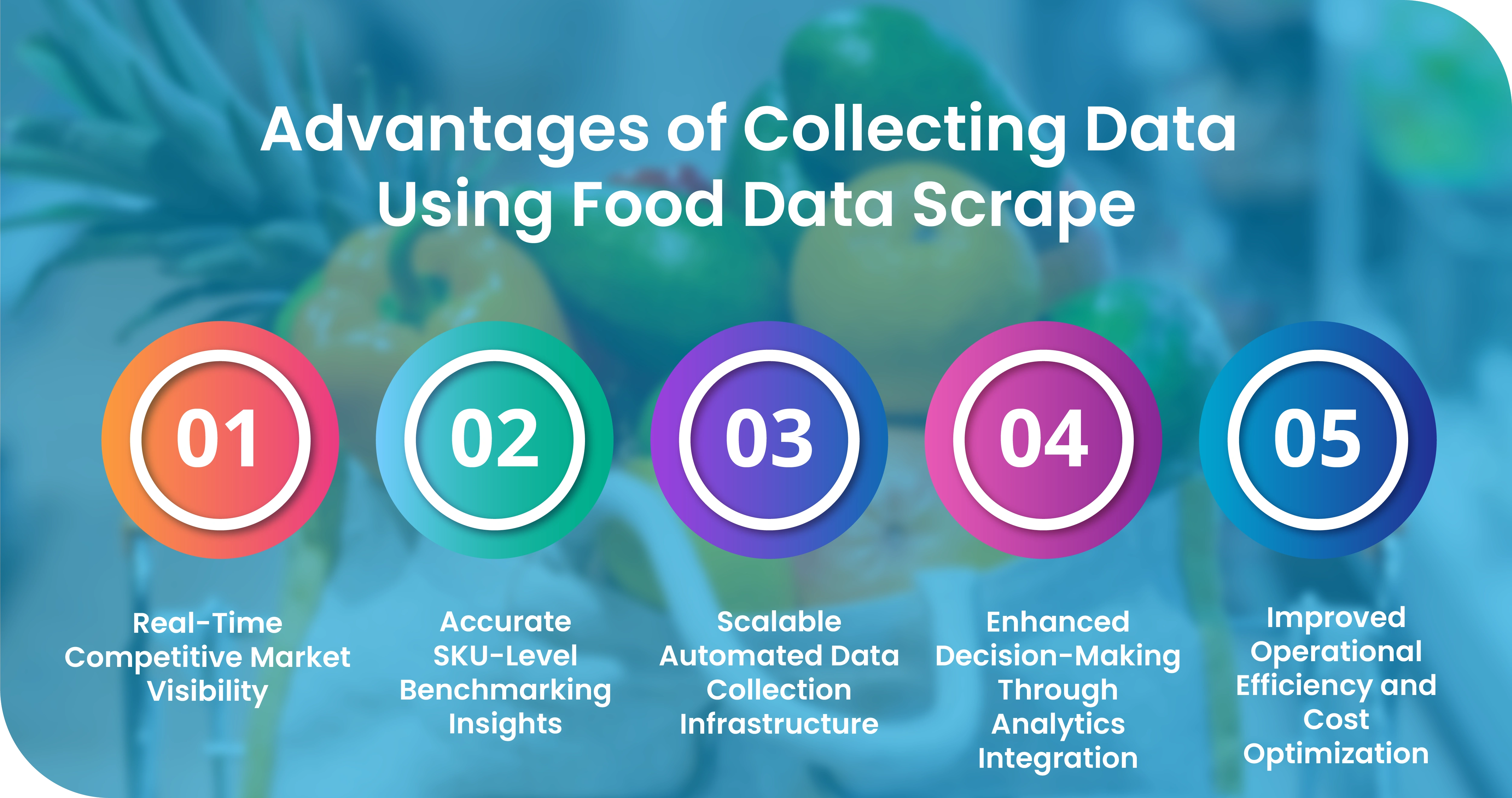
- Real-Time Competitive Market Visibility
Our data scraping services provide continuous access to live grocery pricing, promotions, and stock availability across major ecommerce platforms. Businesses gain faster market visibility, enabling proactive pricing decisions, stronger competitive positioning, and improved responsiveness to rapidly changing retail trends and customer purchasing behavior patterns. - Accurate SKU-Level Benchmarking Insights
We deliver highly structured and normalized datasets that simplify SKU-level comparison across Walmart, Amazon, Kroger, and Instacart. This improves pricing accuracy, reduces manual validation efforts, and enables retail teams to identify inconsistencies, optimize margins, and strengthen category-level strategic planning with reliable competitive intelligence. - Scalable Automated Data Collection Infrastructure
Our automated extraction systems support high-frequency, large-scale grocery data collection without operational disruptions. Businesses benefit from faster refresh cycles, reduced dependency on manual monitoring, and seamless integration into analytics workflows, helping organizations maintain consistent access to critical ecommerce intelligence across multiple retail ecosystems. - Enhanced Decision-Making Through Analytics Integration
The scraped datasets integrate directly with dashboards, BI tools, and forecasting systems, allowing organizations to convert raw pricing information into actionable insights. This improves merchandising strategies, demand forecasting accuracy, inventory planning, and promotional effectiveness while supporting data-driven retail transformation initiatives at enterprise scale. - Improved Operational Efficiency and Cost Optimization
By automating repetitive data collection and monitoring processes, our services significantly reduce operational overhead and manual research costs. Retailers save time, improve productivity, and focus resources on strategic initiatives while maintaining accurate, real-time grocery intelligence for smarter pricing and business optimization decisions.
Client’s Testimonial
“Their grocery ecommerce data scraping solutions transformed the way we monitor competitor pricing across Walmart, Amazon, Kroger, and Instacart. The datasets were highly accurate, consistently updated, and structured perfectly for our analytics workflows. Their team helped us improve SKU-level benchmarking, pricing optimization, and promotional tracking with exceptional efficiency. The real-time intelligence enabled faster business decisions and strengthened our competitive positioning in the US grocery market. What impressed us most was their scalability, responsiveness, and ability to deliver clean, actionable insights without operational delays. We experienced measurable improvements in pricing strategy, reporting accuracy, and market visibility throughout the engagement.”
— Director of Retail Pricing & Competitive Intelligence
Final Outcome
The project successfully transformed fragmented grocery ecommerce pricing information into a centralized intelligence system that improved visibility, accuracy, and operational efficiency. The client gained real-time access to structured pricing insights across Walmart, Amazon, Kroger, and Instacart, enabling faster strategic decisions and improved competitive positioning in the US grocery market.
Advanced analytics workflows built on Grocery Datasets helped streamline SKU-level benchmarking, promotional analysis, and regional pricing comparisons with greater precision.
The automated extraction infrastructure reduced manual effort, improved refresh frequency, and enhanced scalability for high-volume retail intelligence operations. As a result, the client achieved stronger pricing optimization, better forecasting accuracy, improved reporting capabilities, and more effective category management strategies. Overall, the engagement delivered measurable business value by converting complex grocery ecommerce data into actionable insights that supported long-term retail growth, operational agility, and smarter competitive decision-making across evolving digital grocery ecosystems.