Introduction
The craft beer industry has evolved into a competitive marketplace where breweries, retailers, distributors, and online liquor platforms continuously adjust their prices to attract customers and improve profitability. Consumers increasingly compare beer styles, alcohol content, pack sizes, brands, and promotional offers before purchasing. These changing preferences make pricing intelligence essential for businesses seeking to understand market movements and maintain competitive positioning.
Craft Beer Price Data Scraping helps businesses collect publicly available pricing information from online liquor stores, brewery websites, beverage marketplaces, and retail platforms. This information enables companies to compare product prices, monitor competitor strategies, and identify differences across locations and sales channels. Through structured data collection, businesses can understand how prices vary between craft lagers, pale ales, India pale ales, stouts, porters, and seasonal releases.
Similarly, Craft Beer Pricing Data Extraction transforms scattered product listings into organized Alcohol and Liquor Datasets containing prices, brands, product descriptions, package quantities, alcohol by volume (ABV), discounts, and availability. These datasets support systematic analysis rather than relying on occasional manual research.
By implementing Craft Beer Price Trend Intelligence, businesses can identify historical price movements, evaluate promotional effectiveness, understand regional differences, and make informed decisions about product positioning. The result is a more transparent approach to pricing, stronger competitive awareness, and improved planning across the craft beer supply chain.
Understanding Craft Beer Price Data Scraping
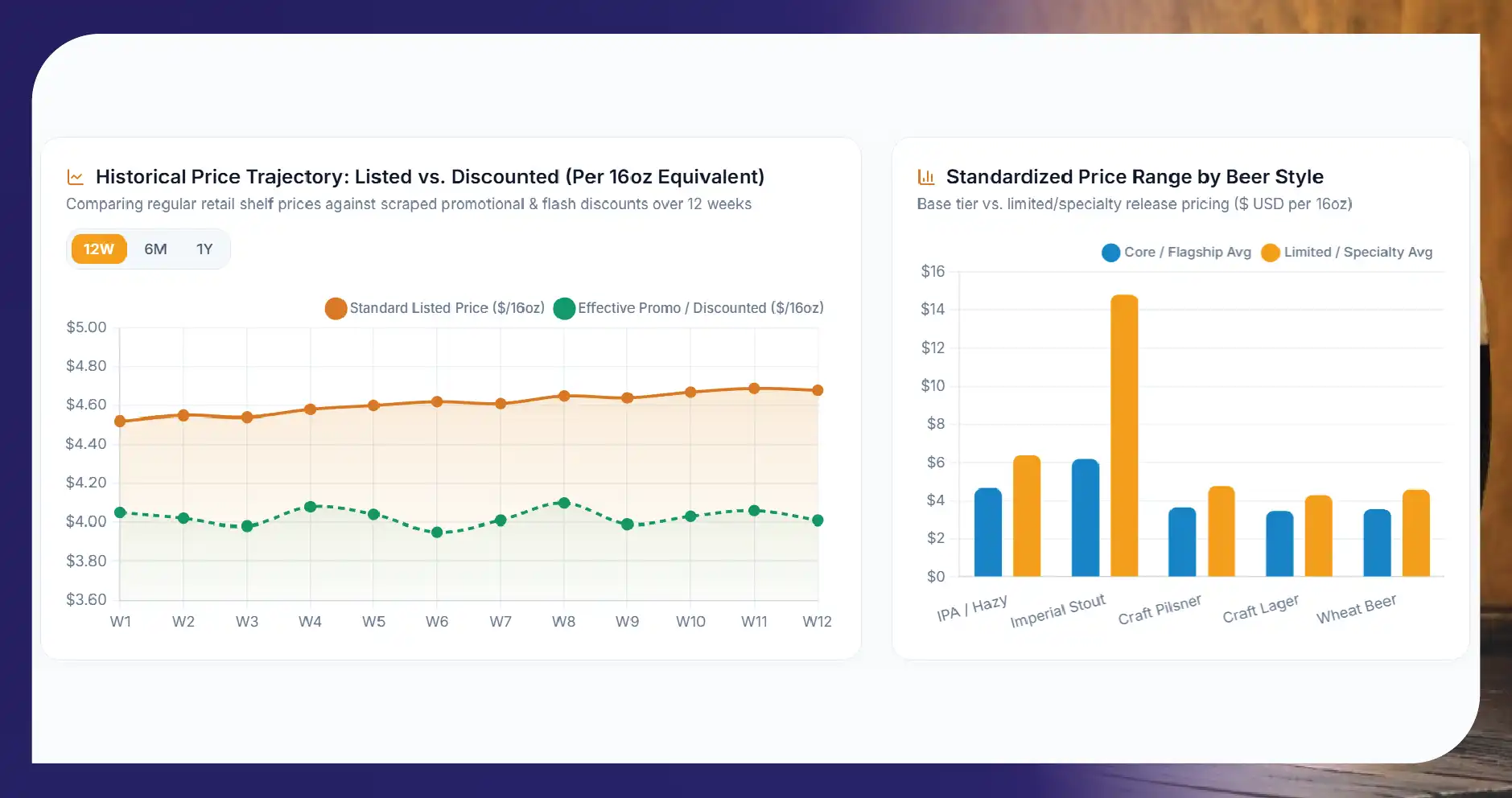
Craft beer pricing varies according to several factors, including brewing ingredients, production methods, brand reputation, packaging, distribution expenses, local taxes, and consumer demand. Limited-edition releases and specialty brews may command premium prices, while widely distributed products often compete through discounts and multipack offers.
Collecting this information manually becomes challenging when businesses monitor hundreds of products across multiple retailers, cities, and digital channels. Prices may change frequently, promotional listings can disappear quickly, and identical products may appear under different descriptions.
Automated data scraping addresses these challenges by collecting relevant information from accessible online sources and organizing it into standardized formats. Depending on source availability and permitted access, businesses can schedule collection at appropriate intervals and compare current observations with historical records.
A typical dataset may include:
- Craft beer brand and product name
- Beer style, such as IPA, lager, pilsner, stout, or wheat beer
- Bottle or can size and multipack quantity
- Listed price and price per unit
- Discounted price and promotional percentage
- Alcohol by volume and product description
- Retailer, brewery, or marketplace name
- Product availability and listing status
- Location, currency, and collection timestamp
When these attributes are standardized, analysts can compare equivalent products, recognize pricing differences, and develop a clearer understanding of the market.
Why Craft Breweries and Retailers Need Pricing Intelligence?
1. Competitive Price Benchmarking
Craft breweries need to understand how their products compare with competing brands in similar categories. A brewery selling a 355 ml IPA, for example, may want to compare its price with other IPAs featuring comparable alcohol content, positioning, and packaging.
Collecting competitor pricing information makes these comparisons more systematic. Businesses can examine premium and entry-level price ranges, identify unusually expensive listings, and determine whether their products remain competitive within specific categories.
Craft Brewery Pricing Data Scraping supports this process by organizing publicly available product prices across relevant breweries, retailers, and marketplaces. The resulting information can help businesses assess pricing gaps, review product positioning, and evaluate whether changes to their pricing strategy are justified.
2. Understanding Consumer-Facing Price Differences
A craft beer's price may vary significantly between retailers, even when the brand, package size, and product specifications are identical. These differences can result from promotional activity, distribution arrangements, local taxes, retailer pricing policies, or regional market conditions.
Businesses that compare prices across multiple sales channels can identify where their products appear more expensive or less competitive. Retailers can also investigate whether their pricing remains consistent with their intended positioning.
Craft Beer Market Pricing Insights provide a foundation for understanding these variations. By analyzing comparable products across different channels, businesses can distinguish ordinary price differences from significant competitive gaps and make more informed decisions about pricing and assortment management.
3. Monitoring Discounts and Promotions
Discounts play an important role in attracting customers, increasing product visibility, and encouraging larger purchases. Craft beer retailers may promote seasonal releases, offer multipack deals, reduce prices during special events, or provide loyalty-based incentives.
However, promotions can make competitor comparisons difficult because standard prices and discounted prices may appear together. A retailer comparing only displayed selling prices could overlook the original price or misunderstand the actual discount.
Liquor Discount Data Scraping helps capture available promotional information, including original prices, current prices, advertised discounts, and promotional dates when those details are published. This enables businesses to evaluate discount frequency, identify recurring campaigns, and understand how promotional strategies influence the competitive landscape.
Important Data Sources for Craft Beer Pricing
A reliable pricing intelligence program draws information from multiple relevant sources rather than depending on a single website.
- Online liquor retailers: Retail websites provide product names, package sizes, current listed prices, promotions, and availability indicators. They are particularly useful for comparing prices across competing sellers.
- Brewery websites: Breweries may publish direct-sale prices, seasonal releases, product descriptions, and package information. These sources help businesses understand brand-level positioning and new product introductions.
- Online beverage marketplaces: Marketplaces can provide a broader view of different brands, beer styles, and product categories. Their listings can help analysts compare similar products within the same shopping environment.
- Retailer product catalogs: Digital catalogs can reveal differences in assortment, pack sizes, promotional visibility, and regional availability. These details help businesses understand how products are presented to consumers.
- Craft beer discovery and membership platforms: Beer discovery websites and subscription services may provide information about participating breweries, featured products, and limited releases, depending on their publicly accessible content.
When collecting information from these sources, businesses should respect website terms, access restrictions, privacy requirements, and applicable alcohol advertising and sales regulations. Data availability and collection frequency also depend on each source's technical structure and permitted access.
Key Applications of Craft Beer Pricing Data
Product-Level Price Comparison
Product-level analysis allows businesses to compare equivalent beers using standardized attributes. Comparing a single can with a multipack without adjusting for quantity can produce misleading conclusions. Calculating unit prices helps establish more meaningful comparisons.
For example, a dataset containing six-pack prices, individual can prices, and package sizes can support price-per-can calculations. Analysts can then compare different brands using consistent measurements rather than relying exclusively on headline prices.
Regional Pricing Analysis
Craft beer pricing may differ between cities, states, and countries because of taxes, transportation costs, local demand, distribution structures, and regulatory requirements.
Regional analysis helps businesses understand where products are positioned at premium prices and where competitive pressure appears stronger. When location-specific pricing information is available, companies can examine geographic patterns and evaluate opportunities for market expansion.
Comparisons across countries also require currency conversion, tax treatment, and package-size normalization. Without these adjustments, apparent price differences may reflect measurement inconsistencies rather than genuine market advantages.
Seasonal and Historical Trend Analysis
Craft beer demand often changes with weather, holidays, sporting events, tourism, and seasonal product launches. Breweries may introduce limited-edition beers, while retailers adjust promotions to match changing consumer interest.
Historical pricing records help businesses understand whether observed price changes are temporary or part of a longer-term pattern. Analysts can compare prices across weeks or months, identify repeated promotional periods, and evaluate changes in the availability of particular beer styles.
Historical data should retain collection timestamps and source information. This helps distinguish a genuine price change from a product listing that was updated, removed, or replaced.
Product Assortment and Availability Monitoring
Pricing alone does not provide a complete view of market competition. A product may have an attractive listed price but be unavailable for purchase, while a competing product may remain consistently available.
Combining price information with product availability allows businesses to evaluate assortment coverage and identify gaps in online catalogs. Retailers can monitor which styles and pack sizes are listed, while breweries can understand where their products appear across accessible sales channels.
Availability indicators should be interpreted carefully because a listing may not reflect actual inventory across every store or delivery location.
Building Reliable Craft Beer Pricing Datasets
The usefulness of a pricing intelligence system depends on the quality of its underlying data. Inconsistent product names, duplicate listings, missing package sizes, and outdated prices can undermine comparisons.
A structured data workflow typically includes the following steps.
Step 1: Identify relevant sources. Select Liquor Data Scraping Services, brewery catalogs, marketplaces, and other permitted sources that cover the desired brands, products, and locations.
Step 2: Extract product information. Collect relevant fields such as product names, package quantities, listed prices, discounts, ABV, and timestamps where available.
Step 3: Standardize product attributes. Normalize currency formats, measurement units, product categories, and package descriptions to enable consistent comparisons.
Step 4: Match equivalent products. Use brand names, package sizes, product identifiers, and other attributes to reduce duplicate records and distinguish similar products.
Step 5: Validate pricing records. Check for missing values, unexpected price changes, invalid package quantities, and inconsistencies between original and discounted prices.
Step 6: Store historical observations. Retain dated records so analysts can examine changes over time instead of replacing every previous observation with the latest value.
These processes create more reliable datasets for reporting, competitor benchmarking, and business intelligence applications.
Measuring the Value of Craft Beer Price Intelligence
Businesses can use several performance indicators to understand how effectively their pricing intelligence processes support commercial decisions.
| Metric | Business Application |
|---|---|
| Average listed price | Understand pricing levels across selected products |
| Median product price | Compare typical prices while reducing the influence of extreme values |
| Price per 100 ml | Compare products with different package sizes |
| Promotional frequency | Measure how often tracked products appear with advertised discounts |
| Competitor price gap | Assess differences between comparable products |
| Product availability rate | Understand the proportion of tracked listings marked available |
| Historical price variation | Examine changes between dated price observations |
| Category price distribution | Compare pricing across beer styles and product segments |
These indicators become more meaningful when businesses define consistent comparison rules. For example, taxes, deposits, shipping charges, and location-based fees should be handled consistently wherever relevant data is available.
Companies should also avoid treating a displayed price as proof of a completed sale. Online listings reflect advertised offers, which may differ from final transaction prices or actual consumer demand.
Challenges in Craft Beer Price Data Scraping
Despite its advantages, collecting pricing information presents several practical challenges.
- Dynamic website structures: Retail websites may update their layouts, product pages, and data delivery methods. Collection systems therefore require ongoing maintenance and validation.
- Inconsistent product descriptions: Similar beers may appear with abbreviated names, different package labels, or inconsistent measurement units. Product matching and normalization are essential for accurate comparisons.
- Regional price differences: The same product may have different prices depending on delivery location, local taxes, and retailer-specific promotions. Geographic context should be retained whenever available.
- Incomplete historical information: Many websites display current prices without providing historical records. Businesses may need to maintain their own dated observations to build a useful trend dataset.
- Data quality concerns: Missing prices, discontinued products, duplicate listings, and misleading promotional labels can affect analysis. Automated checks and periodic quality reviews help reduce these problems.
- Regulatory and access restrictions: Alcohol-related information must be collected and used responsibly, with due consideration for applicable laws, website policies, and restrictions on automated access.
Working with experienced data specialists can help businesses develop collection processes that are scalable, maintainable, and appropriate for their intended use.
How Food Data Scrape Can Help You?
1. Automated Craft Beer Price Collection
Food Data Scrape can help businesses collect publicly accessible craft beer pricing information from relevant online retailers and product catalogs, organizing available prices, brands, pack sizes, discounts, and timestamps into structured datasets.
2. Competitor Benchmarking and Price Comparison
Businesses can compare equivalent craft beer products across selected retailers and breweries. Standardized pricing records help identify price gaps, evaluate competitive positioning, and understand differences between product categories and package sizes.
3. Historical Pricing and Trend Analysis
Maintaining dated pricing observations enables businesses to examine price movements, promotional cycles, and seasonal variations. These historical records support evidence-based decisions about pricing strategies, assortment planning, and competitive monitoring.
4. Customized Data Delivery and Integration
Food Data Scrape can provide organized datasets in suitable formats, such as CSV, Excel, or JSON, subject to project requirements. Structured outputs can support reporting workflows, analytical tools, and business intelligence systems.
5. Scalable Data Monitoring Solutions
Businesses can establish collection schedules suited to their monitoring objectives and source limitations. Data validation, product matching, and historical storage help maintain consistent pricing intelligence as tracked product catalogs change.
Conclusion
Craft beer pricing intelligence enables breweries, retailers, distributors, and beverage analysts to understand competitive positioning, identify promotional patterns, and evaluate market changes using structured information. By collecting relevant product prices, standardizing package details, and preserving historical observations, businesses can move beyond manual comparisons toward more consistent and data-driven decisions.
A well-designed scraping solution should prioritize reliable product matching, transparent data quality checks, appropriate collection intervals, and compliance with applicable access restrictions. Combining price information with discounts, product availability, beer styles, and geographic context provides a more complete picture of the competitive environment.
Businesses can also Scrape Craft Beer Passport Data where publicly accessible information and permitted access make it relevant to analyzing participating breweries, featured products, or craft beer discovery trends. Such data can complement retailer pricing records, although platform participation and product coverage should not be treated as a complete representation of the market.
Integrating collected information into a liquor industry trend analytics dashboard can help teams review price distributions, promotional activity, category performance, and regional differences in one analytical environment. With appropriately scheduled Real-Time Price Monitoring, or monitoring at other suitable intervals, businesses can identify relevant listing changes and respond more quickly to market developments.
Ultimately, effective craft beer price data scraping combines dependable collection, accurate normalization, historical analysis, and actionable reporting. When these capabilities align with clear business objectives, pricing intelligence becomes a valuable resource for strengthening market awareness and making more informed commercial decisions.
Are you in need of high-class scraping services? Food Data Scrape should be your first point of call. We are undoubtedly the best in Food Data Aggregator and Mobile Grocery App Scraping service and we render impeccable data insights and analytics for strategic decision-making. With a legacy of excellence as our backbone, we help companies become data-driven, fueling their development. Please take advantage of our tailored solutions that will add value to your business. Contact us today to unlock the value of your data.
Get a Free Food Data Sample in 48 Hours.
Tell us your platforms, target markets and required fields — we'll map exactly what's possible with food data scraping, recommend the right approach, and send a working sample so you can verify quality before any commitment.