The Grocery Store and Its Problem
The store — referred to here as a regional grocery operator running a chain of neighbourhood supermarkets — had a capable inventory team and a working AI forecasting model trained on point-of-sale history, day-of-week patterns and seasonality. On ordinary days the model performed well and the team trusted it.
The problem was the days that were not ordinary, and in grocery those are the days that decide profit.
Three patterns kept repeating:
- Perishable waste on quiet days. When demand softened unexpectedly, the model kept ordering to its baseline, and fresh stock ended up marked down or binned. The team could see the waste but not the cause.
- Stock-outs on busy days. When demand surged, the model under-ordered, the shelf emptied, and the sale was lost. Afterwards it was written off as "soft demand" — the wrong explanation for an empty shelf.
- A blind spot on the competitive shelf. The team could not see competitor pricing, availability or promotions without checking manually, so it was always reacting late to moves that had already reshaped local demand.
The common thread was uncomfortable once the team saw it. Every one of these failures was caused by something happening outside the store — and the store's AI could only see inside it.
The Realisation: The AI Was Working Blind
The store's model was not broken. It was blind by design.
A forecasting model trained on internal sales history captures the store's own offer perfectly and the surrounding market not at all. When a competitor two streets away launched a promotion on chilled dairy, demand at the store softened — and the model, seeing only its own history, read that softening as random noise and kept ordering. When a nearby rival ran out of a staple and sent its shoppers over, demand spiked — and the model, again seeing only itself, missed the spike and ran out too.
The team had assumed AI meant the system understood the market. It did not. It understood the store. The market was a blind spot, and the blind spot was exactly where the waste and the stock-outs were coming from.
Fixing it did not require a smarter model. It required giving the existing model something to see.
The Fix: Feeding the AI External Signals
The store did not replace its forecasting model — a deliberate decision that protected the system the team already trusted. Instead, it fed the model external market signals as new inputs, delivered by FoodDataScrape.
- Competitor pricing and promotions, collected daily across the categories the store cared about, per catchment.
- Competitor availability, because a rival's stock-out is a measurable demand transfer to the store.
- Category and weather-linked demand signals, for weather-sensitive categories and category-level trend movement.
- Local market events, such as competitor openings and closures within each store's catchment, each of which shifts baseline demand by a measurable amount.
Each signal arrived as a named, quantified demand modifier — one adjustment factor per store, per category, per day — that the store's model applied on top of its internal baseline without any rebuild.
Sample Data: A Demand Signal Record
The structure below reflects the signal feed the store's AI consumed. Values are illustrative.
{
    "store_id": "GRO-STORE-0142",
    "catchment": "North District",
    "forecast_date": "2026-08-22",
    "category": "Chilled Dairy",
    "competitor_signals": {
        "competitors_in_catchment": 4,
        "competitors_promoting_category": 2,
        "avg_competitor_discount_pct": 18.5,
        "competitor_stock_out_detected": true
    },
    "demand_modifiers": {
        "competitor_promo_pressure": -0.06,
        "competitor_stock_out_transfer": 0.09,
        "category_trend": 0.02,
        "net_demand_modifier": 0.05
    },
    "recommended_order_adjustment": "+5% vs internal baseline"
}
The demand_modifiers block was what the store's AI had been missing. Each line is a named, quantified external force acting on demand for one category, in one catchment, on one date. The net modifier here is +5% — a competitor's stock-out on chilled dairy outweighs the promotional pressure from two other rivals — and the store's model applied that single number directly. The demand walking over from the competitor's empty shelf was caught before the store's own shelf could miss it.
Sample Data: The Store's Adjusted Order Plan
Store: GRO-STORE-0142 — Week of 18 August 2026
| Category | AI Baseline | Net Modifier | Adjusted Order | Driver |
|---|---|---|---|---|
| Chilled Dairy | 420 units | +5% | 441 | Competitor out of stock in catchment |
| Bakery (fresh) | 300 units | −8% | 276 | 2 competitors promoting bakery |
| Ready Meals | 180 units | +11% | 200 | Nearest competitor closed |
| Fresh Produce | 540 units | −4% | 518 | Category price deflation locally |
| Cold Beverages | 260 units | +14% | 296 | Heatwave signal + competitor out of stock |
This is where the store's inventory decisions changed. The bakery order drops 24 units — waste avoided — because two competitors are promoting bakery and local demand will soften. The cold-beverage order rises 36 units — stock-out avoided — because a heatwave and a competitor stock-out will spike demand. Neither move was possible when the AI could see only the store's own history.
Sample Data: Competitor Availability the Store Could Finally See
Category: Staples — Catchment: North District
| Competitor | SKU | Status | Since | What It Meant for the Store |
|---|---|---|---|---|
| Competitor A | Basmati Rice 5kg | Out of stock | 2 days | Strong demand transfer to the store |
| Competitor B | Atta 10kg | In stock | — | Neutral |
| Competitor A | Cooking Oil 1L | Out of stock | 1 day | Moderate demand transfer |
| Competitor C | Sugar 1kg | In stock | — | Neutral |
For the first time, the store could see its rivals' shelves. A competitor out of stock on a staple for two days is demand walking through the door — and knowing it early let the store deepen its own stock on exactly those SKUs, capturing the transfer instead of running out alongside the competitor.
What Changed for the Store
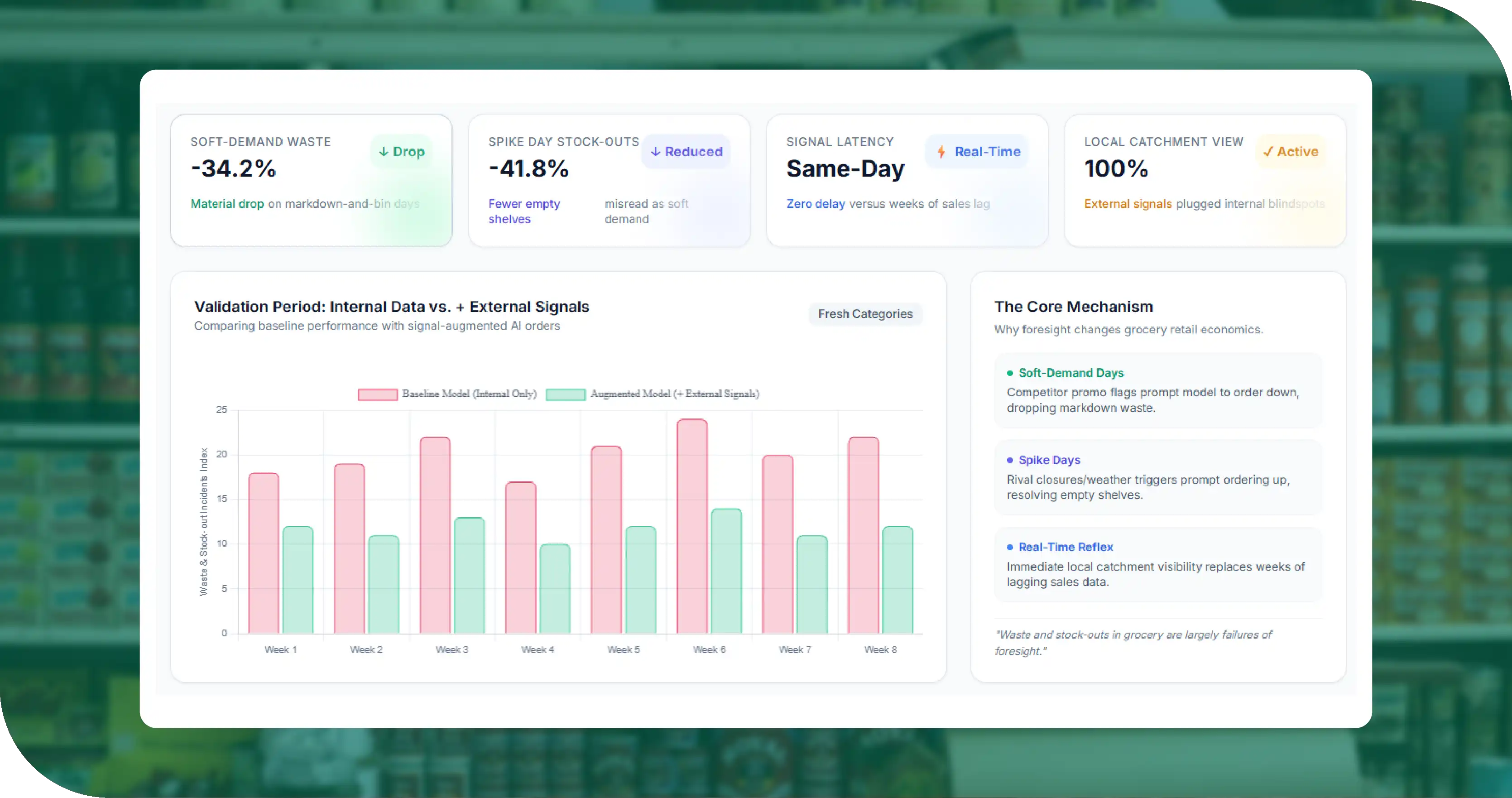
The store designed the rollout so the result could be measured on its own numbers rather than taken on faith. It ran its existing AI model with and without the external signals over a validation period and compared the two. The direction of change was consistent across categories.
- Waste fell on soft-demand days. When competitor promotional pressure was flagged in advance, the model ordered down on the affected fresh categories, and markdown-and-bin waste on those days dropped materially.
- Stock-outs fell on spike days. When competitor stock-outs, closures and weather signals were flagged, the model ordered up, and the empty-shelf events previously misread as "soft demand" were substantially reduced.
- The team stopped reacting late. Instead of learning about a competitor's promotion weeks after it hurt sales, the store saw it the same day, per catchment, and ordered and priced accordingly.
The mechanism behind all three is the same. Waste and stock-outs in grocery are largely failures of foresight, and foresight in a local market requires seeing the local market — which the store's internal data structurally could not do, and which external signals finally supplied.
Why It Worked
The store's AI did not become smarter. It became sighted.
Before, every fluctuation caused by an outside force — a competitor's promotion, a rival's stock-out, a heatwave — reached the model as unexplained noise, and it learned to treat that noise as randomness. After, those same forces arrived as named, quantified inputs: the promotion as a −6% modifier, the stock-out as a +9% transfer, the heatwave as a +14% spike. The model stopped guessing on exactly the days that mattered most.
And because the signals were inputs rather than a replacement system, the store kept the forecasting model it already trusted and simply gave it eyes on the market.
Who This Applies To
- Grocery chains and supermarkets reducing perishable waste and preventing stock-outs across multiple stores and catchments.
- Convenience and neighbourhood retailers where a single competitor's move materially shifts local demand.
- Quick-commerce and dark-store operators forecasting at the catchment level, where internal history is thin for newer stores.
- Grocery technology and forecasting vendors enriching their own AI products with external market signals they cannot collect themselves.
- Category and supply-chain teams building waste-reduction and availability programmes grounded in external demand drivers.
The FoodDataScrape Signal Data Model
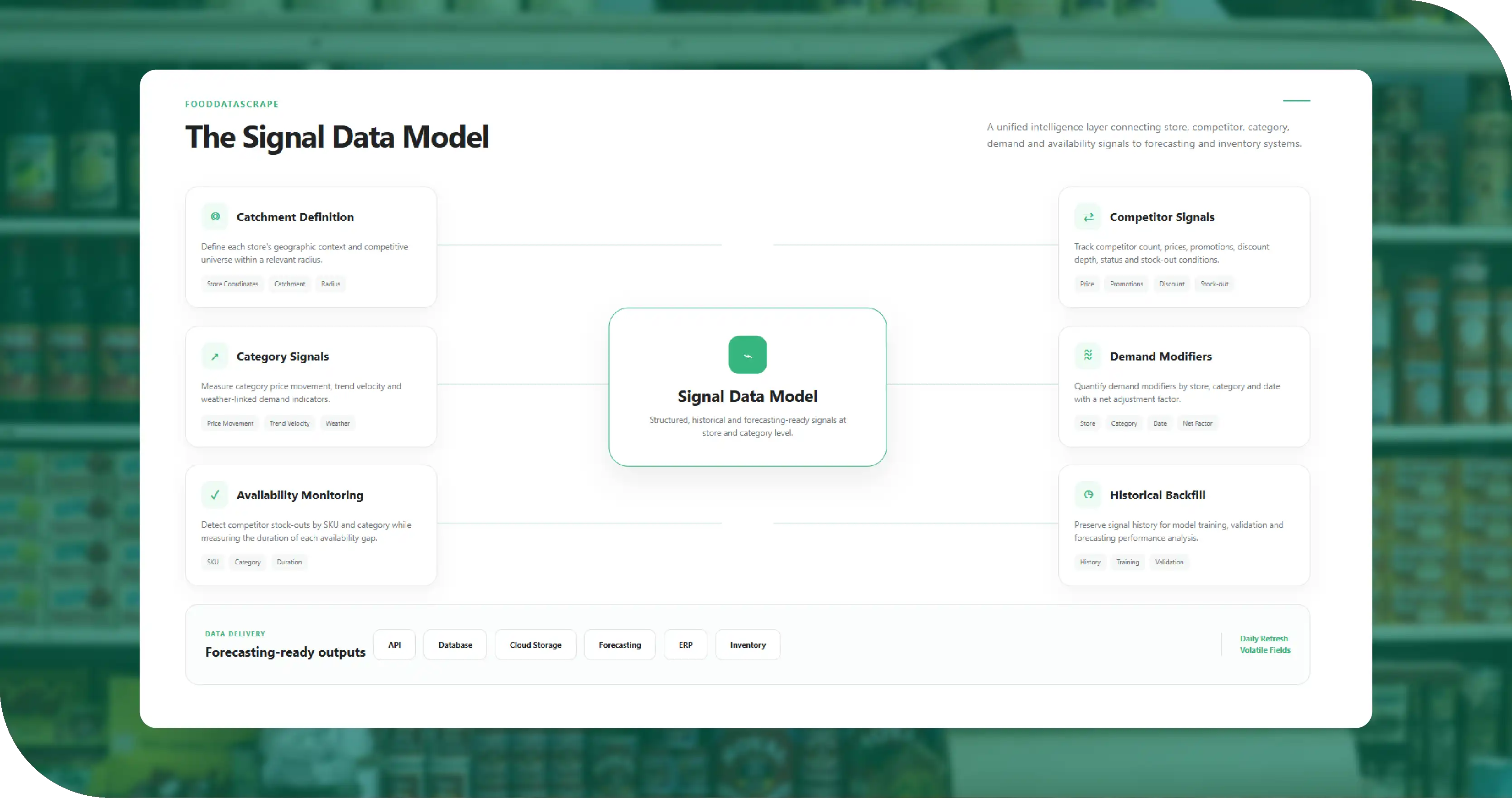
- Catchment definition: store coordinates, catchment, competitor universe within radius
- Competitor signals: competitor count, prices, promotions, discount depth, open/closed status, stock-out detection
- Category signals: category price movement, trend velocity, weather-linked demand indicators
- Demand modifiers: named, quantified modifiers per store, per category, per date, with a net adjustment factor
- Availability monitoring: competitor stock-out detection by SKU and category, with duration
- Historical backfill: signal history for model training and validation
Delivered via API, database push, cloud storage or direct integration into forecasting, ERP and inventory systems, with daily refresh on volatile fields.
Methodology and Compliance
- We collect publicly accessible pricing, availability and promotional information only. No authenticated content, no private data, no personal consumer data.
- Signals are delivered as inputs, not forecasts. They supply the external variables a model is missing; they do not replace the model.
- Demand modifiers are named and traceable, so an inventory manager can see exactly why an order was adjusted and override it when they know something the data does not.
- Historical backfill lets a store validate the improvement on its own data before relying on it.
- Crawlers are rate-limited and engineered not to degrade the platforms we collect from.
Conclusion
Waste and stock-outs are the two most expensive words in grocery, and both are failures of foresight. This grocery store had already bought the AI — but its AI was working blind, seeing only its own sales history on exactly the days when the market outside the store was moving.
Grocery Store Data Scraping gave that AI the external signals it had always been missing: competitor pricing, promotions, availability, closures and weather-linked demand, quantified and delivered as inputs it could use immediately. The store kept the model it trusted and finally let it see the market it competes in — and stopped throwing money in the bin.
FoodDataScrape crawls 220M+ pages of food and grocery data every week so that a grocery store's inventory decisions account for the world outside its four walls, not just the sales inside them.