The Retailer and the Problem
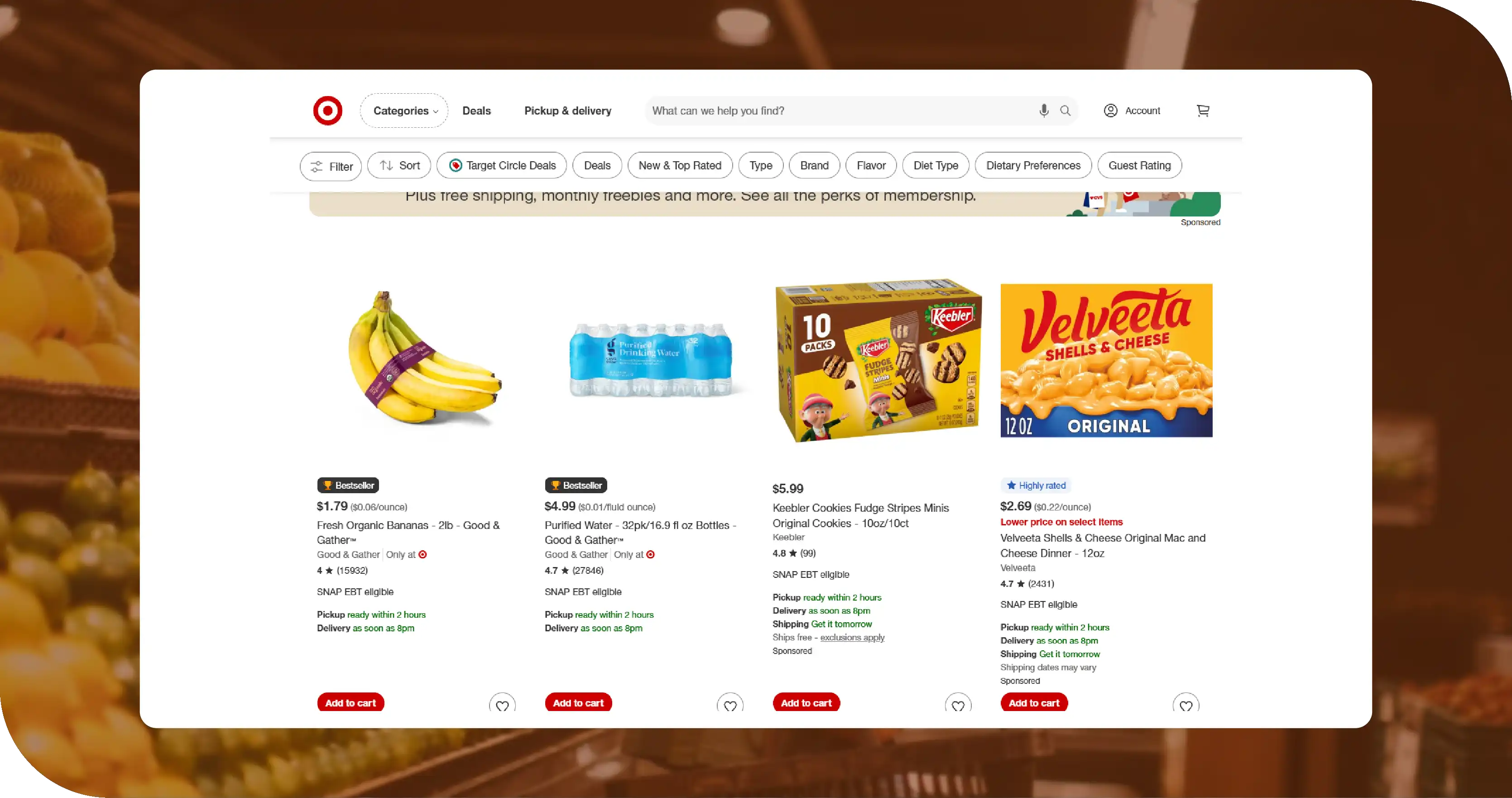
The retailer — a regional U.S. grocery chain operating across multiple states — priced the way most grocers do: category managers set prices against a mix of cost, target margin and occasional manual competitor checks. On a national scale, across thousands of SKUs and dozens of markets, that process broke down in predictable ways.
- Competitor checks were sampled and stale. A category manager could check a handful of competitor prices manually, at one moment, for a fraction of the range. By the time a decision was made, the checked prices had often already moved.
- Pricing was reactive, never anticipatory. The team responded to competitor moves after they saw them — days or weeks late — rather than anticipating them. In a market where large retailers reprice algorithmically, responding late means always chasing a price that no longer exists.
- Regional pricing was guesswork. The retailer knew competitor prices varied by region but could not see the pattern, so its own regional pricing was set by intuition rather than evidence.
- There was no training data for AI. The data science team wanted to build a price prediction model, but a prediction model needs history — a long, clean, structured record of competitor prices over time. That record did not exist internally, and it could not be reconstructed after the fact.
That last point was the blocker. The retailer had the modelling talent and the ambition. It was missing the fuel.
The Solution: A Structured, Historical Competitor Price Feed
FoodDataScrape supplied the training and operating data the engine needed, built around four requirements.
- Full-catalogue competitor coverage. Daily prices for the retailer's priority categories across major competitors — including national chains — rather than a sampled subset.
- ZIP-cluster granularity. Prices captured per ZIP cluster, because a national average erases exactly the regional variance the retailer needed to price against.
- Historical depth. A back-history of competitor prices, so the data science team had a training set from day one instead of waiting months to accumulate one.
- Effective-price fields. Not just shelf price, but discount depth, promotional pricing and unit price — the components an accurate prediction model needs, because a promotion is a price change the model must learn from.
Delivered daily into the retailer's data warehouse, the feed became both the training set for the model and the live input that kept it current.
Sample Data: A Competitor Price Record
The structure below reflects a FoodDataScrape grocery price feed. Values are illustrative.
{
    "sku_name": "Store Brand 2% Milk 1 Gallon",
    "category": "Dairy",
    "zip_cluster": "TX-DFW-03",
    "capture_date": "2026-08-20",
    "competitor_prices": [
        { "competitor": "Competitor A", "shelf_price_usd": 3.48, "promo": false, "unit_price_usd_per_oz": 0.027 },
        { "competitor": "Competitor B", "shelf_price_usd": 3.29, "promo": true, "unit_price_usd_per_oz": 0.026 },
        { "competitor": "Competitor C", "shelf_price_usd": 3.59, "promo": false, "unit_price_usd_per_oz": 0.028 }
    ],
    "your_price_usd": 3.49,
    "market_min_usd": 3.29,
    "market_max_usd": 3.59,
    "your_price_rank": 3,
    "price_gap_vs_min_pct": 6.1
}
The your_price_rank and price_gap_vs_min_pct fields are the ones the model learned from. They told the engine not just what competitors charged, but where the retailer sat in the local price ladder — third of four, 6.1% above the cheapest option — which is the position that actually drives volume in a price-sensitive category like dairy.
Sample Data: Competitor Price History for Model Training
SKU: Store Brand 2% Milk 1 Gallon — ZIP Cluster: TX-DFW-03
| Date | Competitor A | Competitor B | Competitor C | Your Price | Market Min |
|---|---|---|---|---|---|
| Aug 06 | 3.48 | 3.48 | 3.59 | 3.49 | 3.48 |
| Aug 09 | 3.48 | 3.29 | 3.59 | 3.49 | 3.29 |
| Aug 13 | 3.38 | 3.29 | 3.49 | 3.49 | 3.29 |
| Aug 16 | 3.38 | 3.38 | 3.49 | 3.49 | 3.38 |
| Aug 20 | 3.48 | 3.29 | 3.59 | 3.49 | 3.29 |
This is the raw material an AI price prediction engine needs and cannot manufacture internally. The pattern is visible even to the eye: Competitor B repeatedly drops to $3.29 on a roughly weekly cycle, and the market minimum follows it. A model trained on this history learns the cycle and can anticipate the next drop — which is the entire difference between reacting to a competitor's price and pricing ahead of it.
Sample Data: Regional Price Variance
SKU: Store Brand 2% Milk 1 Gallon — Same day, five ZIP clusters
| ZIP Cluster | Region | Market Min | Market Max | Your Price | Your Rank |
|---|---|---|---|---|---|
| TX-DFW-03 | Dallas | 3.29 | 3.59 | 3.49 | 3 |
| TX-HOU-01 | Houston | 3.19 | 3.49 | 3.49 | 4 |
| CA-LAX-05 | Los Angeles | 3.59 | 3.99 | 3.49 | 1 |
| IL-CHI-02 | Chicago | 3.39 | 3.69 | 3.49 | 2 |
| FL-MIA-04 | Miami | 3.29 | 3.59 | 3.49 | 3 |
The retailer had been pricing this SKU at a flat $3.49 everywhere. The data shows why that was leaving money on the table in both directions: in Los Angeles the retailer was the cheapest option and could have raised price without losing rank, while in Houston it was the most expensive and was likely losing volume. A single national price was wrong in five different ways at once — and only ZIP-level data made that visible.
What the Retailer Built
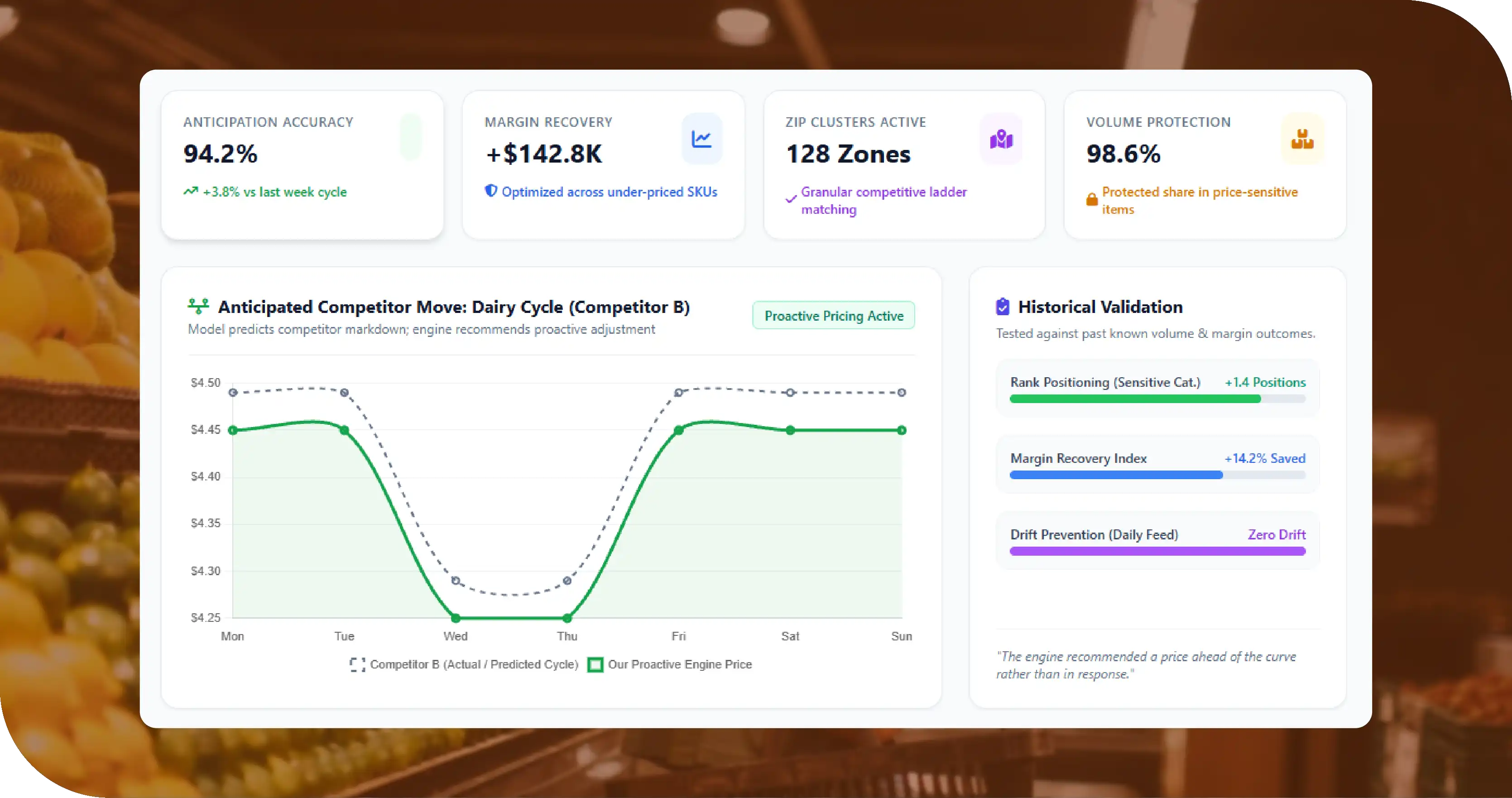
With the feed in place, the data science team built and trained a price prediction engine on the historical competitor data. The engine did three things the old process could not.
- It anticipated competitor moves. Trained on price-history patterns, the model predicted likely competitor price changes — like Competitor B's weekly dairy cycle — and recommended the retailer's price ahead of them rather than in response.
- It priced regionally. Instead of a flat national price, the engine recommended a price per ZIP cluster based on the local competitive ladder, capturing margin where the retailer was under-priced and protecting volume where it was over-priced.
- It ran on current data. Because the same feed that trained the model kept updating daily, the engine's recommendations stayed current instead of drifting as the market moved.
The retailer validated the engine against its own historical outcomes before trusting it — running the model's recommendations against periods where it already knew what happened to volume and margin. The direction of improvement was consistent: better rank positioning in price-sensitive categories and recovered margin in categories where the retailer had been needlessly cheap.
Why It Worked
An AI price prediction engine is only as good as the price history it learns from. The retailer had the model architecture and the talent; what it lacked was fuel — a clean, structured, historical, regional record of what competitors actually charged.
Internal data could never supply this. A retailer's own systems record its own prices, not its competitors', and certainly not its competitors' prices over time across every region. That history has to be collected from the outside, continuously, and structured so a model can learn from it. Once it was, the engine could do what the manual process never could: see the pattern, anticipate the move, and price for it — region by region, ahead of the market instead of behind it.
Who This Applies To
- Grocery retailers and chains building or improving pricing and price-optimization systems that need competitor data as training and operating input.
- Retail data science teams that have the modelling capability but lack a structured, historical competitor price feed.
- Pricing and revenue-management vendors enriching their products with external competitor pricing they cannot collect themselves.
- E-commerce and omnichannel grocers needing ZIP-level competitor pricing to set location-based online prices.
- Category managers replacing sampled manual checks with full-catalogue, continuous competitive pricing.
- Investors and analysts building independent price indices and measuring competitive pricing dynamics across regions.
The FoodDataScrape Grocery Price Data Model
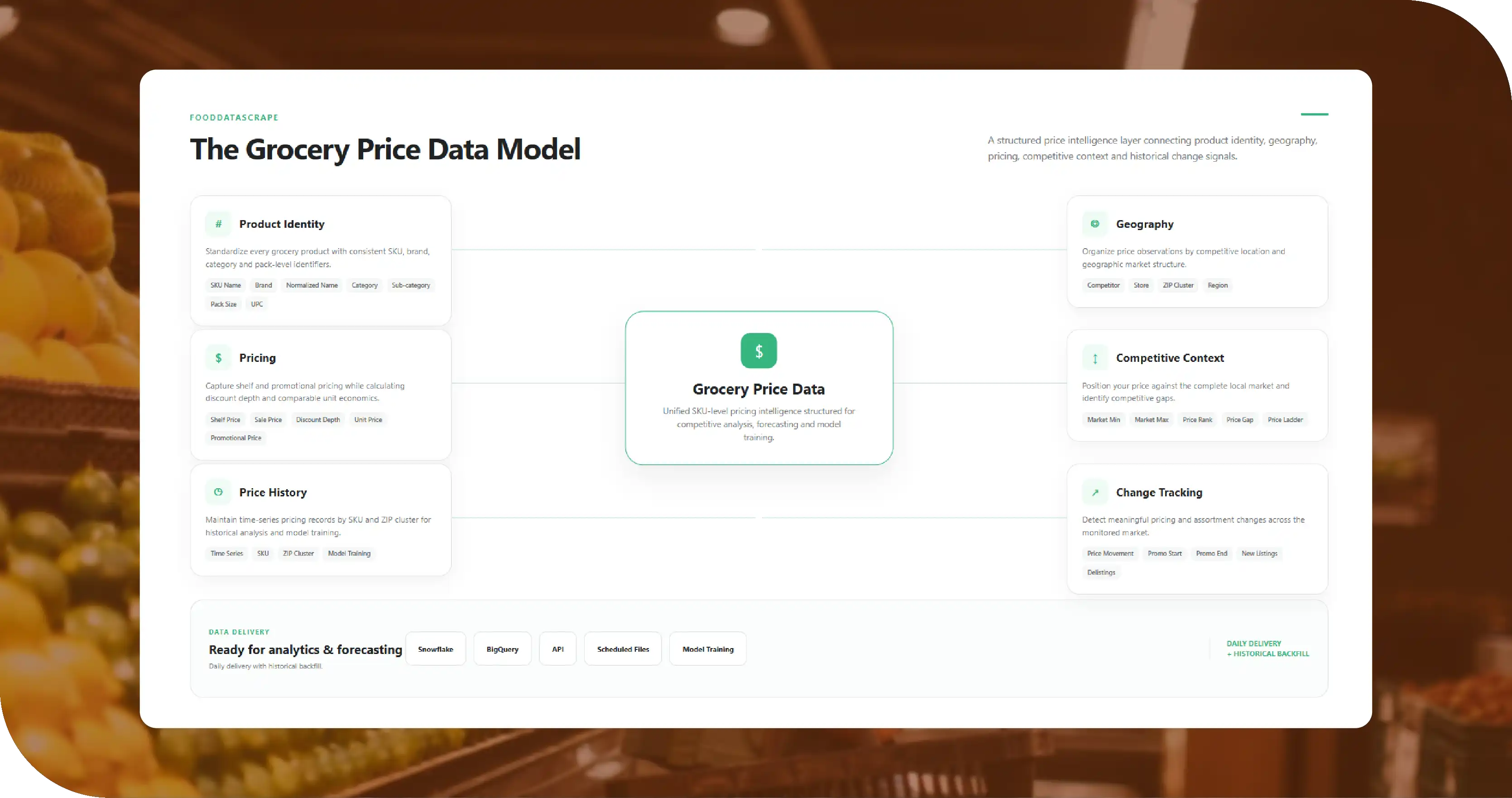
- Product identity: SKU name, brand, normalised name, category and sub-category, pack size, UPC where published
- Geography: competitor, store or ZIP cluster, region
- Pricing: shelf price, sale price, discount depth, unit price, promotional pricing
- Competitive context: market minimum and maximum, your price rank, price gap to minimum, full local price ladder
- History: time-series price records per SKU per ZIP cluster, structured for model training
- Change tracking: price movements, promotion starts and ends, new listings and delistings
Delivered daily into a data warehouse (Snowflake, BigQuery), via API, or as scheduled files, with historical backfill for model training.
Methodology and Compliance
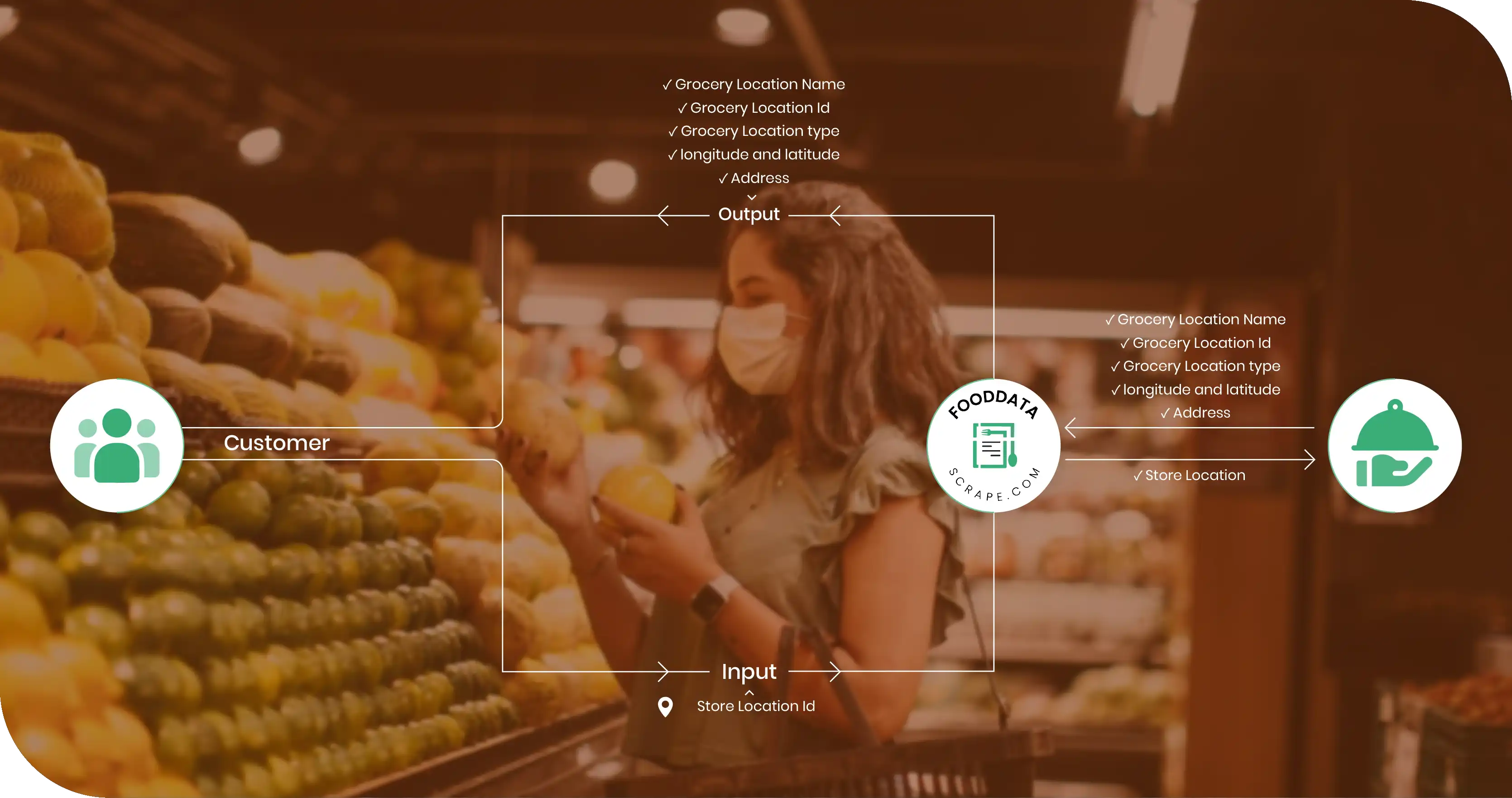
- We collect publicly accessible catalogue and pricing information only. No authenticated content, no private data, no personal consumer data. Member-only prices are excluded and flagged as such.
- Collection is at the ZIP-cluster level, because a national average erases the regional variance a pricing model must learn.
- Prices are normalised across competitors — UPC-first where available — so cross-competitor comparison is genuinely like-for-like.
- Historical depth is provided so a model has training data from day one rather than waiting to accumulate it.
- Crawlers are rate-limited and engineered not to degrade the sites we collect from.
Conclusion
A grocery price prediction engine does not fail for lack of algorithms. It fails for lack of fuel — the clean, structured, historical, regional record of competitor prices that no retailer can generate from its own systems. This U.S. retailer had the model and the talent, and was blocked by exactly that gap.
Grocery Price Data Scraping filled it: full-catalogue competitor pricing, at ZIP-cluster granularity, with the historical depth a model needs to learn the patterns and the daily refresh to keep pricing ahead of the market instead of behind it.
FoodDataScrape crawls 220M+ pages of food and grocery data every week so that a retailer's pricing engine trains on what competitors actually did — everywhere, over time — not on a handful of manual checks.