Introduction
China's restaurant ecosystem is one of the world's most dynamic, competitive, and digitally connected food markets. Restaurants constantly adjust menus, prices, promotions, ratings, locations, and customer engagement strategies, making structured restaurant intelligence extremely valuable for businesses, investors, aggregators, and technology companies. Dianping Restaurant Data Scraping in China enables organizations to collect large-scale restaurant information and convert constantly changing platform data into actionable market insights.
For businesses looking to understand restaurant competition across Chinese cities, the strategy to Scrape Dianping Restaurant Data In China can provide structured information covering restaurant names, addresses, cuisines, ratings, reviews, pricing, menus, operating hours, facilities, and other attributes. Such datasets can support competitive benchmarking, market research, location analysis, restaurant discovery, and food-sector intelligence.
The opportunity can also extend beyond mainland China. Businesses comparing regional dining markets may combine Chinese restaurant intelligence with Hong Kong Restaurant Data Scraping to analyze restaurant supply, cuisine trends, pricing differences, customer sentiment, and market positioning across neighboring markets.
Why Dianping Data Matters for China's Restaurant Market?
Dianping has become an important digital destination for discovering restaurants, comparing dining options, reading customer feedback, and evaluating food experiences. For data-driven companies, the platform can represent a valuable source of structured and semi-structured restaurant information.
China's foodservice market is highly fragmented. Thousands of restaurants compete across major metropolitan areas, commercial districts, shopping centers, residential neighborhoods, and tourism destinations. Restaurant data therefore needs to be continuously monitored rather than collected only once.
A historical restaurant dataset can reveal how businesses evolve over time. A restaurant may increase prices, introduce new dishes, receive a surge in reviews, change operating hours, or experience a shift in customer sentiment. Tracking these changes creates a more complete picture of market behavior.
What Restaurant Information Can Be Collected?
A comprehensive Dianping-oriented dataset can contain multiple layers of restaurant information. Depending on project requirements, businesses can structure collected information into standardized fields.
Typical restaurant-level fields may include:
- Restaurant name and business category
- Address and geographic location
- City and district
- Cuisine type
- Restaurant rating
- Number of reviews
- Average spending per customer
- Menu categories
- Individual dishes and prices
- Promotional offers
- Opening and closing hours
- Contact information where publicly displayed
- Restaurant facilities and amenities
- Customer review information
- Images and publicly available restaurant attributes
- Delivery-related information
- Popular dishes
- Restaurant tags
This structured approach allows organizations to move beyond individual restaurant pages and build scalable datasets suitable for analytics, dashboards, benchmarking, and machine-learning workflows.
Tracking Restaurant Prices and Menu Changes
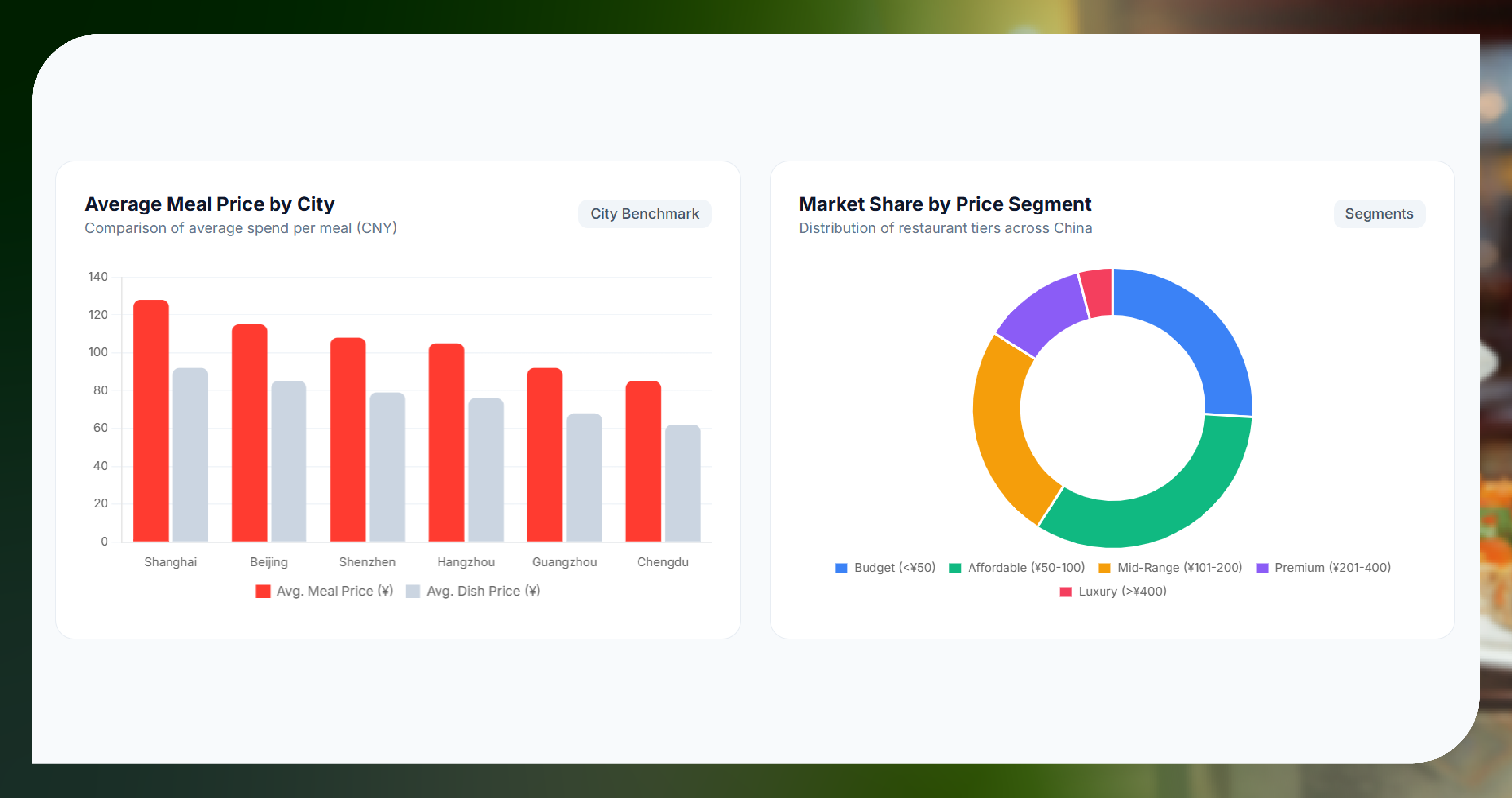
Price intelligence is one of the most valuable applications of restaurant data collection. Restaurants frequently modify prices according to ingredient costs, demand, location, seasonality, promotions, and competitive pressure.
Dianping Restaurant Pricing Data Scraping can help businesses build historical price datasets covering restaurants, dishes, meal categories, average spending, and promotional pricing.
For example, a market intelligence team could compare average meal prices across Beijing, Shanghai, Guangzhou, Shenzhen, Chengdu, and other cities. It could then segment restaurants by cuisine, neighborhood, restaurant category, or price range.
Menu-level analysis can provide even deeper insights. By monitoring individual dishes, organizations can identify frequently offered items, premium dishes, discounted products, emerging food categories, and differences in menu positioning.
Unlock smarter restaurant market insights with Dianping data scraping—connect with Food Data Scrape today for customized restaurant intelligence solutions.
Understanding Ratings and Customer Sentiment
Restaurant ratings can influence consumer decisions and restaurant visibility. However, a rating becomes more meaningful when analyzed alongside review volume, review recency, cuisine type, location, and pricing.
Dianping Rating & Review Data Scraping can support large-scale analysis of customer feedback and restaurant performance indicators.
Businesses can examine rating distributions across restaurant categories and identify establishments with unusually strong or weak customer sentiment. Review trends can also reveal changes in consumer perception.
For instance, a restaurant with a historically strong rating but declining recent reviews may require additional investigation. Conversely, a newer restaurant receiving consistently positive feedback may represent an emerging competitor or expansion opportunity.
Natural-language processing can further transform review data into sentiment categories such as food quality, service, ambience, delivery experience, cleanliness, value for money, and staff behavior.
Creating Restaurant Market Intelligence
Raw restaurant records become substantially more valuable when transformed into analytical intelligence.
Dianping Restaurant Market Intelligence Data can help organizations examine market density, cuisine distribution, pricing structures, customer sentiment, competitive positioning, and restaurant growth patterns.
Consider a foodservice company planning expansion into a new Chinese city. Instead of relying solely on general demographic statistics, it could evaluate the local restaurant ecosystem.
The analysis could answer questions such as:
- Which cuisines dominate the market?
- Which districts have the highest restaurant concentration?
- What price ranges are most common?
- Which restaurants receive the strongest customer engagement?
- Where are premium restaurants concentrated?
- Which cuisines appear underserved?
- How competitive is a particular neighborhood?
- Which restaurant categories are gaining visibility?
This type of intelligence can support location strategy, franchise planning, investment research, competitor monitoring, and market-entry decisions.
Restaurant Delivery Intelligence
China's restaurant ecosystem is closely connected with digital food ordering. Consumers increasingly use mobile platforms to discover restaurants, evaluate dishes, compare prices, and order meals.
Dianping Food Delivery App Data Scraping can help organizations study delivery-oriented restaurant information and understand how menus, pricing, promotions, ratings, and restaurant availability vary across digital channels.
Delivery datasets can be especially useful for businesses operating restaurant aggregation platforms or competitive intelligence systems. Data teams can compare menu prices, promotional structures, popular dishes, and restaurant availability.
Delivery-focused analysis may also reveal differences between dine-in and delivery positioning. A restaurant could have one pricing strategy for in-store customers and another for online orders, while promotional bundles may differ by channel.
Building an API-Driven Restaurant Data Pipeline
Large businesses often require restaurant information continuously rather than as a one-time dataset. An API-based architecture can make this process more scalable.
A Dianping Food Delivery Scraping API can be designed as part of a broader restaurant data workflow, allowing structured information to move into databases, analytics platforms, business intelligence dashboards, or internal applications.
An automated pipeline can include several stages:
- Source discovery and page identification
- Data collection
- Parsing and field extraction
- Data normalization
- Duplicate identification
- Validation and quality checks
- Historical record management
- Database integration
- Scheduled updates
- Dashboard or API delivery
This architecture allows organizations to establish repeatable data workflows instead of relying on manual collection.
City-Level Restaurant Analysis
China's restaurant market differs significantly from city to city. Consumer preferences, disposable income, tourism, business activity, and local food culture all influence restaurant supply.
A city-level dataset can help compare restaurant ecosystems across major urban markets.
For example, analysts could evaluate:
| Intelligence Metric | Beijing | Shanghai | Guangzhou | Shenzhen | Chengdu |
|---|---|---|---|---|---|
| Restaurant Records | 82,450 | 91,280 | 68,740 | 63,520 | 59,870 |
| Avg. Rating | 4.12 | 4.18 | 4.09 | 4.15 | 4.21 |
| Avg. Spend | ¥86 | ¥98 | ¥74 | ¥92 | ¥68 |
| Review Records | 2.84M | 3.12M | 2.21M | 2.08M | 1.96M |
| Major Cuisine Groups | 28 | 31 | 27 | 29 | 30 |
*Illustrative dataset structure for demonstrating how restaurant intelligence can be organized.*
Such a database can be segmented further by districts, cuisines, restaurant formats, spending levels, ratings, and delivery availability.
Cuisine-Wise Competitive Benchmarking
Cuisine analysis can uncover important opportunities hidden inside broader restaurant-market statistics.
Chinese consumers have access to an extensive range of culinary categories, from Sichuan and Cantonese cuisine to hotpot, noodles, barbecue, seafood, bakery, coffee, desserts, Japanese food, Korean food, Western cuisine, and specialty dining.
A structured dataset enables businesses to compare cuisine categories according to restaurant counts, average pricing, ratings, review volumes, popular dishes, and geographic concentration.
Investors can use these insights to identify crowded categories and emerging niches. Restaurant groups can benchmark their menus against competitors. Food delivery businesses can identify cuisine gaps within specific neighborhoods.
How Businesses Can Use Dianping Restaurant Data?
Restaurant data can support numerous commercial applications. Food delivery companies can use it for competitor monitoring and restaurant discovery. Market researchers can study consumer behavior and pricing trends. Investors can evaluate restaurant clusters and competitive density.
Restaurant chains can benchmark competitors before opening new outlets. Technology companies can enrich restaurant discovery applications with structured information. Data providers can create specialized datasets for hospitality, foodservice, and retail analytics.
Another major application is location intelligence. Combining restaurant coordinates with neighborhood-level information can help identify high-density food zones, emerging commercial areas, tourism clusters, and cuisine-specific hotspots.
Data Quality and Continuous Monitoring
The value of restaurant intelligence depends heavily on data quality. Restaurant information changes frequently, and outdated records can quickly reduce the usefulness of a dataset.
Effective data workflows should therefore include validation, normalization, duplicate detection, missing-field checks, and periodic refreshes.
Historical snapshots are particularly valuable. Instead of simply replacing old records, businesses can preserve previous observations to analyze price movements, rating changes, restaurant openings and closures, menu evolution, and competitive shifts.
A continuously refreshed database can ultimately become a strategic intelligence asset rather than a static directory.
How Food Data Scrape Can Help You?
Scalable Collection
Food Data Scrape can help businesses structure large-scale restaurant datasets covering locations, menus, ratings, reviews, pricing, cuisines, and other attributes for market research and competitive analysis.
Price Monitoring
Its data workflows can support restaurant price monitoring across cities and categories, helping businesses compare average spending, dish-level pricing, promotional offers, and changing competitive price positions.
Review Intelligence
Collected review information can be organized for sentiment analysis, rating benchmarking, customer experience monitoring, and identification of recurring themes across restaurant categories and geographic markets.
Market Benchmarking
Restaurant datasets can help companies benchmark cuisine availability, restaurant density, pricing, ratings, review activity, and competitive positioning across cities, districts, and customer segments.
Custom Delivery
Food Data Scrape can provide structured outputs according to project requirements, supporting databases, dashboards, analytics systems, research projects, and downstream applications through flexible delivery formats.
The Future of Restaurant Data Intelligence in China
The restaurant industry is becoming increasingly data-driven. Competition is no longer determined solely by food quality or physical location. Digital visibility, pricing, customer reviews, menu innovation, delivery availability, promotions, and consumer sentiment all influence restaurant performance.
For businesses operating in this environment, continuously updated restaurant datasets can provide a competitive advantage. Instead of viewing individual restaurant pages as isolated information sources, companies can combine thousands of records to identify market-wide patterns.
Automation also makes it possible to move from periodic research to continuous intelligence. Businesses can establish monitoring systems that detect meaningful changes in prices, menus, ratings, reviews, restaurant availability, and competitive activity.
As artificial intelligence becomes more integrated into foodservice analytics, structured restaurant data will become even more important. AI systems require clean, consistent, and sufficiently rich datasets to generate reliable recommendations, forecasts, classifications, and market insights.
Conclusion
Dianping restaurant data can provide a valuable foundation for understanding China's highly competitive and rapidly changing foodservice ecosystem. From restaurant locations and menus to pricing, ratings, reviews, delivery information, and cuisine trends, structured datasets can turn scattered digital information into actionable business intelligence.
For organizations seeking Restaurant Menu Data Scraping Services, scalable collection and structured delivery can support competitive benchmarking, menu monitoring, pricing intelligence, and restaurant discovery.
The combination of large-scale restaurant datasets and AI Restaurant Intelligence can further help businesses identify market trends, classify restaurants, analyze customer sentiment, predict competitive movements, and uncover expansion opportunities.
With detailed Cuisine-wise Menu Data, companies can compare food categories, dish availability, pricing, popularity, and regional preferences to make more informed decisions across China's evolving restaurant market.
If you are seeking for a reliable data scraping services, Food Data Scrape is at your service. We hold prominence in Food Data Aggregator and Mobile Restaurant App Scraping with impeccable data analysis for strategic decision-making.
Get a Free Food Data Sample in 48 Hours.
Tell us your platforms, target markets and required fields — we'll map exactly what's possible with food data scraping, recommend the right approach, and send a working sample so you can verify quality before any commitment.
Request a strategy call
Thanks — our data team will reach out within 48 hours with your sample.