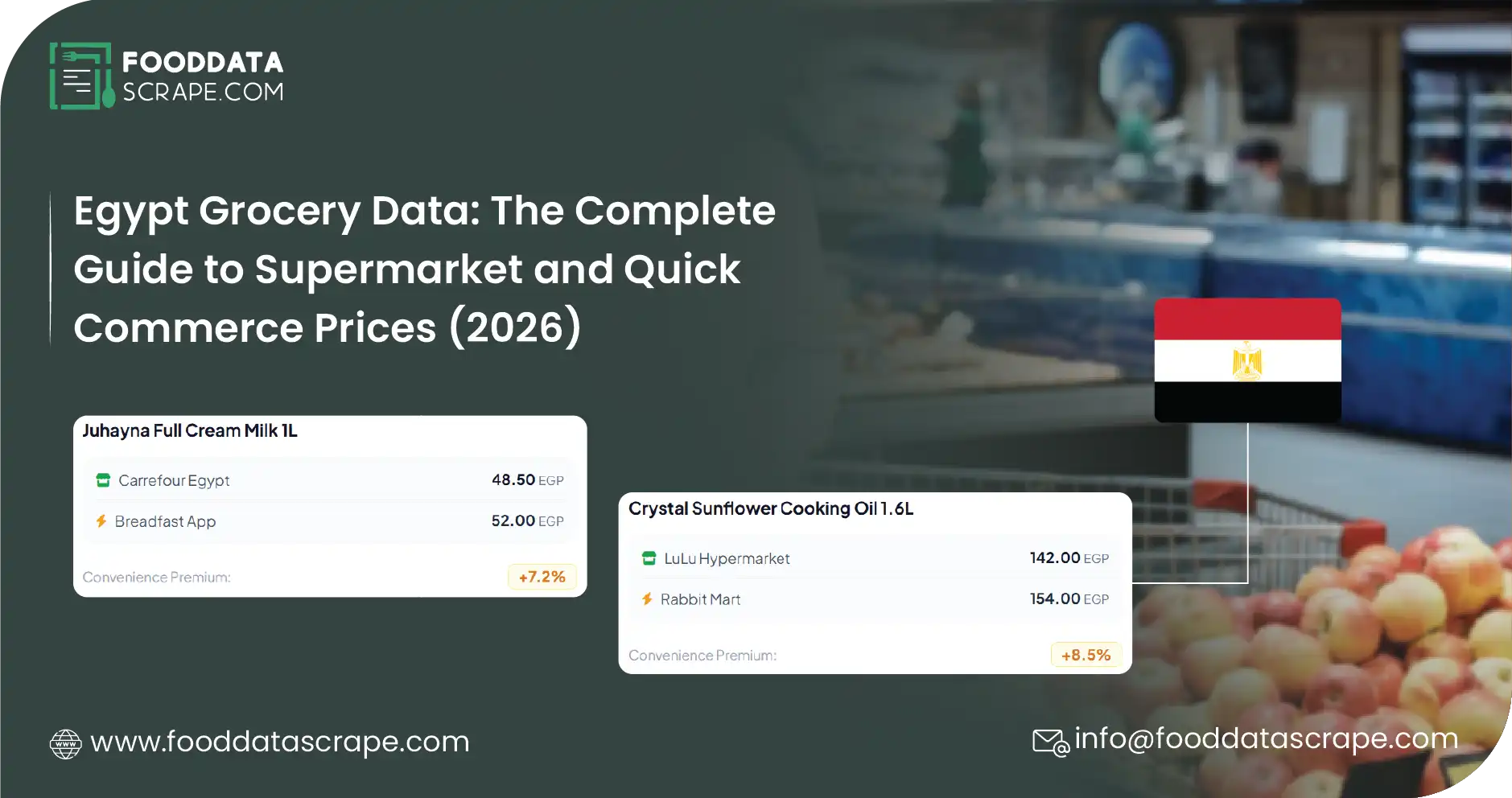
Introduction
Food prices in Egypt can move fast, and the shelf price in one Cairo district is not always the price a shopper sees across the Nile in Giza. That is why brands, retailers and analysts are asking for clean, structured Egypt grocery data instead of manual price checks.
Egypt grocery data is structured information about products sold through Egyptian supermarket and quick-commerce apps: product names in Arabic and English, EGP selling prices, unit prices, promotions, pack sizes and stock status by delivery area. Teams use it to track inflation at shelf level, benchmark competitors and plan promotions across Cairo, Giza and Alexandria.
This guide explains which platforms matter, which fields you can collect, how to match Arabic and English product names, and what to keep in mind on compliance. It closes with a practical build-vs-buy checklist.
Why grocery price data matters in Egypt right now
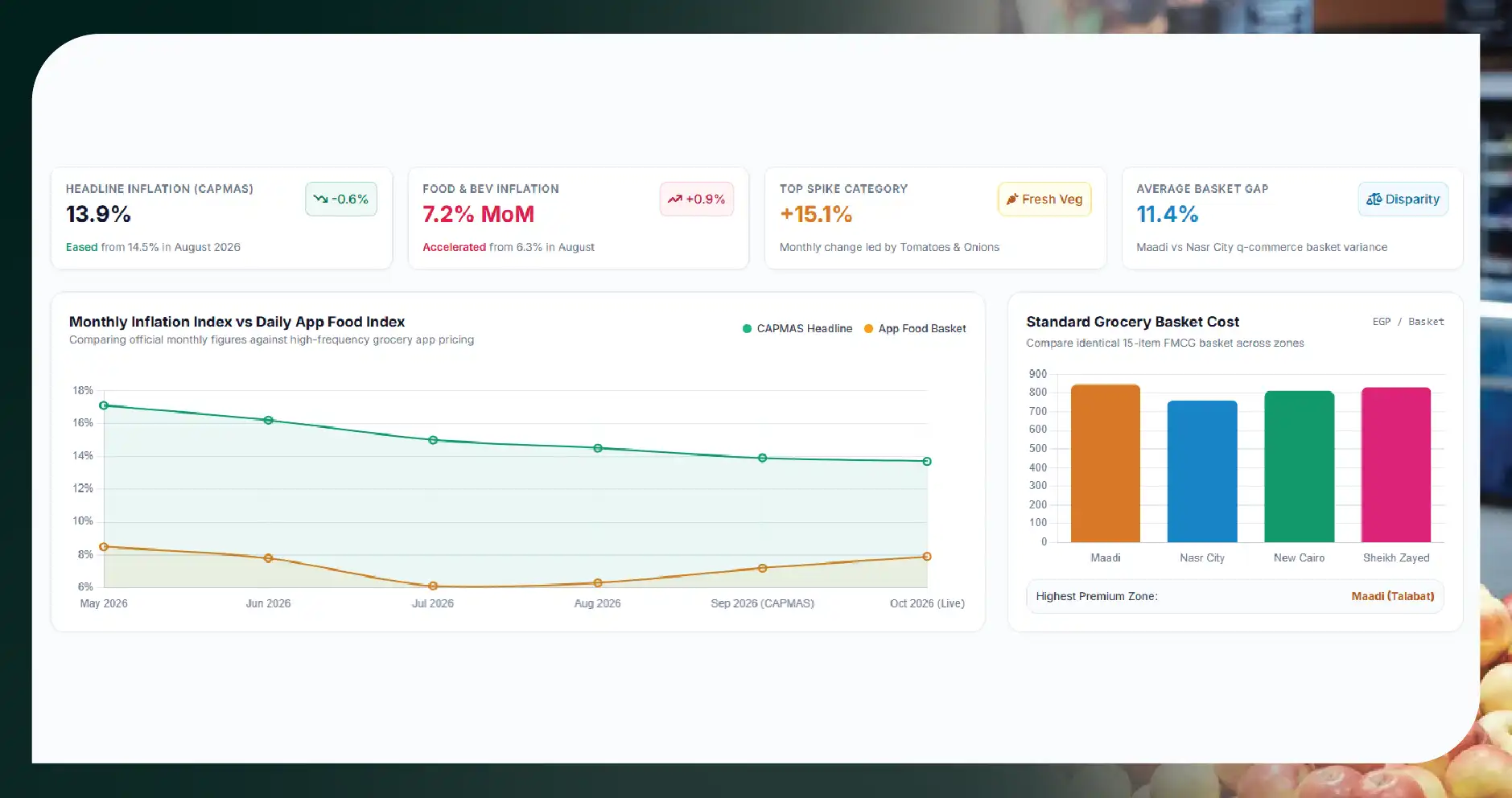
Egypt's official statistics show how much prices are still moving. According to CAPMAS figures reported by Daily News Egypt, annual urban headline inflation eased to 13.9% in September 2026 from 14.5% in August, while monthly inflation rose to 1.3%. Vegetables alone rose 15.1% month on month.
Trading Economics reports that food and beverage inflation accelerated to 7.2% in September 2026, up from 6.3% in August. Official indices are monthly and national. They do not show which retailer moved first, which SKU went out of stock, or how a promotion changed the price in Maadi versus Nasr City.
Daily or weekly Egypt grocery data from apps fills that gap. Typical users include:
- FMCG brands checking that their recommended prices and promotions show correctly on each app.
- Retailers and quick-commerce operators benchmarking basket prices against rivals.
- Market researchers and investors building shelf-level price indices that complement CAPMAS releases.
- Distributors watching availability gaps by zone to plan replenishment.
The 8 grocery platforms that matter and how they differ
The Egyptian online grocery market mixes delivery marketplaces, quick-commerce dark stores and supermarket chains with their own apps. The table below lists platforms we could confirm as active from public sources on 20 October 2026.
| Platform | Model | What the public source shows | Why it matters for data |
|---|---|---|---|
| Talabat Mart (talabat Egypt) | Quick commerce inside a delivery marketplace | talabat's Egypt grocery listings show Talabat Mart branches alongside local supermarkets (talabat Egypt) | Store-level prices and delivery times per area |
| Breadfast | Vertically integrated quick commerce | About 7,000 SKUs, more than 1,000 own-brand items and 47 fulfilment centres (AllAfrica, Feb 2026) | Strong private label (about 40% of grocery sales) |
| Rabbit | Quick commerce (dark stores) | More than 40 million items delivered to 1.4 million users in Egypt (Arab News) | Fast-moving essentials, local sourcing |
| Carrefour Egypt | Hypermarket chain with app and web shop | Site advertises "50,000+ items" with scheduled and "NOW" delivery (Carrefour Egypt) | Widest assortment; promo-heavy |
| Spinneys Egypt | Supermarket chain app | App lists groceries, butchery, bakery, organic and imported foods (App Store) | Mid-to-premium price benchmark |
| Seoudi Supermarket | Supermarket chain app | App describes more than 15,000 products with 24/7 ordering (App Store) | Cairo-centric mainstream benchmark |
| Gourmet Egypt | Premium food retailer app | Imported specialty foods, meat, seafood and ready meals (App Store) | Premium and imported price tier |
| Amazon Now (Amazon.eg) | Ultra-fast delivery service | Launched in selected areas of Cairo, Giza, Alexandria and the North Coast (Muslim Network TV, July 2026) | New entrant to watch for price pressure |
Two notes on scope. First, many supermarket chains also sell through talabat, so the same retailer can show different prices in its own app and on a marketplace. Second, we only list platforms we could verify today; other chains and apps can be added per project after a feasibility check.
The 10 data fields you can collect
A good Egypt grocery data feed is built around the product, the price and the place. These are the fields we recommend as a baseline:
- Product name (Arabic and English) – both versions when the app shows them, kept as separate columns.
- Brand – parsed from the title or product page, normalised (for example, one spelling per brand).
- Category path – such as Dairy > Cheese > White cheese, mapped to a common taxonomy.
- Pack size and unit – grams, kilograms, litres or pieces, parsed into numeric value plus unit.
- Selling price (EGP) – the price shown to a shopper at collection time.
- Original / strike-through price (EGP) – the "was" price when a discount is displayed.
- Unit price – calculated as EGP per kg, per litre or per piece, so different pack sizes compare fairly.
- Promotion details – percentage off, bundle offers, "buy X get Y" and promo labels as shown.
- Availability – in stock, out of stock or limited, per store or delivery zone.
- Zone and store reference – city, area (for example Maadi, Sheikh Zayed, Smouha) and store or dark-store label, plus a collection timestamp.
Optional fields include barcode where publicly displayed, image URL, delivery fee and minimum order, and estimated delivery time. Ratings and reviews are rarely useful for groceries and are excluded from most projects.
Here is what a sample record can look like:
| Field | Example value |
|---|---|
| product_name_en | Full Cream Milk 1L |
| product_name_ar | Haleeb Kamel El-Dasam 1 Litr (Arabic listing name, romanised) |
| brand | Example Dairy |
| pack_size / unit | 1 / L |
| selling_price_egp | 54.95 |
| original_price_egp | 59.95 |
| unit_price_egp_per_l | Calculated from selling price ÷ litres |
| promo_label | e.g. "10% off" when shown |
| availability | in_stock / out_of_stock |
| city / area | Cairo / Maadi |
| collected_at | 2026-10-20 09:00 (Africa/Cairo) |
How to collect, clean and match the data
Collecting the pages is the easy part. Making the data comparable is where most of the work sits.
Set the delivery location first. Most Egyptian grocery apps show prices and stock for the address or area you select. A useful plan defines a fixed list of zones, for example five to ten areas in Greater Cairo, two to four in Giza and two to three in Alexandria, and collects each one at the same time of day.
Handle Arabic and English names. The same product can appear as an English title on one app and an Arabic title on another. Matching works best in layers:
- Normalise Arabic text (unify alef and yaa forms, remove diacritics and extra spaces).
- Extract brand, pack size and variant (for example "full cream", "low fat") as structured attributes.
- Match on brand + size + variant first, then use text similarity on the remaining title.
- Use barcodes only where an app shows them publicly; otherwise rely on attribute matching with a manual review queue for low-confidence pairs.
Compute unit prices. A 900 g pack on promotion can look cheaper than a 1 kg pack when it is not. Convert everything to EGP per kg, litre or piece before you compare.
Track promotions as events. Record the start and end of each promo label so you can measure depth and duration, not just a one-day snapshot. Our guide to promotion and discount monitoring explains how to structure this.
Check quality. Flag sudden price jumps above a set threshold, missing prices, and SKUs that disappear for several days. Keep the raw record so every number can be traced back.
Collection strategy by city and use case
The right frequency and zone mix for Egypt grocery data depend on the question you need to answer. This table shows common set-ups.
| Use case | Platforms | Zones | Frequency | Main output |
|---|---|---|---|---|
| Shelf-level inflation index | Carrefour Egypt, Seoudi, Spinneys Egypt, Breadfast | 3–5 Cairo areas, 1–2 Alexandria | Weekly | Basket price index by category |
| Quick-commerce price gaps | Talabat Mart, Breadfast, Rabbit, Amazon Now | Greater Cairo and Giza areas served by each | Daily | Price and availability gaps per SKU |
| Brand price compliance | All relevant apps | Agreed list of priority areas | Daily or twice weekly | Exceptions report vs recommended price |
| Premium / imported range check | Gourmet Egypt, Spinneys Egypt, Carrefour Egypt | New Cairo, Sheikh Zayed, Maadi | Weekly | Price ladder for imported brands |
| Stock and distribution gaps | Quick-commerce apps | Store or dark-store level per zone | Daily | Out-of-stock heatmap |
For teams that need a single feed, our real-time price monitoring service can deliver scheduled updates by CSV, Excel, JSON or API.
Use cases for Egypt grocery data
- Inflation tracking at shelf level: compare app prices for a fixed basket against CAPMAS monthly releases to see where retail prices lead or lag.
- Competitor benchmarking: see whether a supermarket or quick-commerce app is cheaper on staples such as oil, sugar, rice and dairy, by zone.
- Promotion planning: measure how often rivals discount a category and how deep the discounts go before planning your own calendar.
- Private-label analysis: Breadfast reports that own-brand goods are a large share of its grocery sales, so tracking private-label vs branded price gaps is a useful signal.
- Distribution and availability: spot SKUs that are out of stock in specific areas, which helps sales teams and distributors act quickly.
- Market entry research: new brands can map price ladders and pack sizes before launching in Egypt.
An anonymised example: a Cairo-based team recently asked us what supermarket data from a grocery app in Egypt would involve. The typical scope we discuss covers one or two apps, a fixed list of Cairo delivery areas, the ten fields above and a weekly CSV.
Legal and compliance basics
Grocery price data is public business information, but collection still needs care.
- Public data only. We collect what any shopper can see without logging in: product titles, prices, promotions and stock labels. Loyalty or member-only prices are out of scope unless the client supplies authorised access.
- No personal data. Customer names, phone numbers, addresses, order histories and reviews tied to individuals are never collected. Egypt's Personal Data Protection Law (Law No. 151 of 2020) is another reason to keep projects strictly to product-level data.
- Respect terms and robots.txt. Check each platform's terms of service and robots.txt, use reasonable rate limits, and do not bypass logins, CAPTCHAs or app protections.
- Use trademarks fairly. Platform and brand names are used to describe the data source, not to imply partnership.
Build vs buy: choosing a data provider
Building an in-house scraper can work for one app and a handful of SKUs. It becomes harder as you add apps, zones, Arabic text handling and daily schedules, because app layouts change and location settings must be managed for every run.
| Question | Build in-house | Use a managed provider |
|---|---|---|
| How many apps and zones? | 1 app, 1–2 zones | 3+ apps, many zones |
| Arabic/English matching | You build normalisation and review | Delivered as part of the feed |
| Maintenance when apps change | Your engineering team | Provider's responsibility |
| Time to first data | Weeks | Usually days for a sample |
| Cost model | Developer time + infrastructure | Per feed / per refresh |
When you compare providers, ask for a sample in your own categories and zones, a field dictionary, a clear refresh schedule and a written compliance approach. Our grocery SKU dataset page shows the standard field structure we use across markets.
Sample data
| app | delivery_area | product_name_en | product_name_ar (romanised) | brand | selling_price_egp | original_price_egp |
|---|---|---|---|---|---|---|
| App A | Maadi | Full Cream Milk 1L | Haleeb Kamel El-Dasam 1 Litr | Example Dairy | 54.95 | 59.95 |
| App A | Maadi | White Rice 1kg | Roz Abyad 1 Kilo | Brand R | 42.50 | 42.50 |
| App B | Nasr City | Full Cream Milk 1L | Haleeb Kamel El-Dasam 1 Litr | Example Dairy | 56.00 | 59.95 |
| App B | Nasr City | Sunflower Oil 800ml | Zeit Abbad El-Shams 800 ml | Brand S | 89.95 | 99.95 |
| App A | Sheikh Zayed | Black Tea 40 bags | Shai Eswed 40 Kees | Brand T | 64.00 | 64.00 |
Get a free sample dataset. Tell us your apps, categories and Egyptian delivery zones, and we will scope a sample feed for you.
Questions
Frequently Asked Questions
Usually product names in Arabic and English, brand, category, pack size, selling and original price in EGP, unit price, promotion labels, stock status, delivery area and a timestamp. Fields depend on what each app shows publicly.
Commonly requested sources include Talabat Mart, Breadfast, Rabbit, Carrefour Egypt, Spinneys Egypt, Seoudi, Gourmet Egypt and Amazon Now. Each new source gets a feasibility check before a project starts.
Yes. Most apps show prices and stock for a selected delivery location, so collection is set up per area or store. You choose the zone list, and the same list is collected on every run.
Weekly is common for inflation and assortment tracking. Daily or twice-daily updates suit quick-commerce price gaps and promotion monitoring.
Collecting publicly visible product and price information is generally lower risk than collecting personal data, but you should review each site's terms and robots.txt, use fair rate limits, and avoid any personal data. Take local legal advice for your specific use.
Get a Free Food Data Sample in 48 Hours.
Tell us your platforms, target markets and required fields — we'll map exactly what's possible with food data scraping, recommend the right approach, and send a working sample so you can verify quality before any commitment.
Request a strategy call
Thanks — our data team will reach out within 48 hours with your sample.