Client
The client was a food technology company developing AI-powered applications for food recognition, culinary recommendations, restaurant intelligence, and automated food classification. Its existing information sources provided insufficient Egyptian food coverage and lacked the depth required for sophisticated machine-learning applications. The client therefore required an Egyptian food AI dataset containing detailed information about dishes, ingredients, menus, restaurants, food categories, prices, locations, and images. A major requirement was developing a regional food cuisine dataset that could distinguish Egyptian culinary characteristics from broader Middle Eastern and international cuisines. The company also wanted structured information covering traditional restaurants alongside modern food businesses and contemporary menu concepts. Food Data Scrape designed the collection framework around these requirements, delivering standardized and validated records that could support AI training, market research, culinary trend analysis, and restaurant intelligence. The Middle Eastern food dataset ultimately gave the client a stronger foundation for developing scalable food technology solutions and expanding its geographic and cuisine-level coverage.
Key Challenges
-
Developing a Custom AI-Ready Dataset
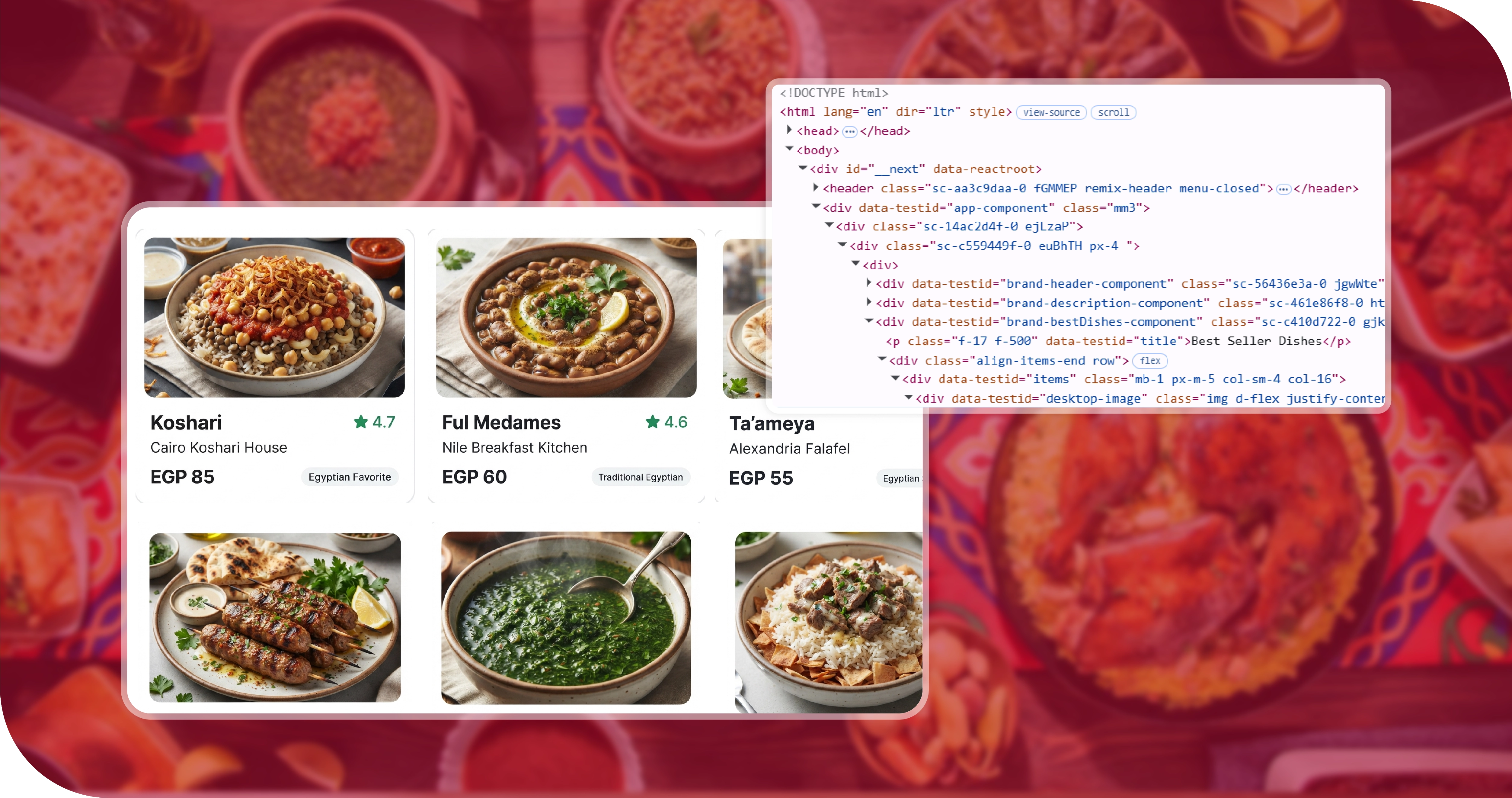
The client needed a custom food dataset for AI combining dish names, descriptions, ingredients, images, categories, cuisines, restaurant information, and locations. Existing sources used inconsistent structures and terminology, creating challenges around extraction, normalization, duplicate removal, attribute mapping, and machine-learning compatibility. -
Maintaining Consistent Cuisine-wise Menu Data
Different restaurants presented similar dishes using varying names, spellings, descriptions, categories, and pricing formats. Cuisine-wise Menu Data therefore required standardized classification rules, consistent field structures, regional tagging, and careful normalization to make records comparable and suitable for analytical applications. -
Collecting Diverse Information Across Egypt
Scraping from Egypt involved handling multiple website structures, restaurant formats, languages, locations, menu layouts, and data availability patterns. The project required geographically diverse coverage while reducing incomplete records, duplicate information, inconsistent attributes, outdated prices, and missing restaurant or dish-level details.
Key Solutions
-
Developing an Egypt-Focused Food Data API
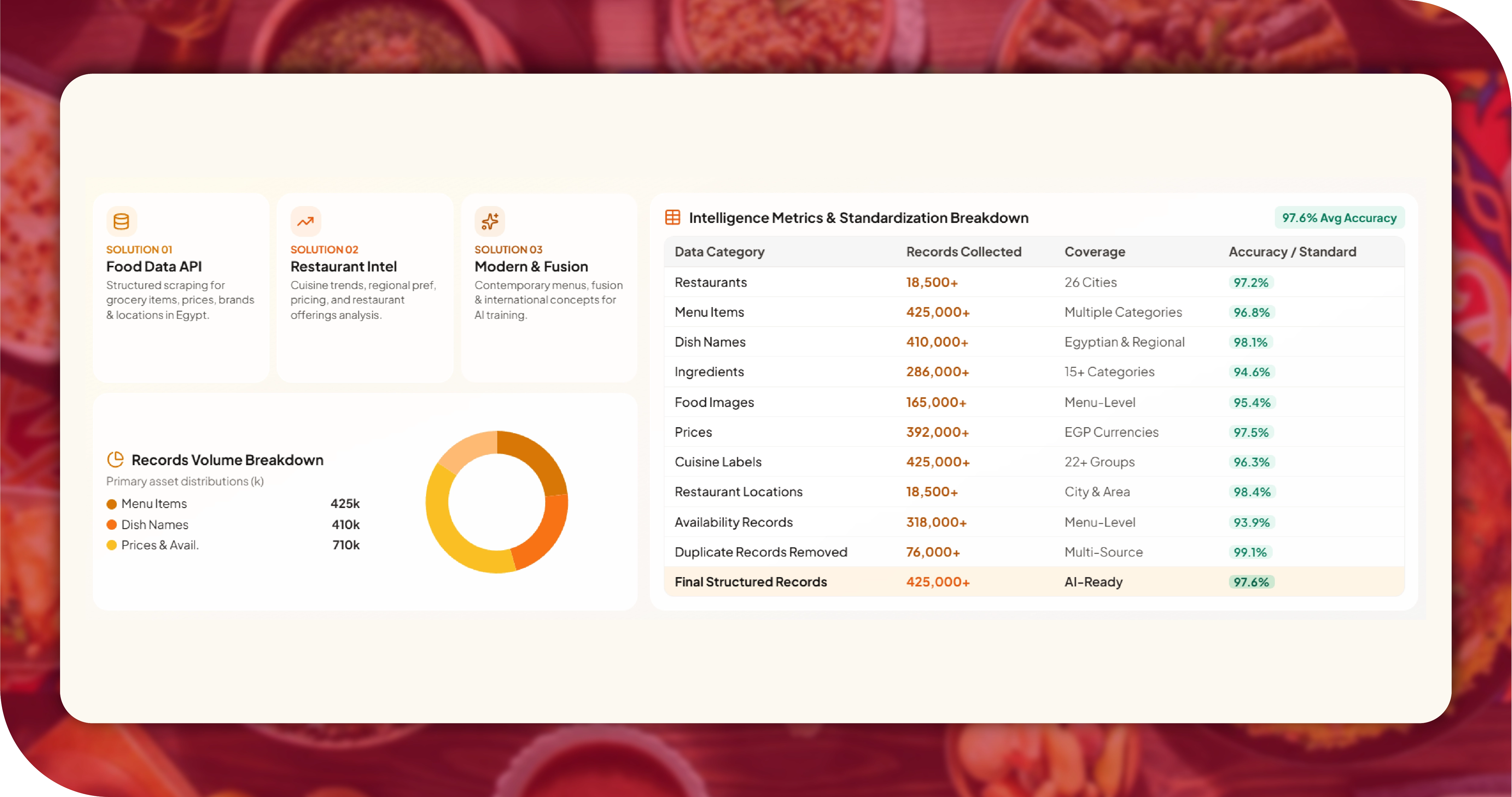
We created a structured Web Scraping API for Grocery Data in Egypt to automate large-scale collection of food and grocery information. The solution captured product names, categories, prices, brands, descriptions, availability, locations, and other relevant attributes in standardized machine-readable formats. -
Building Cuisine and Restaurant Intelligence
Our solution incorporated Cuisine and Restaurant Trends Analysis by categorizing restaurants and dishes according to cuisine, location, restaurant type, pricing, menu characteristics, and food categories. This allowed the client to identify culinary trends, regional preferences, popular dishes, emerging cuisines, and changing restaurant offerings. -
Expanding Traditional and Contemporary Food Coverage
Through Scraping of Modern Cuisine, we expanded the dataset beyond traditional Egyptian dishes to include contemporary restaurants, fusion menus, international food concepts, modern interpretations, and evolving culinary offerings. This created broader representation for AI training, restaurant analytics, and food market intelligence.
Data Coverage Summary
| Data Category | Records Collected | Coverage | Accuracy / Standardization |
|---|---|---|---|
| Restaurants | 18,500+ | 26 Cities | 97.2% |
| Menu Items | 425,000+ | Multiple Categories | 96.8% |
| Dish Names | 410,000+ | Egyptian & Regional | 98.1% |
| Ingredients | 286,000+ | 15+ Categories | 94.6% |
| Food Images | 165,000+ | Menu-Level | 95.4% |
| Prices | 392,000+ | EGP | 97.5% |
| Cuisine Labels | 425,000+ | 22+ Groups | 96.3% |
| Restaurant Locations | 18,500+ | City & Area | 98.4% |
| Availability Records | 318,000+ | Menu-Level | 93.9% |
| Duplicate Records Removed | 76,000+ | Multi-Source | 99.1% |
| Final Structured Records | 425,000+ | AI-Ready | 97.6% |
Methodologies Used
-
Multi-Source Web Data Extraction
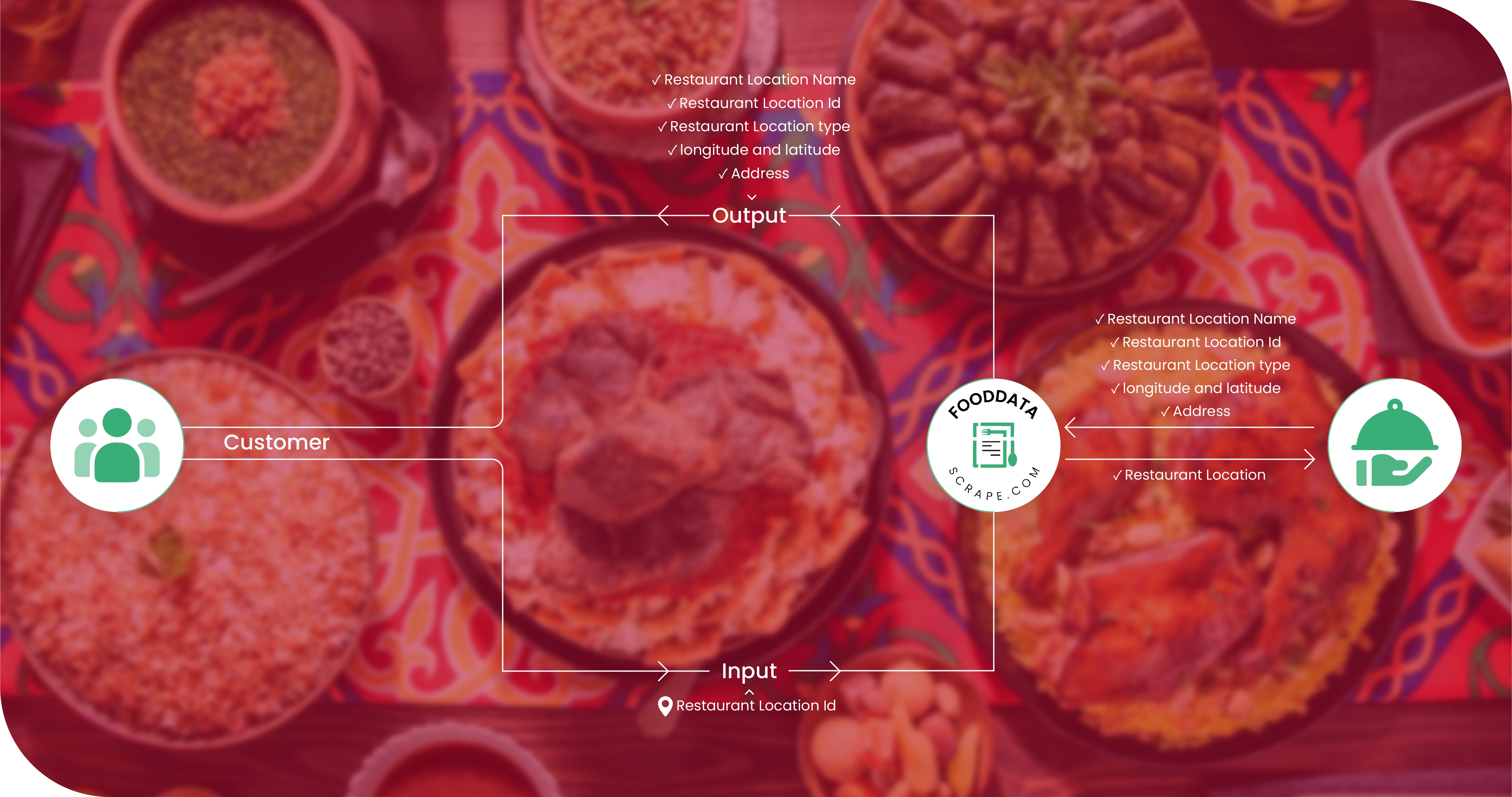
We identified relevant restaurant, food, grocery, menu, and culinary sources before implementing automated extraction workflows. Multiple website structures were mapped to collect restaurant details, dishes, ingredients, prices, descriptions, categories, locations, images, and availability while maintaining consistent collection standards. -
Automated Parsing and Data Structuring
Automated parsing systems were configured to recognize menu-level information across different page layouts and formats. Extracted information was transformed into predefined fields, enabling the client to work with consistent records regardless of the original source structure or presentation. -
Data Cleaning and Normalization
Collected records were processed through systematic cleaning workflows to remove duplicates, irrelevant entries, malformed values, incomplete records, and inconsistent naming patterns. Restaurant names, dishes, cuisines, prices, locations, and ingredients were normalized to produce reliable information for AI and analytics. -
Cuisine and Regional Classification
Cuisine classification rules were applied to distinguish Egyptian dishes from broader Middle Eastern and international categories. Regional tagging organized restaurant and food records by geographic area, enabling the client to identify culinary variations, regional specialties, location-specific food patterns, and cuisine preferences. -
Quality Validation and Structured Delivery
Automated validation checks identified missing attributes, duplicate records, incorrect formats, inconsistent classifications, and abnormal values. After quality verification, the finalized information was delivered in structured, machine-readable formats suitable for AI training, analytics, visualization, restaurant intelligence, and application development.
Advantages of Collecting Data Using Food Data Scrape
-
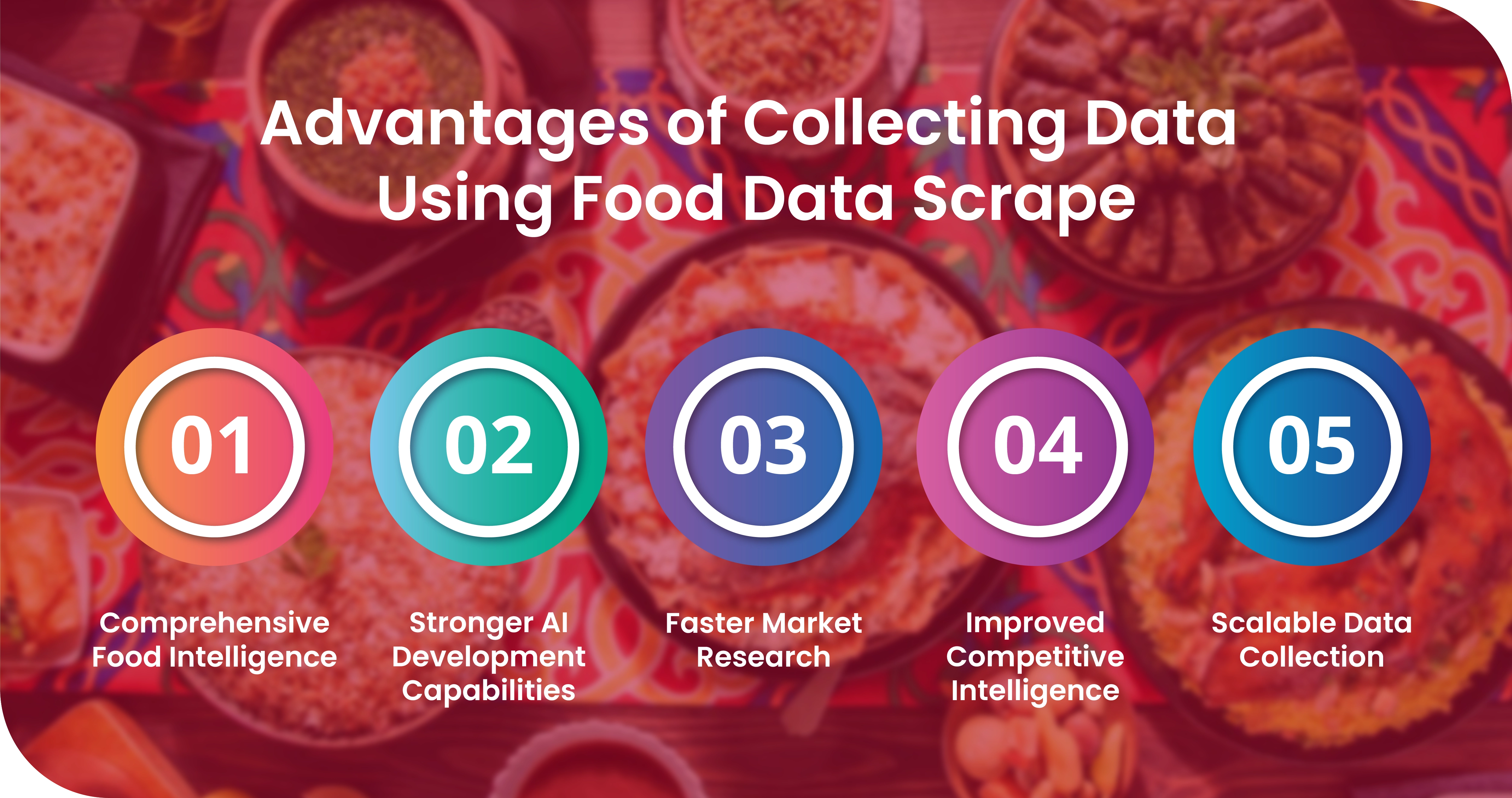
Comprehensive Food Intelligence
Food Data Scrape provides extensive restaurant and food information collected from multiple digital sources. Structured datasets enable businesses to study menus, dishes, ingredients, prices, cuisines, restaurant categories, locations, and availability without relying on fragmented manual research processes. -
Stronger AI Development Capabilities
Clean, structured, and consistently categorized food information can support machine-learning workflows. Businesses can use dish names, descriptions, ingredients, categories, and images as valuable inputs for food recognition, recommendation engines, classification models, and culinary intelligence applications. -
Faster Market Research
Automated data collection reduces the time required to gather large volumes of restaurant and menu information. Businesses can analyze market changes, emerging cuisines, pricing movements, restaurant expansion, menu additions, and regional food preferences using regularly refreshed datasets. -
Improved Competitive Intelligence
Structured restaurant information enables organizations to compare competitors across menu breadth, cuisine categories, pricing, dish availability, and geographic presence. These insights can support menu optimization, competitive positioning, pricing strategies, market-entry decisions, and identification of underserved culinary segments. -
Scalable Data Collection
Food Data Scrape solutions can scale across thousands of restaurants, dishes, locations, cuisines, and food categories. Automated workflows make it easier to expand geographic coverage, introduce new attributes, refresh existing datasets, and deliver large volumes of organized information according to changing business requirements.
Client's Testimonial
"Food Data Scrape transformed our fragmented Egyptian food information into a structured dataset that our AI and analytics teams could immediately use. The team understood our need for comprehensive Egyptian cuisine coverage and delivered detailed information across dishes, restaurants, ingredients, prices, categories, images, and regional attributes. We especially appreciated the attention given to normalization, duplicate removal, cuisine classification, and quality validation. Including both traditional Egyptian dishes and modern restaurant offerings significantly strengthened our training resources. The final dataset has improved our food recognition development, culinary analytics, and restaurant intelligence capabilities. The workflow was scalable, technically organized, and aligned with our requirements, giving us a dependable foundation for expanding our food technology applications across Egypt and other Middle Eastern markets."
—Head of AI & Data Science
Final Outcome
The project successfully delivered a comprehensive and structured Egyptian food dataset covering restaurants, dishes, menus, ingredients, prices, cuisines, images, locations, and availability. Combining traditional Egyptian cuisine with modern and international restaurant offerings created broader representation of the country's evolving food ecosystem. Data normalization and validation improved consistency across thousands of records, while regional classification provided stronger geographic and culinary intelligence. The client gained a reliable resource for improving food recognition training, strengthening dish classification, analyzing restaurant trends, and developing advanced food technology applications. Automated collection also established a scalable foundation for future data refreshes, allowing additional restaurants, cities, cuisines, dishes, and attributes to be incorporated efficiently. The solution ultimately transformed scattered online food information into an organized intelligence resource capable of supporting both present and future AI initiatives.