Introduction
A food and beverage company database for Europe is a structured list of manufacturers, drinks producers, wholesalers, specialist retailers and foodservice outlets, built from public business registers and public business listings. Each record carries a company name, registration number, NACE code, location and published business contacts, cleaned and deduplicated for sales, marketing or market research.
The market is big enough that a food and beverage company database needs clear focus; a generic "Europe companies" list rarely fits. According to FoodDrinkEurope's Data & Trends 2026, the EU food and drink industry had a turnover of about €1.5 trillion and employed 4.8 million people, with nearly 309,000 companies in 2023, and SMEs made up 99.2% of them. That is a long tail of small firms that no single source lists well.
This guide explains who uses a food and beverage company database, how to segment it with NACE codes, which public sources to use in six major countries, which fields to collect, and how to stay on the right side of GDPR and ePrivacy rules.
Who uses a food and beverage company database?
Demand for a food and beverage company database comes from teams that sell to, invest in or study the sector. In our own inquiries, outlet and HoReCa databases are a fast-rising request, and the same need now shows up for Europe.
- CPG and ingredient suppliers: find manufacturers in C10 and C11 that may buy flavours, starches, proteins or packaging inputs.
- Packaging and equipment firms: size the number of bakeries, dairies or breweries in a region before planning a sales territory.
- Foodservice distributors: map restaurants, cafes and hotels (HoReCa) by city and outlet count to plan routes and coverage.
- Consumer brands: plan trade or field campaigns across shops, bars and restaurants in several countries.
- Trade-show organisers: find likely exhibitors and visitors by segment and country.
- Investors and M&A teams: screen companies by legal form, size band and segment before deeper due diligence.
The 5 NACE segments that define the food and beverage sector
The cleanest way to scope a food and beverage company database is by activity code. NACE Rev. 2 is the EU's statistical classification of economic activities, and most national registers use a national version of it (SIC 2007 in the UK, NAF in France, ATECO in Italy, CNAE in Spain, SBI in the Netherlands, WZ in Germany).
| NACE code | Segment | Typical companies | Main data source |
|---|---|---|---|
| C10 | Manufacture of food products | Meat, dairy, bakery, confectionery, ready meals | Business registers, company websites, trade associations |
| C11 | Manufacture of beverages | Breweries, wineries, distilleries, soft drinks, water | Registers, excise or producer lists where public, websites |
| G46.3 | Wholesale of food, beverages and tobacco | Importers, distributors, cash and carry | Registers, websites, trade-show exhibitor lists |
| G47.2 | Retail sale of food in specialised stores | Butchers, bakers, delis, wine shops | Registers, Google Maps business listings |
| I56 | Food and beverage service activities | Restaurants, cafes, bars, caterers, dark kitchens | Google Maps listings, delivery apps, registers |
The EU is moving to NACE Rev. 2.1 for statistics from 2025, and some codes have been renumbered. [Verify NACE Rev. 2.1 mapping for G47.2 and I56 before publishing] Keep both the original code and the code version in your data so you can map old and new codes later.
One practical point: registers describe legal entities, not outlets. A restaurant group with 40 sites is one company in a register but 40 rows on a map. For I56 and G47.2, plan a company layer and an outlet layer from the start.
Public sources for European food and beverage companies lists
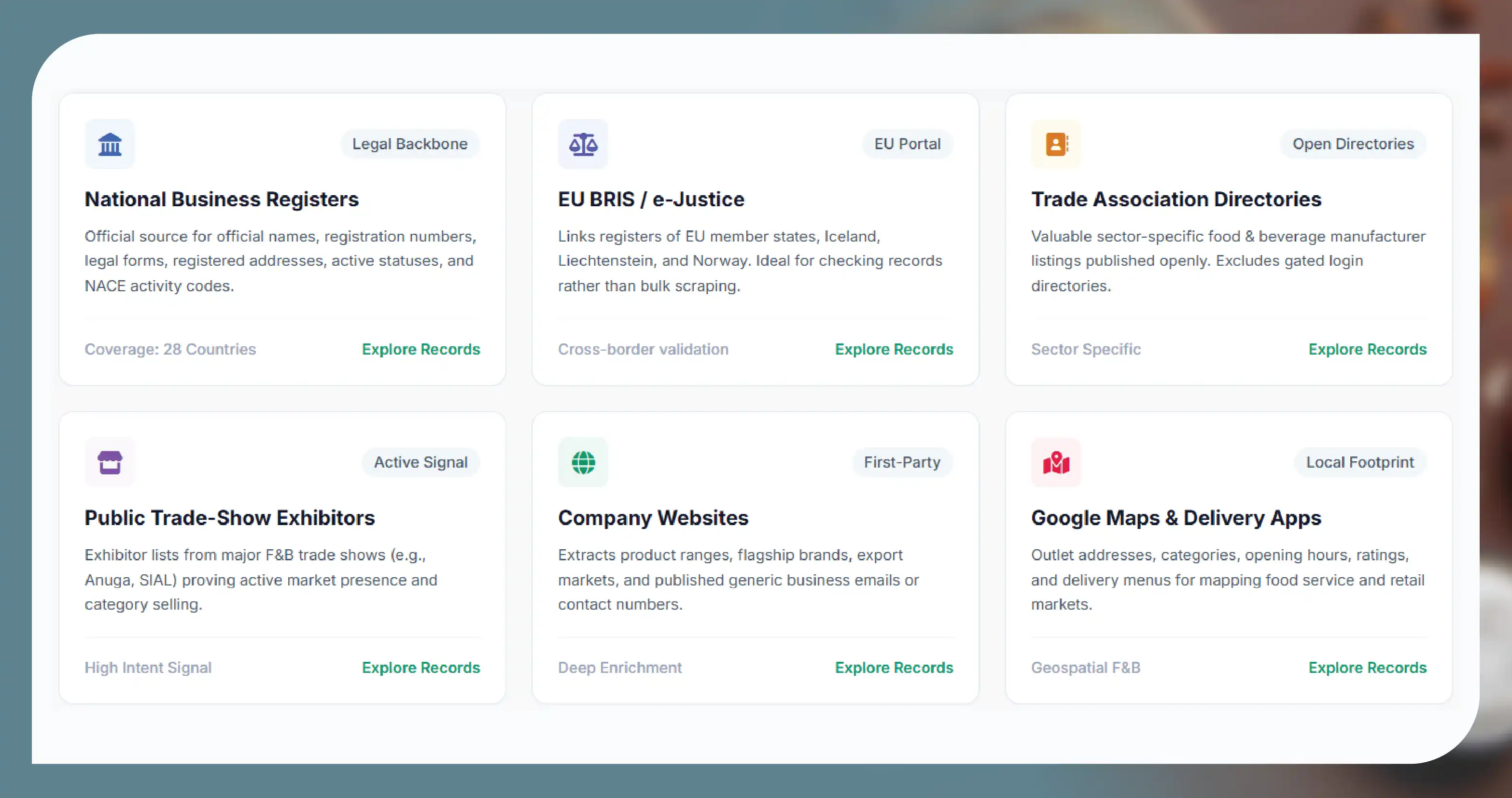
No single source covers everything, so a good food and beverage company database combines several. All of the sources below are publicly available business data.
- National business registers: the legal backbone. They give the official name, registration number, legal form, registered address, status and activity code.
- EU BRIS / e-Justice "Find a company": the European e-Justice Portal links the registers of EU member states, Iceland, Liechtenstein and Norway. It searches by company or registration number, so it is best for checking records rather than bulk listing.
- Trade association member directories: useful where they are published openly. Do not copy directories that sit behind a login.
- Public trade-show exhibitor lists: a good signal that a company is active and selling in a category.
- Company websites: product range, brands, export markets, and the generic business email or phone the company publishes.
- Google Maps business listings: outlet addresses, categories, opening hours, ratings and review counts for shops and restaurants.
- Food delivery apps: restaurant names, cuisines, menus and delivery areas. See our guide on how restaurant data helps segment the European restaurant market.
When collecting from websites and platforms, respect robots.txt, terms of service and sensible rate limits. Never bypass logins, CAPTCHAs or paywalls.
Country-by-country: official registers to start from
Each country runs its own register with different access rules, so a pan-European food and beverage company database is really several national builds joined together, each with its own costs and code systems. The table below shows where to start in six large markets.
| Country | Official register | Activity code | Access notes |
|---|---|---|---|
| UK | Companies House | SIC 2007 | Free monthly snapshot of live companies as CSV files |
| Germany | Handelsregister / Unternehmensregister | WZ 2008 (not held in the commercial register) | Free online search; activity codes need another source [Verify current access terms] |
| France | INSEE Sirene via data.gouv.fr | NAF rév. 2 (APE code) | Open data on companies and establishments (SIREN / SIRET) |
| Italy | Registro Imprese (InfoCamere) | ATECO | Search is open; most extracts and documents are paid [Verify current pricing] |
| Spain | Registro Mercantil (Registradores) and BORME | CNAE 2009 | Paid company notes; BORME publishes notices [Verify current access terms] |
| Netherlands | KVK Handelsregister | SBI | Free basic search; paid extracts and API [Verify current pricing] |
France stands out because Sirene lists both legal units and establishments, which helps with the outlet layer. In Germany, you will usually add activity codes from websites and listings, since the commercial register does not classify by sector. For country-level help, see our Germany food data page and our Spain, France and Italy coverage.
The 12 data fields every food and beverage company database needs
Keep the food and beverage company database schema simple and consistent across countries. These fields work for most sales and research use cases.
| Field | Description | Typical source |
|---|---|---|
| company_name | Registered legal name | Business register |
| trading_name | Brand or shop name used in public | Website, Google Maps |
| legal_form | GmbH, SAS, S.r.l., S.L., B.V., Ltd, etc. | Register |
| registration_number | National company number (e.g. SIREN, KVK number) | Register |
| nace_code | Harmonised NACE code plus national code and version | Register, mapped |
| country | ISO country code | Register |
| city / postcode | Registered or outlet location | Register, Google Maps |
| website | Official company domain | Website, listings |
| business_email | Generic address published by the company (info@, sales@) | Company website |
| business_phone | Main switchboard published by the company | Website, listings |
| outlet_count | Number of public locations found | Google Maps, delivery apps |
| status / last_seen | Active, dissolved, and date last verified | Register, crawl date |
Only collect a business email or phone if the company itself publishes it. Do not add named individuals' personal emails, mobile numbers or social profiles.
How to collect, clean and match the data
Volume is the easy part. A pan-European food and beverage company database of 100,000 to 500,000 rows only works if the records are clean and linked. A sensible pipeline looks like this:
- Scope first: pick countries, NACE codes and size bands, and decide whether you need companies, outlets or both.
- Pull the register layer: load register data per country and map national codes to NACE.
- Add the web layer: find each company's official website and its published generic contacts.
- Add the outlet layer: collect public map and delivery-app listings for retail and foodservice codes. Our restaurant POI dataset covers this layer.
- Normalise: standardise names (remove legal suffixes for matching), addresses, phone formats and country codes.
- Deduplicate: merge records with the same registration number, domain or normalised name plus postcode.
- Match outlets to companies: link each outlet to its parent using domain, brand name and address, and keep a match-confidence score.
- Validate and date-stamp: check status against the register, flag dissolved firms, and record when each row was last seen.
In any food and beverage company database, expect a share of records to need manual review, especially franchise outlets and companies with several trading names. [Add typical match rate from delivery team]
Legal and compliance basics: GDPR, ePrivacy and PECR
A compliant food and beverage company database stays at company level. Company-level data, such as a registered name, number, address and a generic info@ email, is mostly not personal data. Data about named people is. That is the line to design around.
- Keep it company-level: do not collect named individuals' personal contacts. Sole traders are a grey area, because their business name and address can identify a person.
- Legitimate interests: if any personal data is processed, the EDPB Guidelines 1/2024 set out a three-step test: a legitimate interest, necessity, and a balancing test against people's rights.
- UK rules: the ICO's B2B marketing guidance says PECR's email consent rule does not apply to corporate subscribers. Sole traders and partnerships are treated like individuals. Live calls must be screened against TPS and CTPS, and every message needs your identity and an opt-out.
- EU ePrivacy: national rules on B2B email and calls differ by country. [Compliance: confirm B2B email rules for DE, FR, IT, ES, NL with legal counsel]
- Suppression lists: keep opt-outs on a suppression list so they are not re-added in the next refresh.
This section is general information, not legal advice.
Build vs buy: choosing the right approach
There are three ways to get a European food and beverage company database: build it yourself, buy an off-the-shelf list, or commission a custom build.
| Option | Best for | Strengths | Watch-outs |
|---|---|---|---|
| Build in-house | One or two countries, technical team available | Full control of scope and fields | Register access, code mapping and outlet matching take time |
| Buy an off-the-shelf list | Quick, broad company counts | Fast to start | Unclear sources, mixed freshness, often weak on outlets and HoReCa |
| Custom build from public data | Multi-country campaigns, outlet-level needs | Scoped to your NACE codes, fields and refresh cycle | Needs a clear brief and a compliance review |
When you compare food and beverage company database providers, ask four questions. Which sources feed each field? How often is the data refreshed? How are outlets matched to companies? And which fields contain personal data, if any?
Food Data Scrape builds custom company and outlet datasets from public business listings, delivery apps and company websites, delivered as CSV, Excel, JSON or API. Sales teams can also add buying signals through our foodservice lead intelligence service. [Confirm figure: European countries currently covered]
Get a free sample dataset: tell us your countries, NACE codes and fields, and we will send a sample of European food and beverage company and outlet records.
Questions
Frequently Asked Questions
It is a structured list of food manufacturers, beverage producers, wholesalers, specialist retailers and foodservice outlets, with fields such as name, registration number, NACE code, location and published business contacts.
The core codes are C10 (food manufacturing), C11 (beverages), G46.3 (food and drink wholesale), G47.2 (specialised food retail) and I56 (food and beverage service activities).
Using public business data at company level is generally lawful. Avoid named individuals' personal contacts, follow GDPR and national marketing rules, and respect each source's terms of use.
Some registers offer free data, such as the UK Companies House monthly snapshot and France's Sirene open data. Other countries charge for extracts, and you will still need to clean and merge them.
Refresh a food and beverage company database quarterly for most sales use cases. Foodservice outlets open and close often, so monthly refreshes work better for HoReCa campaigns.
Get a Free Food Data Sample in 48 Hours.
Tell us your platforms, target markets and required fields — we'll map exactly what's possible with food data scraping, recommend the right approach, and send a working sample so you can verify quality before any commitment.
Request a strategy call
Thanks — our data team will reach out within 48 hours with your sample.