Boo-st your food data. Save 20% on scraping services
Menus · Grocery · Alcohol · AI Intelligence, across 40+ countries

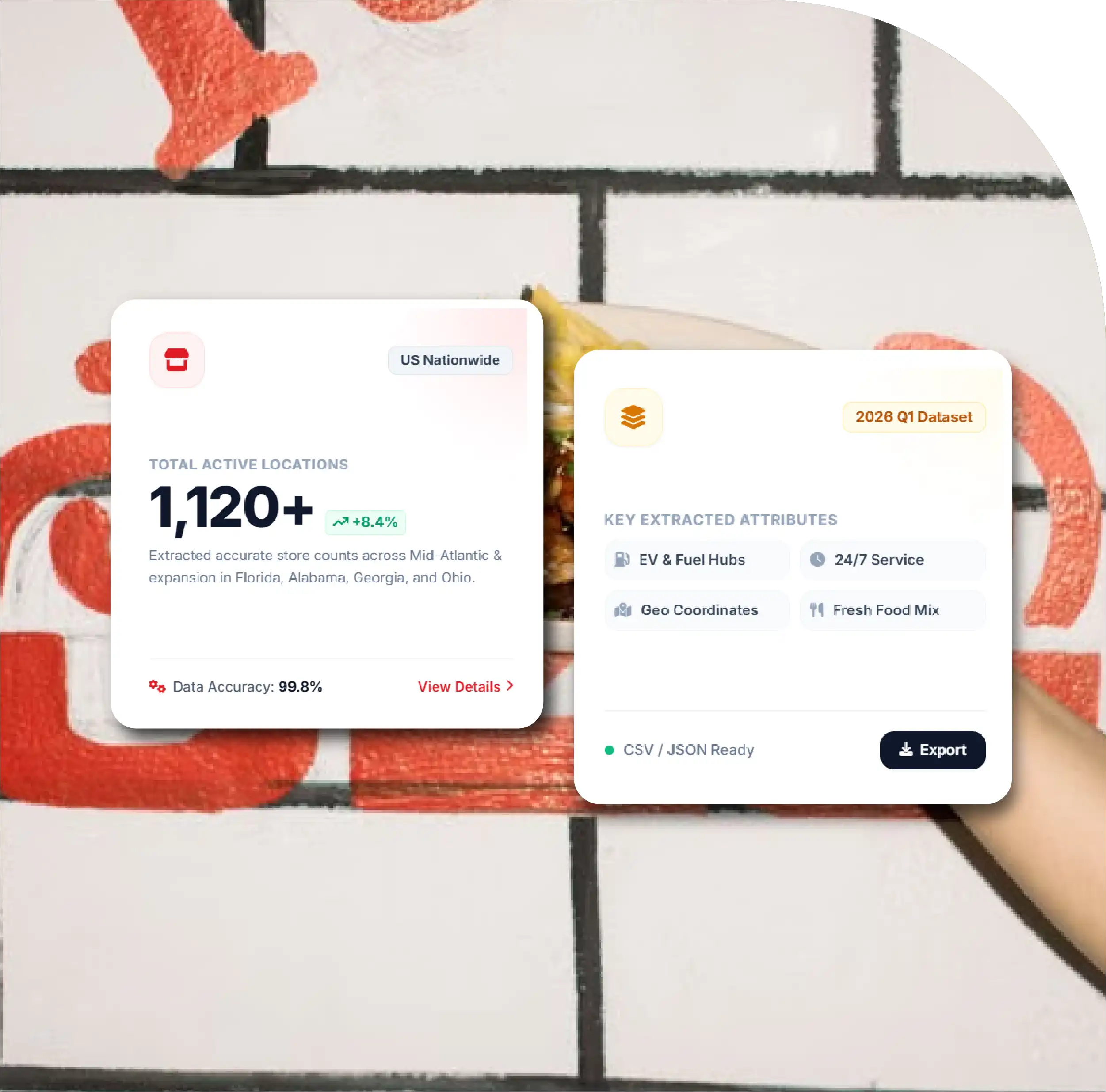
1. 1,251 Wawa Stores: The United States has 1,251 Wawa locations recorded as of September 22, 2026.
2. Florida Leads: Florida has the highest concentration with 327 stores, representing approximately 26% of the total network.
3. Top Three Markets: Florida, New Jersey, and Pennsylvania collectively account for 900 Wawa locations in the supplied state-level data.
4. Leading Cities: Orlando has 35 stores, followed by Philadelphia with 31, Jacksonville with 18, and Tampa with 17.
5. Detailed Location Dataset: Store records include addresses, ZIP codes, phone numbers, geographic coordinates, country, and last updated dates.

Wawa has established a substantial convenience-store footprint across the United States, supported by a strong presence in the Mid-Atlantic and growing operations in the Southeast. As of September 22, 2026, the supplied location dataset records 1,251 Wawa stores across the United States, spanning hundreds of cities and multiple states. Florida has the largest concentration, with 327 stores, followed by New Jersey with 299 and Pennsylvania with 274.
This research report examines the method to Extract Wawa Stores In USA Data in United States 2026, focusing on store distribution, geographic concentration, population coverage, leading cities, customer ratings, and representative location-level information. The Number of Wawa locations in the USA in 2026 provides an important reference point for understanding Wawa's physical retail presence and regional expansion.
The analysis also demonstrates how Wawa Store Location Data Extraction can organize individual store records, including street addresses, cities, states, ZIP codes, telephone numbers, geographic coordinates, complete addresses, and update dates. Such structured information supports market research, competitive analysis, retail planning, location intelligence, and convenience-store benchmarking.
The supplied dataset contains 1,251 Wawa locations in the United States as of September 22, 2026. These stores are distributed across hundreds of cities, with the average location rating reported at 3.83 based on customer reviews.
The geographic footprint is highly concentrated rather than evenly distributed across the country. Florida, New Jersey, and Pennsylvania collectively account for a significant share of the entire network. Florida alone has 327 locations, representing approximately 26% of the reported total. New Jersey contributes 299 locations, while Pennsylvania has 274.
The dataset reports Wawa locations across 16 states and territories, although one summary line in the supplied source states 15 states and territories. This difference suggests a minor internal discrepancy in the source material. The detailed location sample also includes Tennessee, which is not included in the top-state table. Therefore, the detailed location records should be considered when interpreting the geographic footprint.
Wawa's store network demonstrates a clear regional concentration. Florida leads the country with 327 stores, making it the largest Wawa market in the supplied 2026 dataset.
| State / Territory | Number of Stores | Share | Population | Population per Store |
|---|---|---|---|---|
| Florida | 327 | 26% | 23.46M | 71.75K |
| New Jersey | 299 | 24% | 9.55M | 31.93K |
| Pennsylvania | 274 | 22% | 13.06M | 47.66K |
| Virginia | 139 | 11% | 8.88M | 63.88K |
| Maryland | 69 | 6% | 6.26M | 90.80K |
| Delaware | 51 | 4% | 1.06M | 20.78K |
| North Carolina | 20 | 2% | 11.20M | 559.90K |
| Ohio | 17 | 1% | 11.90M | 700.06K |
| Indiana | 15 | 1% | 6.97M | 464.87K |
| Kentucky | 11 | 1% | 4.61M | 418.82K |
The figures show substantial differences in store density. New Jersey has approximately one Wawa location for every 31,933 people, while North Carolina has one for every 559,900 people based on the supplied population figures. This illustrates how established Wawa markets have considerably greater location penetration than newer or smaller markets.
Florida represents the largest individual state market in the dataset, with 327 stores. Its locations account for roughly 26% of all reported Wawa stores in the United States.
Several Florida cities feature prominently in the store network. Orlando has 35 locations, Jacksonville has 18, Tampa has 17, and Bradenton has eight. The concentration across major population centers indicates that Wawa's Florida network extends across both metropolitan and regional markets.
Florida's 327 locations also provide a substantial base for analyzing store density, market coverage, geographic clustering, and potential retail competition. For researchers studying convenience-store expansion, Florida represents an important market for understanding Wawa's current physical footprint.
New Jersey ranks second with 299 Wawa stores, representing approximately 24% of the reported US network. The state also has the lowest population-per-store figure among the three largest markets, at approximately 31,933 people per store.
Pennsylvania follows with 274 stores, representing around 22% of the network. Philadelphia has 31 Wawa locations, making it one of the largest city-level markets in the dataset. Allentown also appears among the leading cities with eight locations.
Together, Florida, New Jersey, and Pennsylvania account for 900 stores in the supplied state-level figures. This demonstrates how strongly the overall Wawa network is concentrated within a relatively small number of established markets.
City-level distribution provides another perspective on the company's retail footprint.
| City | State | Number of Locations |
|---|---|---|
| Orlando | Florida | 35 |
| Philadelphia | Pennsylvania | 31 |
| Jacksonville | Florida | 18 |
| Tampa | Florida | 17 |
| Fredericksburg | Virginia | 12 |
| Virginia Beach | Virginia | 11 |
| Richmond | Virginia | 10 |
| Toms River | New Jersey | 9 |
| Bradenton | Florida | 8 |
| Allentown | Pennsylvania | 8 |
Orlando leads the listed cities with 35 locations, followed by Philadelphia with 31. Jacksonville and Tampa also have significant concentrations.
The city-level figures are useful for evaluating urban market penetration. Multiple stores within the same city can indicate strong consumer demand, high traffic corridors, broad geographic coverage, or Wawa's established operating presence.
Modern retail research increasingly depends on detailed location records rather than simple store counts. US Convenience Store Data Scraping can support the collection and organization of information such as store names, addresses, telephone numbers, geographic coordinates, operating details, and update timestamps.
The supplied Wawa dataset illustrates the value of this approach. Individual records contain fields including street address, city, state, ZIP code, phone number, latitude, longitude, country, complete address, and last updated date.
For example, the dataset includes Wawa locations in Marlboro, New Jersey; West Chester and Phoenixville, Pennsylvania; Wilmington, North Carolina; Miamisburg, Ohio; and several Virginia and New Jersey markets.
This granular information can be used to construct geographic databases, identify regional clusters, compare markets, and support location-based business intelligence.
Wawa US Market Data Scraping can help researchers develop a structured view of the company's retail footprint. Instead of relying only on aggregate store totals, analysts can examine individual locations and compare them by market, city, population, coordinates, and other attributes.
For convenience-store market research, geographic information can reveal where stores are concentrated and where coverage remains limited. Researchers can also compare Wawa's footprint with competing convenience-store chains, grocery retailers, fuel stations, restaurants, and other retail formats.
Extract Wawa US Store Count Data for historical tracking when comparable datasets are collected at different dates. Store counts can then be compared over time to identify changes in geographic distribution and market expansion.
The supplied dataset reports an average Wawa rating of 3.83 based on more than 138,750 customer reviews. It also reports a 74.22% high customer satisfaction rating and 19.73% poor customer feedback.
The highest-rated locations listed in the source include stores in West Palm Beach, Melbourne, Port Orange, Venice, and Orlando, each receiving a 4.4 rating.
At the other end of the supplied sample, locations in Orlando, Philadelphia, and Maplewood show ratings ranging from 2.3 to 2.8. These differences demonstrate why store-level review data can provide a more detailed perspective than network-wide averages.
However, the source specifically notes that the primary Wawa location dataset does not include location reviews. Customer review information is therefore presented separately from the core location database.
The supplied source identifies numerous states and territories without Wawa stores, including California, Texas, New York, Illinois, Michigan, Colorado, Washington, Oregon, Massachusetts, Minnesota, Wisconsin, Arizona, and others.
The absence of locations across these markets demonstrates that Wawa's national footprint remains geographically concentrated. This is particularly relevant for researchers examining regional convenience-store competition and market-entry patterns.
For example, major population centers outside Wawa's established footprint can be studied separately to understand the differences between markets with significant Wawa penetration and those without reported locations.
The supplied sample demonstrates the type of structured information available for each store.
| Data Field | Example |
|---|---|
| Store Name | Wawa |
| Street | 455 Rte 520 |
| City | Marlboro |
| State | NJ |
| ZIP Code | 07746 |
| Phone | 732-972-4515 |
| Latitude | 40.332717 |
| Longitude | -74.24628 |
| Address | 455 Rte 520, Marlboro, NJ, 07746 |
| Last Updated | 2026-09-22 |
Such fields allow businesses to transform raw location information into structured retail intelligence. Latitude and longitude can support mapping and proximity analysis, while state, city, and ZIP information enable geographic segmentation.
Grocery Data Scraping in the USA can support broader retail intelligence initiatives by helping businesses organize information about stores, products, prices, locations, and competitive markets.
Although Wawa primarily operates as a convenience-store retailer, its extensive food and beverage offering makes its locations relevant to grocery, quick-commerce, restaurant, and food-retail research.
Grocery Data Scraping Services can also help businesses maintain structured databases that are refreshed periodically. Updated location records can support territory planning, competitor monitoring, market research, and geographic analysis.
For analysts, the combination of store count, population, location coordinates, customer ratings, and city-level distribution creates a more comprehensive picture of retail presence than a simple nationwide store count.
The 2026 Wawa store dataset provides a detailed view of a 1,251-location US retail network as of September 22, 2026. Florida leads with 327 stores, followed by New Jersey with 299 and Pennsylvania with 274. The concentration of stores across these markets highlights the regional character of Wawa's footprint.
The location-level records add another layer of intelligence by providing addresses, phone numbers, coordinates, ZIP codes, and update dates. Combined with city and state distribution, these fields can support geographic analysis, competitive benchmarking, market research, and retail planning.
AI Grocery Intelligence can further organize large retail datasets into structured insights for monitoring geographic trends, store coverage, and competitive activity.
A Supermarket Store Locator DB can similarly consolidate location records into searchable geographic datasets that support mapping and market analysis.
For organizations requiring broader retail intelligence, Grocery Delivery Scraping API Services can extend location research into delivery, product, pricing, availability, and digital-commerce datasets, creating a wider view of the US food and convenience retail ecosystem.
Are you in need of high-class scraping services? Food Data Scrape should be your first point of call. We are undoubtedly the best in Food Data Aggregator and Mobile Grocery App Scraping service and we render impeccable data insights and analytics for strategic decision-making. With a legacy of excellence as our backbone, we help companies become data-driven, fueling their development. Please take advantage of our tailored solutions that will add value to your business. Contact us today to unlock the value of your data.