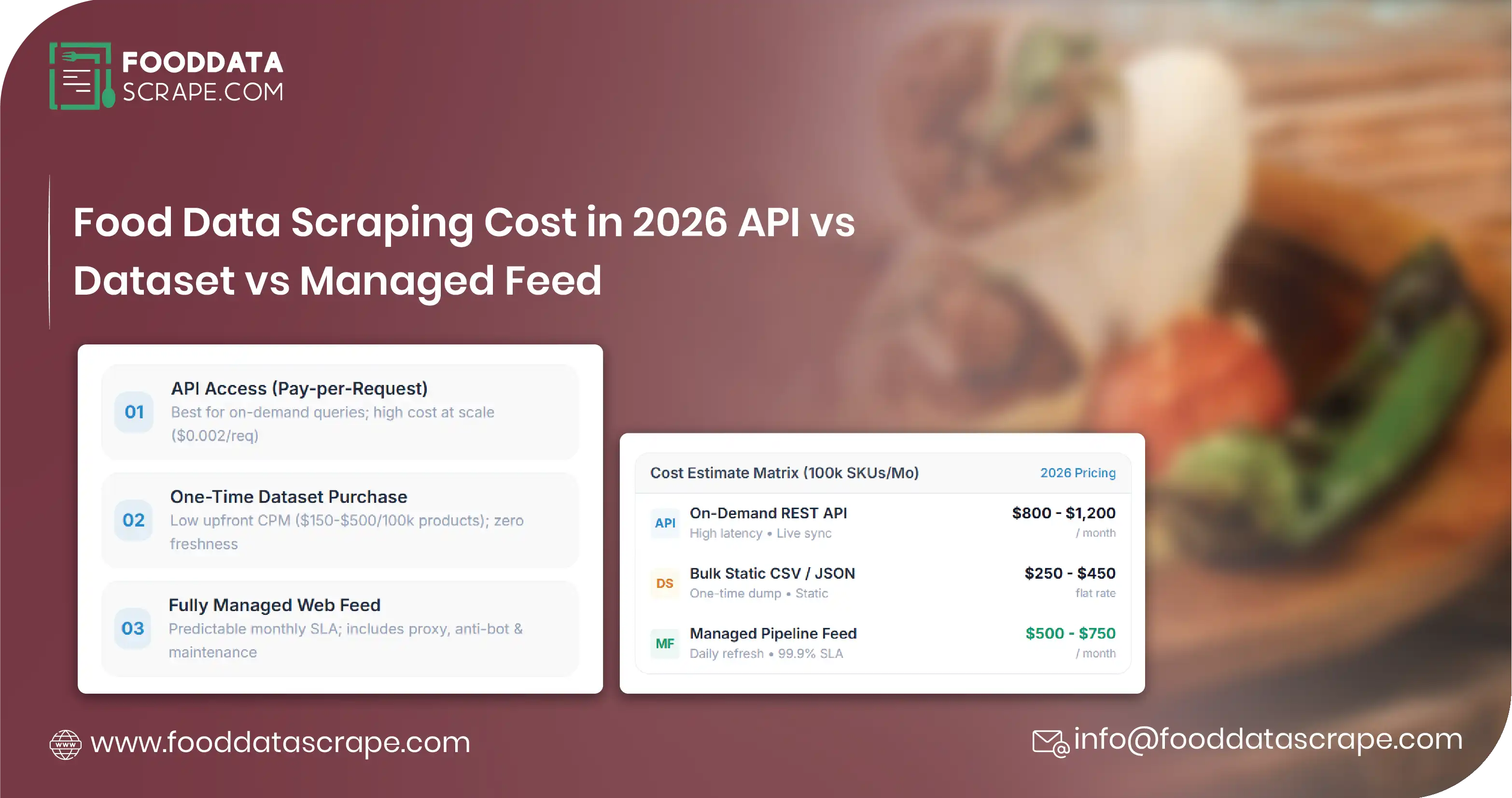
Introduction
"What will this cost?" is often the first question a new buyer asks us, usually before there is a written spec. That is fair, but food data scraping cost depends far more on what you ask for than on the act of scraping itself.
Short answer: Food data scraping cost is driven by scope, not by a fixed rate. The main drivers are how many platforms you need, how many cities or pincodes, how often data refreshes, how deep each record goes, and how much matching and QA is required. A one-off dataset usually costs least; real-time APIs and managed feeds cost more.
This guide explains each driver of food data scraping cost, compares five delivery models, gives you a scoping checklist and shows where budgets leak. It does not quote a rate card, because a fair price only comes after the scope is clear.
What drives food data scraping cost?
Every quote we prepare starts with the same ten questions. Each one moves food data scraping cost up or down.
- Number of sources and platforms: Each delivery app, grocery site or quick-commerce app needs its own collector, schema mapping and monitoring.
- Geography and location granularity: Delivery and quick-commerce prices, menus and stock often change by city, store, pincode or ZIP code. Each location is a separate request set.
- Refresh frequency: A monthly snapshot is cheap to run. Daily, hourly or intra-day refreshes multiply requests, storage and monitoring effort.
- Fields and depth: Store name and rating are light. Full menus with modifiers, variant prices, nutrition, allergens and review text are heavy.
- Matching and normalisation: Matching the same dish, SKU or pack size across platforms is skilled work. Grocery data pricing is often driven more by product matching than by collection.
- Anti-bot difficulty and maintenance: Some sites change layouts and defences often. Ongoing repair work is a real, recurring part of food data scraping cost.
- Quality assurance: Schema checks, de-duplication, price sanity checks and spot-checks all take time.
- Delivery format: A CSV is simple. Warehouse loads, webhooks or a custom schema add integration work.
- History and backfill: Past data exists only if someone captured it at the time, so backfill is scoped separately.
- Licensing for display: Showing third-party content (such as menu photos or review text) inside your own product raises rights questions and can change scope.
Which delivery model fits your budget? API vs dataset vs managed feed
Our Dubai and India leads often ask: "What is the difference between a food API, a dataset and scraping?" Scraping is the collection method. Dataset, feed, API and dashboard are ways of delivering the result. The delivery model you pick shapes your food data scraping cost as much as the scope does.
| Delivery model | What you get | Best for | Relative upfront cost | Relative ongoing cost | Your team's effort |
|---|---|---|---|---|---|
| Ready-made dataset | A one-time file (CSV, JSON, Parquet) from an existing collection | Market sizing, one-off research, lead lists of public business listings | Low | Low (none unless refreshed) | Low |
| Scheduled feed | Recurring files delivered daily, weekly or monthly to your storage | Price monitoring, assortment tracking, BI reporting | Medium | Medium | Low to Medium |
| Real-time API | On-demand JSON calls or webhooks | Apps, pricing engines, live alerts | Medium to High | High | Medium (integration) |
| Managed dashboard | Cleaned data shown in charts and alerts | Category and commercial teams without engineers | Medium | Medium | Low |
| DIY scraper | Your own code, proxies and servers | Teams with in-house data engineers and narrow scope | Low to start | High and unpredictable | High |
A simple rule: if you need the data once, buy a dataset. If you need it on a rhythm, use a managed data feed. If your software must ask for it at any moment, pay for an API. Food data API pricing is usually the highest of the three because the provider must keep capacity ready at all times.
How restaurant data cost and grocery data pricing differ
Food data scraping cost also varies by vertical, even with the same delivery model.
| Vertical | What usually raises the cost | What usually keeps it lower |
|---|---|---|
| Restaurant and menu data | Full menus with modifiers, many outlets per chain, review text, frequent menu changes | Store-level fields only (name, cuisine, rating, address), monthly refresh |
| Grocery and supermarket | Large catalogues, cross-retailer SKU matching, pack-size normalisation, promotions | A fixed basket of SKUs, weekly refresh, one retailer per country |
| Quick commerce | Pincode or dark-store level pricing and stock, intra-day refresh | A small set of pincodes, a focused category list |
| Alcohol and beverage | Age-gated sites, state or country rules, vintage and pack variants | Public listing pages only, brand-level tracking |
For restaurant data cost, depth is usually the biggest factor: full menus across many outlets produce far more records than a list of restaurants with ratings. For grocery data pricing, matching usually matters most.
Is web scraping cost per record a fair way to compare quotes?
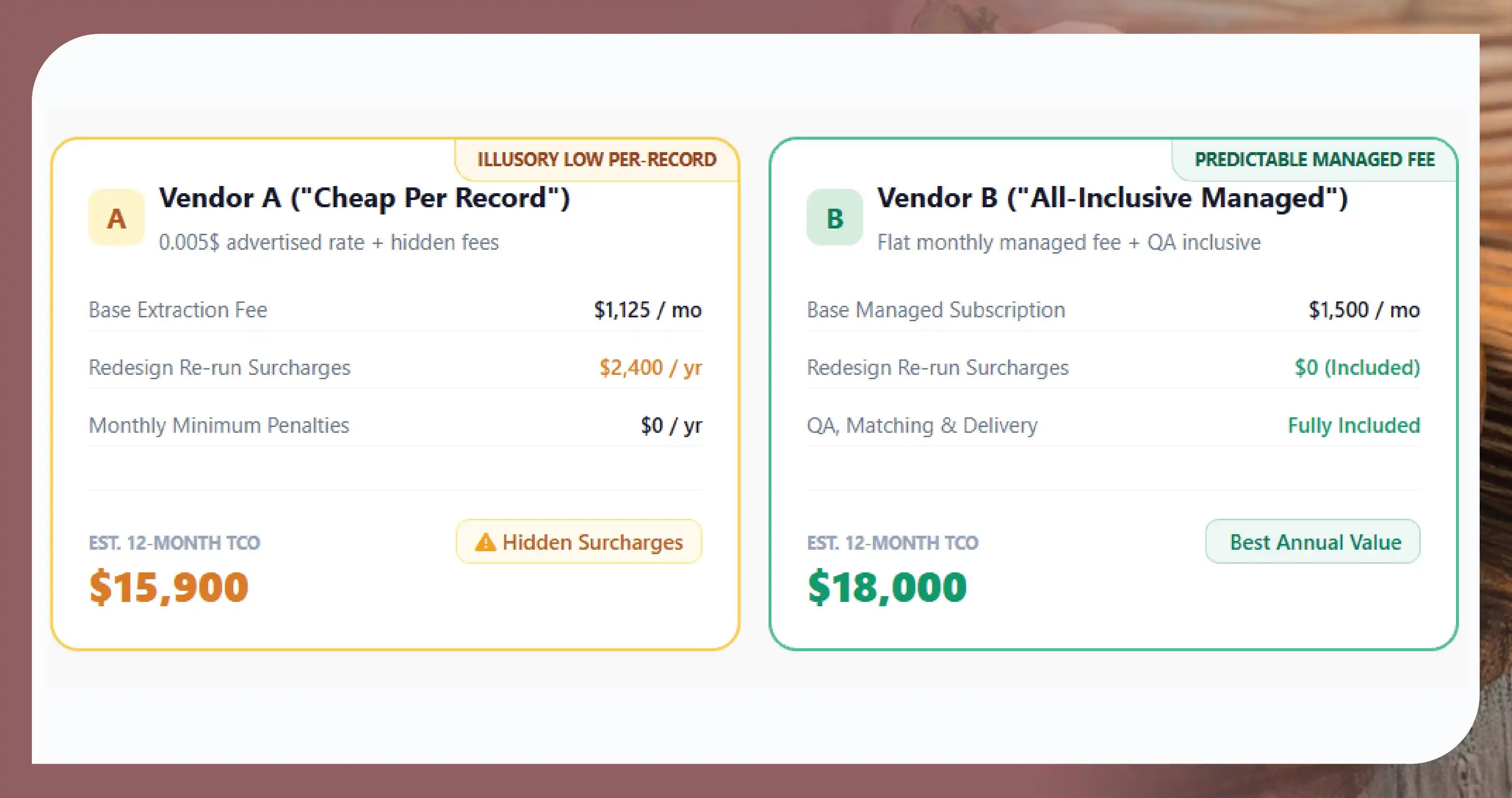
Per-record pricing looks easy to compare, but it can mislead. Web scraping cost per record depends on what one "record" means. A store row, a dish row and a dish-with-modifiers row are very different units of work.
Before comparing quotes, ask each provider to state:
- The record definition: for example one SKU per store per day, or one dish per outlet per snapshot.
- What is included: QA, matching, re-runs after site changes and delivery integration.
- Minimums: monthly minimums, setup fees or platform onboarding fees.
- Change handling: what happens when a platform redesigns its app or adds a new field.
A low per-record figure with paid re-runs can push total food data scraping cost above a flat managed fee. Model the full year, not the first month.
Scoping checklist: get an accurate quote faster
Many first-time buyers ask for a sample and a price with no spec. A short brief gets you a sharper quote and a more useful free sample.
- Business question: What decision will this data support (pricing, expansion, assortment, lead generation of public business listings)?
- Platforms: Which sites or apps, and in which countries?
- Locations: Which cities, pincodes, ZIP codes or store IDs?
- Categories: Which cuisines, aisles or brands, and roughly how many items?
- Fields: Which fields are must-have and which are nice-to-have?
- Refresh: One-time, monthly, weekly, daily or intra-day?
- History: Do you need past data, and from which date?
- Matching: Do items need to be matched across platforms or to your own product list?
- Delivery: File, cloud storage, data warehouse, API or dashboard?
- Use of data: Internal analysis only, or displayed to your own customers?
- Timeline and budget range: When do you need the first delivery, and what range has been approved?
A brief like this keeps food data scraping cost down, because you stop paying for fields and refresh rates you will never use.
How to reduce food data scraping cost
- Start with a pilot: Test one platform and one city before scaling. Our current pilot terms are on the FAQs page [Confirm figure].
- Cut fields you will not use: Every extra field adds parsing, QA and storage.
- Match refresh to decisions: If prices are reviewed weekly, a daily feed may be wasted spend.
- Sample locations: A representative set of pincodes or ZIP codes often answers the question as well as full coverage.
- Separate history from live data: Scope backfill as its own project so it does not inflate the ongoing fee.
Hidden costs of DIY scraping
A DIY scraper looks cheap on day one. The real food data scraping cost of an in-house build shows up later.
- Engineering time: Scrapers need skilled people to build and fix. In the US, the median annual wage for software developers was $135,980 in May 2025, according to the US Bureau of Labor Statistics.
- Anti-bot pressure: Websites invest heavily in bot defences. Thales reported that automated traffic made up 51% of all web traffic in 2024, with bad bots at 37% (Thales, 2025 Imperva Bad Bot Report). Defences keep tightening, so maintenance never stops.
- Proxies and infrastructure: Proxy networks, headless browsers, servers, storage and monitoring are recurring bills.
- Breakage and data gaps: When an app updates, scrapers can fail silently, and missed days cannot be recovered.
- Normalisation: Cleaning units, currencies, pack sizes and duplicates often takes longer than collection.
- Compliance review: Someone must check terms, data types and local law for every new source.
Build vs buy: which costs less?
Neither option wins every time. It depends on scope, skills and how central the data is to your product.
| Situation | Build in-house | Buy from a provider |
|---|---|---|
| One or two simple, stable sites | Often reasonable | Also fine; compare total cost |
| Many platforms across several countries | Hard to staff and maintain | Usually more cost-effective |
| Pincode or store-level quick-commerce data | High request volume and frequent changes | Usually more cost-effective |
| Data is your core product and IP | Worth investing in | Use a provider for gaps or speed |
| You need data in weeks, not quarters | Slow to start | Faster to first delivery |
| No in-house data engineers | Not practical | Recommended |
A fair test: compare 12 months of fully loaded internal cost (people, proxies, infrastructure, downtime) with a 12-month managed quote for the same scope.
Legal and compliance basics
A low food data scraping cost is worthless if the data creates legal risk. A responsible quote assumes:
- Public business data only: prices, menus, product listings, store locations and ratings that are publicly visible. No content behind logins or paywalls.
- No personal data of individuals: Public does not mean free to use. The UK ICO notes that scraped content which identifies a person can be personal data, and that lawful use needs a clear legal basis and a balancing test (ICO). Reviewer names and profiles should be excluded or anonymised.
- Respect for sites: Follow robots.txt where applicable, terms of service and sensible rate limits. Do not bypass CAPTCHAs or security controls.
- Display rights: If you plan to show third-party content to your own users, take legal advice first.
- Order and sales volumes: These are not public on delivery platforms. Any quote promising them should be questioned. Public proxies such as rating counts, "bestseller" badges and availability can be offered and labelled as proxies.
[Compliance team to review this section against current UK, EU, UAE and India rules before publishing]
Get a free sample dataset: send us your platforms, locations and fields, and we will scope the right delivery model and share a sample before you commit.
Questions
Frequently Asked Questions
There is no single rate. Food data scraping cost depends on platforms, locations, refresh frequency, field depth, matching and delivery format. A one-time dataset usually costs least, while real-time APIs cost most. Share a short brief to get an accurate quote [Confirm figure].
Usually, yes. Food data API pricing reflects capacity that stays ready at all times. If you need data periodically, a scheduled feed or dataset is normally better value.
Yes. We offer a free sample or pilot so you can check fields and quality before committing. Current pilot terms are listed on our FAQs page [Confirm figure].
Buy an existing dataset if one fits, or limit a custom job to one platform, a few cities, must-have fields and a monthly refresh.
Providers define a "record" differently and include different things, such as QA, matching, re-runs and integration. Ask each provider to state these in writing and compare a full year of cost.
Sometimes, for one or two simple sites. At scale, engineering time, proxies and breakage usually make DIY food data scraping cost more over a year.
Get a Free Food Data Sample in 48 Hours.
Tell us your platforms, target markets and required fields — we'll map exactly what's possible with food data scraping, recommend the right approach, and send a working sample so you can verify quality before any commitment.
Request a strategy call
Thanks — our data team will reach out within 48 hours with your sample.