Introduction
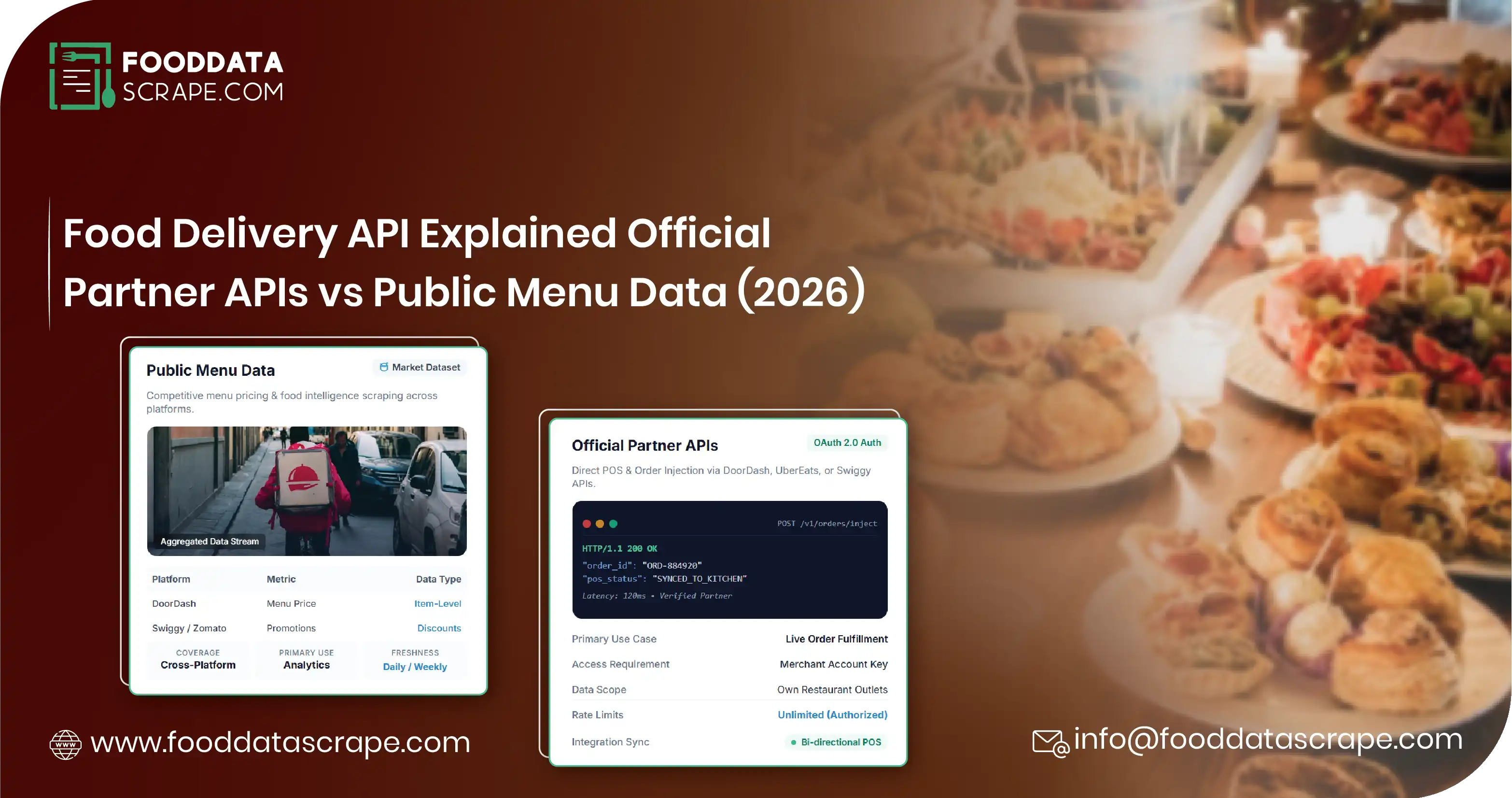
When people search for a food delivery API, they usually want one of two very different things. Some need to run their own restaurant on Uber Eats, DoorDash or Wolt: push menus, accept orders, open and close the store. Others want to see the whole market: competitor menus, prices, delivery fees, ETAs and ratings.
The short answer: official delivery platform APIs are partner integrations. They let an approved restaurant, retailer or integrator manage its own stores, menus and orders, and sometimes book couriers. They do not expose competitors' menus, prices, fees or ratings. That market-wide view comes from public listing data, collected responsibly and delivered as feeds.
This guide compares what each platform's developer documentation says, as read on 14 October 2026, and shows where public menu data fits. It also explains, plainly, what Food Data Scrape does and does not do.
What is a food delivery API, really?
The phrase covers three separate things. Mixing them up is the most common reason integration projects stall.
- Merchant (marketplace) APIs: Used by a restaurant or its POS / middleware provider to sync menus, receive orders and control store status on a platform.
- Last-mile delivery APIs: Used by a business that takes orders on its own website or app and wants a platform's courier network to deliver them (for example DoorDash Drive or Wolt Drive).
- Market data feeds: Structured copies of what any customer can see on a delivery app – menus, prices, fees, ETAs, ratings and availability – across many restaurants and areas.
The first two are run by the platforms and require a relationship with them. The third is what a data provider such as Food Data Scrape supplies.
What do the official platform APIs cover?
The table below is based only on each platform's own developer documentation. Where the public page does not say something, we say so rather than guess.
| Platform | Official API family | Who can access | What it covers | What it does not cover |
|---|---|---|---|---|
| Uber Eats | Marketplace APIs: Integration Activation, Store, Menu, Order, Reporting, POS integrations (docs) | Partners and integrators; Uber states access "may require written approval", and the getting-started guide requires a signed NDA and API licensing agreement (guide) | Stores, menus, item availability and pricing, hours, orders and reports for the stores authorised to the app | Other restaurants' menus, prices, fees or ratings |
| DoorDash | Marketplace integration and Drive (Marketplace, Drive) | Marketplace "is not open-access" and participation is "by approval only", reviewed quarterly; Drive access is by application via the Developer Portal | Menu, store and order data for the partner's restaurants; Drive books Dasher deliveries for a business's own orders | Market-wide competitor listings or prices |
| Wolt | Order, Menu and Venue management APIs; Wolt Drive (docs) | Partners who choose an implementation plan; credentials are generated by a Wolt partner manager and integrations must be demoed before rollout | Receiving orders, pushing venue-specific menus, managing venue hours and status | Other venues' menus, prices or ratings |
| Deliveroo | Partner Platform (Order, Menu, Site), Signature, Retail (Catalogue, Picking) (docs) | Partners with Developer Portal access; existing contracts go through the Deliveroo Account Manager | Incoming orders, menu updates (stock, prices, allergens), site open/close and hours, courier requests for own orders | Competitor menus, fees or ratings |
| Grubhub | Partner endpoints for menu ingestion and order transmission (portal) | Brands, POS companies and online ordering providers; the portal and Grubhub's tech integrations page publish no self-serve sign-up or terms (checked 14 Oct 2026), and POS requests start with a partner form | Ingesting a partner's menu content and transmitting orders | Market-wide menu or price data |
| talabat | Restaurant Integration API (support page) | Restaurant partners via their POS; access is requested through a sign-up form | Managing orders, menu and restaurant branches via the POS | Other restaurants' data |
| Just Eat Takeaway.com | Public developer portal with POS integration guides and API references for orders, order acceptance and delivery webhooks, restaurants and delivery fees (portal, POS guide) | POS and integration partners; no self-serve sign-up is shown (checked 14 Oct 2026), and partner integrations such as Toast's need Just Eat to complete its side of setup | A partner's own orders and menu sync via POS | Competitor listings |
The pattern is consistent. Every official food delivery API we reviewed is scoped to the partner's own business, sits behind an agreement or approval, and is built for operations, not market research.
Why official APIs don't give you competitor data
Platform APIs exist to make operations smoother for the restaurant and the platform. That shapes three limits.
- Scope is your own stores: Uber Eats retrieves stores "for a given user authorized to your application", and Wolt notes authentication is at merchant or venue level. You cannot query a rival's store.
- Access is gated: DoorDash reviews Marketplace requests quarterly and supports a limited number of integrations each year. Uber requires legal agreements and test stores created by Uber Eats.
- Data flows mostly one way: Many endpoints push your menu in and pull your orders out. Customer-facing fields such as other restaurants' ratings, delivery fees shown to shoppers or promotions in an area are simply not part of the contract.
So if your goal is pricing strategy, menu benchmarking or market entry analysis, even a fully approved partner integration will not answer the question.
Need order management? Use the official route
Food Data Scrape does not build order, POS or menu-sync integrations with delivery platforms, and no data provider can legitimately grant that access.
If you are a restaurant or brand that needs orders in your POS, menu sync or store status control, go to the platform's partner programme directly, or use an approved integrator or POS provider already certified with that platform. The developer pages linked in the table above are the right starting point.
If you work in India, our separate guide on Zomato and Swiggy order APIs vs menu data explains the same split for that market.
What public menu and price data covers
Public listing data is what any customer sees when they open a delivery app for a given address. Collected consistently, it becomes a market-wide food menu API or scheduled feed. Typical fields:
| Field | What it shows | Notes |
|---|---|---|
| platform | Uber Eats, DoorDash, Wolt, Deliveroo, talabat, etc. | One row per platform listing |
| restaurant_id / restaurant_name | Public store identifier and name | Used to match the same restaurant across apps |
| cuisine_tags | Cuisine and category labels | As displayed on the listing |
| item_name / item_description | Menu item and description | Includes size and pack variants |
| item_price / original_price | Current and struck-through price | Captured with currency |
| modifiers | Add-ons and options with prices | Where publicly listed |
| item_availability | In stock / sold out | Snapshot at capture time |
| delivery_fee / service_fee | Fees shown to a customer | Vary by address, time and membership |
| min_order_value | Minimum basket, if shown | Platform and area specific |
| eta_minutes | Displayed delivery time estimate | Changes through the day |
| rating / rating_count | Star rating and number of ratings | Rating count is a public popularity proxy, not order volume |
| promo_label | Offers such as "20% off" or free delivery | Text and type |
| location / postcode | Address or area used for the capture | Needed to compare fees and ETAs fairly |
| captured_at | Timestamp of collection | Essential for price history going forward |
Note what is missing: order counts, sales and revenue are not public, and we do not supply them. Where you need a demand signal, we offer clearly labelled public proxies such as rating counts, "popular" or bestseller badges and availability changes.
Official API vs public data: which one do you need?
Most teams need one lane, and some need both. Use the questions below to decide.
| Your goal | Right route | Why |
|---|---|---|
| Receive orders in your POS | Official partner API or approved integrator | Only the platform can grant order access |
| Sync your own menu and prices to apps | Official partner API or approved integrator | Menu APIs write to your own listing |
| Book couriers for your own website orders | Platform last-mile API (e.g. DoorDash Drive, Wolt Drive, Deliveroo Signature) | Delivery is a contracted platform service |
| Benchmark competitor menus and prices | Public menu data feed | Partner APIs do not expose other stores |
| Track delivery fees and ETAs by area | Public data captured per address | Fees depend on location and time |
| Monitor ratings and promotions in a market | Public data feed | Customer-facing fields only |
| Check your own prices as customers see them | Public data alongside your partner API | Confirms what shoppers actually see |
How public menu data is collected responsibly
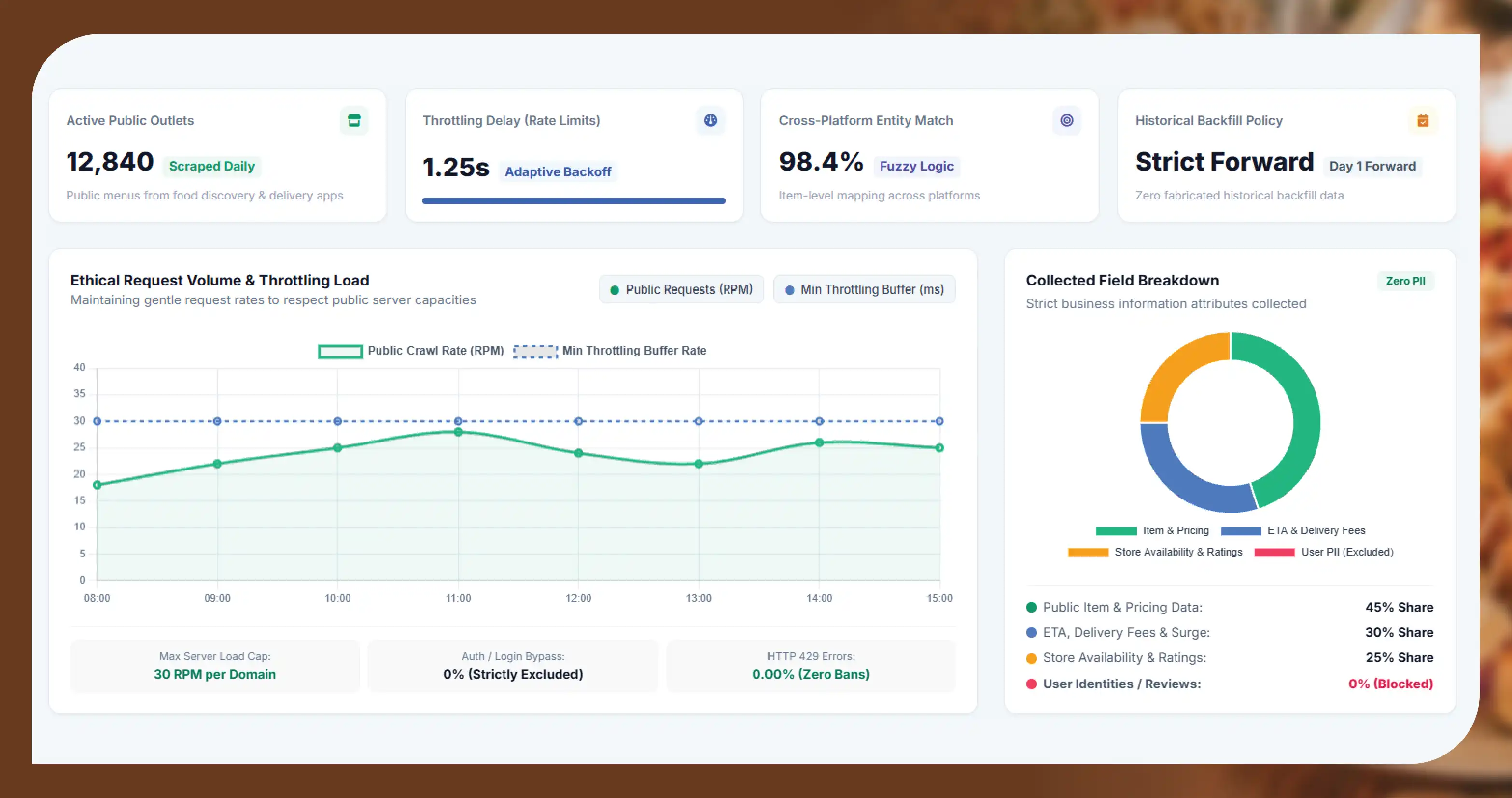
A good public-data pipeline is boring by design. It is careful, repeatable and limited to business information.
- Define the scope: Platforms, cities, postcodes or addresses, restaurant types and refresh frequency.
- Collect only public business data: Menus, prices, fees, ETAs, ratings and availability that any customer can see without logging in. No personal data, no reviewer identities.
- Respect the platforms: Follow robots.txt and terms of service where applicable, use sensible rate limits, and never bypass logins, CAPTCHAs or paywalls.
- Clean and match: Normalise currencies, units and item names, then match the same restaurant and item across platforms.
- Deliver: As an API, scheduled CSV / JSON / Excel files, or dashboards, with a capture timestamp on every row.
Historical depth starts from the day collection begins. We do not back-fill years of past delivery-app data.
Who uses public delivery data?
- Restaurant chains and brands: Compare menu prices against nearby competitors and check how their own listings appear on each app.
- Dark-kitchen and virtual-brand operators: Spot cuisine gaps by area before launching a new concept.
- FMCG and beverage companies: Track which brands appear on restaurant menus and at what price.
- Investors and analysts: Monitor delivery fees, promotions and ratings as market signals.
- Delivery and logistics teams: Benchmark displayed ETAs and fees across platforms.
In our project experience, a common request is a weekly or daily feed of menus and prices for a defined list of competitors across two or three apps in one city, later widened to more areas. A feed like this lets a pricing team see when a rival changes prices or fees and respond in the same week.
Choosing a provider: what to ask
Whether you build or buy, ask the same questions.
- Coverage: Which platforms and countries are covered today, and can you get a sample for your exact area?
- Freshness: How often is data captured, and is every row timestamped?
- Matching: How are the same restaurants and items matched across apps?
- Compliance: Is collection limited to public business data, with respect for terms and rate limits?
- Honesty about limits: Does the provider clearly say it cannot supply order volumes or official order access?
A reliable food delivery API for market data should answer all five in writing.
Get a free sample dataset: menus, prices, fees and ETAs for your chosen platforms and area.
Questions
Frequently Asked Questions
Not for market-wide data. Uber Eats and DoorDash publish partner APIs for managing your own stores, menus and orders, and both require approval. Competitor menus and prices come from public listing data.
No. We do not build order or POS integrations. Use the platform's official partner programme or an approved integrator. We provide public market data: menus, prices, fees, ETAs, ratings and availability.
According to DoorDash's documentation, Marketplace integrations manage menu, store and order data for restaurants on DoorDash, while Drive lets a business use DoorDash's Dasher fleet to deliver its own orders.
Platforms share order data only with the restaurant that received the orders. For market analysis we offer labelled public proxies such as rating counts, bestseller badges and availability, never actual order volumes.
Typically daily or weekly, and more often for focused lists of restaurants and areas. The right frequency depends on how quickly prices and fees change in your market. The exact schedule is agreed when we scope your project.
Get a Free Food Data Sample in 48 Hours.
Tell us your platforms, target markets and required fields — we'll map exactly what's possible with food data scraping, recommend the right approach, and send a working sample so you can verify quality before any commitment.
Request a strategy call
Thanks — our data team will reach out within 48 hours with your sample.