Introduction
The food delivery industry has become one of the most competitive segments of the digital commerce ecosystem. Customers can compare restaurants, menus, delivery times, promotions, and final prices across multiple applications before deciding where to order.
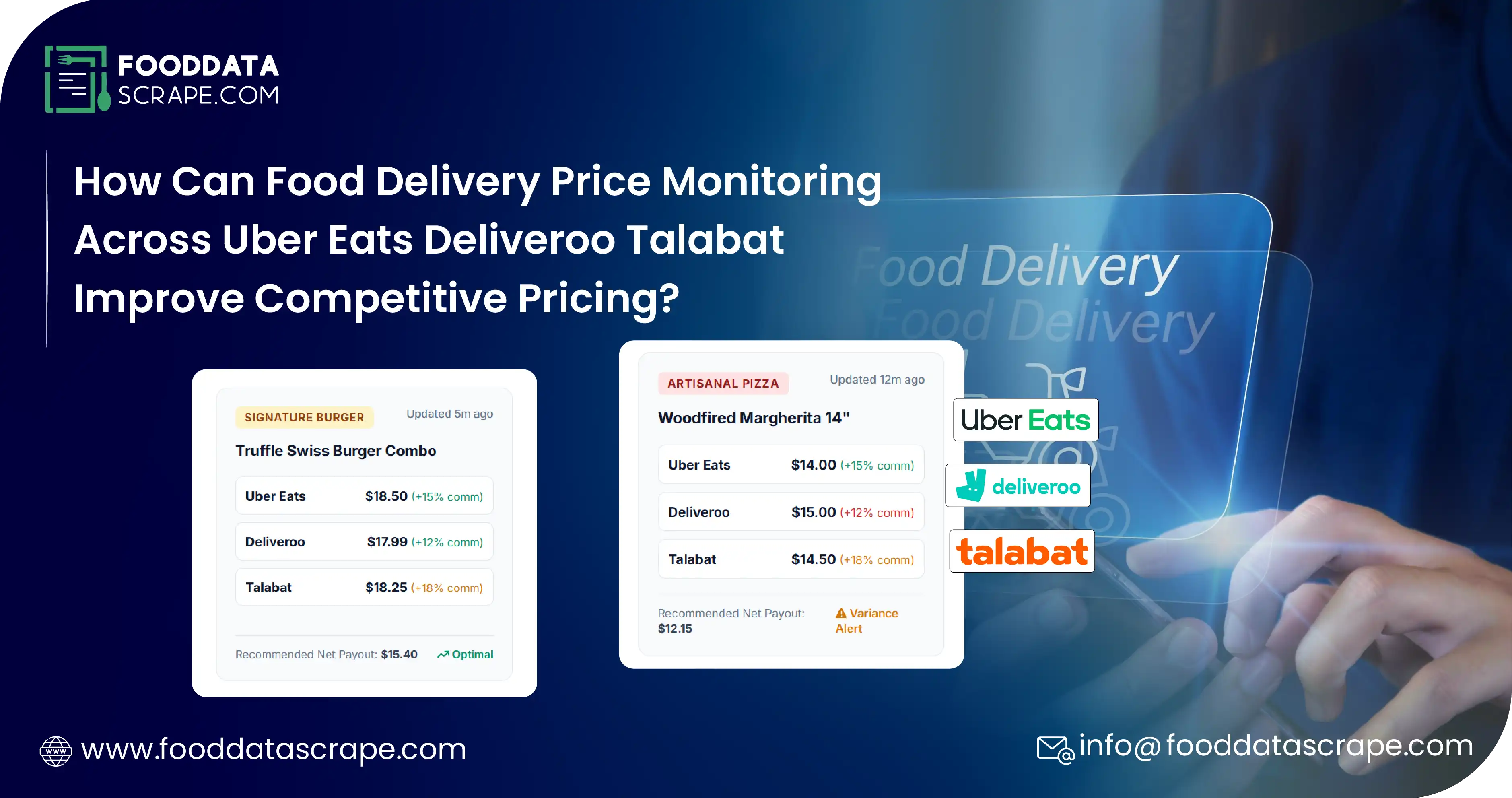
Food Delivery Price Monitoring Across Uber Eats Deliveroo Talabat gives restaurants, aggregators, market researchers, investors, and consumer brands a structured way to understand these changing market conditions.
Across different platforms, the same restaurant or menu item may appear with different prices, promotions, delivery charges, service fees, or availability. Monitoring these variations regularly can help businesses understand how competitors position themselves and how customer-facing prices change throughout the day.
Restaurant Delivery Price Tracking Across MENA is particularly valuable as food delivery competition continues to develop across markets such as Saudi Arabia, the UAE, Qatar, Kuwait, Bahrain, and other regional locations.
Businesses operating in these markets can examine restaurant-level pricing, cuisine-level trends, city-level differences, promotional activity, and delivery charges to develop a more complete view of the competitive environment.
Why Food Delivery Price Monitoring Matters?
Food delivery pricing is rarely completely static. A restaurant can change its menu prices, introduce a limited-time promotion, adjust meal bundles, or become temporarily unavailable.
At the same time, delivery platforms may modify delivery charges, promotional campaigns, subscription benefits, or customer incentives.
Food Delivery Pricing Intelligence helps businesses organize these changing observations into useful datasets that can support competitive analysis and market research.
Instead of checking individual restaurants manually, companies can establish systematic monitoring processes that collect information at predefined intervals.
This allows analysts to compare current observations with historical records and determine how prices have changed over time.
For restaurant groups, this can provide greater visibility into competitor positioning. For delivery platforms, it can support marketplace analysis. For researchers, it can provide a foundation for studying pricing behavior across different markets.
What Food Delivery Data Can Be Monitored?
A comprehensive monitoring program can capture numerous restaurant and platform attributes.
Typical data fields may include:
- Restaurant name
- Restaurant location
- Cuisine type
- Menu categories
- Menu item names
- Item descriptions
- Regular prices
- Discounted prices
- Promotional offers
- Delivery charges
- Minimum order values
- Estimated delivery times
- Restaurant ratings
- Review counts
- Restaurant availability
- Operating status
- Platform promotions
- Collection timestamps
- Geographic information
The exact fields can be customized according to the purpose of the project.
Businesses may Extract Restaurant Delivery Data from selected restaurants, locations, cuisines, and platforms to build structured competitive datasets.
Historical collection is particularly important because a single price observation provides limited context. Repeated observations can reveal whether a price is stable, seasonal, promotional, or frequently changing.
Monitoring Restaurant Menu Prices
Restaurant menus can contain dozens or even hundreds of individual products. Monitoring these menus manually becomes increasingly difficult when businesses need to track multiple restaurants across several cities.
Automated collection makes it possible to Scrape Food Delivery Menu Prices at scale and organize menu information into structured datasets.
For example, a business may track burgers, pizza, biryani, sushi, fried chicken, desserts, beverages, meal combinations, and family packs across multiple restaurant groups.
The collected information can then be compared based on product category, restaurant, location, platform, and monitoring date.
This creates a historical view of menu pricing that can help analysts identify changes that may otherwise remain difficult to observe.
Tracking Competitor Pricing
Competitive intelligence extends beyond simply comparing the price of one menu item.
Businesses need to understand the complete customer proposition offered by competing restaurants and platforms.
With the ability to Scrape Food Delivery Competitor Data, organizations can collect information about menu prices, promotions, delivery charges, ratings, availability, and estimated delivery times.
This can help businesses investigate questions such as:
- Which restaurants have the lowest prices within a cuisine?
- Which competitors frequently offer discounts?
- How often do menu prices change?
- Which restaurants maintain premium pricing?
- Which locations have higher delivery charges?
- Which cuisines show greater price variation?
- How do promotional prices compare with regular prices?
Such analysis can provide a more comprehensive picture of competitive positioning.
Track restaurant prices, menus, promotions, and competitor activity across Uber Eats, Deliveroo, and Talabat with Food Data Scrape.
Real-Time and Near-Real-Time Monitoring
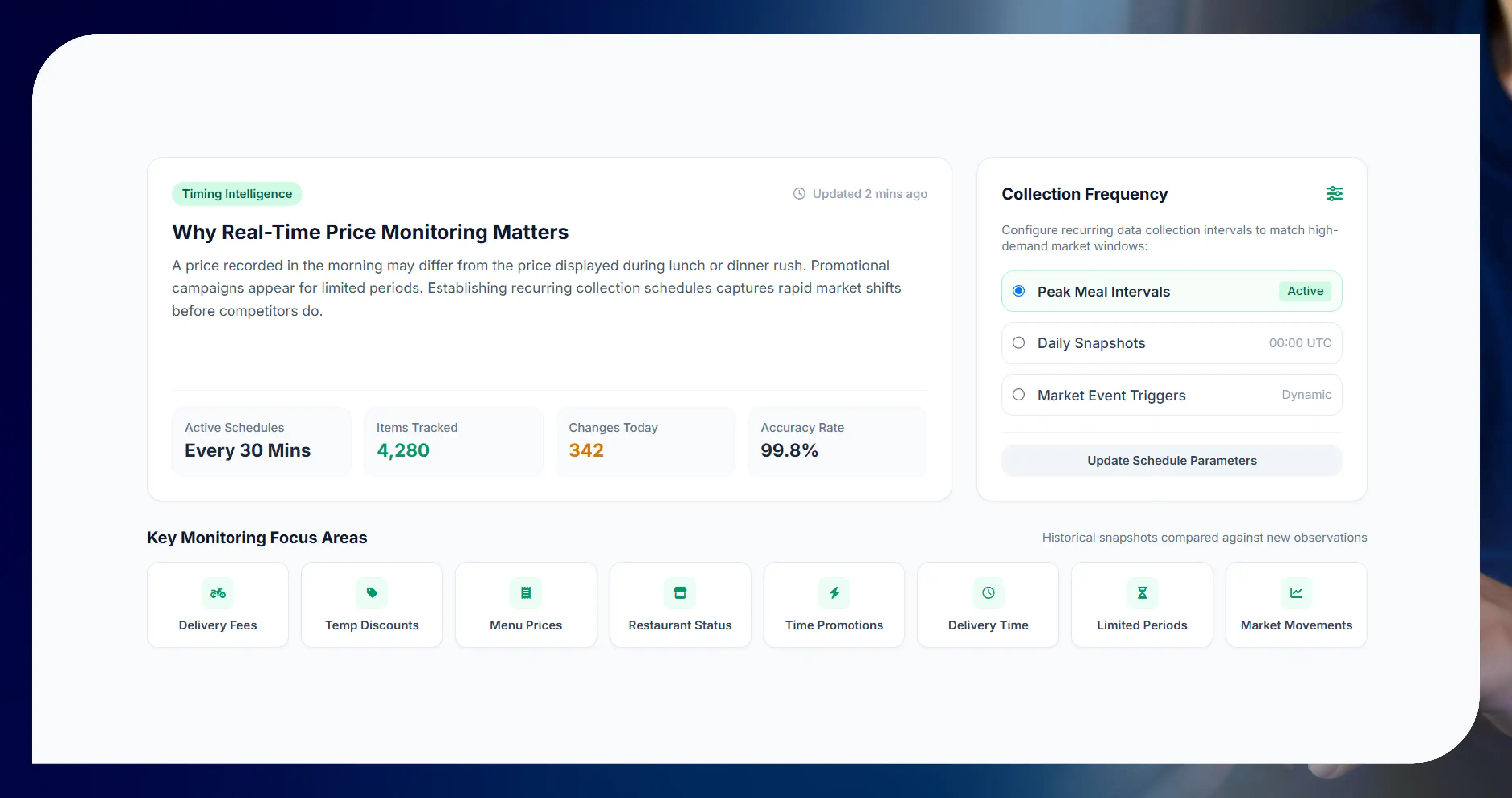
The timing of data collection can significantly affect the usefulness of pricing intelligence.
A price recorded in the morning may differ from the price displayed during lunch or dinner. Promotional campaigns may also appear for limited periods.
Real-Time Food Delivery Price Monitoring enables businesses to establish recurring data collection schedules and capture changes more frequently.
Depending on the business requirement, monitoring can occur at regular intervals throughout the day, daily, weekly, or according to specific market events.
This approach can be useful for monitoring:
- Delivery fee changes
- Temporary discounts
- Menu price changes
- Restaurant availability
- Time-sensitive promotions
- Delivery-time changes
- Limited-period campaigns
- Competitive pricing movements
Historical snapshots can then be compared against new observations to identify significant changes.
Understanding MENA Restaurant Pricing
The MENA region contains diverse restaurant markets with different consumer behaviors, operating environments, competitive structures, and delivery ecosystems.
Pricing can vary considerably between cities even when restaurants belong to the same brand.
For example, restaurants operating in Dubai and Riyadh may have different menu prices, promotional structures, delivery charges, and customer offers.
A city-level monitoring strategy can therefore provide more meaningful insights than relying only on country-level averages.
Businesses can monitor markets such as Dubai, Abu Dhabi, Riyadh, Jeddah, Doha, Kuwait City, Manama, and other selected locations.
They can then compare restaurants by cuisine, price range, delivery fee, discount frequency, and availability.
Building Structured Restaurant Datasets
Collecting large amounts of information is only useful when the data is organized consistently.
Restaurant Menu Data Scraping can help businesses create structured records containing restaurant names, locations, categories, menu items, prices, discounts, delivery information, and timestamps.
Data normalization becomes especially important when information is collected from multiple platforms.
Different platforms may use different names for the same category or product. A standardized dataset can make cross-platform comparison easier.
Businesses can store the resulting information in formats such as CSV, JSON, databases, dashboards, or API-ready structures.
Comparing Prices Across Platforms
Cross-platform price comparison should consider more than the listed menu price.
Suppose a restaurant lists the same meal at slightly different prices across two delivery applications. The difference may become much larger after accounting for delivery fees, service charges, promotions, and discounts.
A comprehensive pricing model can therefore examine:
- Menu price
- Promotional price
- Discount percentage
- Delivery charge
- Minimum order
- Service charges
- Basket-level promotions
- Final customer-facing cost
Businesses can calculate absolute and percentage differences between platforms to understand where meaningful price gaps exist.
This analysis can also be performed at restaurant, cuisine, city, and product-category levels.
API-Based Data Collection
Businesses requiring continuous access to structured food delivery information can integrate automated data pipelines with their existing analytics infrastructure.
An Uber Eats Food Delivery Scraping API can provide structured information for businesses that require platform-specific restaurant and menu intelligence.
API-based workflows can make collected information easier to connect with dashboards, business intelligence systems, internal applications, and analytical databases.
The same approach can be adapted according to geographic coverage, restaurant selection, data fields, and monitoring frequency.
Food Delivery Pricing Dashboards
Collected information becomes more useful when it can be transformed into an accessible dashboard.
A pricing intelligence dashboard may display:
- Restaurant-level prices
- Competitor price differences
- Menu price changes
- Discount trends
- Delivery charges
- Restaurant availability
- Cuisine-level averages
- City-level comparisons
- Historical price movements
- Promotional activity
Users can apply filters based on platform, restaurant, city, cuisine, category, or date.
This allows decision-makers to move from raw datasets to practical market analysis without manually reviewing thousands of individual records.
Applications Across Different Business Functions
Food delivery pricing datasets can support several business functions.
Restaurant groups can analyze their positioning against comparable restaurants.
Delivery platforms can monitor competitive marketplace behavior.
Consumer brands can understand restaurant pricing and promotional activity around specific categories.
Market researchers can evaluate pricing patterns across cities and countries.
Investors and consultants can use structured historical datasets to study restaurant market dynamics.
Marketing teams can also examine promotional intensity and identify periods when competitors increase discount activity.
Scaling Food Delivery Monitoring
Large-scale monitoring requires a consistent data architecture capable of handling multiple platforms, restaurants, cities, and collection periods.
Automated pipelines can reduce repetitive manual work and create standardized datasets at scale.
Food Data Scraping Services can help businesses design customized collection solutions based on their required platforms, locations, restaurant coverage, fields, update frequency, and output formats.
A scalable solution can also preserve historical observations, allowing businesses to analyze pricing trends over weeks or months.
This historical perspective can reveal recurring promotional cycles, seasonal changes, pricing volatility, and longer-term competitive movements.
How Food Data Scrape Can Help You?
1. Continuous Competitive Monitoring
Food Data Scrape can collect restaurant pricing, promotions, delivery charges, menus, and availability at scheduled intervals, helping businesses maintain updated competitive intelligence across selected markets.
2. Multi-Market Restaurant Analysis
Businesses can monitor restaurants across cities and countries, enabling comparisons of menu prices, cuisine categories, delivery costs, promotions, availability, and competitive positioning.
3. Structured Menu Datasets
Food Data Scrape can organize restaurant menus into standardized datasets, making it easier to analyze products, categories, prices, restaurants, locations, and historical changes.
4. Automated Price Change Detection
Recurring data collection can help identify pricing movements, promotional adjustments, delivery-fee changes, availability shifts, and other important signals without relying exclusively on manual checks.
5. Customized Data Solutions
Businesses can receive structured datasets through customized workflows based on their preferred platforms, geographic coverage, monitoring schedules, required fields, output formats, and analytical objectives.
Conclusion
The food delivery ecosystem is constantly changing, making continuous competitive monitoring increasingly important for restaurants, aggregators, researchers, and other businesses operating in digital food commerce.
Real-Time Price Monitoring provides businesses with a structured approach to observing changing customer-facing prices and competitive activity.
Historical datasets can help organizations understand price movements, promotional cycles, delivery charges, menu changes, and restaurant availability.
For businesses operating across multiple platforms, automated data collection can make cross-platform analysis more scalable and consistent.
Deliveroo Food Delivery Scraping API can support structured delivery-platform data workflows for businesses monitoring restaurant and menu information.
Talabat Food Delivery Scraping API can similarly support customized data collection requirements across selected restaurants, locations, and categories.
Advanced analytics can further transform collected information into actionable market signals.
AI Restaurant Intelligence can combine structured restaurant datasets with analytical models to identify pricing patterns, competitive movements, menu trends, anomalies, and emerging opportunities.
Ultimately, food delivery price monitoring is not simply about checking whether one restaurant is more expensive than another. It is about building a continuously updated understanding of the digital food marketplace and converting fragmented platform information into structured intelligence for business analysis.
If you are seeking for a reliable data scraping services, Food Data Scrape is at your service. We hold prominence in Food Data Aggregator and Mobile Restaurant App Scraping with impeccable data analysis for strategic decision-making.
Get a Free Food Data Sample in 48 Hours.
Tell us your platforms, target markets and required fields — we'll map exactly what's possible with food data scraping, recommend the right approach, and send a working sample so you can verify quality before any commitment.
Request a strategy call
Thanks — our data team will reach out within 48 hours with your sample.