Introduction
Should you build a food delivery scraper or buy the data? Build when delivery-app data is core to your product, you need a handful of platforms and you have engineers to maintain it every week. Buy a managed API, feed or dataset when you need many platforms, countries or addresses quickly and want maintenance, QA and matching handled for you.
That is the short answer. The longer one depends on how many platforms you track, how often you need fresh menus and prices, and who fixes things when an app changes its layout at 2 a.m.
This guide gives data, engineering and product teams at restaurant-tech, CPG and analytics firms a decision matrix, a list of hidden costs, a total cost of ownership worksheet and the compliance line you should not cross — with examples from the US, UK, UAE and India.
What are the four ways to get delivery-app data?
Most teams choose between four routes. Each one moves a different share of the work — and the risk — off your team.
- In-house scraper. Your engineers write, host and maintain the collectors.
- Open-source or marketplace actor. You run a pre-built script or a third-party "actor" on someone else's platform and still own configuration and QA.
- Managed data API. A provider runs the collection and you call an endpoint for fresh records on demand.
- Ready dataset or scheduled feed. You receive files (CSV, JSON, Parquet) on a fixed cadence, with no code on your side.
| Criteria | In-house scraper | Open-source / marketplace actor | Managed data API | Ready dataset / feed |
|---|---|---|---|---|
| Time to first data | Weeks to months | Days | Days (after scoping) | Days (sample first) |
| Upfront engineering | High | Medium | Low | None |
| Ongoing maintenance | Your team, every app change | Shared – you fix config, author fixes script | Provider | Provider |
| Control over fields and logic | Full | Limited to what the script exposes | High – agreed schema | Agreed schema, fixed cadence |
| Geo coverage by address / pin code | You build and run it | Varies by actor | Provider runs agreed locations | Agreed locations per drop |
| Freshness | Whatever you schedule | Whatever you schedule | On demand or near real time | Daily / weekly / monthly |
| QA and cross-platform matching | You build it | Usually not included | Usually included – confirm | Usually included – confirm |
| Compliance review | Your legal team, per source | Your legal team, per source | Shared – ask for the provider's policy | Shared – ask for the provider's policy |
| Best fit | Core product data, few sources | Prototypes, one-off pulls | Apps and pricing engines | BI, research, model training |
What does an in-house food delivery scraper really cost to run?
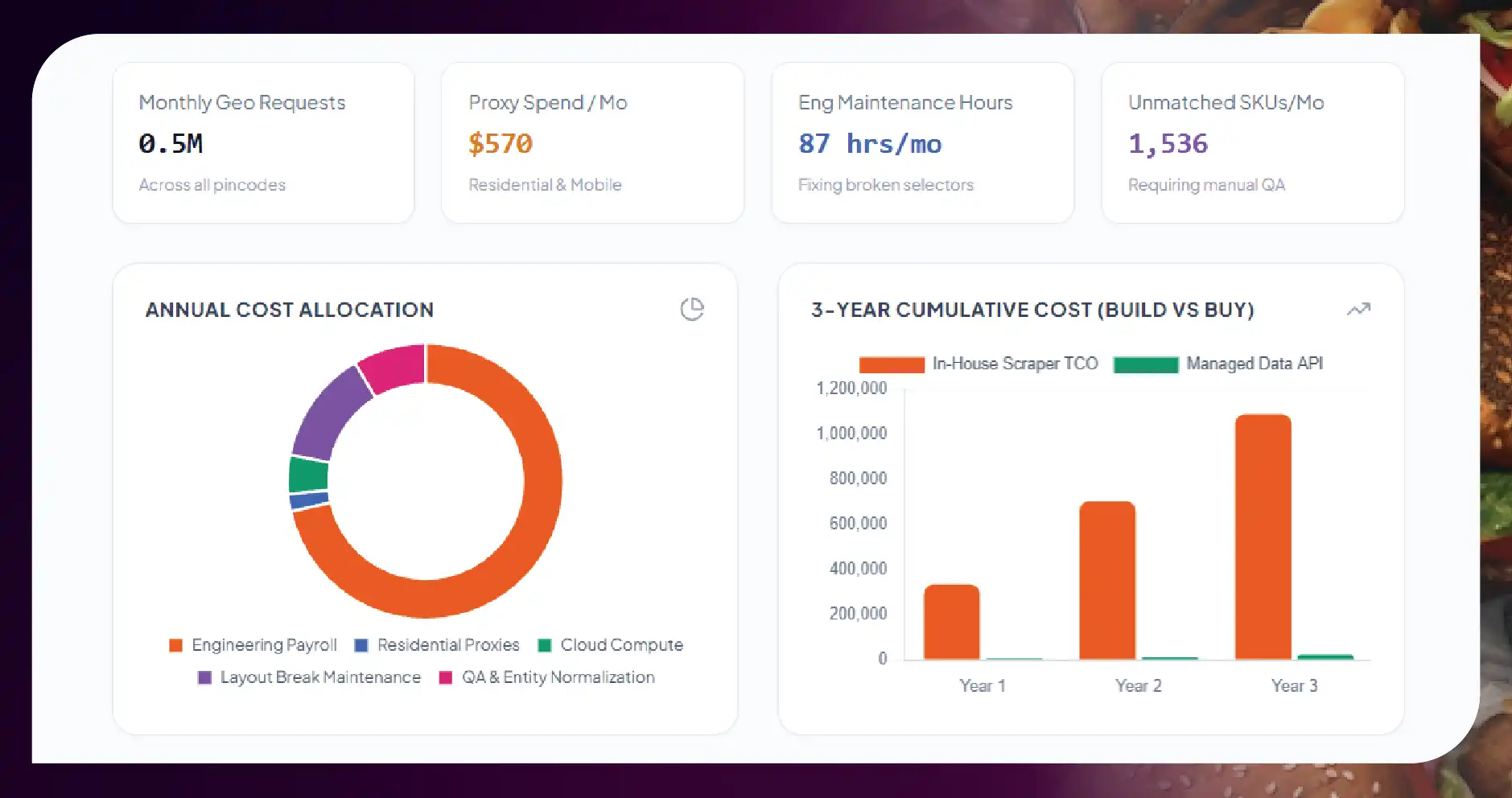
The first version of a scraper is the cheap part. The expense sits in keeping it right, every week, for every platform and city you promised the business.
- Maintenance when apps change. Delivery apps update layouts, endpoints and menu structures often. Each change can silently break fields such as modifiers, add-ons or discount labels.
- Geo coverage by address. Menus, prices, fees and availability on Uber Eats, DoorDash, Talabat or Swiggy depend on the delivery address. Covering a city means choosing and rotating many sample addresses or pin codes, not one storefront URL.
- Infrastructure and proxies. Hosting, scheduling, storage and location-appropriate network access all add recurring cost and need monitoring.
- Quality assurance. Someone has to catch empty menus, duplicated items, currency errors and stale prices before they reach a dashboard.
- Matching and normalisation. The same restaurant or SKU appears under different names on each app. Entity matching across platforms is often the hardest engineering problem in the whole project.
- Legal and compliance review. Each new platform and country means reading terms of service, checking robots.txt and documenting what you collect and why.
- Key-person risk. If the one engineer who understands the collectors leaves, the pipeline often degrades quietly.
A total cost of ownership worksheet you can fill in
Use this worksheet to compare a 12-month food delivery scraper build against a 12-month subscription. We have left every figure as a placeholder: plug in your own salaries, cloud bills and vendor quotes rather than relying on generic industry numbers.
| Cost line (12 months) | Build in-house | Buy managed API / feed | How to estimate |
|---|---|---|---|
| Initial build (engineer time) | Your estimate | Setup fee, if any, per vendor quote | Engineer days × loaded day rate |
| Ongoing maintenance | Your estimate | Included – check the vendor quote | Hours per month fixing breakages × rate |
| Hosting, scheduling, storage | Your cloud estimate | Included – check the vendor quote | Current cloud bill for similar jobs |
| Network access / proxies | Your estimate | Included – check the vendor quote | Requests per month × unit cost |
| QA and monitoring | Your estimate | Ask which QA checks are included | Analyst hours per week |
| Matching and normalisation | Your estimate | Per vendor quote | One-off build + monthly upkeep |
| Legal / compliance review | Your legal estimate | Time to review the vendor's terms | Hours per platform and country |
| Data subscription | Not applicable | Per vendor quote | Monthly fee × 12 |
| Opportunity cost | Your estimate | Lower – your estimate | Roadmap work delayed by the build |
| Total | Sum of the rows above | Sum of the rows above | Compare, then add a risk buffer |
Two tips. Count maintenance honestly — teams often budget for the build and forget the weekly fixes. And compare like for like: the same platforms, the same cities, the same refresh rate.
When does building your own scraper make sense?
Building is the right call in a narrower set of cases than most teams expect — but those cases are real.
- The data is your product. If menu or price intelligence is what you sell, owning the collection logic can be a competitive asset.
- Scope is small and stable. One or two platforms, a few cities, weekly refreshes — a lean food delivery scraper can be maintained by a small team.
- You need unusual logic. Custom crawl paths, niche fields or tight coupling with internal systems can be easier to build than to specify.
- You already run scraping infrastructure. If monitoring, scheduling and legal review already exist for other sources, the marginal cost is lower.
- You are prototyping. A quick script or marketplace actor is fine for testing whether the data is useful before committing budget.
When does buying a managed feed make sense?
Buying wins when breadth, speed and reliability matter more than owning the code of a food delivery scraper.
- Many platforms or countries. Tracking Uber Eats and DoorDash in the US, Deliveroo and Just Eat in the UK, Talabat in the UAE and Swiggy and Zomato in India multiplies maintenance.
- Address-level coverage. Price and availability by neighbourhood or pin code needs disciplined location sampling that providers already run.
- Matched outputs. If you need one row per restaurant or product across apps, buying the matching saves months.
- Downstream deadlines. BI dashboards, pricing models and retraining jobs need data on time — a scheduled data feed with an agreed cadence fits that better than a fragile in-house job.
- Engineers are scarce. If your team should be shipping product, a food data scraping API or a ready-made dataset keeps them focused.
Many teams land on a hybrid: buy broad coverage, then build a thin layer for one or two sources that are truly unique to them.
Official partner APIs vs public menu data: where the compliance line sits
A common confusion in first conversations is the idea that delivery platforms offer an open "data API" for market research. In practice, the official APIs serve merchants and their integration partners.
- Uber Eats. Uber's developer documentation says the Eats Marketplace APIs let partners manage stores, menus and orders, that access may require written approval, and that partners act with the merchant's authorisation.
- DoorDash. DoorDash's Marketplace documentation describes the integration as covering menu, store and order data for restaurant businesses, states it is not open-access and that participation is by approval only.
- Talabat, Swiggy, Zomato and others. Treat any partner tooling as merchant-side only and check each platform's own partner documentation. Swiggy and Zomato order integration into a POS or third-party system is not something we offer.
So an official partner API is the right tool for managing your own restaurant's listings. Market-wide intelligence — competitor menus, prices, fees, ratings and availability — comes from publicly visible listing data.
Whether you build or buy, the same ground rules apply:
- Public business data only. Restaurant names, menus, prices, fees, ratings and review counts — never customer or courier personal data, and nothing behind a login.
- Respect terms and robots.txt. Read each platform's terms of service and honour the Robots Exclusion Protocol (RFC 9309).
- Rate limits. Collect at a pace that does not burden the platform.
- No security bypass. No working around CAPTCHAs, paywalls or access controls.
- Sales volumes are not public. Order counts are not visible on delivery apps. Use labelled proxies such as rating counts, review counts, bestseller badges and search rank.
Seven questions to put to a data vendor before a pilot
If you lean towards buying, these questions separate a reliable partner from a risky one.
- Which platforms, countries and locations are in scope? Ask for the exact address or pin-code sampling method.
- What is the schema? Request field names, types and a sample file before you sign.
- How fresh is the data? Confirm cadence and the timestamp on each record.
- How is quality checked? Ask what happens when a platform changes and how fast breakages are fixed.
- How are restaurants and items matched across apps? Ask for match keys and how uncertain matches are flagged.
- What is your compliance policy? Ask how they handle terms of service, robots.txt, rate limits and personal data.
- How is data delivered? API, webhooks, S3, Snowflake, BigQuery or SFTP — and who owns the integration work.
Write a one-page spec before you ask for a sample
Our inquiries show a pattern: first-time buyers often ask for "a sample" before deciding what they need. A sample without a spec rarely answers the build-vs-buy question. Spend 30 minutes on these five lines first:
| Spec line | Example entry |
|---|---|
| Platforms | Uber Eats and DoorDash (US); Talabat (UAE) |
| Locations | 20 delivery addresses in Dallas; 10 areas in Dubai |
| Fields | restaurant_name, item_name, item_price, delivery_fee, rating, review_count, availability, captured_at |
| Cadence | Daily menu and price snapshot; weekly full refresh |
| Delivery | CSV to S3, or a JSON API for the pricing engine |
With that spec, any provider — or your own engineers — can quote realistically, and your TCO worksheet compares like with like. If you need data from app-only sources, mention it: mobile app data collection changes both scope and effort.
Get a free sample dataset. Send us your one-page spec (platforms, locations, fields, cadence) and we will return a sample for your build-vs-buy comparison, covering countries. We aim to send it within business days.
Questions
Frequently Asked Questions
Collecting publicly visible business data such as menus and prices is common, but rules differ by country and platform. Review each site's terms, respect robots.txt and rate limits, avoid personal data and logins, and take legal advice for your use case.
No. Their official developer APIs are for approved partners managing merchants' own stores, menus and orders. Market-level competitor data comes from public listing pages instead.
A prototype for one platform can take days; a production pipeline with address coverage, QA and matching usually takes much longer. The ongoing maintenance matters more than the build time.
An API returns fresh records when your system calls it. A dataset or scheduled feed delivers files on a fixed cadence. Apps and pricing engines usually prefer APIs; BI and research teams often prefer files.
No. Order volumes are not public. Providers can supply clearly labelled proxies such as review counts, rating counts, bestseller badges and search rank.
Get a Free Food Data Sample in 48 Hours.
Tell us your platforms, target markets and required fields — we'll map exactly what's possible with food data scraping, recommend the right approach, and send a working sample so you can verify quality before any commitment.
Request a strategy call
Thanks — our data team will reach out within 48 hours with your sample.