Introduction
Natasha's Law did not introduce a new idea. It closed a gap that had been visible, and fatal, for years.
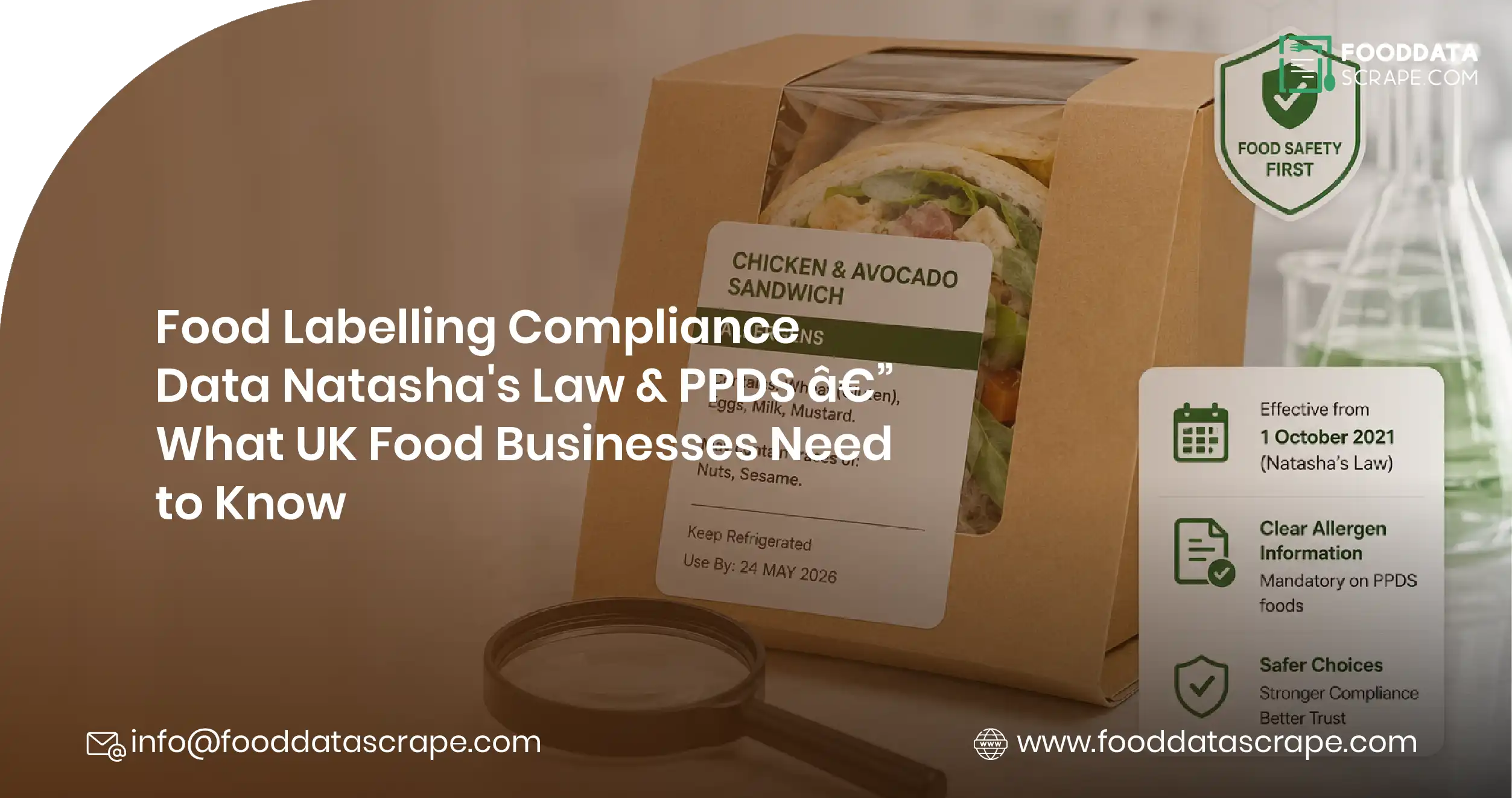
Prepacked for Direct Sale — PPDS — describes food that is packaged on the same premises from which it is sold, before the customer orders it. The sandwich made in the back of the café and placed in the chiller. The salad box assembled that morning. The pastry bagged and put on the counter. Before the law changed, this category could be sold without a full ingredient list, because it was neither made-to-order nor prepacked by a manufacturer elsewhere.
The consequence of that gap was the death of a teenager who ate a baguette she had no way of knowing contained the allergen that killed her.
Since October 2021, PPDS food sold in Great Britain must carry the name of the food and a full ingredients list, with the fourteen regulated allergens emphasised within it. It is not a labelling suggestion. It is a legal requirement enforced by local authorities, and non-compliance carries prosecution risk, business closure risk, and the risk that sits behind every allergen failure — that somebody dies.
For a single café with twelve products, compliance is a laminated sheet and an afternoon's work. For a bakery chain with 300 sites, a supermarket with an in-store food-to-go counter in every store, a contract caterer running hundreds of kitchens, or a franchise network where each unit prepares its own food — it is a data problem, and it is not being solved with laminated sheets.
Food Labelling Compliance Data is how it gets solved at scale. At FoodDataScrape , we crawl 220M+ pages of food data every week, including product listings, ingredient declarations and allergen statements across UK retailers, restaurant groups and food-to-go operators. This article explains what PPDS actually requires, where multi-site businesses fail, and what a data-driven allergen tracking strategy looks like.
What PPDS Actually Requires
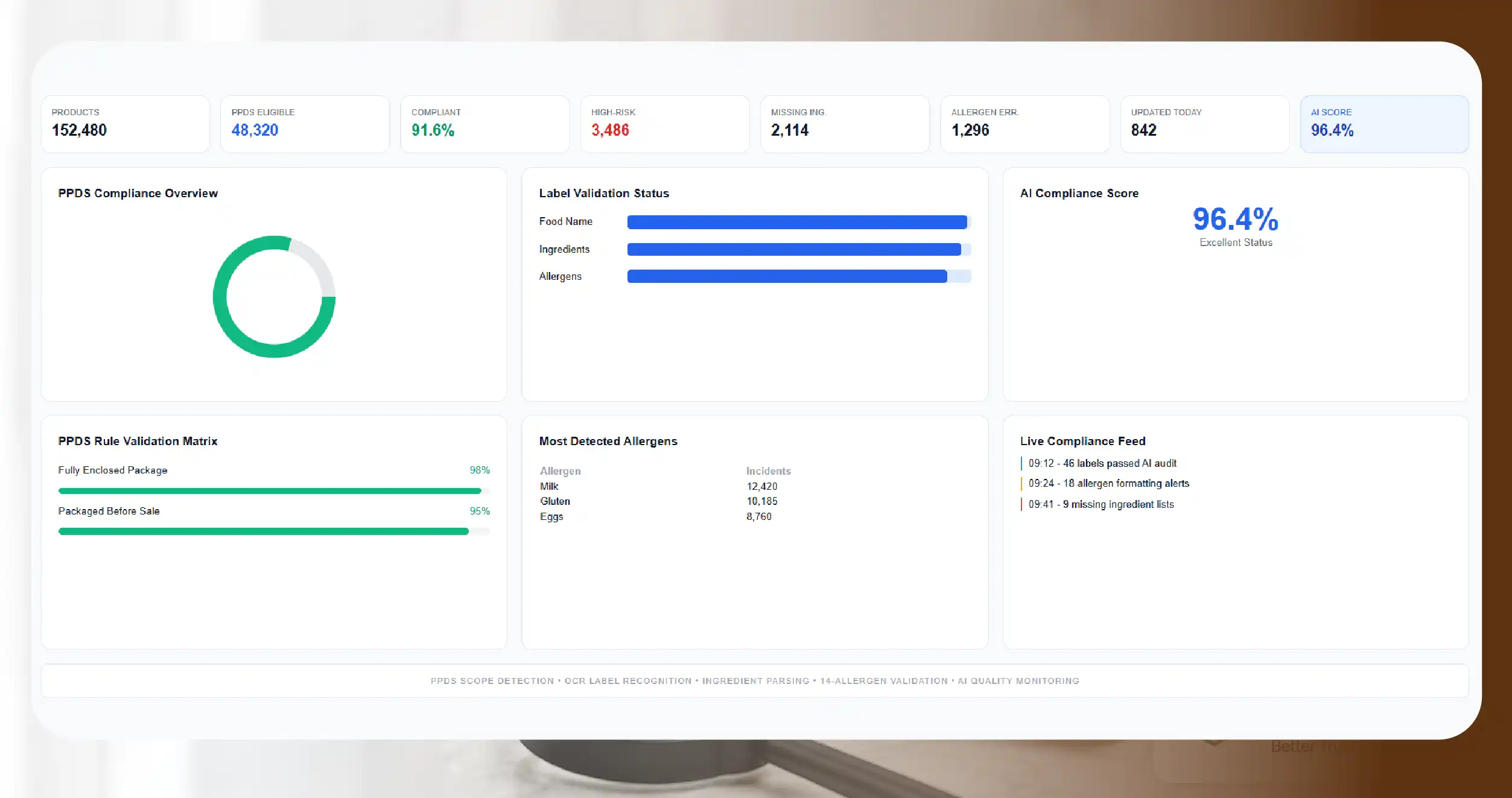
The scope test is deceptively simple and frequently misapplied. Food falls into PPDS when it is:
- Fully or partly enclosed by packaging, and
- Packaged before being ordered by the consumer, and
- Sold at the same premises where it was packaged.
If all three are true, full ingredient labelling applies.
The label must carry the name of the food and a full list of ingredients , in descending order of weight, with the fourteen regulated allergens emphasised within that list — typically in bold, but the emphasis must make them stand out from the surrounding text.
The fourteen allergens are: celery, cereals containing gluten, crustaceans, eggs, fish, lupin, milk, molluscs, mustard, tree nuts, peanuts, sesame, soybeans, and sulphur dioxide and sulphites above the specified threshold.
Where businesses get the scope wrong:
- Made-to-order food is not PPDS. A sandwich assembled after the customer orders it is not caught. But if a batch is made in the morning and placed in the chiller, it is.
- A "may contain" statement is not an ingredients list. Precautionary allergen labelling is a separate matter and does not satisfy the PPDS requirement.
- A QR code alone is not sufficient. The information must be on the packaging or on a label attached to it.
- Distance selling and delivery have their own requirements , and food-to-go operators selling through delivery platforms need to address both.
The scope errors are where enforcement finds businesses. Not because they refused to comply, but because they concluded — incorrectly — that a product was out of scope.
Why Multi-Site Businesses Fail at This
The failure is never a lack of intent. It is a lack of data control across four dimensions.
Recipe drift Head office publishes a recipe. Site 47 substitutes an ingredient because the delivery was short. The label still says what head office published. This is the single most common allergen incident vector in multi-site food businesses.
Supplier reformulation A supplier changes a formulation — adds a new emulsifier, changes a stock base, switches an oil — and notifies you in a document that reaches procurement and never reaches the labelling team. Every downstream label is now wrong.
Label version control Labels are printed locally. Three sites are printing from a superseded recipe version. Nobody knows which three.
Menu velocity Seasonal items, LTOs and trial products launch faster than the labelling process can validate them. The commercial team ships; compliance catches up afterwards, if at all.
Every one of these is a data lineage problem the chain from supplier specification, through recipe, to product, to printed label, is broken somewhere, and nobody can see where.
Sample Data: A PPDS Compliance Audit Record
The structure below reflects a FoodDataScrape UK labelling compliance extract. Values are illustrative.
{
  "record_id": "FDS-UK-PPDS-018443",
  "business_name": "Example Bakery Group",
  "site_id": "SITE-047",
  "site_location": "Manchester — Deansgate",
  "product_name": "Chicken & Bacon Club Sandwich",
  "ppds_in_scope": true,
  "scope_reason": "Packaged on premises before customer order",
  "ingredients_list_present": true,
  "ingredients_list_complete": true,
  "allergens_declared": ["Cereals containing gluten", "Milk", "Eggs", "Mustard"],
  "allergens_emphasised": true,
  "emphasis_method": "Bold",
  "allergens_detected_in_recipe": ["Cereals containing gluten", "Milk", "Eggs", "Mustard", "Sulphur dioxide"],
  "discrepancy_detected": true,
  "discrepancy_detail": "Sulphur dioxide present in cured bacon component but not declared on label",
  "compliance_status": "NON-COMPLIANT",
  "severity": "HIGH",
  "action_required": "Immediate label reprint and product withdrawal from sale"
}
Look carefully at what this record does.allergens_declared— what the label says.allergens_detected_in_recipe— what the ingredients actually contain, reconstructed from supplier specifications. The two lists do not match.
Sulphur dioxide is present in the cured bacon and is not on the label. That is not a paperwork failure. That is a product on a shelf, right now, that could seriously harm a sulphite-sensitive customer who read the label and reasonably believed it was safe.
The entire value of allergen compliance data sits in that one comparison: what the label claims, versus what the recipe contains. No manual process reliably performs that comparison across thousands of products and hundreds of sites. Data does it every day.
Sample Data: Multi-Site Compliance Dashboard
| Site | PPDS Products | Compliant | Discrepancies | Missing Labels | Risk Score |
|---|---|---|---|---|---|
| SITE-012 — London Bridge | 34 | 34 | 0 | 0 | Low |
| SITE-047 — Manchester | 31 | 27 | 3 | 1 | High |
| SITE-089 — Birmingham | 29 | 28 | 1 | 0 | Medium |
| SITE-104 — Leeds | 33 | 33 | 0 | 0 | Low |
| SITE-156 — Bristol | 30 | 24 | 4 | 2 | Critical |
| SITE-201 — Glasgow | 32 | 31 | 1 | 0 | Medium |
Two sites carry the overwhelming majority of the group's exposure. Without this view, a compliance team audits sites in alphabetical order or by geography and finds the problem — if at all — by chance. With it, they drive to Bristol on Monday morning.
That is the difference between compliance as a paperwork exercise and compliance as risk management.
Sample Data: Supplier Reformulation Alert
| Ingredient | Supplier | Previous Spec | Current Spec | New Allergen | Products Affected | Labels to Update |
|---|---|---|---|---|---|---|
| Brioche Bun | Supplier A | No sesame | Sesame seeds added | Sesame | 14 | 412 across 118 sites |
| Mayonnaise Base | Supplier B | Egg, mustard | Egg, mustard | None | 22 | 0 |
| Cured Bacon | Supplier C | No sulphites declared | Sulphur dioxide | Sulphur dioxide | 9 | 267 across 94 sites |
| Stock Base | Supplier D | Celery | Celery removed | None (removal) | 18 | 340 (optional update) |
The brioche bun row is a genuine emergency. A supplier has added sesame to a bun used in fourteen products across 118 sites, and 412 printed labels are now wrong. Sesame is a severe allergen. Without automated supplier specification monitoring, this is discovered when a customer has a reaction.
This table is the single most valuable output in the entire dataset. It converts an invisible, silent, potentially fatal change into a work order with a number attached.
What Enforcement Actually Looks For
Understanding how local authorities assess PPDS compliance tells you where to point your data.
Is the product correctly scoped? The first question is whether the business has correctly identified which of its products are PPDS. Businesses that have under-scoped — deciding a chilled sandwich is out of scope because it is "made fresh" — fail here immediately, before any label is even examined.
Is the ingredients list complete and in descending weight order? A partial list is a non-compliant list. So is a list assembled from a recipe that no longer matches what the kitchen makes.
Are the fourteen allergens emphasised? Presence in the list is not enough. The emphasis must genuinely make the allergen stand out — the same font, same weight, same colour as the surrounding text is a failure even if the allergen is technically declared.
Does the label match the product? This is the one that catches multi-site businesses. The label is compliant, well-formatted and correctly emphasised — and describes a recipe that Site 47 stopped making three months ago.
Is there a documented system? Enforcement officers assess process, not just artefacts. A business that can demonstrate a controlled, monitored, evidenced labelling system is treated very differently from one that produces a correct label and cannot explain how it got there.
That last point is why compliance data has value beyond catching errors. The audit trail itself is the defence. A business that can show a continuous, dated record of label-versus-recipe verification across every site is demonstrating exactly the due diligence that enforcement is looking for — and that a court would look for if the worst happened.
Who Uses Food Labelling Compliance Data
Bakery, café and food-to-go chains. Monitor PPDS compliance across every site continuously rather than through periodic audits that sample a fraction of the estate.
Supermarkets and convenience retailers with in-store food preparation, counters or food-to-go ranges.
Contract caterers and hospitality groups running large numbers of kitchens under a single legal entity and a single liability.
Franchise networks , where the franchisor carries brand and often legal exposure for franchisee labelling failures they cannot directly observe.
Food manufacturers supplying into PPDS operators, who need to know that their specification changes are reaching their customers' labelling teams.
Delivery platforms and marketplaces displaying allergen information supplied by restaurant partners.
Local authority enforcement teams and consultants conducting compliance assessments at scale.
Insurers and diligence teams quantifying allergen liability exposure in a food business.
The FoodDataScrape UK Labelling Compliance Data Model
- Business and site: business name, site identifier, location, estate structure, franchise status
- Product: product name, product category, preparation method, PPDS scope determination and reason
- Recipe and ingredients: component breakdown, supplier-linked ingredient specifications, full ingredient declaration, descending weight order validation
- Allergen intelligence: allergens present in recipe, allergens declared on label, emphasis method and adequacy, discrepancy detection, precautionary statement usage
- Label conformance: ingredients list presence, completeness, format conformance, name-of-food presence
- Supplier monitoring: supplier specification tracking, reformulation detection, downstream product impact mapping
- Compliance status: computed status, severity tier, specific non-conformance, required action, affected label count
- Change tracking: new products, recipe changes, supplier changes, label version history
Delivered as API, CSV, JSON, direct integration into recipe management, PLM or labelling systems.
Methodology and Compliance
- We collect publicly accessible product, ingredient and allergen information as published by businesses and their suppliers. No authenticated content, no private data, no personal consumer data.
- This is a monitoring and risk-surfacing layer, not a substitute for legal advice or for a business's own allergen management system. Final responsibility for PPDS compliance rests with the food business operator, and nothing in this dataset displaces that.
- Discrepancy detection is evidence-based and traceable — every flag shows the label declaration and the recipe-derived allergen list side by side, so a compliance officer can verify rather than trust.
- Ingredient names are normalised against a controlled taxonomy so that varied supplier terminology resolves to the correct regulated allergen.
- Crawlers are rate-limited and designed not to degrade the sites we collect from.
Measurable Outcomes
| Metric | Manual Compliance | With FoodDataScrape |
|---|---|---|
| Estate audit coverage | Sampled sites, periodic | Every site, continuous |
| Label-vs-recipe discrepancy detection | Rare, incidental | Systematic, daily |
| Supplier reformulation lead time | Discovered after incident | Flagged on specification change |
| Time to identify affected labels | Days of manual tracing | Immediate, with counts |
| Site risk prioritisation | Not possible | Ranked by exposure |
| Enforcement readiness | Reactive | Evidenced and documented |
Conclusion
Natasha's Law exists because a labelling gap killed someone. The businesses that comply properly are not the ones with the best intentions — every food business has good intentions. They are the ones who can actually see, across every site and every product, whether the label matches the recipe today.
At one site, you can check that by hand. At three hundred, you cannot. And the gap between what you believe your labels say and what they actually say is where the incident happens.
Food Labelling Compliance Data closes that gap — continuously, across the whole estate, with supplier changes flagged before they reach a printed label.
FoodDataScrape crawls 220M+ pages of food data every week so that no product on your shelf is telling a customer something that is not true.
Questions
Frequently Asked Questions
No. Compliance is your legal responsibility as the food business operator. This dataset ensures you can see your compliance position across your entire estate, which is the prerequisite for managing it. It does not replace your allergen management system, your staff training or professional legal advice.
No. Food assembled after the customer orders it falls outside PPDS. But the scope test is where businesses most often get it wrong, and the dataset records the scope determination and its reason for every product so it can be reviewed.
Requirements differ across the UK nations. Coverage is scoped to the jurisdictions you operate in.
Yes — and this is the highest-value function of the entire system. Supplier changes are the leading cause of silent label failures.
Weekly by default, with supplier specification monitoring on a continuous basis given the severity of the risk.
Yes — API, database push or direct integration with common PLM and recipe platforms.
Get a Free Food Data Sample in 48 Hours.
Tell us your platforms, target markets and required fields — we'll map exactly what's possible with food data scraping, recommend the right approach, and send a working sample so you can verify quality before any commitment.
Request a strategy call
Thanks — our data team will reach out within 48 hours with your sample.