Introduction
A food supplier database for Australia is a structured list of farms, wineries and food processors. Each record holds business-level facts such as ABN, entity type, farming type, products, postcode, state and certifications. You build one by joining ABN Lookup data with public directories and company websites, then cleaning and coding each record by ANZSIC class.
Demand for a food supplier database is rising. Distributors want local growers, packaged-food brands want regional ingredients, and equipment sellers want to reach dairies and packing sheds. Most off-the-shelf lists, however, are thin on the fields that matter: what a farm actually grows, where it is, and whether it is certified.
This guide explains who uses a food supplier database, which public sources to use, the fields to capture, how to clean and classify the data, and where the legal lines sit under Australian privacy and spam law.
Who uses a food supplier database in Australia?
Food supplier database users fall into two groups: buyers who want to source from producers, and sellers who want to sell to them.
- Foodservice distributors: find regional growers and processors to add local lines for restaurants, cafes and caterers.
- Packaged-food and beverage brands: source local dairy, fruit, grain or meat, and check a supplier's certifications before a first call.
- Ag-input and equipment suppliers: map dairies, poultry sheds, orchards and vineyards by postcode to plan sales territories for feed, packaging, refrigeration or water treatment.
- Wine and beverage buyers: shortlist wineries and cellar doors by region, variety and scale.
- Organic and specialty-diet retailers: filter for certified-organic, free-range or allergen-aware producers.
- Researchers and regional bodies: measure the producer base in a shire or LGA.
The market is large. The Australian Bureau of Statistics counted 170,185 actively trading businesses in Agriculture, Forestry and Fishing at 30 June 2026, down 0.5% on the year and the only industry to shrink (ABS, Counts of Australian Businesses, Jul 2022 – Jun 2026). Not all of those are food producers, which is why classification matters.
The public sources that matter and how they differ
No single source gives you a complete food supplier database. Each one fills a different gap.
| Source | What it gives you | Strengths | Limits |
|---|---|---|---|
| ABN Bulk Extract (data.gov.au) | ABN, status, entity type, legal and business names, state and postcode, GST status | Official, national, open licence (CC BY 3.0 AU) | No products, no farming type, no street address |
| ABN Lookup web services | Same register data, queried record by record | Good for checking ABN status and GST | Governed by an agreement; withdrawn records must be deleted |
| State agriculture and regional directories | Producer and processor listings by region | Often list products and locality | Format and coverage vary by state and shire |
| Wine and winery directories | Winery name, region, cellar door, varieties | Strong for wine regions | Wine-only; may mix brands and producers |
| Certified-organic operator directories | Certified operators and scope | Proves certification status | Covers certified businesses only |
| Farmers' market and food-trail listings | Small producers, products, region | Finds small and new producers | Patchy, seasonal, often no ABN |
| Australian Food and Beverage Catalogue (FIAL) | Supplier profiles by product category | Export-ready suppliers | Self-listed; not every producer joins |
| Company websites | Products, certifications, farm-gate sales | Richest product detail | Unstructured; needs parsing |
| Google Maps business listings | Business category, address, website, rating | Good location and activity signal | Categories are broad; must follow platform terms |
The ABN Bulk Extract covers the core register fields, including entity type, GST status and the state and postcode of the main business location (data.gov.au). The ABN Lookup Web Services Agreement says the data is provided "as is", must not be used to imply government endorsement, and must be deleted promptly if you are told it has been withdrawn (ABR Web Services Agreement). The Australian Food and Beverage Catalogue run by FIAL is a free supplier directory for buyers (Future Food Systems).
The 13 data fields every food producer record needs
A useful food supplier database keeps the same core fields for every record, whatever the source. This is the food supplier database schema we suggest.
| Field | Description | Typical source |
|---|---|---|
| business_name | Trading or registered business name | ABN extract, website |
| abn | 11-digit Australian Business Number | ABN Lookup |
| entity_type | Company, trust, partnership, sole trader | ABN Lookup |
| gst_status | Registered or not, with date | ABN Lookup |
| farming_type | Dairy, poultry (meat/eggs), orchard, vineyard, grain, vegetables, processor | Directories, website, classified |
| products | Main products, e.g. apples, free-range eggs, shiraz | Website, directories |
| postcode | Postcode of main business location | ABN Lookup, listings |
| locality | Suburb or town | Listings, website |
| state | State or territory | ABN Lookup |
| lga | Local government area, mapped from locality and postcode | Derived |
| website | Business website URL | Listings |
| certifications | Organic, free-range, HACCP or other stated certifications | Certifier directories, website |
| source_url | Page each value came from | Pipeline log |
A few notes on these fields:
- abn is the join key. Match every directory and website record back to an ABN, so you can remove duplicates and check the business is active.
- farming_type is the hardest field. Register data does not tell you what a farm grows. You infer it from directory categories, website text and ANZSIC mapping.
- certifications need proof. Only record a certification you can see in a certifier directory or on the business's own site, and keep the source_url.
- source_url is your audit trail. It lets a buyer check any value and lets you remove records when asked.
Food producer data by state: where the businesses are
Production is not evenly spread, so plan your food supplier database by state and commodity. ABS 2024-25 horticulture figures show how concentrated some categories are (ABS, Australian Agriculture: Horticulture, 2024-25).
| State / territory | Wine grape crush 2024-25 (tonnes) | Wine grape local value 2024-25 ($m) | Avocado-producing businesses 2024-25 | Collection focus |
|---|---|---|---|---|
| New South Wales | 478,185 | 209.3 | 133 | Vineyards, horticulture, grain, poultry |
| Victoria | 277,701 | 200.6 | 44 | Dairy, orchards, vineyards, grain, processors |
| Queensland | 777 | 1.5 | 287 | Bananas, avocados, macadamias, beef processing |
| South Australia | 747,688 | 577.4 | 36 | Wineries, grain, food processing |
| Western Australia | 42,019 | 69.0 | 216 | Avocados, grain, wine |
| Tasmania | 18,764 | 73.3 | 5 | Wine, dairy, specialty produce |
| Producer records in your database | [Insert Food Data Scrape dataset value] | – | [Insert Food Data Scrape dataset value] | – |
The same release puts the local value of horticulture, including wine grapes, at $19.5 billion in 2024-25, with South Australia holding 47.8% of the national wine grape crush. For a wine-heavy list, start in South Australia. For tropical fruit, start in Queensland. For a mixed regional list like dairy, orchards and grain, Victoria is a good first state.
How to collect, clean and classify the data
A clean food supplier database comes from a repeatable pipeline, not a one-off copy and paste.
Step 1: Start from the register
Load the ABN Bulk Extract and filter to active ABNs in your target states and postcodes. This gives your food supplier database a base list with entity type and GST status already attached.
Step 2: Add producer detail from public sources
Collect public business listings from state and regional directories, winery and organic directories, food trails and company websites. Respect each site's robots.txt, terms of service and rate limits, and do not go behind logins or paywalls.
Step 3: Match records to ABNs
Match on normalised business name plus postcode, then confirm with website or address. Flag low-confidence matches for review rather than forcing a join.
Step 4: Classify with ANZSIC codes
Map each business to an ANZSIC 2006 (Revision 2.0) class so buyers can filter the food supplier database consistently (ABS ANZSIC codes and titles). Useful classes include:
- 0160 Dairy Cattle Farming
- 0171 / 0172 Poultry Farming (Meat) / (Eggs)
- 0131 Grape Growing and 0134 Apple and Pear Growing
- 0149 Other Grain Growing and 0123 Vegetable Growing (Outdoors)
- 1111 Meat Processing, 1112 Poultry Processing, 1131 Milk and Cream Processing, 1140 Fruit and Vegetable Processing
- 1214 Wine and Other Alcoholic Beverage Manufacturing
A business can be both a grower and a processor, such as a vineyard with its own winery. Keep a primary class and an optional secondary class.
Step 5: Clean, de-duplicate and refresh
Standardise names, postcodes and LGA names, merge duplicates on ABN, and drop cancelled ABNs. Re-check ABN status and websites on a set cadence, such as monthly or quarterly.
Legal and compliance basics
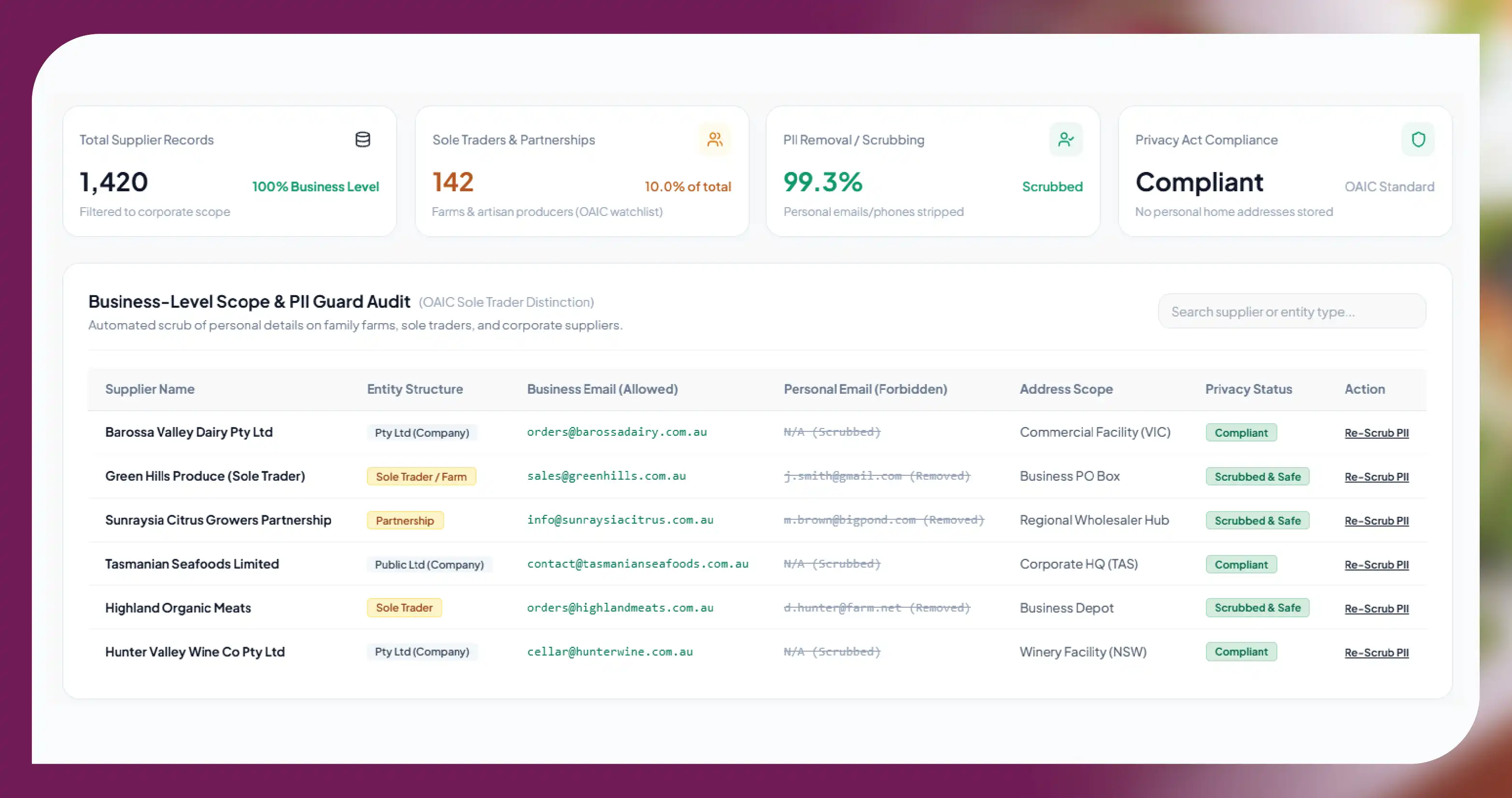
Keep your food supplier database at the business level. That is the safest and most useful scope.
- Privacy Act: information only about a company is generally not personal information. But the OAIC notes that information about a sole trader's business can be personal information about that person (OAIC). Many family farms trade as sole traders or partnerships, so treat their names and contact details with care, and do not collect personal phone numbers, personal emails or home addresses.
- Spam Act: commercial emails and SMS need consent, must identify the sender (name or ABN), and must include a working unsubscribe that is honoured within five working days. Buying a list does not transfer consent, and lists built with address-harvesting software are prohibited (ACMA).
- Register terms: follow the ABN Lookup agreement, including deleting withdrawn records.
- Website terms: collect only publicly available business data, and respect robots.txt and rate limits.
This article is general information, not legal advice. [Compliance: have the legal team review this section before publishing]
Use cases
- Local sourcing shortlist: a foodservice distributor filters orchards and dairies within 150 km of its warehouse by farming_type and postcode.
- Territory planning: an equipment supplier counts poultry and dairy businesses per LGA to size sales regions.
- Certified supply check: an organic retailer lists certified operators by product and state, with a source_url for each certification.
- Wine range building: a beverage buyer filters wineries by region and ANZSIC class 1214.
- Market sizing: a CPG brand compares producer counts with ABS figures to judge coverage.
Build vs buy: choosing a provider
Building a food supplier database in-house works if you need one region and one commodity. Once you need several states, regular refreshes and clean classification, the effort grows fast.
| Factor | Build in-house | Buy or commission |
|---|---|---|
| Set-up time | Weeks of source research and parser work | Sample can be scoped quickly [Confirm figure] |
| Coverage | Limited to sources you maintain | Multiple sources joined on ABN |
| Classification | Manual ANZSIC and farming_type tagging | Rules-based tagging plus review |
| Refresh | Ad hoc | Scheduled feed (monthly or quarterly) |
| Compliance | You design the controls | Agreed scope, business-level fields only |
| Cost | Staff time and tools | Project or subscription fee |
When you compare food supplier database providers, ask four things: which sources they use, how they match records to ABNs, how they handle sole-trader data, and whether every value has a source_url. Avoid any provider that promises personal contact details of farmers or "complete" coverage.
Food Data Scrape builds custom producer and supplier datasets for Australia from public business sources, delivered as CSV, JSON or API feeds. Our team has handled supplier-side requests from foodservice and equipment businesses that want to reach food operators [Add result from delivery team].
Get a free sample dataset: tell us the states, commodities and fields you need, and we will scope a sample food supplier database for Australia.
Questions
Frequently Asked Questions
It is a structured list of food-producing businesses, such as farms, wineries and processors, with business-level fields like ABN, products, location and certifications. Buyers use it to source supply and sellers use it to plan sales.
The ABN Bulk Extract on data.gov.au is free and open, but it does not say what a farm grows. You need directories, websites and classification to add farming type and products.
Most active businesses have an ABN on the public register, but matching a directory listing to the right ABN takes careful name and postcode matching. Some records will stay unmatched.
Farms sit in Division A, for example 0160 Dairy Cattle Farming and 0131 Grape Growing. Food processors sit in Division C, for example 1111 Meat Processing and 1214 Wine and Other Alcoholic Beverage Manufacturing.
Only with consent under the Spam Act, a clear sender identity and a working unsubscribe. A purchased list does not give you consent, so check how each address was obtained.
Monthly or quarterly suits most food supplier database users. ABN status, websites and certifications change, so re-check them on a schedule.
Get a Free Food Data Sample in 48 Hours.
Tell us your platforms, target markets and required fields — we'll map exactly what's possible with food data scraping, recommend the right approach, and send a working sample so you can verify quality before any commitment.
Request a strategy call
Thanks — our data team will reach out within 48 hours with your sample.