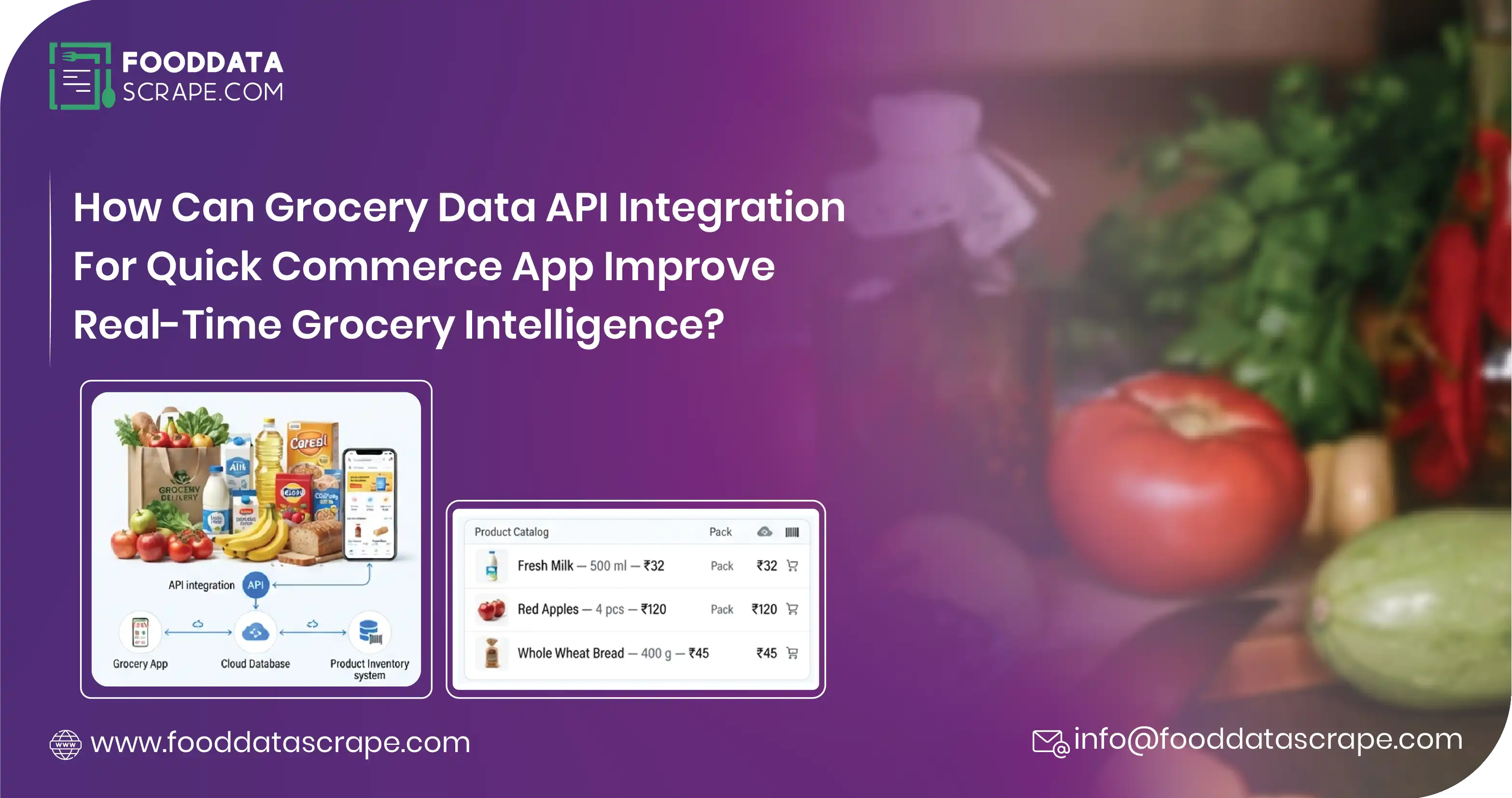
Introduction
The rapid expansion of quick commerce has changed how consumers purchase groceries, household essentials, personal care products, and everyday necessities. With customers expecting deliveries within minutes, quick-commerce applications need accurate, structured, and frequently updated product information to power search, pricing, availability, recommendations, and competitive intelligence.
Grocery Data API Integration For Quick Commerce App enables businesses to connect continuously refreshed grocery information with their applications, dashboards, analytics platforms, and internal systems. Instead of depending on manually collected product records, businesses can integrate automated feeds containing product names, SKUs, prices, discounts, brands, categories, pack sizes, ratings, availability, and other relevant attributes.
For businesses looking to Scrape Grocery Data for Quick-Commerce Apps, an API-driven approach can transform information collected from multiple digital grocery channels into structured datasets that are easier to consume and analyze. A Quick Commerce Pricing Data API can further support real-time or scheduled monitoring of price changes across products, locations, stores, and competing platforms.
Why Grocery Data APIs Matter for Quick Commerce?
Quick-commerce businesses operate in an environment where product prices and inventory can change frequently. A product available in one neighborhood may be unavailable in another, while promotional prices can differ between locations and time periods.
Traditional spreadsheets and periodic manual research cannot efficiently capture these changes at scale. An API provides a standardized mechanism for transferring structured grocery information into business applications.
A well-designed grocery API can include:
- Product name and description
- SKU or product identifier
- Brand
- Category and subcategory
- Pack size and unit
- Regular price
- Selling price
- Discount percentage
- Stock status
- Store or fulfillment location
- Ratings and reviews
- Product images
- Promotional information
- Timestamp
- Source platform
This structure allows organizations to build automated monitoring systems rather than repeatedly collecting information manually.
Building Quick-Commerce Market Data Intelligence
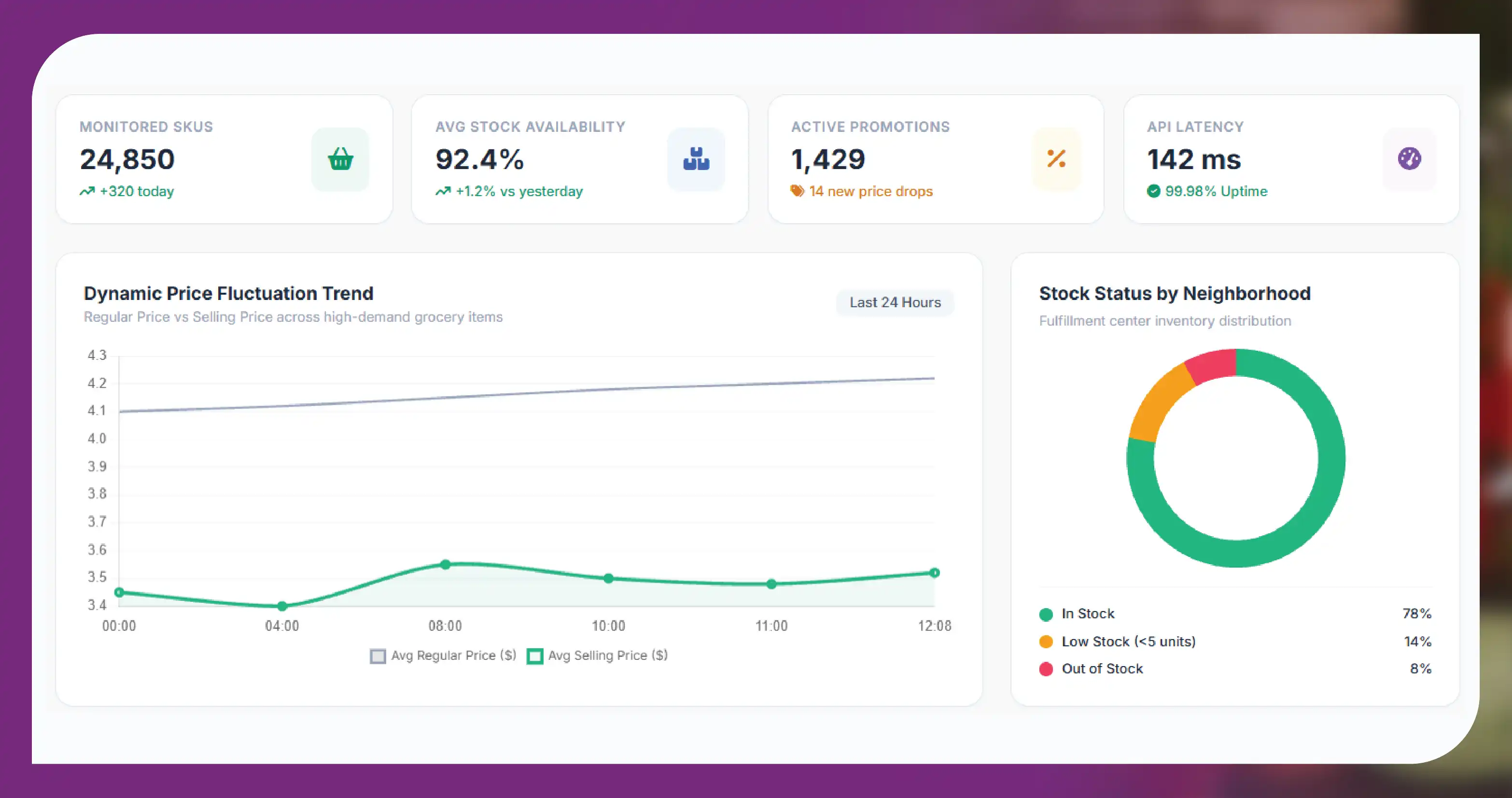
Modern grocery applications need more than individual product records. They require market-level visibility to understand what is happening across competing platforms, brands, categories, and geographic markets.
Quick-Commerce Market Data Intelligence combines product, pricing, availability, promotional, and location-level information to create a broader view of the market.
For example, an analytics team could compare the selling price of a 1-liter cooking oil product across several quick-commerce platforms. The same framework could monitor whether discounts increase during weekends, whether certain brands experience frequent stockouts, or whether prices vary significantly between cities.
Historical datasets are particularly valuable because they allow companies to identify patterns instead of looking at isolated price points.
Grocery Data Extraction API For Quick Commerce
A Grocery Data Extraction API For Quick Commerce can automate the collection and delivery of information from relevant digital sources into a predefined schema.
The extraction pipeline generally follows several stages:
1. Source Identification
Relevant grocery marketplaces, quick-commerce applications, websites, mobile platforms, and digital catalogs are identified according to the business requirement.
2. Data Extraction
Automated systems collect publicly accessible product and market information while handling differences in website structures and data formats.
3. Data Processing
Raw information is cleaned, normalized, deduplicated, and mapped into consistent fields.
4. Data Validation
Records can be checked for missing prices, incorrect categories, duplicate SKUs, inconsistent units, and other quality issues.
5. API Delivery
Processed information is exposed through an API or delivered in formats such as JSON, CSV, or database-ready structures.
This architecture makes grocery intelligence easier to integrate into applications and analytical workflows.
Grocery SKU Data API For Quick Commerce Apps
SKU-level information is particularly important for grocery businesses because products frequently have multiple pack sizes, flavors, variants, and brands.
A Grocery SKU Data API For Quick Commerce Apps can help businesses maintain granular visibility into these product variations.
Consider a packaged snack available in 50g, 100g, and 200g versions. Treating these as one product could produce misleading pricing analysis. SKU-level data allows each variant to be tracked independently.
Businesses can use SKU-level datasets to monitor:
- Price movement
- Pack-size variations
- Discount activity
- Product availability
- Brand assortment
- Store-level inventory signals
- Product substitutions
- Category expansion
- Competitive pricing
This information can also support product catalogs and recommendation systems.
Pricing Intelligence Across Grocery Platforms
Pricing is one of the most dynamic components of quick commerce. Retailers may adjust prices according to promotions, demand, inventory, geography, or commercial strategies.
An integrated API can capture these changes at defined intervals and maintain historical records.
For example:
| Product Category | SKU Example | Regular Price | Observed Price | Discount | Availability | Monitoring Frequency |
|---|---|---|---|---|---|---|
| Dairy | Milk 1L | ₹68 | ₹64 | 5.9% | In Stock | Hourly |
| Snacks | Chips 100g | ₹30 | ₹27 | 10.0% | In Stock | 2 Hours |
| Beverages | Cola 750ml | ₹45 | ₹40 | 11.1% | In Stock | Hourly |
| Staples | Rice 5kg | ₹420 | ₹389 | 7.4% | In Stock | 4 Hours |
| Personal Care | Shampoo 650ml | ₹699 | ₹559 | 20.0% | In Stock | 4 Hours |
| Household | Detergent 2kg | ₹310 | ₹279 | 10.0% | Limited | 2 Hours |
*Illustrative data for demonstrating an API-based grocery monitoring structure.*
Companies can use historical observations to calculate average selling prices, discount frequency, price gaps, and promotional intensity.
Location-Level Grocery Intelligence
Quick commerce is highly location-dependent. A product catalog in one service area may differ from another because fulfillment centers, dark stores, inventory levels, and local demand vary.
Location-aware data can therefore provide additional analytical value.
Businesses can compare:
- City-level product availability
- Neighborhood-level assortment
- Store-level prices
- Regional promotions
- SKU availability
- Delivery-area differences
- Local brand presence
For example, an analytics dashboard could show that a particular product is consistently available in one metropolitan area but experiences frequent stockouts in another.
Such information can support assortment planning, competitive research, and expansion analysis.
AI Grocery Intelligence
AI Grocery Intelligence adds another analytical layer to structured grocery datasets. Once historical product, pricing, availability, and promotional information has been collected, AI and machine-learning systems can process the data to identify patterns.
Potential applications include:
- Product demand analysis
- Price anomaly detection
- Promotion identification
- Product classification
- Brand comparison
- Assortment optimization
- Stockout pattern analysis
- Price-change alerts
- Competitive monitoring
- Recommendation engines
For example, an AI model can analyze historical SKU prices and identify unusual movements that deserve human review. Similarly, classification models can normalize product names from different platforms into common categories.
The quality of AI output, however, depends heavily on the quality, consistency, freshness, and coverage of the underlying data.
Transform your quick-commerce strategy with accurate grocery data, real-time pricing intelligence, and scalable API solutions. Connect with Food Data Scrape today.
Mobile App Scraping for Grocery Intelligence
Quick-commerce activity increasingly takes place through mobile applications. Product catalogs, location-specific availability, promotions, and user-facing information may therefore need to be collected from app environments where permitted.
Mobile App Scraping can help businesses gather structured information from relevant publicly accessible app experiences and incorporate it into broader grocery intelligence workflows.
A typical mobile-oriented dataset could contain:
| Field | Example |
|---|---|
| Platform | Quick-Commerce App |
| Product | Organic Wheat Flour |
| Brand | Example Brand |
| SKU | SKU-45821 |
| Pack Size | 5 kg |
| MRP | ₹410 |
| Selling Price | ₹365 |
| Discount | 10.98% |
| Availability | In Stock |
| Delivery Area | Example Zone |
| Timestamp | 09:30 AM |
| Category | Staples |
*Illustrative dataset structure.*
When app and web data are combined appropriately, organizations can create a broader view of digital grocery markets.
API Integration Architecture
A reliable grocery data integration system usually contains multiple components rather than a single scraper.
A simplified workflow looks like:
Source Platforms → Data Collection → Parsing → Cleaning → Validation → Standardization → API Layer → Database/Dashboard/Application
The API layer can then make selected information available to internal applications.
For example, a quick-commerce application could request product information based on:
- SKU
- Brand
- Category
- Location
- Price range
- Availability
- Update timestamp
Businesses can also establish scheduled refresh cycles according to the volatility of each dataset. Fast-changing prices may require more frequent updates than relatively stable product descriptions.
How Food Data Scrape Can Help You?
1. Automated Grocery Data Collection
Food Data Scrape can automate structured grocery information collection across relevant digital sources, reducing repetitive manual research and creating consistent datasets for quick-commerce analytics and applications.
2. SKU-Level Data Processing
Its data workflows can organize product names, SKUs, brands, pack sizes, prices, discounts, and availability into standardized records, making detailed grocery catalog analysis easier across multiple platforms.
3. Competitive Price Monitoring
Food Data Scrape can support recurring grocery price monitoring by collecting comparable product information and organizing historical observations for benchmarking, promotional analysis, and competitive intelligence.
4. API-Ready Data Delivery
Businesses can receive processed grocery information through structured delivery formats designed for integration with dashboards, databases, analytical systems, applications, and other technology environments requiring refreshed market data.
5. Scalable Market Intelligence
Food Data Scrape can help organizations expand grocery intelligence across categories, locations, platforms, and SKUs while maintaining standardized data structures suitable for ongoing market monitoring and analysis.
Conclusion
Quick commerce depends on speed, accuracy, assortment visibility, and continuously changing market information. A structured grocery API can connect these requirements with applications, dashboards, databases, and analytical platforms.
By combining SKU-level product information, pricing, discounts, availability, location signals, and historical observations, businesses can develop stronger visibility into digital grocery markets. API integration also reduces the friction involved in moving processed data between collection systems and business applications.
For organizations seeking scalable intelligence, Grocery Delivery Scraping API Services can provide structured information for applications and analytical workflows. Similarly, Grocery Data Scraping Services can support recurring collection, cleaning, validation, and standardization requirements across grocery ecosystems.
Businesses can also use Web Scraping Quick Commerce Data workflows to build historical datasets that support price benchmarking, assortment analysis, promotional tracking, and broader market intelligence.
The combination of automated extraction, structured APIs, SKU-level datasets, and analytical systems creates a practical foundation for understanding the fast-changing quick-commerce grocery landscape.
Are you in need of high-class scraping services? Food Data Scrape should be your first point of call. We are undoubtedly the best in Food Data Aggregator and Mobile Grocery App Scraping service and we render impeccable data insights and analytics for strategic decision-making. With a legacy of excellence as our backbone, we help companies become data-driven, fueling their development. Please take advantage of our tailored solutions that will add value to your business. Contact us today to unlock the value of your data.
Get a Free Food Data Sample in 48 Hours.
Tell us your platforms, target markets and required fields — we'll map exactly what's possible with food data scraping, recommend the right approach, and send a working sample so you can verify quality before any commitment.