Introduction
Grocery platforms contain a constantly changing stream of valuable information, including product names, prices, discounts, availability, categories, brands, pack sizes, ratings, nutritional details, and UPC identifiers. For retailers, brands, researchers, and data intelligence companies, this information can support pricing decisions, assortment analysis, competitive benchmarking, and market research. However, collecting grocery information at scale requires more than simply extracting data from webpages. Responsible collection must consider website terms, applicable laws, privacy requirements, intellectual property, technical restrictions, and the intended use of the resulting dataset.
Grocery Data Compliance scraping provides a framework for collecting useful grocery information while incorporating appropriate legal, ethical, and operational safeguards into the scraping workflow.
Likewise, grocery data scraping compliance is becoming increasingly important as grocery platforms expand their digital presence and businesses rely on automated data collection for real-time intelligence.
A responsible approach to compliance for grocery data collection scrape starts by understanding exactly what information is being collected, where it comes from, whether it is publicly accessible, and how it will be stored and used. Compliance is not simply a legal checkpoint at the end of a project; it should be incorporated into data-source selection, crawler architecture, extraction rules, storage, monitoring, and downstream analytics.
Why Grocery Data Compliance Matters?
Online grocery ecosystems are highly dynamic. Thousands of products may change price, stock status, promotional messaging, or delivery availability several times throughout a day. Businesses therefore have strong incentives to automate collection rather than manually monitor websites.
Yet scale introduces additional responsibility.
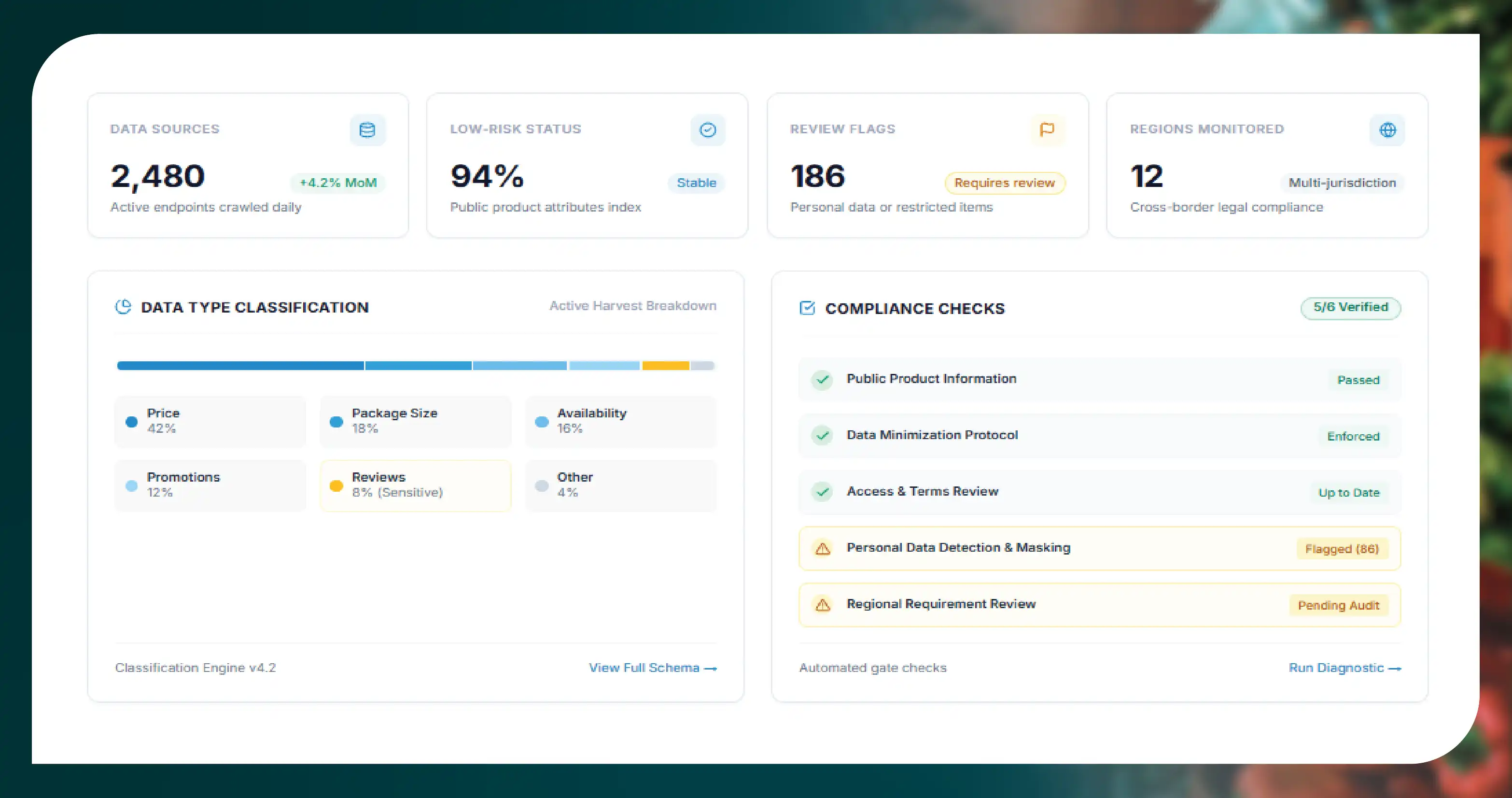
A scraper that collects public product information from a grocery website can still encounter contractual restrictions, technical access controls, copyright considerations, personal information, or regional regulations. The risk profile also changes depending on whether the dataset contains ordinary product attributes or information connected to identifiable individuals.
For example, collecting a product's displayed price and package size is generally very different from collecting customer names, reviews containing personal information, account information, addresses, or other sensitive data.
This makes compliance for grocery data collection intelligence an important consideration for organizations that want their datasets to remain useful, defensible, and sustainable.
Key Areas of Grocery Data Scraping Compliance
1. Define the Data Before Scraping
The first compliance step is creating a precise data specification.
Instead of instructing a crawler to "collect everything," define the required fields. A typical grocery intelligence dataset might include:
- Product name
- Brand
- Category
- Product URL
- SKU or product identifier
- UPC, EAN, or GTIN
- Listed price
- Promotional price
- Unit price
- Package size
- Availability
- Product description
- Rating and review count
- Store or marketplace identifier
- Timestamp
- Location or market where publicly displayed
This approach reduces unnecessary collection and makes it easier to determine whether particular fields create additional privacy or legal concerns.
2. Review Website Terms and Access Rules
Before collecting information from a grocery platform, organizations should review the website's terms of service, robots directives, access policies, API documentation, and other applicable rules.
Terms may restrict automated access or specify permitted methods of obtaining information. A compliant scraping strategy should therefore evaluate the source before deployment rather than assuming that publicly visible information can automatically be collected without restrictions.
Where an official API, licensed feed, partnership, or downloadable dataset exists, it may provide a more appropriate collection route.
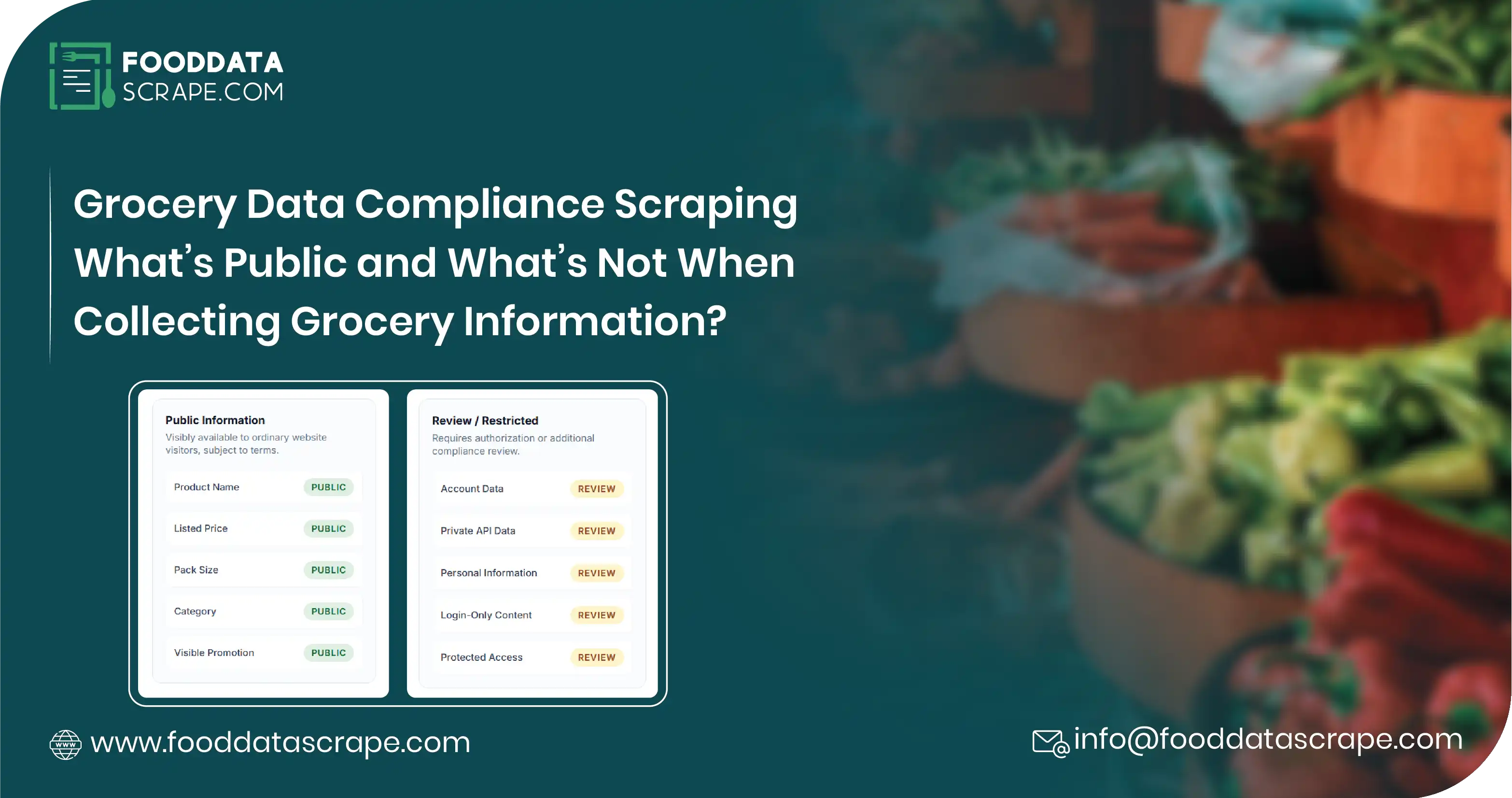
3. Separate Public Product Data from Personal Data
One of the most important principles in grocery product data scraping compliance is distinguishing commercial product information from personal information.
Product-level information such as a cereal's name, listed price, brand, package size, or UPC generally serves a different purpose from customer-level information.
Scraping should avoid collecting unnecessary personal information such as:
- Customer names
- Phone numbers
- Email addresses
- Home addresses
- Account identifiers
- Payment information
- Private shopping history
- Authentication credentials
- Sensitive user-generated information
If reviews or other user-generated content are part of a legitimate research project, organizations should evaluate privacy implications carefully and collect only what is genuinely necessary.
Retail Web Scraping Compliance and Responsible Architecture
Retail web scraping compliance should influence the technical architecture of a grocery data project.
A responsible scraper can include rate limiting, request scheduling, source monitoring, error handling, data minimization, access controls, and retention policies. These measures can improve both compliance and technical reliability.
Rate Limiting and Responsible Request Volumes
Aggressive crawling can create unnecessary server load and increase the possibility of access restrictions. A carefully configured crawler should request information at reasonable frequencies and avoid unnecessary duplication.
Instead of repeatedly downloading an unchanged product page, an intelligent system can prioritize pages where changes are more likely, use appropriate caching strategies, and schedule collection according to business requirements.
Respect Technical Boundaries
Scraping systems should not be designed to circumvent authentication, paywalls, access controls, or other security mechanisms.
If information requires an account or private access, the organization should determine whether it has legitimate authorization to collect that information. Public availability does not mean every technical barrier should be bypassed.
Maintain Source and Collection Records
A mature grocery data operation should maintain metadata describing where information came from and when it was collected.
Useful metadata includes source URL, platform, collection timestamp, geographic market, product identifier, extraction method, and processing status.
This creates an audit trail that helps analysts understand how a particular data point entered the dataset.
Grocery Data Privacy Considerations
Grocery data privacy considerations scrape should be addressed before collecting information at scale.
Privacy requirements can vary depending on jurisdiction, the nature of the information, the organization collecting it, and how the dataset is used. Businesses operating across multiple countries should therefore evaluate applicable privacy and data-protection requirements for each relevant market.
A strong privacy strategy follows data minimization.
If the business objective is competitive grocery price monitoring, there may be no reason to collect customer accounts, usernames, addresses, or other personal information. Limiting collection to product and commercial attributes reduces unnecessary exposure.
Organizations should also consider:
- Why the information is being collected
- Whether each field is necessary
- How long information will be retained
- Who can access the dataset
- Whether information is transferred internationally
- Whether personal information is present
- How deletion requests or compliance requirements will be handled where applicable
Legal review should be obtained for projects involving significant personal information, restricted sources, or multiple jurisdictions.
Building a Compliance-First Grocery Scraping Workflow
A reliable compliance process can be organized into several stages.
Stage 1: Source Assessment
Identify grocery websites, marketplaces, retailer catalogs, mobile platforms, APIs, or licensed sources. Document their access conditions and determine which sources are suitable.
Stage 2: Data Classification
Classify every field as product, commercial, technical, location-related, user-generated, or potentially personal information.
Stage 3: Collection Rules
Create crawler rules specifying acceptable pages, request frequency, fields, collection schedules, and exclusions.
Stage 4: Validation
Check whether extracted records contain unexpected personal information, restricted content, or fields outside the original specification.
Stage 5: Storage Controls
Use secure databases, controlled access, encryption where appropriate, and defined retention periods.
Stage 6: Continuous Monitoring
Compliance is not a one-time activity. Websites change their structures, policies, access mechanisms, and data presentation. Regular monitoring helps ensure the collection process remains aligned with current requirements.
What Grocery Data Can Reveal Without Excessive Collection?
A compliance-conscious approach does not mean sacrificing business value.
Organizations can still develop powerful datasets for competitive intelligence using carefully selected product attributes.
For example, price history can reveal inflation patterns and competitive price movements. Availability data can highlight stockout trends. Promotion information can identify discount intensity. Assortment data can reveal which brands and pack sizes are gaining visibility.
UPC and GTIN identifiers can also help organizations match equivalent products across different grocery platforms, making cross-retailer comparison more reliable.
This is where Grocery Data Scraping becomes especially valuable: businesses can transform publicly presented commercial information into structured datasets while maintaining clear boundaries around unnecessary data collection.
AI Grocery Intelligence and Compliance
AI Grocery Intelligence can make compliant grocery datasets even more useful.
Machine-learning systems can normalize product names, classify categories, match equivalent products, detect unusual price changes, identify promotions, forecast demand, and discover assortment gaps.
However, AI does not remove the need for governance. In fact, automated analysis makes data lineage more important.
A business should know which source generated each record, when it was collected, how it was transformed, and whether the information contains restrictions that could affect downstream use.
For example, an AI pricing model built from product-level commercial information can be considerably easier to govern than a system trained on unnecessary customer-level information.
Practical Compliance Checklist for Grocery Data Projects
Before launching a grocery scraping project, organizations should ask:
- Is the source publicly accessible or otherwise legitimately authorized for collection?
- Have applicable website terms and access policies been reviewed?
- Are only necessary fields being collected?
- Does the dataset contain personal information?
- Are rate limits and responsible request patterns implemented?
- Are authentication barriers or technical controls being avoided unless authorized?
- Is source and timestamp metadata being retained?
- Are storage and access controls defined?
- Is there a retention and deletion policy?
- Has legal or privacy expertise reviewed high-risk use cases?
These questions create a practical governance layer around automated grocery intelligence.
How Businesses Benefit From Compliant Grocery Data
Compliance can actually strengthen a data strategy.
Cleanly defined datasets are easier to maintain, validate, compare, and integrate with analytics systems. Data minimization can reduce storage costs. Source documentation improves traceability. Responsible crawling can reduce technical disruptions. Clear governance can make datasets easier to share internally.
For retailers, this can support competitive pricing and assortment monitoring. For brands, it can improve digital shelf visibility. For researchers, it can support market studies and longitudinal price analysis. For technology companies, structured grocery datasets can power recommendation and intelligence products.
The objective is not simply to scrape more information. The objective is to collect the right information, from appropriate sources, using responsible processes, and transform it into actionable intelligence.
How Food Data Scrape Can Help You?
1. Compliance-Focused Data Collection
Food Data Scrape can structure grocery collection workflows around defined fields, source assessment, responsible crawling practices, and data minimization principles to support more sustainable intelligence programs.
2. Product Intelligence at Scale
Businesses can organize product names, prices, brands, categories, pack sizes, availability, promotions, and identifiers into structured datasets designed for competitive grocery analysis.
3. Cross-Platform Monitoring
Structured grocery datasets can help compare products and commercial attributes across retailers, marketplaces, and grocery platforms, supporting assortment benchmarking, price intelligence, and market research.
4. Better Data Governance
Source URLs, timestamps, product identifiers, extraction records, and validation processes can improve traceability, helping teams understand where grocery intelligence originated and how records changed.
5. Actionable Grocery Analytics
Processed grocery information can feed dashboards, pricing systems, market research workflows, AI models, and competitive intelligence platforms, turning large-scale commercial data into measurable business insights.
Conclusion
Grocery data collection has enormous potential, but valuable intelligence should be built on responsible foundations. A successful scraping strategy combines accurate extraction, thoughtful source selection, privacy awareness, technical restraint, structured storage, and continuous governance.
Organizations looking to Scrape Data from Grocery Platforms should evaluate source conditions, collect only necessary information, and build monitoring processes that can adapt as websites and regulations evolve.
Modern Web Scraping APIs for Grocery Data can further streamline structured collection, allowing businesses to integrate product information into dashboards, databases, analytics platforms, and automated intelligence systems.
For product matching and competitive research, organizations can also Scrape UPC Data Grocery Products to build cleaner cross-retailer product mappings and improve the accuracy of grocery price and assortment comparisons.
Ultimately, compliance should not be viewed as a barrier to grocery intelligence. It is a foundation for building reliable, scalable, and trustworthy data operations that deliver business value without unnecessary data exposure.
Ready to build a responsible grocery intelligence pipeline? Partner with Food Data Scrape to transform grocery information into structured, actionable, and compliance-conscious datasets.
Are you in need of high-class scraping services? Food Data Scrape should be your first point of call. We are undoubtedly the best in Food Data Aggregator and Mobile Grocery App Scraping service and we render impeccable data insights and analytics for strategic decision-making. With a legacy of excellence as our backbone, we help companies become data-driven, fueling their development. Please take advantage of our tailored solutions that will add value to your business. Contact us today to unlock the value of your data.
Get a Free Food Data Sample in 48 Hours.
Tell us your platforms, target markets and required fields — we'll map exactly what's possible with food data scraping, recommend the right approach, and send a working sample so you can verify quality before any commitment.
Request a strategy call
Thanks — our data team will reach out within 48 hours with your sample.