Introduction
The U.S. grocery market has become increasingly competitive, with retailers constantly adjusting prices to attract value-conscious shoppers while protecting margins. Comparing identical or closely comparable grocery SKUs across Wegmans, Walmart, Aldi, and Sam's Club can reveal meaningful differences in pricing, pack sizes, promotions, and value positioning. Grocery SKU Price Benchmarking Data Scraping enables retailers, brands, distributors, and analysts to systematically collect these pricing signals and transform them into actionable competitive insights.
Modern grocery benchmarking goes beyond simply checking whether one retailer sells a product for less than another. Businesses need to Scrape Grocery SKU Pricing Data across categories, brands, package sizes, locations, and promotional periods to understand how prices change. Such structured information creates a reliable foundation for Retail Grocery Pricing Intelligence, helping businesses identify pricing gaps, competitive advantages, and emerging market patterns.
Why Grocery SKU Price Benchmarking Matters?
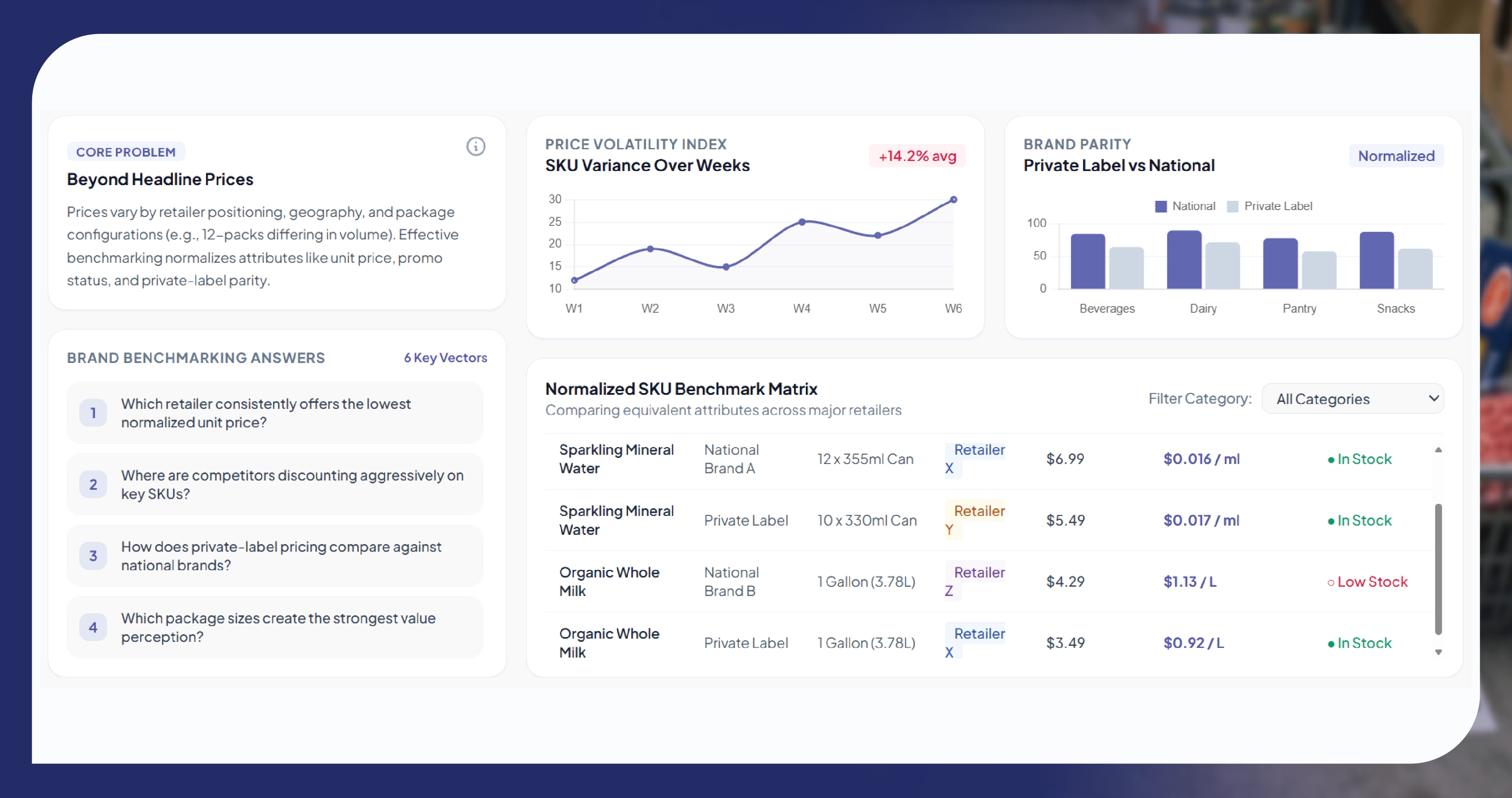
Grocery prices can vary substantially depending on retailer positioning, geographic market, package configuration, private-label strategy, and promotional activity. A 12-pack of beverages, for example, may appear cheaper at one retailer while actually offering less volume than a competing pack. Comparing only displayed prices can therefore produce misleading conclusions.
Effective Grocery Price Benchmarking Data normalizes important attributes such as SKU name, brand, category, package quantity, unit price, promotional price, regular price, availability, and retailer. This makes it possible to compare equivalent products rather than simply comparing headline prices.
For brands, benchmarking can answer questions such as:
- Which retailer consistently offers the lowest price?
- Where are competitors discounting aggressively?
- Which products experience the greatest price volatility?
- How does private-label pricing compare with national brands?
- Which package sizes create the strongest value perception?
- Where are pricing gaps widening or narrowing?
These insights become particularly valuable when analyzed over several weeks or months instead of as a one-time snapshot.
Comparing the Four Retail Models
Wegmans, Walmart, Aldi, and Sam's Club represent different approaches to grocery retail. Their pricing structures make cross-retailer benchmarking especially valuable.
Wegmans combines conventional grocery retail with strong private-label offerings, prepared foods, specialty products, and a differentiated shopping experience. Its assortment can contain premium, mainstream, and value-oriented products, creating multiple pricing layers within the same category.
Walmart competes heavily on price and operates at enormous scale. Its grocery assortment spans national brands, private labels, fresh products, household essentials, and numerous package configurations. Price movements at Walmart can therefore serve as an important competitive reference point.
Aldi follows a highly value-focused model with a strong emphasis on private-label products and a comparatively streamlined assortment. Benchmarking Aldi requires careful attention to product equivalency because an identical national-brand SKU may not always be available.
Sam's Club operates through a membership warehouse model, where larger pack sizes and bulk purchasing influence perceived value. A product that appears more expensive in absolute terms may have a significantly lower unit cost than a smaller package sold elsewhere.
This difference makes unit economics essential to grocery benchmarking.
Building a Comparable SKU Dataset
A robust benchmarking project begins by establishing a standardized product structure. Each record can include retailer name, product title, brand, category, SKU identifier, package size, quantity, regular price, sale price, unit price, promotion information, availability, location, and collection timestamp.
Product matching is one of the most important elements. Consider two cereal products: one is a 12-ounce box and another is an 18-ounce box. Their shelf prices cannot be fairly compared without calculating price per ounce.
The same principle applies to beverages, snacks, dairy, frozen foods, meat, household products, and personal-care categories commonly purchased through grocery channels.
Grocery Market Intelligence Data becomes more valuable when these records are standardized and enriched with historical observations. Instead of seeing isolated prices, analysts can identify pricing trajectories and competitive patterns.
Brand-Level Competitive Analysis
Brands can use cross-retailer benchmarking to understand how their products are positioned in different channels. Suppose a branded pasta product is priced at $2.99 at one retailer, $3.29 at another, and $3.49 at a third. The difference may appear modest, but across thousands of SKUs and millions of transactions, these variations can materially affect consumer perception.
Brands can also identify whether retailers maintain consistent price relationships across their product portfolios.
A premium product may command a higher price at Wegmans, while a bulk configuration at Sam's Club may produce a lower cost per unit. Walmart may emphasize competitive shelf pricing, whereas Aldi's private-label alternatives can establish a different value benchmark.
These distinctions allow businesses to evaluate not just absolute prices but also relative positioning.
Tracking Promotions and Discounts
Promotions can completely change the competitive picture. A retailer's regular price might be higher than competitors, but a temporary discount could make the product significantly cheaper during a particular week.
A comprehensive benchmarking system should therefore distinguish between regular price, promotional price, discount percentage, promotional period, and unit price.
For example, an analyst might discover that one retailer discounts beverages heavily during weekends while another maintains lower everyday pricing. Such patterns are difficult to identify through occasional manual checks.
Historical datasets make promotional frequency measurable. Businesses can calculate average discount depth, promotional duration, price recovery after promotions, and category-level discount intensity.
Scrape Wegmans Grocery Prices
Collecting structured pricing information from Wegmans can help businesses evaluate category-level pricing across packaged foods, beverages, dairy, snacks, frozen products, household essentials, and other grocery segments.
Rather than focusing on individual prices, organizations can examine hundreds or thousands of SKUs simultaneously. Scrape Wegmans Grocery Prices to identify categories where Wegmans consistently commands a premium and categories where its prices remain highly competitive.
Location-specific comparisons can further reveal regional differences in assortment and pricing.
Scrape Walmart Grocery Prices
Walmart provides a particularly valuable benchmark because of its broad assortment and strong value-oriented market position. Scrape Walmart Grocery Prices initiatives can support comparisons across national brands, private labels, fresh groceries, packaged foods, and household categories.
Historical Walmart pricing can also help analysts identify competitive responses. If a competing retailer reduces prices on a high-volume category, Walmart's subsequent price movement can be studied to determine whether it responds immediately, gradually, or selectively.
This type of analysis can contribute to more sophisticated competitive pricing strategies.
Scrape Aldi Grocery Prices
Aldi presents a different analytical challenge because its private-label-heavy assortment often requires product matching based on attributes rather than exact SKU identity.
Businesses can Scrape Aldi Grocery Prices and compare equivalent products based on package weight, ingredients, category, product specifications, and unit economics. This allows analysts to benchmark value even when identical brands are unavailable.
Such analysis is particularly useful for understanding private-label pressure on national brands. If Aldi consistently offers comparable products at substantially lower unit prices, brands can evaluate how that difference may affect consumer switching behavior.
Unit Economics Across Pack Sizes
Sam's Club introduces another critical dimension: bulk purchasing.
A 24-count package may carry a higher shelf price than a six-count package, but its price per item could be considerably lower. Grocery benchmarking should therefore calculate normalized metrics such as:
- Price per ounce
- Price per pound
- Price per item
- Price per liter
- Price per serving
- Discount percentage
These calculations create a more accurate basis for comparing retailers with fundamentally different package strategies.
A retailer can appear expensive at the shelf-price level while actually providing stronger value when measured by unit cost.
Turning Data Into Pricing Intelligence
Once collected and normalized, grocery pricing data can be transformed into dashboards and analytical models. Grocery Data Scraping Service solutions can support automated collection across large product catalogs while creating standardized datasets for business intelligence systems.
Dashboards can display retailer price indexes, SKU-level differences, category averages, promotional activity, price volatility, and competitive gaps. Decision-makers can then move from manually checking websites to monitoring structured market signals.
AI Grocery Intelligence can add another analytical layer by identifying unusual price movements, clustering similar products, detecting recurring promotional patterns, and highlighting categories requiring attention.
For large grocery businesses, this reduces the burden of manually reviewing thousands of products.
Real-Time Competitive Monitoring
Grocery pricing is dynamic. Prices can change because of promotions, inventory conditions, seasonal demand, supplier costs, local competition, or retailer strategy.
Real-Time Price Monitoring allows businesses to detect these changes quickly. Instead of waiting for periodic market reports, pricing teams can receive structured signals when competitor prices cross predefined thresholds.
For example, a brand could monitor whether a major competitor drops a product below a target price. A retailer could identify categories where its prices have become significantly higher than the market average. A distributor could monitor price movements across several regions.
The objective is not simply faster data collection—it is faster decision-making.
Ready to turn grocery pricing data into actionable competitive insights? Partner with Food Data Scrape to benchmark SKUs, track competitor prices, and make smarter retail pricing decisions.
Creating a Four-Retailer Price Index
A useful benchmarking framework can assign each retailer a normalized price index. Suppose the average normalized price for a comparable SKU group is calculated across all four retailers. Each retailer can then be measured against that benchmark.
An index below 100 can indicate below-average pricing, while an index above 100 can indicate above-average pricing.
This framework can be applied at multiple levels:
- Overall grocery assortment
- Product category
- Brand
- SKU
- Geographic market
- Package size
- Promotional period
Over time, these indexes can reveal whether a retailer is becoming more aggressive or moving toward premium positioning.
How Food Data Scrape Can Help You?
1. Competitive Price Benchmarking
Food Data Scrape collects grocery SKU prices across retailers, helping businesses compare regular prices, discounts, package sizes, and unit costs to identify competitive pricing opportunities.
2. Comprehensive Grocery Data
Businesses can access structured product information including SKU names, brands, categories, package sizes, prices, availability, promotions, and other attributes for detailed grocery market analysis.
3. Real-Time Price Monitoring
Food Data Scrape enables continuous tracking of competitor pricing changes, helping retailers identify sudden price movements, promotional campaigns, discounts, and emerging pricing patterns across grocery categories.
4. Smarter Market Intelligence
Collected grocery data can reveal category trends, retailer positioning, private-label competition, pricing gaps, and consumer value patterns, supporting stronger assortment and strategic business decisions.
5. Scalable Data Solutions
Food Data Scrape provides scalable grocery datasets and scraping solutions that can support large product catalogs, multiple retailers, geographic markets, historical tracking, dashboards, and ongoing competitive intelligence.
Conclusion
Grocery competition increasingly depends on precise, timely, and comparable pricing information. Benchmarking Wegmans, Walmart, Aldi, and Sam's Club gives businesses a broader understanding of how different retail models influence product prices, unit economics, promotions, and consumer value perception.
A well-structured benchmarking program can combine Wegman's Grocery Delivery Dataset information with historical product attributes and price observations to create a detailed competitive view. Businesses can also Scrape Walmart Grocery Data to monitor large-scale assortment and pricing movements across categories.
Similarly, an Aldi Grocery Delivery Scraping API can support structured collection of relevant grocery pricing signals, particularly for private-label and value-oriented competitive analysis.
When these datasets are unified, businesses gain a scalable foundation for pricing strategy, assortment planning, competitor monitoring, promotional analysis, and market intelligence. The result is a shift from occasional price checks to continuous, data-driven grocery intelligence—helping organizations understand not only who is cheaper today, but why prices differ and where the market is heading next.
Are you in need of high-class scraping services? Food Data Scrape should be your first point of call. We are undoubtedly the best in Food Data Aggregator and Mobile Grocery App Scraping service and we render impeccable data insights and analytics for strategic decision-making. With a legacy of excellence as our backbone, we help companies become data-driven, fueling their development. Please take advantage of our tailored solutions that will add value to your business. Contact us today to unlock the value of your data.
Get a Free Food Data Sample in 48 Hours.
Tell us your platforms, target markets and required fields — we'll map exactly what's possible with food data scraping, recommend the right approach, and send a working sample so you can verify quality before any commitment.