Why H-E-B Store-Level Data Matters
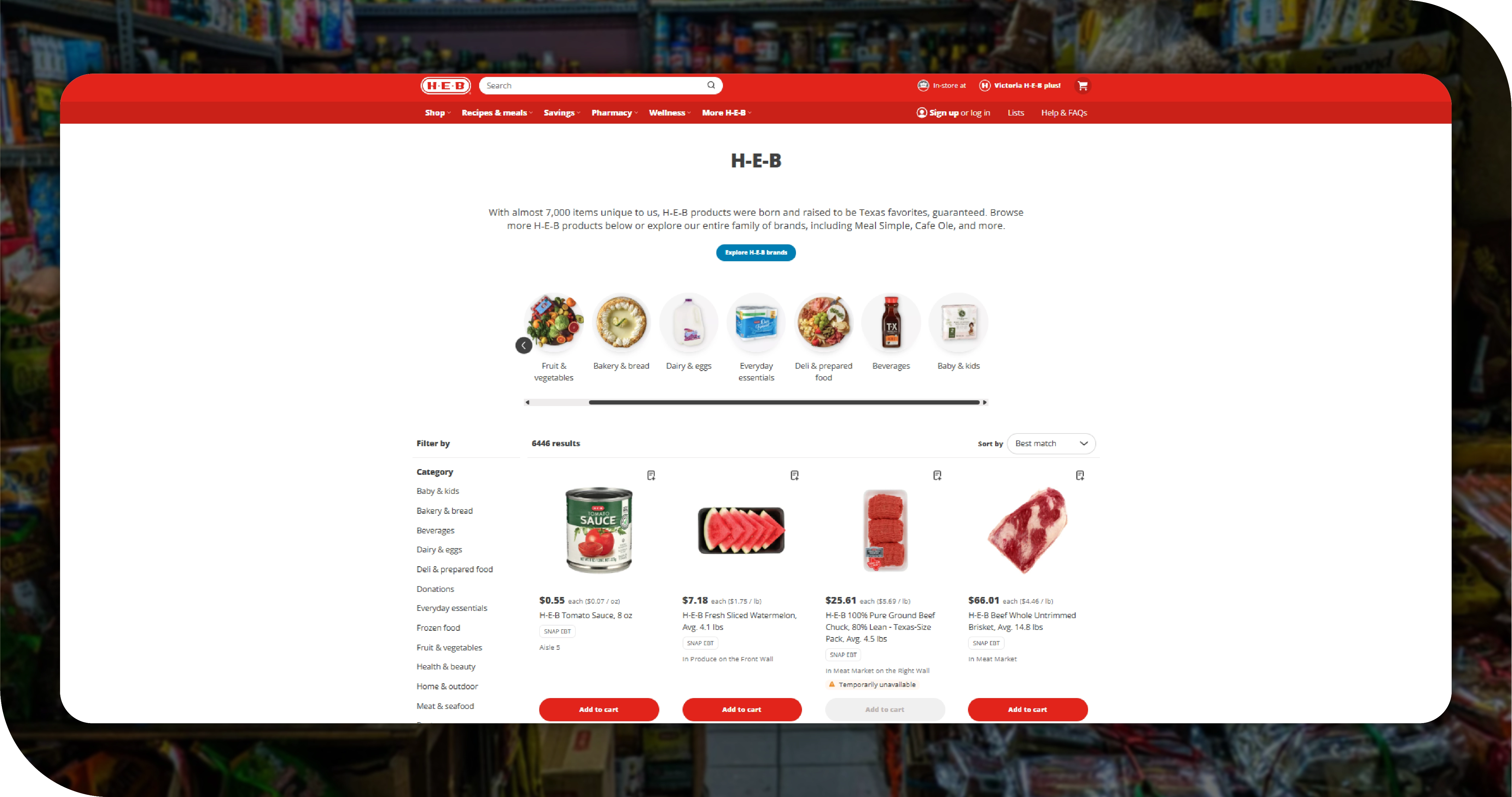
H-E-B's scale in Texas means its shelf is where a large share of the state's grocery volume is decided — and its store-level behavior is more varied than a single brand name suggests.
- Location-based pricing. Prices and availability vary across H-E-B stores and regions. A statewide average is a number that describes no actual shopper's basket.
- Deep private-label presence. H-E-B's own brands are a major force on its shelves. For a national brand, the own-label gap at H-E-B is a retailer-specific competitive threat that has to be measured directly.
- Assortment that varies by store. A SKU carried in one H-E-B store may be absent in another. Distribution gaps are store-specific and ZIP-specific.
- Fast-moving promotions. H-E-B's promotional activity shifts frequently, and a promotion missed is a competitive signal missed.
The commercial question is never "what is my price at H-E-B?" in the abstract. It is "where do I stand across H-E-B's stores, against the competitors and own-label products on the same shelf, region by region?" That question needs an API, not a screenshot.
What the API Returns
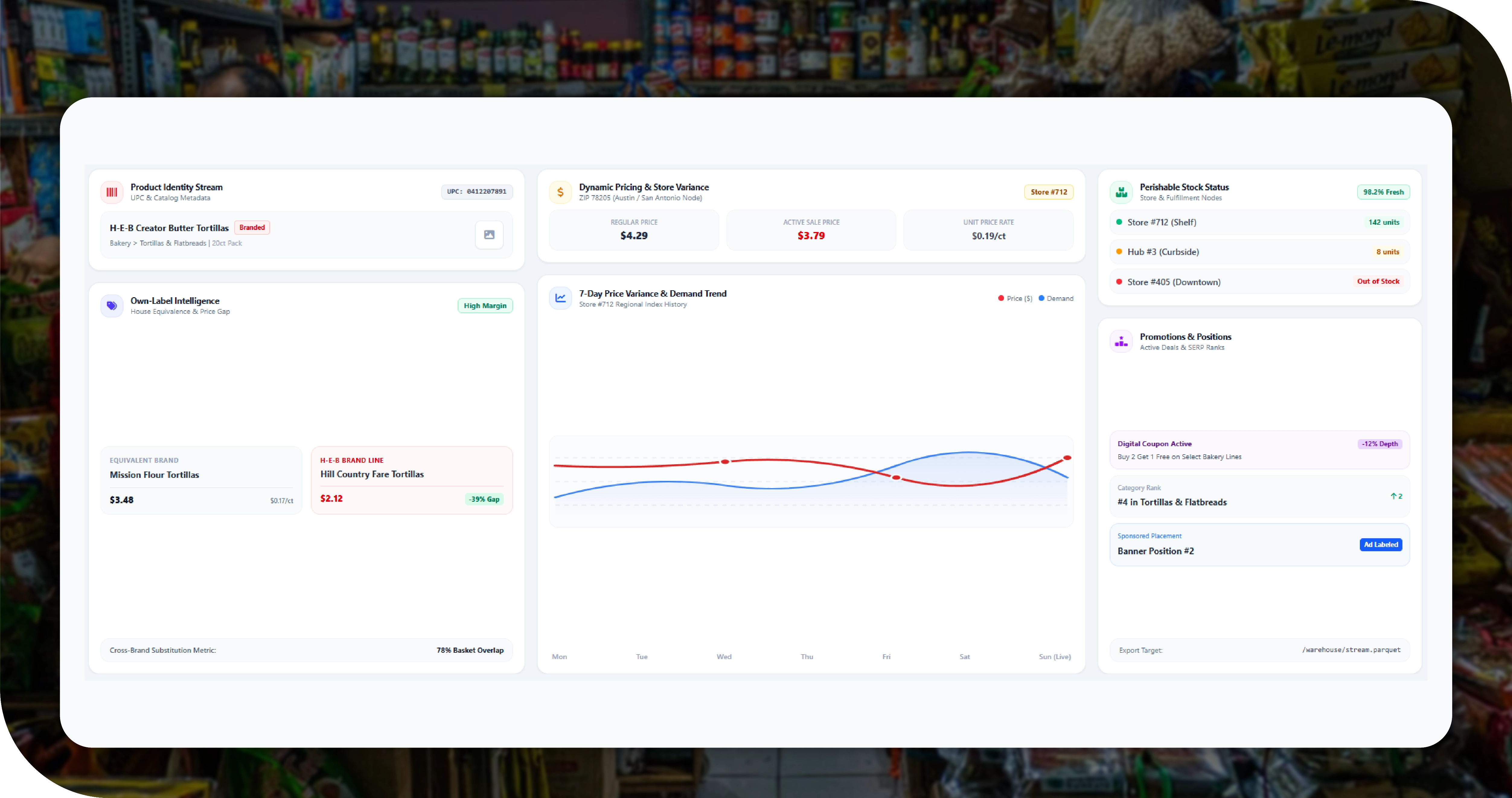
Everything a shopper can see on H-E-B's public catalog is available through the API, structured and refreshable. The fields cluster into six groups.
- Product identity. Product name, brand, normalized name, category and sub-category, pack size, variant, product identifiers such as UPC where published, and images.
- Pricing. Regular price, sale price, discount depth, unit price, and promotional pricing — per store or ZIP, because this is where the variance lives.
- Availability. In-stock or out-of-stock status at the store or fulfillment level, the most perishable and often most valuable field.
- Promotions. Active offers, discount depth, promotional mechanics, and promotion start and end detection.
- Shelf and search position. Category rank and search rank for defined terms, and sponsored placement detection where publicly labeled.
- Own-label context. H-E-B's own-brand equivalents, their prices, and the price gap to the branded product.
Delivered through a REST API with JSON responses, the data can also arrive as bulk export or scheduled files into a warehouse — matched to how the consuming team works.
Sample Data: An H-E-B Product Record
The structure below reflects an API response from the H-E-B feed. Values are illustrative.
{
    "product_name": "Example Brand Tortilla Chips 12oz",
    "brand": "Example Brand",
    "retailer": "H-E-B",
    "category": "Snacks",
    "sub_category": "Tortilla Chips",
    "pack_size": "12oz",
    "upc": "0XXXXXXXXXXX",
    "store_id": "HEB-TX-AUS-042",
    "zip_code": "78704",
    "regular_price_usd": 3.98,
    "sale_price_usd": 2.98,
    "discount_pct": 25.1,
    "unit_price_usd_per_oz": 0.248,
    "in_stock": true,
    "category_rank": 5,
    "own_label_equivalent_usd": 2.48,
    "own_label_price_gap_pct": -37.6
}
The own_label_price_gap_pct field is the one that changes strategy conversations. H-E-B's own-label equivalent priced 37.6% below the branded product, on the same shelf, is the beginning of a substitution curve — and it is invisible to the brand unless the shelf is being watched, store by store.
Sample Data: The Same SKU Across H-E-B Stores
Product: Example Brand Tortilla Chips 12oz — Retailer: H-E-B
| Store / ZIP | Metro | Sale Price (USD) | In Stock | Category Rank |
|---|---|---|---|---|
| HEB-TX-AUS-042 / 78704 | Austin | 2.98 | Yes | 5 |
| HEB-TX-SAT-018 / 78205 | San Antonio | 2.98 | Yes | 4 |
| HEB-TX-HOU-031 / 77002 | Houston | 3.28 | No | 8 |
| HEB-TX-DFW-009 / 75201 | Dallas | 3.18 | Yes | 6 |
| HEB-TX-RGV-025 / 78501 | McAllen | 2.88 | Yes | 3 |
Same retailer, same product, same day — a USD 0.40 price spread across metros, an out-of-stock in Houston, and a category rank ranging from 3rd to 8th. The Houston stock-out is lost revenue in that market for as long as it persists, and the kind of event a national sales report writes off as "soft demand" when the real cause is an empty shelf. Only store-level data makes it visible.
Sample Data: Own-Label Threat Tracking
Category: Tortilla Chips — Retailer: H-E-B
| Tier | Product | Price (USD) | Unit Price (per oz) | Gap vs Brand |
|---|---|---|---|---|
| Value own-label | Value Tortilla Chips 12oz | 1.98 | 0.165 | -50% |
| Core own-label | H-E-B Tortilla Chips 12oz | 2.48 | 0.207 | -38% |
| Your brand | Example Brand 12oz | 3.98 | 0.332 | — |
| Competitor brand | Competitor Chips 12oz | 3.78 | 0.315 | -5% |
| Premium own-label | H-E-B Select 12oz | 3.48 | 0.290 | -13% |
Two H-E-B own-label tiers sit well below the brand, with the value tier at half the price per ounce. In a price-sensitive snacking category, that gap is the number that determines whether the brand holds its volume or cedes it — and H-E-B's own-label strength makes this one of the most important fields in any Texas grocery dataset.
What Developers and Businesses Build With It
- FMCG and food brands monitor price and availability across H-E-B stores, benchmark against competitors and own-label, detect stock-outs, and enforce price consistency in their most important Texas account.
- Competing retailers benchmark H-E-B's pricing, assortment and promotions store by store to inform their own Texas strategy.
- Price-comparison and savings apps power a live, store-accurate H-E-B price and availability layer without building collection infrastructure.
- Distributors and brokers identify H-E-B stores and ZIPs where a brand they represent is under-distributed or out of stock.
- Private-label manufacturers track how H-E-B's own brands are priced and positioned against the national brands they substitute.
- Investors and analysts build independent price indices and measure H-E-B's competitive dynamics across Texas markets.
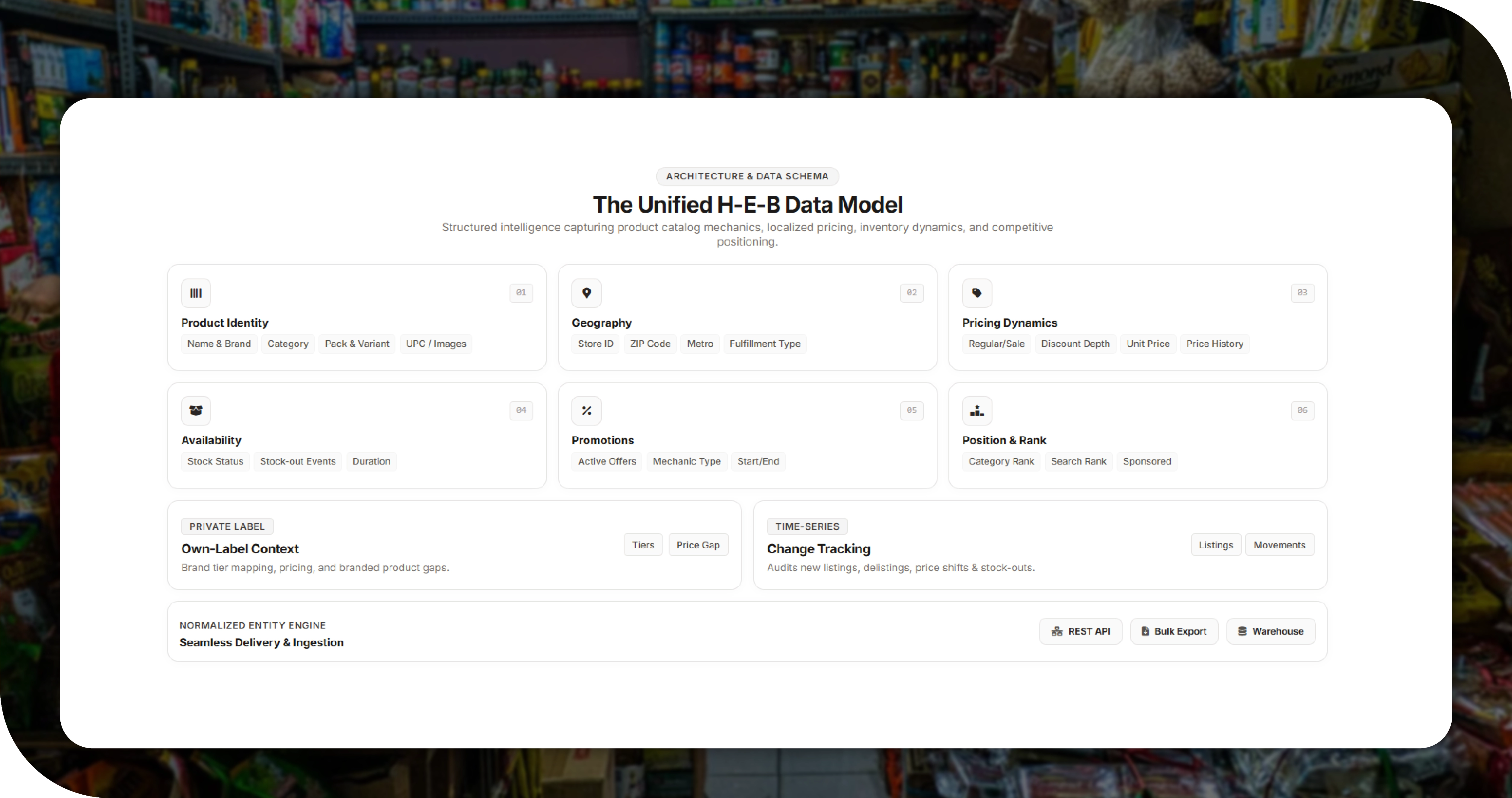
The FoodDataScrape H-E-B Data Model
- Product identity: product name, brand, normalized name, category and sub-category, pack size, variant, UPC where published, images
- Geography: store ID, ZIP code, metro, fulfillment type
- Pricing: regular price, sale price, discount depth, unit price, promotional pricing, price history
- Availability: in-stock or out-of-stock status per store, stock-out events, stock-out duration
- Promotions: active offers, mechanic type, discount depth, promotion start and end detection
- Position: category rank, search rank for defined terms, sponsored placement detection where publicly labeled
- Own-label context: H-E-B own-brand tier mapping, own-label price, price gap to the branded product
- Change tracking: new listings, delistings, price movements, rank changes, stock-out events
Delivered via REST API with JSON responses, bulk export (CSV, JSON, Parquet), or scheduled files into a warehouse, normalized so the same product resolves to a single entity.
Methodology and Compliance
- We collect publicly accessible catalog, price and availability information only. No authenticated content, no private data, no personal consumer data. Member-only prices are excluded and flagged as such.
- Collection is at the store or ZIP level, because a statewide average conceals the regional variance that makes the data valuable.
- Products are normalized — UPC-first where available — so cross-retailer and cross-store comparison is genuinely like-for-like.
- Unit price is computed, enabling true comparison across differing pack sizes.
- Price and availability are captured together, since a price on an out-of-stock item is not a price a shopper can act on.
- Crawlers are rate-limited and engineered not to degrade the sites we collect from.
Conclusion
H-E-B is the center of gravity in Texas grocery, and its shelf — the prices, the availability, the own-label gaps, the store-by-store assortment — is where a large share of the state's grocery volume is decided. All of it is public, all of it is current, and none of it is usable from inside a shopping interface built for filling a cart.
An H-E-B Grocery Data Scraping API makes it usable: structured, store-level, cross-store, with own-label gaps quantified and every change tracked, delivered where your software can actually consume it.
FoodDataScrape crawls 220M+ pages of food and grocery data every week so that your view of the H-E-B shelf is complete, current and comparable — not a series of manual screenshots.