Introduction
Modern households are increasingly managed through mobile applications that bring grocery planning, budgeting, shopping lists, meal organization, inventory tracking, bill management, and smart-home activities into one digital ecosystem. As these applications generate increasingly valuable information, Household Management App Data Scraping is becoming an important approach for businesses seeking structured insights into household behavior, spending patterns, product preferences, and digital home-management trends.
At the same time, Grocery Data Scraping for Household Apps enables businesses to monitor product names, prices, categories, pack sizes, discounts, availability, ratings, and other grocery attributes. Combining this information with household-oriented application data can create a comprehensive view of how consumers plan purchases, compare prices, manage budgets, and replenish everyday essentials.
Another important capability is Household Management Data Extraction, which can transform scattered application information into structured datasets suitable for analytics, dashboards, forecasting systems, recommendation engines, and market research. For retailers, grocery platforms, consumer brands, fintech companies, and technology providers, this data can reveal opportunities that conventional market research may overlook.
Why Household Management Apps Are Becoming Data-Rich Ecosystems?
Household management applications have evolved far beyond simple digital shopping lists. Many platforms now support grocery inventories, recurring purchases, expense tracking, family calendars, recipe planning, household chores, subscription management, and connected-home features.
Every interaction can contribute to a broader understanding of household activity. A grocery list may reveal product demand, while a budget tracker can indicate spending constraints. Inventory records can highlight replenishment cycles, and shopping recommendations can reveal consumer preferences.
When collected responsibly from publicly accessible or authorized sources, these datasets can help organizations understand consumer behavior at a much more granular level.
The real value does not come from collecting isolated fields. It comes from connecting different data points and transforming them into actionable intelligence.
What Data Can Be Collected From Household Management Applications?
The exact fields available depend on the application, its public interfaces, permissions, and applicable terms. However, household-focused datasets can potentially contain several useful categories.
Grocery and Product Information
Product-related information may include:
- Product name
- Brand
- Category
- Subcategory
- Pack size
- Unit
- Listed price
- Discount
- Promotional price
- Availability
- Product rating
- Product attributes
- Dietary tags
- Store or retailer
- Product URL
- Collection timestamp
This information can support price monitoring, assortment analysis, grocery benchmarking, and demand forecasting.
Household Budget Information
Budget-oriented datasets can help businesses understand spending structures at an aggregated level. Depending on the data source and authorization, relevant fields may include expense categories, planned budgets, recurring expenses, spending ranges, and purchase classifications.
These datasets can reveal whether consumers are shifting spending toward private labels, reducing discretionary purchases, increasing grocery budgets, or responding to inflationary pressure.
Household Inventory Information
Digital inventory management is another valuable category. Applications may help users track pantry products, cleaning supplies, beverages, personal-care products, and other household essentials.
Structured inventory information can help identify frequently purchased categories and potential replenishment patterns.
Unlock smarter household and grocery insights with reliable data scraping—connect with Food Data Scrape today for tailored solutions.
How to Scrape Household Grocery Data?
Scrape Household Grocery Data to support businesses that want to understand the grocery component of household-management ecosystems. Instead of looking at individual products independently, businesses can build structured datasets covering categories, prices, promotions, brands, pack sizes, and availability.
For example, a retailer could compare the prices of frequently purchased household products across multiple digital grocery sources. A consumer packaged goods company could monitor how competing brands are positioned within household shopping lists or recommendation environments.
The resulting dataset can be organized by product, category, retailer, geography, date, and other relevant dimensions. Historical snapshots can then be used to identify price movements and assortment changes.
Extract Household Budget Data for Spending Intelligence
Extract Household Budget Data to help organizations understand the relationship between household spending and purchasing behavior.
Budget information becomes especially valuable when analyzed alongside grocery pricing. Suppose grocery prices rise over several months while household budgets remain relatively stable. Consumers may respond by switching brands, reducing premium purchases, buying larger packs, using promotions, or moving toward discount retailers.
These behavioral changes can be transformed into useful market indicators.
Financial service providers can use aggregated and appropriately sourced information to improve consumer-spending analysis. Retailers can identify price-sensitive segments. Grocery companies can evaluate how pricing strategies could influence purchase frequency.
The objective is not simply to collect numbers but to understand the relationship between budget → product selection → purchase frequency → household demand.
Smart Home Data Creates a New Intelligence Layer
Smart Home Management Data Scraping introduces another dimension to household intelligence. Smart-home ecosystems can involve connected appliances, energy-management systems, home-maintenance tools, device dashboards, and household automation applications.
Where data is publicly accessible or explicitly authorized, information around product categories, device capabilities, prices, promotions, availability, and consumer-facing features can provide useful competitive intelligence.
For example, businesses can monitor how smart refrigerators, robotic vacuum cleaners, kitchen appliances, air-quality devices, and other connected products are positioned across digital marketplaces and household applications.
Combining smart-home information with grocery and household purchasing data can also help businesses understand the growing relationship between connected devices and everyday consumption.
Building Household Market Intelligence From Multiple Data Sources
Household Market Intelligence Data becomes significantly more powerful when multiple sources are integrated into one analytical framework.
A comprehensive household intelligence dataset could combine:
| Data Category | Example Fields | Business Application |
|---|---|---|
| Grocery | Product, brand, price, size | Price benchmarking |
| Promotions | Discount, offer, coupon | Promotion intelligence |
| Inventory | Product, quantity status, category | Replenishment analysis |
| Budget | Category, planned spend, actual spend | Consumer spending analysis |
| Retailer | Store, platform, geography | Competitive benchmarking |
| Smart Home | Device, category, price | Product intelligence |
| Recipes | Ingredients, meal type, cuisine | Demand forecasting |
| Reviews | Rating, sentiment, feedback | Product improvement |
Once standardized, this information can feed dashboards, business intelligence systems, machine-learning models, recommendation engines, and forecasting platforms.
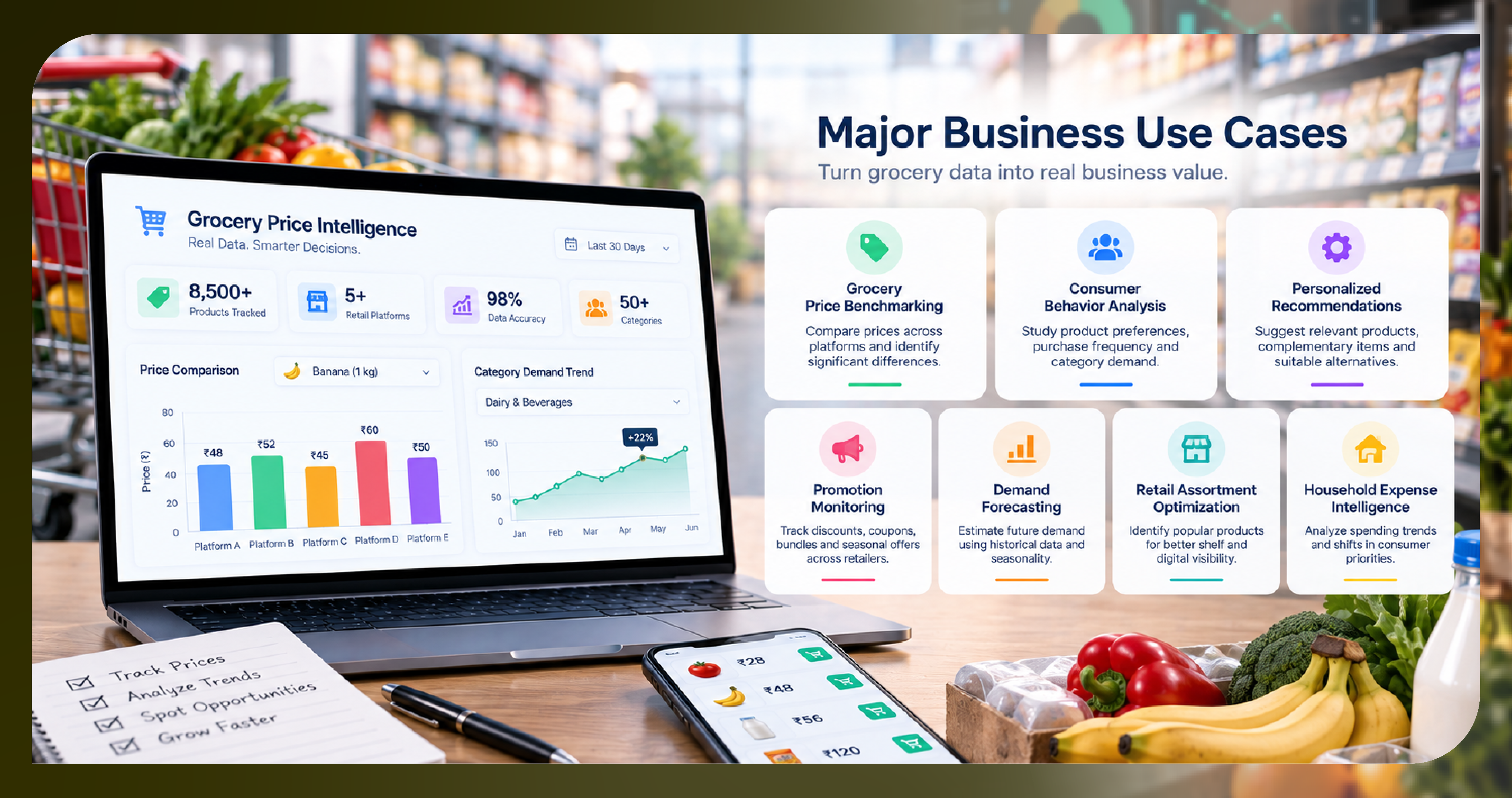
Major Business Use Cases
1. Grocery Price Benchmarking
Retailers can compare grocery prices across competing platforms and identify products where pricing differences are significant.
2. Consumer Behavior Analysis
Brands can study product preferences, purchase frequency, category demand, and household consumption patterns using appropriately aggregated datasets.
3. Personalized Recommendations
Historical product and shopping-list information can help recommendation systems identify relevant products, complementary items, and potential substitutions.
4. Promotion Monitoring
Businesses can track discounts, coupons, bundles, and seasonal offers to understand promotional strategies across competing retailers.
5. Demand Forecasting
Historical grocery and household datasets can help estimate future demand for essential categories, particularly when combined with seasonality and pricing information.
6. Retail Assortment Optimization
Retailers can identify popular products and categories that may deserve greater shelf, digital-search, or promotional visibility.
7. Household Expense Intelligence
Aggregated expense information can help identify shifts in household spending and changes in consumer priorities.
Why Data Quality Matters?
A household-management dataset is only useful when the underlying information is accurate, consistent, and regularly refreshed.
Product names may vary between platforms. Units can differ between kilograms, grams, liters, milliliters, packs, and individual pieces. Promotional prices may have different validity periods, while products can disappear temporarily because of inventory changes.
A reliable data pipeline therefore requires normalization, deduplication, validation, timestamping, and appropriate monitoring.
For grocery intelligence, unit-level normalization is particularly important. Comparing a ₹100 product with a ₹120 product is not meaningful if their package sizes are different. Businesses should calculate comparable metrics such as price per kilogram, price per liter, or price per unit wherever appropriate.
From Raw App Data to Actionable Dashboards
The next stage after extraction is visualization.
A household intelligence dashboard can display:
- Average grocery prices
- Price changes over time
- Brand-level comparisons
- Promotional intensity
- Category-level spending
- Product availability
- Household budget allocation
- Popular grocery categories
- Replenishment patterns
- Retailer comparisons
Interactive dashboards allow decision-makers to move from high-level market trends to individual product or category details.
For example, a grocery retailer could quickly identify which essential categories experienced the largest price changes during a specific month. A consumer brand could monitor competitor promotions across different regions.
AI and Predictive Household Intelligence
Artificial intelligence can significantly increase the value of household datasets. Once structured data is available, AI models can identify relationships that may be difficult to detect through manual analysis.
Predictive systems can potentially forecast demand, identify likely product substitutions, classify household expenses, detect unusual pricing movements, and generate personalized recommendations.
AI can also combine historical grocery prices, product attributes, household purchasing patterns, promotions, and seasonal trends to create more sophisticated decision-support models.
This creates an evolution from simple data collection toward intelligent household commerce.
Challenges in Household Management App Data Scraping
Household application data can present several technical and operational challenges.
Applications frequently change interfaces, data structures, authentication mechanisms, and content organization. Some information may be dynamically loaded, while other data may be available only to authenticated users.
Data privacy is another critical consideration. Businesses should avoid collecting private, sensitive, or unauthorized personal information. Data collection should follow applicable laws, platform terms, permissions, and responsible data-governance practices.
Scalability is also important. A system designed to monitor a few hundred products may struggle when expanded to millions of records across multiple platforms.
Therefore, businesses should prioritize compliant sourcing, structured extraction, validation, security, and scalable infrastructure.
How Food Data Scrape Can Help You?
1. Structured Household Datasets
Food Data Scrape can help transform relevant grocery and household information into structured datasets organized by products, categories, brands, pricing, promotions, retailers, and other business requirements.
2. Grocery Intelligence
Businesses can obtain regularly refreshed grocery information to compare prices, monitor promotions, analyze assortment changes, and identify consumer-market opportunities across multiple digital sources.
3. Customized Data Pipelines
Custom extraction workflows can be designed around specific fields, locations, retailers, categories, frequencies, and output formats, helping businesses receive information aligned with analytical requirements.
4. Analytics-Ready Outputs
Cleaned, standardized, and validated datasets can support dashboards, market research, competitive intelligence, forecasting models, recommendation engines, and other downstream business applications.
5. Scalable Data Solutions
Food Data Scrape can support organizations requiring recurring data collection and large-scale datasets, enabling businesses to monitor changing household grocery and retail trends efficiently.
Conclusion
Household management applications are becoming important digital touchpoints for understanding grocery planning, budgeting, inventory management, shopping behavior, and connected-home activities. When responsibly sourced and transformed into structured datasets, this information can provide valuable insights for retailers, brands, technology companies, market researchers, and consumer businesses.
Mobile App Scraping can help organizations collect relevant publicly available or authorized application information at scale, while Grocery Data Scraping Services can turn grocery product, pricing, promotion, and availability information into useful commercial intelligence.
The next opportunity lies in combining these datasets with artificial intelligence. AI Grocery Intelligence can help businesses move beyond historical reporting toward predictive pricing, demand forecasting, product recommendations, assortment optimization, and smarter consumer-market decisions.
As households increasingly rely on digital tools to organize everyday activities, the organizations capable of converting fragmented household data into reliable intelligence will be better positioned to understand changing consumer needs and respond to an increasingly data-driven retail environment.
Are you in need of high-class scraping services? Food Data Scrape should be your first point of call. We are undoubtedly the best in Food Data Aggregator and Mobile Grocery App Scraping service and we render impeccable data insights and analytics for strategic decision-making. With a legacy of excellence as our backbone, we help companies become data-driven, fueling their development. Please take advantage of our tailored solutions that will add value to your business. Contact us today to unlock the value of your data.
Get a Free Food Data Sample in 48 Hours.
Tell us your platforms, target markets and required fields — we'll map exactly what's possible with food data scraping, recommend the right approach, and send a working sample so you can verify quality before any commitment.
Request a strategy call
Thanks — our data team will reach out within 48 hours with your sample.