Introduction
Choosing a food data provider is easier when you start with a written spec, not a vendor list. Many first-time buyers ask for a dashboard or a sample before they know which platforms, fields or refresh cadence they need. That makes quotes hard to compare.
The short answer: to choose a food data provider, define your use case, platforms, countries, fields and refresh cadence first. Then ask each vendor for a free sample, a data dictionary, a QA method, delivery options and a compliance statement. Run a small paid or free pilot before you sign a long contract.
This guide covers the four main ways to get food data (build vs buy), a 12-point checklist, questions to ask for six common use cases, and the red flags that should end a conversation.
Why choosing the right food data provider matters
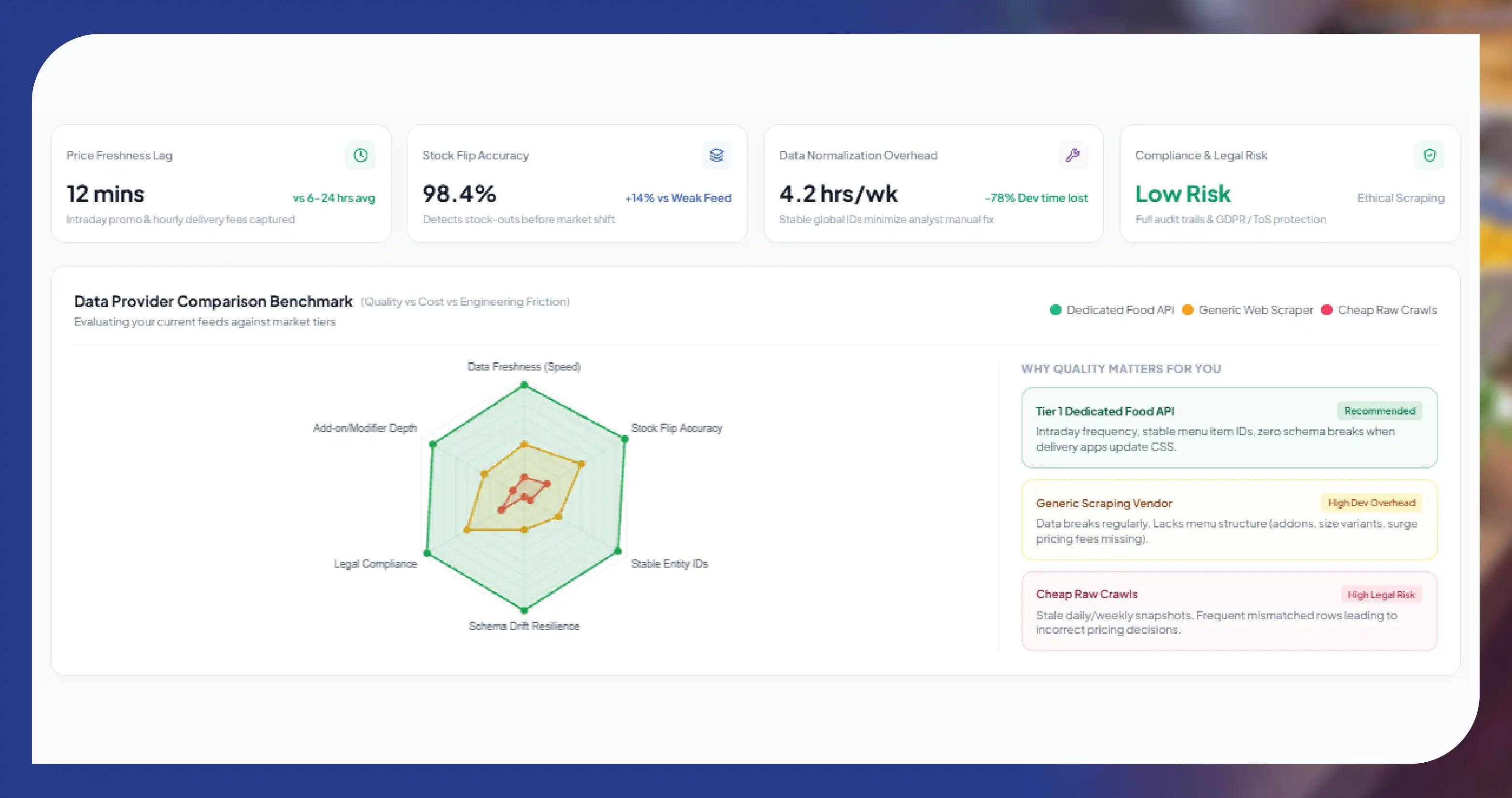
Food data changes fast, and the food data provider you pick decides how well you keep up. Menu prices move with promotions, delivery fees change by hour and grocery stock flips between in stock and out of stock several times a day. A weak data source gives you stale or mismatched rows, and your pricing or market decisions inherit the errors.
The choice also affects your engineering time. A feed that arrives in the wrong format, with no stable IDs, can cost your analysts more hours than the data itself saves. And if a vendor collects data in a careless way, your legal team carries the risk too.
Typical buyers include restaurant brands tracking competitor menus, CPG and FMCG teams watching shelf prices, quick-commerce and delivery start-ups, liquor retailers, nutrition apps and sales teams building HoReCa outlet lists. Each needs a slightly different setup, which is why a checklist beats a generic sales demo.
Build vs buy: four ways to get food data
Before you compare any food data provider, decide which sourcing model fits. There are four common options, and many teams mix them: for example, a ready-made dataset for a one-off market study plus a managed feed for weekly price tracking.
- In-house scrapers: your engineers write and maintain collectors. You keep full control but own every break, block and schema change.
- Managed data services or feeds: a food data provider collects, cleans and delivers data on a schedule to your spec. Less control over code, much less maintenance.
- Scraping platforms or APIs: you rent tools or an API and build the logic yourself. A middle path that still needs technical staff.
- Ready-made dataset marketplaces: you buy a pre-built file. Fast and simple, but fields and dates are fixed.
- Official platform partner APIs: some delivery and retail platforms offer APIs to partners. Reliable for your own store or orders, but usually limited to your own account data rather than market-wide pricing.
Menu-intelligence and research firms are a fifth type. They sell analysis and reports built on their own data, which suits teams that want answers rather than raw rows.
| Option | Best for | Setup time | Ongoing effort for your team | Main trade-off |
|---|---|---|---|---|
| In-house scrapers | Teams with data engineers and a narrow, stable scope | Weeks to months | High – fixes, proxies, QA, monitoring | Full control, but every site change is your problem |
| Managed data service / scheduled feed | Recurring price, menu or availability tracking across many platforms | Days to a few weeks | Low – review QA reports and samples | Less control over collection code; depends on vendor SLAs |
| Scraping platform or API | Developers who want building blocks without running servers | Days to weeks | Medium – you write parsers and matching | Tool cost plus staff time; compliance still on you |
| Ready-made dataset marketplace | One-off studies, model training, quick market sizing | Same day to days | Low | Fixed fields and snapshot dates; may not match your markets |
| Official platform partner API | Your own store, menu or order data | Depends on partner approval | Low to medium | Usually limited to your own account, not competitors |
| Menu-intelligence / research firm | Executive insight, trend reports | Days | Low | Analysis rather than raw, flexible data |
A simple rule of thumb: build when the scope is small, stable and core to your product. Buy when you need many platforms or countries, frequent refreshes, or when engineering time is better spent elsewhere.
The 12-point checklist for choosing a food data provider
Use these 12 points to score each food data provider. Ask for answers in writing so you can compare them side by side.
- Coverage by platform and country: list the exact platforms (for example DoorDash, Deliveroo, Talabat, Zomato, Blinkit, Tesco) and cities you need. Ask which ones the vendor already collects and which would be new builds.
- Field depth and data dictionary: ask for a data dictionary with each field name, type and meaning – item name, price, discount price, pack size, rating, delivery fee, ETA, availability, timestamp. A food data provider that cannot share one is guessing.
- Freshness and cadence: agree on refresh frequency (hourly, daily, weekly) and on what timestamp each row carries. Ask how they handle time zones and peak hours.
- Matching and de-duplication: ask how they match the same restaurant across apps, the same SKU across retailers, or a product to its UPC or EAN barcode where that is shown publicly. Matching is often the hardest part.
- QA and sampling: ask for a free sample for your own platforms and cities, plus their QA method – null-rate checks, price range checks, spot checks against the live site.
- Delivery formats: confirm the format your team can use – CSV, JSON, Excel, a REST API, S3 or cloud storage drops, or a dashboard. Check file naming and schema stability.
- Compliance: the food data provider should collect only publicly available business data, respect robots.txt, terms of service and rate limits, and avoid personal data. Ask for a short written sourcing statement your legal team can review.
- Change handling: apps redesign often. Ask how fast they detect a broken collector, how they notify you and whether field names change without warning.
- SLAs and support: ask about delivery-time commitments, a named contact, response times and what happens if a delivery is missed.
- Pricing model: common models are per record, per refresh, per platform or a monthly subscription. Ask what counts as a record and what costs extra (new fields, new cities, re-runs).
- Pilot or proof of concept: run a short pilot on a small scope – one country, two or three platforms, two weeks – and judge real deliveries, not slides.
- References and case studies: ask for anonymised case studies close to your use case and, if possible, a reference call. Check that results are described honestly.
How to review a free sample in 30 minutes
- Open it in your own tool: load the CSV or JSON into your BI tool or spreadsheet. If it does not load cleanly, that is your answer.
- Spot-check 20 rows: compare prices and availability with the live app or website at the same time of day.
- Check nulls and duplicates: count blank prices, repeated items and missing timestamps.
- Check IDs: each restaurant, outlet or SKU should have a stable ID that stays the same in the next delivery.
Questions to ask a food data provider by use case
The general checklist covers the basics. These questions dig into what matters most for each use case.
| Use case | Key questions to ask | Fields to confirm |
|---|---|---|
| Menu pricing | Do you capture base price and promo price separately? Can you match the same dish across apps? | restaurant_id, item_name, category, base_price, offer_price, add-ons, timestamp |
| Grocery price monitoring | How do you handle pack size and unit price? Do you capture prices by store or postcode? | sku_id, brand, pack_size, unit_price, mrp or list price, promo flag, store or pincode |
| Quick-commerce availability | How often can you check stock by dark-store area? Do you record ETA and delivery fee? | sku_id, in_stock, delivery_eta, delivery_fee, area code, check time |
| Liquor pricing | Do you respect age-gates and regional sale rules? Can you separate bottle sizes and multipacks? | product_name, abv, volume_ml, price, state or region, retailer |
| Nutrition and allergen | Is the data taken from the publicly shown label or menu page? How do you flag missing allergen info? | item_name, calories, macros, allergen list, source_url, capture date |
| HoReCa outlet lists | Is the list limited to public business-listing data? How do you de-duplicate outlets across sources? | outlet_name, cuisine, address, city, rating, review count, public business phone if listed |
For HoReCa lists, keep the data at business-listing level. A responsible food data provider will not sell owner names, personal mobile numbers or staff contacts.
Legal and compliance basics
Most food data – menus, prices, ratings, store locations – is business information. Problems start when personal data slips in, such as reviewer names or private contact details. Data protection laws apply to information about identifiable people, not to a restaurant's menu.
- EU GDPR: the official text of Regulation (EU) 2016/679 is on EUR-Lex (https://eur-lex.europa.eu/eli/reg/2016/679/oj).
- UK GDPR: the ICO explains that personal data is information relating to an identifiable living person, and that company information on its own is not personal data (https://ico.org.uk/for-organisations/uk-gdpr-guidance-and-resources/personal-information-what-is-it/what-is-personal-information-a-guide/).
- California CCPA: the California Attorney General's page sets out consumer rights and notes that personal information does not include publicly available information as defined in the law (https://oag.ca.gov/privacy/ccpa).
- India DPDP Act 2023: the official text of the Digital Personal Data Protection Act is published by MeitY (https://www.meity.gov.in/static/uploads/2024/06/2bf1f0e9f04e6fb4f8fef35e82c42aa5.pdf).
Beyond privacy law, a good food data provider respects robots.txt, platform terms of service and rate limits, and never logs in to accounts, bypasses CAPTCHAs or goes behind paywalls. This is general information, not legal advice; ask your own counsel to review any sourcing statement.
Red flags when choosing a food data provider
- Promises of 100% accuracy: real-world data has gaps. Look for a clear QA method and honest error handling instead.
- Selling personal contact data: owner phone numbers, staff emails or customer lists are a legal and ethical risk.
- Bypassing logins or security: any offer to use other people's accounts, defeat CAPTCHAs or scrape behind paywalls should end the talk.
- No sample, no data dictionary: if they will not show real output for your scope, you cannot judge quality.
- Vague pricing: no definition of what a record or a refresh is usually means surprise costs later.
- No change-handling plan: if they cannot explain what happens when an app redesigns its pages, expect gaps.
How to write a simple data spec before you contact vendors
A one-page spec gets you faster, comparable quotes from every food data provider you contact. Include:
- Goal: the decision the data supports, for example weekly competitor menu pricing in Dubai.
- Sources: platforms, websites or apps, and countries and cities.
- Fields: a must-have list and a nice-to-have list.
- Cadence and history: how often, and whether you need past data or only from today.
- Volume estimate: rough number of outlets, SKUs or cities.
- Delivery: format, destination and who will use it.
With this in hand, you can ask for a sample that matches your real scope. You can also see quickly whether a ready-made dataset fits or whether you need a scheduled feed or API.
How Food Data Scrape approaches a new project
In our own inquiries, many first-time buyers arrive without a spec. Our data team usually starts by turning the request into a field list, a platform list and a cadence, then shares a sample for review. Delivery can be a ready-made dataset, a scheduled feed, a real-time API or a dashboard, depending on the use case. Coverage is set per project across the countries and platforms you need – ask for the current list.
Get a free sample dataset. Share your platforms, countries, fields and refresh cadence, and our data team will prepare a sample for your exact scope so you can test it before you decide.
Questions
Frequently Asked Questions
A food data provider is a company that collects, cleans and delivers food-related data, such as restaurant menus, grocery prices, delivery fees, stock status or nutrition details, from public sources in a structured format.
Build if the scope is small, stable and core to your product, and you have engineers to maintain it. Buy if you need many platforms, countries or frequent refreshes, or want predictable effort.
Real rows for your own platforms and cities, every field you plan to use, timestamps, stable IDs and the same format you will receive later.
Common models are per record, per refresh, per platform or a monthly subscription. Ask each food data provider to define what counts as a record and what costs extra.
Collecting publicly available business data is widely practised, but rules vary by country and platform. Choose a food data provider that respects robots.txt, terms of service and rate limits, avoids personal data, and can explain its sourcing to your legal team.
Get a Free Food Data Sample in 48 Hours.
Tell us your platforms, target markets and required fields — we'll map exactly what's possible with food data scraping, recommend the right approach, and send a working sample so you can verify quality before any commitment.
Request a strategy call
Thanks — our data team will reach out within 48 hours with your sample.