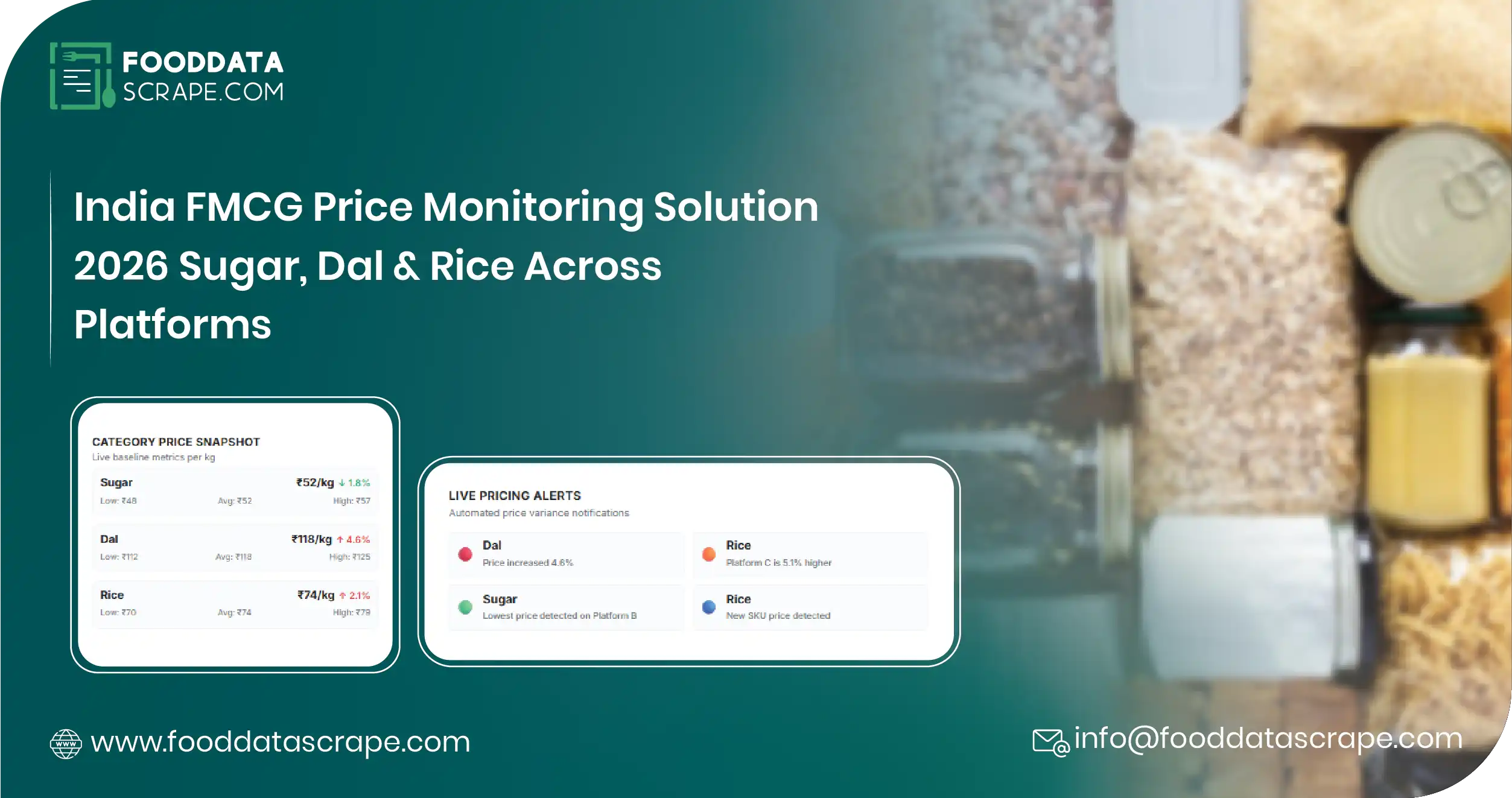
Introduction — Why India FMCG Staples Price Comparison Matters in 2026
Sugar, dal, and rice are the three foundational staples — and sugar dal rice price monitoring India has become critical infrastructure — of the Indian household grocery basket — categories where daily pricing dynamics across quick-commerce platforms, e-commerce marketplaces, and traditional grocery e-tailers directly shape consumer spend, brand share, and category economics. In 2026, with Blinkit, Zepto, BigBasket grocery data services, Amazon Fresh India data extraction, JioMart, Swiggy Instamart, and DMart Ready all competing for the same household basket across every major Indian metro, the ability to see per-SKU staples pricing across every platform every day has moved from an analytical luxury to an operational requirement for FMCG brands, category teams, and grocery aggregators.
This is exactly the problem that a modern India FMCG Price Monitoring Solution pipeline solves. When Indian FMCG analytics teams and category managers deploy purpose-built India grocery data scraping services, they gain daily-refreshed visibility across every major Indian q-commerce and e-commerce grocery platform — turning staples pricing decisions from weekly guesswork into daily precision anchored to what shoppers actually see on their apps.
This guide breaks down how leading Indian FMCG brands, category teams, and grocery aggregators build a staples pricing intelligence capability in 2026, with real sample data structures for sugar, dal, and rice across major Indian platforms, use cases, and the specific pipeline architecture that powers Indian grocery intelligence programs at scale.
The 2026 India Grocery Platform Landscape — What Changed
Three structural shifts have made daily India staples pricing intelligence essential in 2026, and each one increases the value of a properly designed Blinkit price data extraction and Zepto product data scraping pipeline.
1. Quick-commerce has permanently reshaped the staples buying occasion. Blinkit, Zepto, and Swiggy Instamart now deliver sugar, dal, and rice in 10-15 minutes across every major metro — meaning staples buying has shifted from planned monthly kirana visits to impulse or top-up q-commerce orders. India q-commerce competitor tracking across these three platforms plus the traditional grocery e-commerce set has become the operational baseline for any FMCG brand or category team.
2. Platform-specific pricing has fragmented the "single price" concept. The same 1 kg pack of Aashirvaad Atta can now sit at four different prices across Blinkit, Zepto, BigBasket, and Amazon Fresh in the same Bengaluru neighborhood on the same day — with promotional overlays adding a fifth variable. Continuous India FMCG category analytics that captures all platforms simultaneously is the only way to see the actual competitive picture.
3. Private-label penetration has accelerated in staples categories. BigBasket Fresho, Amazon Fresh's Solimo, JioMart's Good Life, and Blinkit's private-label offerings now compete directly with branded staples — often at 15-25% price gaps that shift weekly based on procurement dynamics. Branded FMCG teams need continuous visibility into these private-label pricing corridors to defend category share.
The Indian FMCG operators winning in 2026 are those with the fastest, cleanest daily visibility into how sugar, dal, rice, and adjacent staples are actually priced across every platform their target shoppers actually use.
What India FMCG Staples Price Comparison Data Delivers
A modern India multi-platform grocery pricing pipeline is a data infrastructure that continuously scrapes product listings, pricing, availability, and promotional overlays from every major Indian grocery platform — anchored to specific pincodes and delivery zones for local competitive accuracy.
A well-designed India grocery e-commerce data pipeline captures:
- Per-SKU shelf price in INR across every monitored platform
- Promotional overlays (coupon codes, platform discounts, membership prices, festival offers)
- Availability and delivery-time signals per pincode
- Pack size and per-kg unit-price normalization for staples
- Brand and private-label equivalents (Aashirvaad, Fortune, Tata Sampann, plus BigBasket Fresho, Solimo, Good Life)
- Category tagging aligned to Indian grocery merchandising structure
- Pincode-level and city-level attribution
- Daily or 12-hour refresh cadence based on category volatility
- Historical time-series for seasonal pattern analysis (festival, monsoon, harvest cycles)
The output plugs directly into the operator's pricing dashboard, category-review workflow, or consumer-facing grocery app — replacing weekly manual comparisons with continuous multi-platform staples intelligence.
Sample Data — Real Indian Staples Snapshot
Below is a sample of the structured output a properly designed Indian FMCG category analytics pipeline produces for a category manager tracking sugar, dal, and rice SKUs across four Indian grocery platforms including JioMart grocery data scraping coverage in a Bengaluru pincode.
Sample 1 — Multi-Platform Staples Price Snapshot
| SKU | Pack | Blinkit ₹ | Zepto ₹ | BigBasket ₹ | Amazon Fresh ₹ | Cheapest |
|---|---|---|---|---|---|---|
| Madhur Sugar | 1 kg | 48 | 46 | 50 | 49 | Zepto |
| Trust Sugar | 1 kg | 45 | 44 | 47 | 46 | Zepto |
| Tata Sampann Toor Dal | 1 kg | 195 | 189 | 199 | 192 | Zepto |
| Fortune Chana Dal | 1 kg | 155 | 149 | 159 | 152 | Zepto |
| BB Royal Toor Dal | 1 kg | — | — | 179 | — | BB only |
| India Gate Basmati | 5 kg | 725 | 699 | 745 | 719 | Zepto |
| Daawat Rozana Basmati | 5 kg | 549 | 525 | 559 | 545 | Zepto |
| Fortune Sona Masoori | 5 kg | 425 | 419 | 449 | 429 | Zepto |
The sample reveals immediate signals: Zepto is systematically cheapest across 7 of 7 comparable SKUs, with 5-8% gaps below BigBasket shelf pricing — a consistent pattern that suggests aggressive Zepto pricing to capture share. BigBasket's private-label BB Royal ranges (Toor Dal at ₹179, Sonamasoori at ₹399) sit meaningfully below the branded equivalents (Tata Sampann Toor at ₹199, Fortune Sona Masoori at ₹449) — a 10-15% branded-vs-private-label gap that a Fortune or Tata Sampann category manager needs to watch closely. Blinkit and Amazon Fresh sit in the middle across most SKUs.
Sample 2 — 4-Week Staples Price Trend Panel
| SKU | Wk 1 | Wk 2 | Wk 3 | Wk 4 | Trend |
|---|---|---|---|---|---|
| Madhur Sugar 1kg | Zepto ₹46 | Zepto ₹46 | Zepto ₹47 | Zepto ₹47 | +₹1 (2%) |
| Tata Sampann Toor Dal | Zepto ₹189 | Zepto ₹192 | Zepto ₹195 | Zepto ₹199 | +₹10 (5%) |
| India Gate Basmati 5kg | Zepto ₹699 | Zepto ₹705 | Zepto ₹712 | Zepto ₹719 | +₹20 (3%) |
| Fortune Chana Dal 1kg | Zepto ₹149 | Blinkit ₹152 | Zepto ₹151 | Zepto ₹149 | Volatile |
| Daawat Rozana 5kg | Zepto ₹525 | Zepto ₹529 | Zepto ₹535 | Zepto ₹545 | +₹20 (4%) |
Four weeks of data reveals the trend the category team needs to see: pulses (Toor Dal, Chana Dal) and premium rice (Basmati) are on rising price trends — likely reflecting agricultural cycle, procurement cost pressures, and platform pass-through. Sugar is nearly flat. This kind of continuous trend visibility across platforms is impossible from monthly retail audits or panel data delayed 6-8 weeks — it requires the continuous refresh that comprehensive India FMCG category analytics provides.
The Ravikumar Sugar-Dal-Rice Case — Category Manager Intelligence
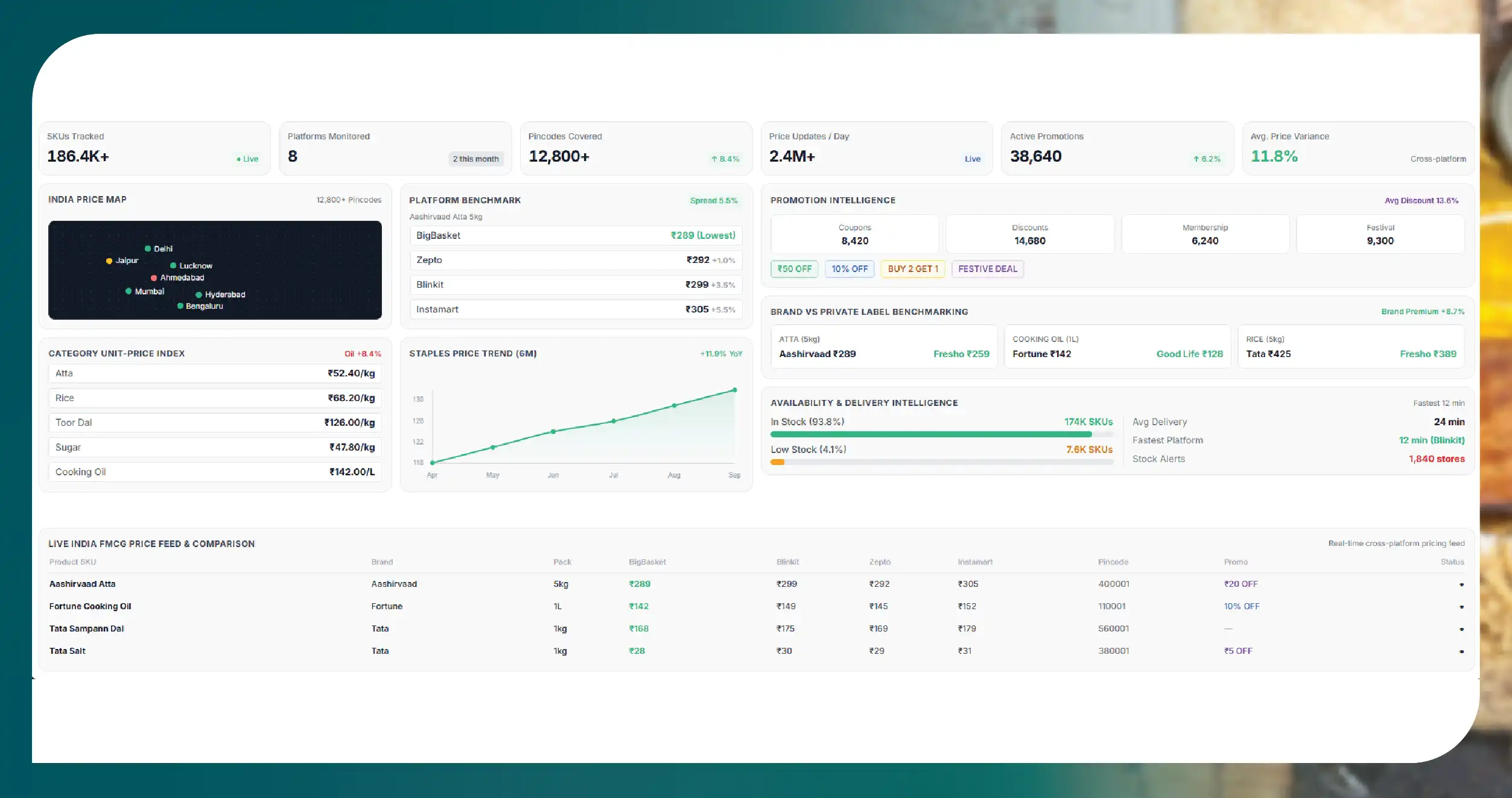
The Ravikumar sugar-dal-rice pattern — an Indian FMCG category manager or grocery analyst tracking 20-50 staples SKUs across Blinkit, Zepto, BigBasket, Amazon Fresh, JioMart, and Swiggy Instamart in target metros — is one of the most common entry points into Indian grocery intelligence deployment.
The Indian staples market combines the two-sided complexity of continuous pricing dynamics driven by agricultural cycles and procurement pressures, plus platform-specific pricing behaviours driven by competitive share capture. A category manager tracking staples across this landscape needs both dimensions visible daily — the agricultural-driven baseline movement AND the platform-driven competitive variation. Continuous multi-platform scraping is the only way to see both.
The sugar-dal-rice patterns visible in Bengaluru — Zepto's systematic price leadership, BigBasket's private-label competitive pressure, festival-cycle promotional spikes — appear in similar forms across Mumbai, Delhi NCR, Chennai, Hyderabad, Kolkata, Pune, and every Indian metro, with local variations in platform intensity, brand preference, and private-label penetration.
How the India Grocery Data Pipeline Architecture Works
FoodDataScrape builds India grocery data pipelines on a five-layer architecture designed for India's specific data challenges — pipelines built specifically for india fmcg grocery price comparison data requirements at production scale.
Layer 1: Platform and Pincode Mapping. For each engagement, the team defines the exact set of platforms (Blinkit, Zepto, BigBasket, Amazon Fresh, JioMart, Swiggy Instamart, DMart Ready) and pincodes to monitor. A typical Bengaluru-focused engagement covers 6-8 platforms across 20-40 pincodes.
Layer 2: Cross-Platform SKU Matching. The same product often appears with variations across platforms. An AI SKU matching layer pairs equivalent SKUs across all platforms and links to their private-label equivalents (Aashirvaad ↔ BigBasket Fresho ↔ Solimo ↔ Good Life) for like-for-like competitive comparison.
Layer 3: Continuous Daily Scraping. Per-platform extractors pull shelf price, promotional overlays, availability, delivery time, and metadata daily across every mapped SKU and pincode. Data is normalized into consistent schema and per-kg unit-price-normalized for staples.
Layer 4: Category Analytics Layer. Raw pricing data is transformed into decision-ready outputs — per-SKU platform-vs-platform gap calculations, per-category promotional cadence, private-label price-gap trends, agricultural-cycle pattern recognition. This is where raw Swiggy Instamart price data becomes true category intelligence.
Layer 5: Delivery and Integration. The platform delivers via REST API, CSV export, S3 delivery, or direct BI stack integration (Power BI, Tableau, Snowflake, Databricks). Grocery apps integrate into consumer-facing products; category teams plug into pricing dashboards.
The build timeline from kickoff to production delivery is typically 5-7 weeks for a mid-scope engagement covering 500-2,000 staples SKUs across 6-8 platforms in a single metro, including a free proof-of-concept sample delivered in the first week.
Why Indian FMCG Operators Choose Continuous Multi-Platform Data
Indian FMCG brands, category teams, and grocery aggregators select continuous India FMCG Price Monitoring Solution pipelines over manual comparisons or off-the-shelf tools for six specific reasons.
- Multi-platform capture in one feed. Indian grocery is uniquely fragmented across q-commerce, e-commerce, and hybrid models. A purpose-built pipeline integrates all platforms into one feed rather than requiring the operator to reconcile multiple sources.
- Q-commerce refresh cadence. Blinkit, Zepto, and Swiggy Instamart change pricing throughout the day. Daily or 12-hour refresh captures these dynamics; weekly audits miss them entirely.
- Private-label equivalence linkage. Indian private-label brands (BigBasket Fresho, Solimo, Good Life, Fresho for JioMart) require careful equivalent matching that generic platforms miss.
- Pincode-level accuracy. Indian grocery pricing varies by pincode; a pipeline that only captures corporate-average pricing produces misleading intelligence.
- Agricultural cycle awareness. Indian staples pricing follows harvest, monsoon, and festival patterns; a purpose-built analytics layer surfaces these patterns rather than flattening them as noise.
- Compliance-aware sourcing. Data sourcing operates within Indian data compliance frameworks and delivers only compliantly-collected retail price data.
Sample Use Cases — How Indian Operators Actually Use the Data
Use Case 1: FMCG Brand Category Manager Weekly Review. A category manager at Fortune, Aashirvaad, or Tata Sampann reviews per-platform staples pricing weekly to inform trade-spend allocation, promotional response, and category strategy against private-label competition.
Use Case 2: Grocery Aggregator Product Feed. An Indian grocery comparison app integrates continuous multi-platform data into its consumer product — showing shoppers the real-time cheapest-per-SKU comparison across every platform available in their pincode.
Use Case 3: Private-Label Competitive Response. A branded manufacturer detects private-label price movements at BigBasket, Amazon Fresh, or JioMart within 24 hours — enabling defensive promotional response before category-share erosion begins.
Use Case 4: Regional and Seasonal Pricing Analysis. A national FMCG brand analyzes seasonal pricing patterns (Diwali, harvest cycles, monsoon) across staples categories to inform annual pricing strategy, promotional calendar, and demand-forecasting inputs.
Use Case 5: Q-Commerce vs E-Commerce Channel Strategy. A brand's channel strategy team analyzes whether q-commerce platforms are cannibalizing e-commerce marketplace share or expanding total category volume — informing platform-specific investment decisions.
Getting Started — The 5-Week Roadmap
Getting an India FMCG Price Monitoring Solution engagement live with FoodDataScrape follows a structured process designed to minimize risk and prove value before scope expansion.
Week 1: Scoping and proof-of-concept. The client defines the SKU list, platforms, target pincodes, refresh cadence, and delivery format. A free proof-of-concept sample is delivered within 5 business days.
Weeks 2-4: Production build. Platform-specific extractors are configured, SKU matching is tuned, category analytics layer is calibrated, and API integration is tested.
Week 5: Live production delivery. The pipeline goes live with daily multi-platform data delivery.
Ongoing: Refinement and expansion. Additional platforms, pincodes, SKUs, and categories are added as needs evolve.
Conclusion — Continuous Multi-Platform India Grocery Data Is the 2026 Standard
The Indian grocery market in 2026 has become too platform-fragmented, too price-dynamic, and too competitively multi-format for weekly manual comparisons or off-the-shelf tools to serve as reliable pricing intelligence. Operators without continuous multi-platform data are structurally disadvantaged against those that have moved to purpose-built India grocery data scraping services pipelines.
The Bengaluru staples pattern is the entry point. Most Indian FMCG brands, category teams, and grocery aggregators expand within 6-12 months to 5,000+ SKUs across multiple metros and every major platform once they see the operational lift from daily continuous visibility.
FoodDataScrape builds the pipelines that deliver this intelligence — covering Blinkit, Zepto, BigBasket, Amazon Fresh India, JioMart, Swiggy Instamart, DMart online price comparison data, and specialty formats with daily refresh, Indian-market SKU matching, private-label linkage, and dedicated category-analytics support.
If you are an Indian FMCG brand, a national or regional grocery aggregator, or a category analyst — daily continuous multi-platform data is the fastest path to closing the visibility gap in the 2026 Indian grocery market.
Ready to See Sample Data for Your SKUs? Tell us your target SKUs, platforms, and pincodes. Get a free proof-of-concept sample of the India multi-platform grocery pricing intelligence output on your actual scope within 5 business days — no commitment required.
Contact FoodDataScrape today for continuous India FMCG pricing intelligence that turns platform complexity into a commercial advantage.
Related Case Studies
- 🇮🇳 India Promo ROI +18% — National restaurant chain — Zomato + Swiggy promo analysis.
- 🇮🇳 Bengaluru Cloud Kitchen Stockouts — 68% stockout cut · ₹8cr revenue recovered.
- 🇦🇪 UAE Q-Commerce SKU — 22% assortment cut · +14% GMV growth.
Questions
Frequently Asked Questions
A well-designed pipeline delivers per-SKU per-platform per-pincode pricing, promotional overlays, availability, per-kg unit-price normalization, private-label equivalents, category tagging, and historical time-series across Blinkit, Zepto, BigBasket, Amazon Fresh, JioMart, Swiggy Instamart, and DMart Ready.
Blinkit, Zepto, BigBasket, Amazon Fresh India, JioMart, Swiggy Instamart, DMart Ready, and other regional platforms as required by the client's competitive scope.
The AI SKU matching layer normalizes pack-size and product-name variations across platforms to produce canonical SKU families for like-for-like comparison, including matching branded SKUs to their private-label equivalents.
Yes — the pincode-anchored multi-platform data structure is specifically designed to power consumer-facing grocery apps showing shoppers real-time cheapest-per-SKU comparisons.
The 18-month historical time-series enables seasonal-pattern detection — surfacing harvest-cycle movements, monsoon effects, and festival-driven pricing spikes across staples categories.
Yes — sourcing operates within Indian data compliance frameworks and only compliantly-collected retail price data is delivered.
Get a Free Food Data Sample in 48 Hours.
Tell us your platforms, target markets and required fields — we'll map exactly what's possible with food data scraping, recommend the right approach, and send a working sample so you can verify quality before any commitment.
Request a strategy call
Thanks — our data team will reach out within 48 hours with your sample.