Introduction
Is it legal to scrape prices from restaurant menus, delivery apps and grocery sites? It is one of the first questions pricing, category and legal teams ask before they buy or build a food price feed. This guide explains the rules in plain English for the four markets we are asked about most.
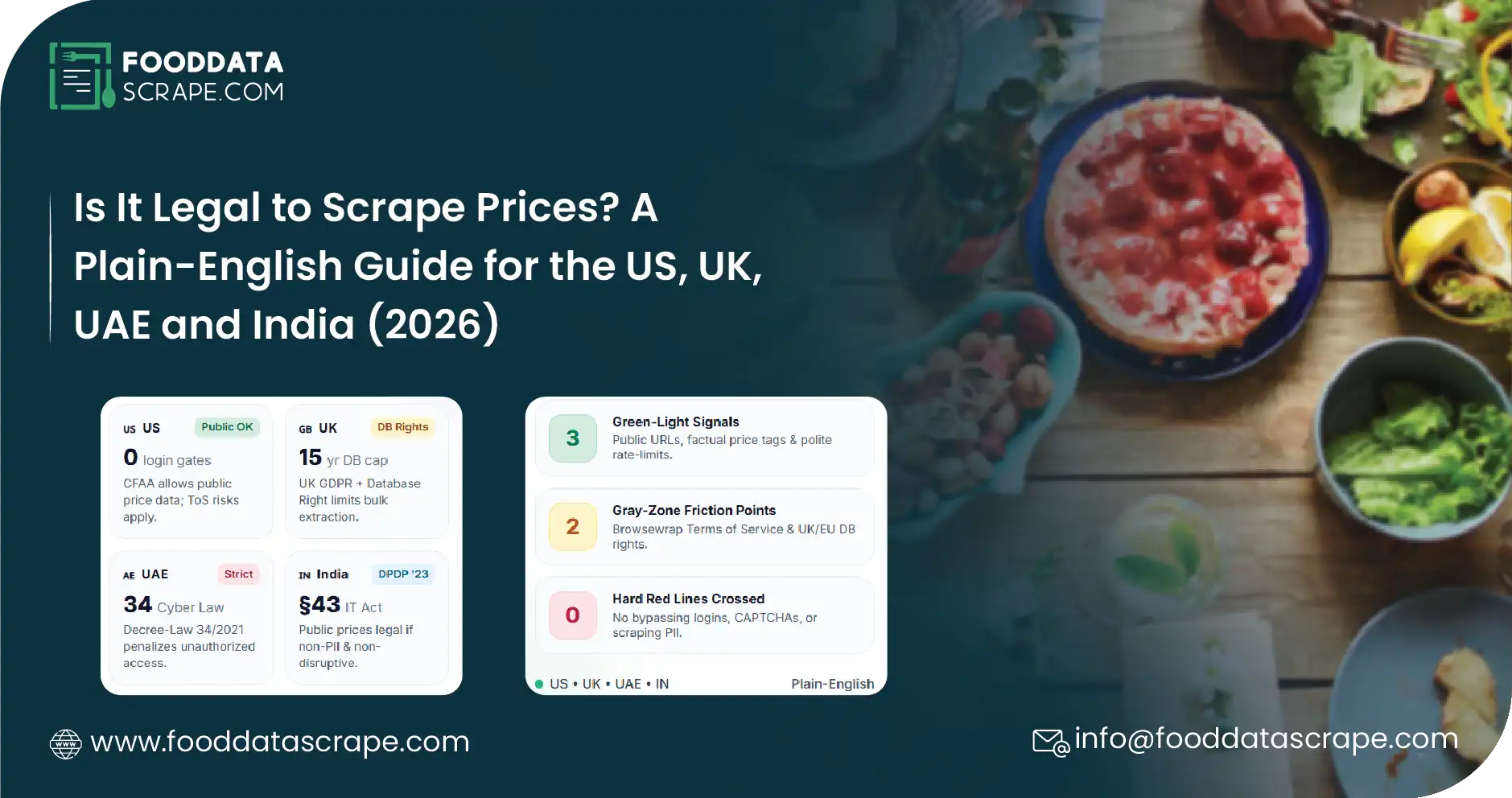
Short answer: collecting publicly displayed prices is generally lower risk in the US, UK, UAE and India when you stay logged out, respect robots.txt and site terms, keep request rates gentle and avoid personal data. Risk rises when you bypass logins or CAPTCHAs, copy whole databases, or republish photos and descriptions.
Below we walk through public versus non-public data, website terms, data protection laws, database rights, copyright and the US court cases people quote most. We finish with official APIs and the questions to ask any provider.
Why food price scraping raises legal questions
Food and beverage businesses watch prices constantly. Restaurant groups compare menu prices on delivery apps, FMCG brands check shelf prices and promotions at grocers, and investors track price moves across cities. Most of that information sits on public web pages and apps.
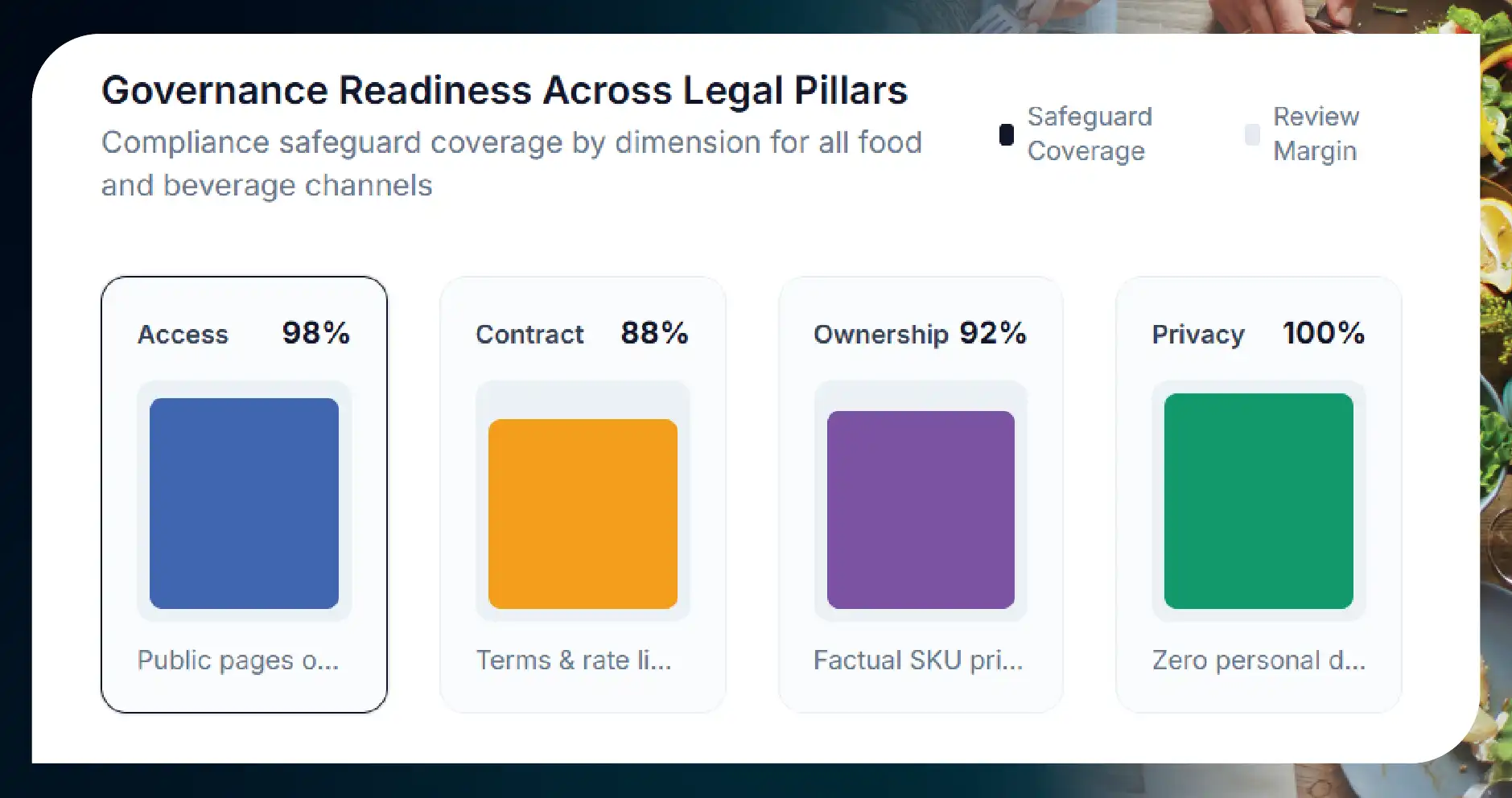
The legal questions come from how the data is collected and used, not from the price itself. Teams usually worry about four things:
- Access – whether the page is public or sits behind a login, paywall or technical barrier.
- Contract – what the website's terms of service say about automated collection.
- Ownership – whether the content is protected by copyright or, in Europe and the UK, database rights.
- Privacy – whether any of the collected fields are personal data about individuals.
Public vs non-public data: where is the line?
A useful first test is simple: could any visitor see this page without signing in, paying or solving a challenge? Menu prices, grocery shelf prices, pack sizes and promotion labels shown to every visitor are public business data. Prices visible only after logging into a merchant portal, a loyalty account or a members' area are not.
Public does not mean free of rules. A public page can still carry terms of use, copyright in its photos and personal data in its reviews. The table below shows how we sort common food data types.
| Data type | Typical status | Why |
|---|---|---|
| Menu item names and prices | Generally OK | Factual business information shown to every visitor |
| Grocery shelf price, unit price, pack size | Generally OK | Public product facts used for price comparison |
| Promotion labels and delivery fees | Generally OK | Public commercial terms displayed before checkout |
| Store or restaurant name, address, opening hours | Generally OK | Public business-listing information |
| Rating score and review count | Usually OK in aggregate | Business-level metric; avoid reviewer identities |
| Reviewer names, profile photos, review text tied to people | Avoid | Personal data under GDPR, UK GDPR, DPDP Act and PDPL |
| Food photos and long marketing descriptions | Avoid republishing | Often protected by copyright; use for internal matching only if counsel agrees |
| Prices behind logins, merchant portals or paywalls | Avoid | Not public; access may breach terms or computer-misuse laws |
| Order volumes or sales data | Not available | Not public; use labelled proxies such as rating counts or bestseller badges |
Terms of service, robots.txt and rate limits
Website terms of service are contracts. Many retailer and delivery-app terms prohibit automated collection, and in earlier compliance reviews we have seen grocery terms that do exactly that. Whether those terms bind a logged-out visitor depends on how they are presented and on local contract law, which is a question for counsel.
In the US, law firm Revision Legal describes breach of contract as one of the most durable claims website owners bring against scrapers (Revision Legal). In practice, a team that has clicked "I agree" or created an account is in a weaker position than a logged-out visitor.
What robots.txt does and does not do
Robots.txt is a file where a site states which paths automated crawlers should avoid. The IETF standard RFC 9309, published in September 2022, notes that these rules "are not a form of access authorization" (RFC 9309). It is still the clearest public signal of a site owner's wishes, so a responsible collector reads it and follows it.
Rate limits and server load
Heavy request volumes can slow a site and invite claims such as trespass to chattels in the US. Good practice is to space requests, collect only the pages you need, cache results, avoid peak hours and stop if a site signals it is under strain.
Copyright and database rights: menus, photos and descriptions
Prices are facts. US courts have long held that raw facts are not protected by copyright, although the selection and arrangement of a database can be (Revision Legal). Photos of dishes, styled menu designs and long marketing copy are different: they are often creative works owned by the restaurant, brand or platform.
The EU and UK add a separate database right. It protects databases built with substantial investment in obtaining, verifying or presenting their contents. In CV-Online Latvia v Melons (3 June 2021), the Court of Justice of the EU said extraction infringes only where it creates "a risk to the possibility of redeeming that investment" (Clifford Chance). UK commentary notes that repeated small extractions can still add up to a substantial part (Sprintlaw).
- Lower risk – collecting individual prices, pack sizes and promotion flags for internal analysis.
- Higher risk – copying a whole catalogue, republishing photos or rebuilding a competitor's directory.
- Practical habit – store derived metrics such as price indices, keep image URLs only where needed for matching, and never resell creative content.
Key US cases: hiQ v. LinkedIn and Meta v. Bright Data
Two US cases are cited in almost every scraping discussion. Neither is about food prices, and both turned on specific facts, so read them as signals rather than rules.
hiQ Labs v. LinkedIn
In April 2022, after a Supreme Court remand, the Ninth Circuit again held that scraping publicly available profiles likely did not breach the Computer Fraud and Abuse Act, which targets access "without authorization" (Fenwick). The story did not end there. In November 2022 the district court ruled that hiQ had breached LinkedIn's User Agreement, and the parties later settled (Wikipedia summary). The lesson: public access helps under anti-hacking law, but contracts still matter.
Meta Platforms v. Bright Data
On 23 January 2024, Judge Edward Chen in the Northern District of California granted summary judgment to Bright Data on Meta's contract claim. The court found that logged-off scraping of public data was not "use" of Facebook or Instagram under Meta's terms (Farella Braun + Martel). Meta then dropped its remaining claim in February 2024 and waived its appeal (TechCrunch).
Both cases support a cautious reading: stay logged out, collect only public data and avoid any technical circumvention. They do not make scraping legal everywhere, and they do not apply outside the US.
Is it legal to scrape prices in the US, UK, UAE and India?
Each market layers its own data protection and contract rules on top of the general principles above. Price data itself is rarely personal data, so the main job is to keep personal data out of scope and respect site terms.
| Country | Main rules to check | Personal data angle | Practical note |
|---|---|---|---|
| United States | CFAA, state contract law, copyright, trespass to chattels | CCPA/CPRA in California and other state privacy laws | Stay logged out; ask counsel how state carve-outs for public information apply |
| United Kingdom | Contract, CDPA 1988, database right (1997 Regulations), Computer Misuse Act 1990 | UK GDPR and Data Protection Act 2018 | ICO says scraped personal data still needs a lawful basis |
| UAE | Contract, UAE copyright law, Federal Decree-Law No. 45 of 2021 (PDPL) | PDPL applies onshore; DIFC and ADGM have their own laws | PDPL has no general legitimate-interests basis |
| India | Contract, Copyright Act, IT Act, DPDP Act 2023 | DPDP Act excludes some personal data made public by the person | Main DPDP obligations phase in to May 2027 |
| EU (for comparison) | Contract, copyright, EU database right | GDPR | CV-Online Latvia narrowed when extraction infringes |
UK and EU: GDPR and UK GDPR
Personal data does not lose protection because it is visible online. The UK Information Commissioner's Office, in its consultation on web scraping, says scraped content may contain personal data and that collectors need a valid lawful basis, usually legitimate interests (ICO). For price feeds, the simple fix is to exclude reviewer names, profile links and free-text reviews.
India: DPDP Act 2023
Section 3(c)(ii) of the Digital Personal Data Protection Act excludes personal data made public by the person it relates to, or published under a legal duty. Commentators stress that the test is how data became public, not whether it can be found online (India Briefing). The Rules were notified on 13 November 2025, with main obligations due from 13 May 2027, according to the same source.
UAE: PDPL
The UAE's Personal Data Protection Law, Federal Decree-Law No. 45 of 2021, is consent-led and has no general legitimate-interests basis. It allows processing of data the person has made public, and it sits alongside the separate DIFC and ADGM regimes (Bird & Bird). Restaurant and grocery prices fall outside it when no individual is identified.
Official APIs, partner feeds and choosing a provider
Before collecting any data, check whether the platform offers an official or partner API. Some delivery platforms and retailers provide merchant or affiliate APIs, though most cover a business's own listings, not competitors' prices. Where an API exists and fits, it is usually the lowest-risk route.
Remember that order, sales and merchant-portal data are not public. Anyone promising competitors' order volumes from scraping is a red flag. Our guide on Zomato and Swiggy APIs vs menu data explains what official routes can and cannot provide.
How Food Data Scrape approaches compliance
- Public business data only – menu prices, shelf prices, promotions, fees and listing details shown to logged-out visitors.
- No logins, CAPTCHA or paywall bypass – we do not access accounts, merchant portals or gated content.
- Respect for robots.txt, terms and rate limits – we review site signals at project scoping and pace collection to avoid load.
- Personal data excluded by design – no reviewer names, customer details or contact data for individuals.
- Documentation for your legal team – a written sourcing approach and NDA on request, as described in our FAQ.
When comparing vendors, ask the same questions: which sources, logged in or out, how they handle robots.txt and terms, what personal data they exclude, and whether they will put this in writing.
Talk to our data team. Want a compliance-first sample of public menu or grocery price data, with a written sourcing note for your legal team? Ask for a free sample.
Questions
Frequently Asked Questions
Often yes, when the prices are public, you stay logged out, follow the site's robots.txt and terms, and keep request rates low. Risk rises if the terms clearly prohibit automated access and you have accepted them, or if you copy large parts of a protected database. Ask counsel to review your specific sources.
Neither on its own. RFC 9309 says robots.txt rules are not a form of access authorization. They are, however, the clearest public statement of a site owner's wishes, and following them is a widely accepted good practice that also helps if a dispute ever arises.
Collecting them for internal product matching may be acceptable in some cases, but republishing them is risky because photos and creative descriptions are often protected by copyright. Prices, item names and sizes are facts and carry much lower risk. Get advice before reusing any images publicly.
No. A menu price or delivery fee describes a business, not a person, so it is normally outside data protection law. Reviews, reviewer names and customer details are personal data, so exclude them or get specific legal advice before processing them.
When an official or partner API covers the data you need, it is usually the lowest-risk option. Many APIs only cover a business's own listings, though, so competitor price monitoring typically relies on carefully scoped collection of public pages.
Get a Free Food Data Sample in 48 Hours.
Tell us your platforms, target markets and required fields — we'll map exactly what's possible with food data scraping, recommend the right approach, and send a working sample so you can verify quality before any commitment.