Introduction
If you run an independent liquor store, your customers compare prices before they walk in. A big-box store nearby and a delivery app on their phone set the price they expect to pay for the same bottle.
Liquor price comparison for an independent retailer means checking the public shelf prices of nearby competitors, matched to your own SKUs by brand, size and proof, on a regular schedule. Done well, it shows which bottles you are over- or under-priced on and where promos are moving shoppers.
This guide explains why prices differ by store, which public sources matter, how to match SKUs, how often to check, and how to stay inside each site's terms and your state's pricing rules.
Why does store-level liquor price comparison matter?
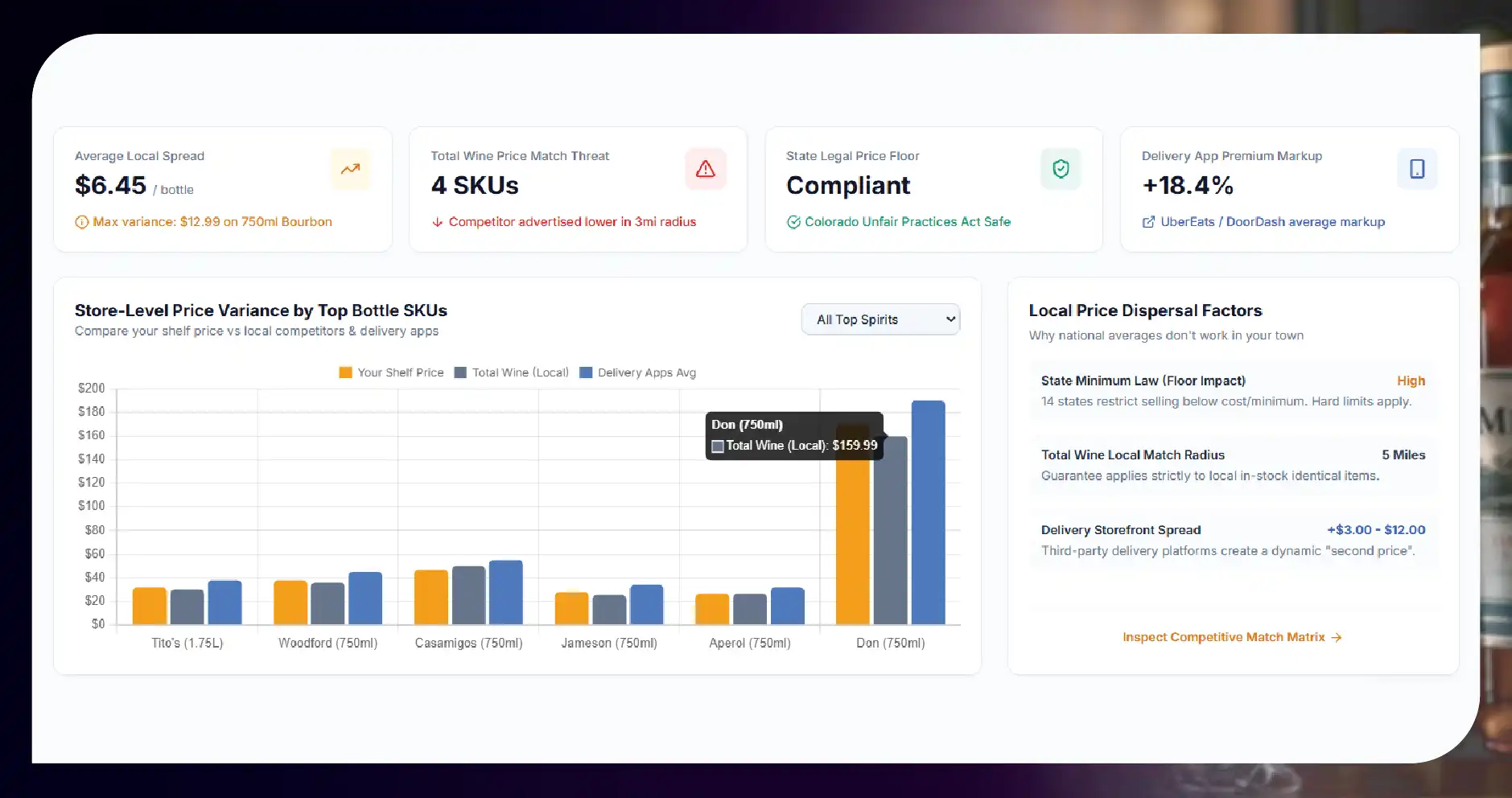
National averages do not help a store owner in one town. Prices for the same bottle can change by state, by store and by week, so your benchmark has to be local.
- Prices vary by location. Total Wine & More's own terms and conditions state that prices, promotions and quantities may vary by state or store location. A price seen in another state tells you little about the store down the road.
- State rules shape the floor. Total Wine's Lowest Price Guarantee notes that laws in 14 listed states, including Colorado, Connecticut, Massachusetts, Michigan, New Jersey and Washington, prohibit selling below cost or below certain minimum prices.
- Price matching is local. The same guarantee applies to a lower price advertised by a local retailer on an identical in-stock item, and it does not apply to online purchases. Your shelf price can directly affect a big-box competitor's in-store price.
- Delivery apps add a second price. Shoppers also see bottle prices on delivery storefronts, which may differ from in-store prices.
Who uses this data? Independent stores, small regional chains, and spirits distributors or brand reps who want to see how their products are priced across accounts.
Which public sources matter for liquor store competitor pricing?
Start with the sources your own shoppers actually check. Note that Drizly is no longer one of them: Uber shut down Drizly at the end of March 2024 and moved alcohol ordering into Uber Eats, as ABC7 reported.
| Source type | Examples | What you can see publicly | Watch-outs |
|---|---|---|---|
| Big-box store pages | Total Wine & More (choose a store) | Shelf price, size, promo badges, in-stock flag for a selected store | Prices vary by store; terms restrict automated access – check before collecting |
| Regional chain websites | Local and state chains with online catalogues | Shelf price, sale price, sometimes mix-and-match deals | Many show one 'home store' price; set the right store |
| Delivery storefronts | Uber Eats, DoorDash, Instacart liquor listings | Delivered price per store, availability | Price may include app markup; fees shown separately |
| Control-state stores | State-run or agency stores (e.g. Pennsylvania, Virginia, North Carolina) | Published state shelf prices | Prices are set by the state, not by local competition |
| Your own POS / price list | Your shelf tags and price file | Your cost, price and margin | Must use the same SKU keys as competitor data |
For context on control states, NABCA lists the jurisdictions where state agencies run the spirits trade at wholesale level, and notes that 13 of them also control off-premises retail sales. If you operate in one of those states, your comparison set looks very different.
The 9 data fields every liquor price comparison needs
Price alone is useless without the fields that prove two listings are the same product. Collect these for every bottle, every source and every check:
- Store ID and ZIP. Which store the price belongs to – essential for Total Wine prices by store.
- Brand and product name. As shown on the listing, kept raw for audit.
- Size. 50 ml, 375 ml, 750 ml, 1 L, 1.75 L – the most common cause of bad matches.
- Proof / ABV. Separates a standard bottling from a barrel-proof or cask-strength release.
- Pack type. Single bottle, gift pack, multipack.
- UPC, where shown. The best match key when a site publishes it; many do not.
- Regular price and sale price. Stored separately, never overwritten.
- Promo text. For example mix-and-match, case discounts or member pricing.
- In-stock flag and timestamp. Availability and the exact time the price was seen.
| Field | Example value | Why it matters |
|---|---|---|
| store_id | [X] | Ties each price to one physical store |
| product_name_raw | Brand X Kentucky Straight Bourbon | Keeps the original listing text for audits |
| size_ml | 750 | Prevents 750 ml vs 1.75 L mismatches |
| proof | 90 | Separates standard and special bottlings |
| upc | [X] | Exact match key when publicly shown |
| regular_price | [X] | Baseline shelf price |
| sale_price | [X] | Temporary promo price |
| promo_text | Mix 6, save 10% | Explains multi-bottle deals |
| in_stock | true | Shows whether the price is actually available |
| captured_at | 2026-10-19T09:00 | Proves when the price was seen |
Field names and example values are illustrative; the brand shown is fictional.
How to match SKUs across stores
SKU matching is where most DIY spirits price monitoring breaks. Use a fixed order of rules so results are repeatable:
- Match on UPC first. If both listings show a UPC, that is your match.
- Then brand + size + proof. Normalise size to millilitres and proof to a number before comparing.
- Flag near-matches for review. Gift packs, limited editions and new label designs often look identical in the name.
- Keep a master SKU table. Map each competitor listing to your own SKU once, then reuse the mapping.
- Compare per 750 ml equivalent only as a secondary view. Shoppers compare the bottle on the shelf, not unit price.
Price vs promo vs mix-and-match: what to compare
A competitor's lowest visible number is not always the price a shopper pays. Track three views side by side:
- Regular shelf price. Your long-term positioning on that bottle.
- Sale price. Short-term promotions; record start and end dates when shown.
- Effective multi-buy price. Mix-and-match or case discounts, calculated per bottle only when the deal terms are clear.
In states with minimum-pricing rules, a competitor's promo may not be something you can legally match. Check your state's regulator before you react to any price gap.
How often should you run local liquor store price tracking?
Cadence should follow how fast prices move in your market and what decisions you make with the data.
| Use case | Suggested cadence | Typical scope |
|---|---|---|
| Shelf-price review for top sellers | Weekly | Your top 100–300 SKUs vs 3–5 nearby competitors |
| Holiday and promo seasons | Daily or twice weekly | Promo-heavy categories such as bourbon, tequila and sparkling wine |
| Allocated or limited bottles | Daily availability check | Small list of high-demand releases |
| Distributor account review | Monthly | Brand portfolio across many retail accounts |
| New store or new competitor opening | One-off baseline, then weekly | Full category snapshot |
These are starting points, not rules. Begin with a short SKU list, see how often prices change, then adjust.
How to run a liquor price comparison in 5 steps
- Pick your competitor set. Three to five stores your shoppers can reach easily, plus one delivery storefront.
- Choose your SKU list. Start with your top sellers by revenue; add bottles customers ask about.
- Collect prices the permitted way. Use manual checks, approved data feeds, or a provider that reviews each source's terms first.
- Match and clean. Apply the matching rules above; review flagged near-matches by hand.
- Set alerts. Trigger an alert when a competitor price moves more than a set amount, or a key bottle goes out of stock.
A simple output is a weekly price-gap report: your price, the lowest local price, the gap in dollars and percent, and a promo flag. Teams that want ongoing alerts can use a real-time competitor price monitoring setup instead of spreadsheets.
Legal and compliance basics
Alcohol price data comes with two sets of rules: the website's terms and your state's alcohol laws.
- Read each site's terms first. Total Wine's terms of use, for example, prohibit scraping or crawling its sites without permission. Where a site restricts automated access, use manual checks, written permission or another approved channel.
- Public prices only. Collect only what any shopper can see. No logins, member-only pages or account data.
- Respect age gates. Confirm age the way a normal visitor would; never bypass age verification, CAPTCHAs or other access controls.
- Follow robots.txt and rate limits. Where automated collection is permitted, keep request rates low and honour robots.txt.
- No personal data. Store and product data only – never customer names, reviews tied to people, or contact details.
- Check state pricing rules. Minimum-pricing and price-posting rules vary by state; confirm with your state regulator or counsel before changing prices.
Build vs buy: choosing an alcohol price data provider

A spreadsheet and weekly store visits work for 50 SKUs. Past that, the work of matching, cleaning and checking terms usually takes more time than it saves.
- Build in-house if you track a small SKU list, a few competitors and can accept weekly gaps.
- Buy if you need many stores, daily cadence, consistent SKU matching, or alerts sent to your team.
- Ask any provider how they handle each source's terms, how they match sizes and proof, how they show promo prices, and what a sample file looks like.
Food Data Scrape scopes US alcohol price data store by store, starting with a short pilot on your own SKU list. You can see what a structured file looks like on our liquor and beverage dataset page. In a recent pilot, the first file matched SKUs across stores and flagged price gaps for the buyer to review.
Get a free sample dataset – send us your top SKUs and three nearby competitor stores, and we will scope a store-level liquor price comparison pilot for your market.
Questions
Frequently Asked Questions
Yes. Total Wine's terms say prices, promotions and quantities may vary by state or store location, so always compare against the specific store near you.
Pick the nearest Total Wine store, list your top-selling SKUs, and record its public shelf prices manually or through an approved channel. Match by size and proof, then review gaps weekly.
No. Drizly shut down at the end of March 2024, and Uber moved alcohol ordering into Uber Eats. Use current delivery storefronts instead.
Use UPC when it is shown. Otherwise match brand, size in millilitres and proof, and review gift packs and limited editions by hand.
Not always. Some states have minimum-pricing or below-cost sales rules. Check with your state regulator or legal adviser before matching a promo.
Looking at public prices is normal market research, but how you collect them must follow each website's terms, robots.txt and applicable law. Some retailers prohibit automated scraping, so use permitted methods only.
Get a Free Food Data Sample in 48 Hours.
Tell us your platforms, target markets and required fields — we'll map exactly what's possible with food data scraping, recommend the right approach, and send a working sample so you can verify quality before any commitment.
Request a strategy call
Thanks — our data team will reach out within 48 hours with your sample.