Introduction
Liquor store locations data is a store-by-store list of wine, beer and spirits outlets for one or more chains, with banner, address, coordinates, opening hours and services such as delivery or pickup. Brands, distributors and site-selection teams use it to see where each chain trades, find gaps and plan field visits.
The US market is large. US beer, wine and liquor stores sold about $6.4 billion in July 2026 alone, according to Census data on FRED. But that spend is split across private chains, state-run stores and thousands of independents.
This guide covers who uses multi-chain store data, the US and UK chains that matter, the fields to collect, how to combine locations with price and availability, and the compliance rules that apply.
Why liquor store location data matters and who uses it
A single chain's store locator answers one question: where is my nearest store? A combined, cleaned file answers business questions across all chains at once.
- Spirits and wine brands: check which banners stock the brand in which states, and plan launches around store density.
- Distributors and importers: size territories, count doors per banner and prioritise accounts.
- Field sales teams: build visit routes from coordinates and opening hours.
- Site selection and real estate: see where competitors cluster and where a market looks underserved.
- Delivery and retail-tech apps: list nearby stores and the services each one offers.
- Analysts and investors: track store openings and closures by chain over time.
The US and UK liquor chains that matter, and how they differ
Store counts below come only from each chain's or regulator's own pages, checked on 21 October 2026. Where we could not find an official figure, we show a placeholder.
| Chain | Country / area | Model | Store count (official source) |
|---|---|---|---|
| Total Wine & More | US – 30 states + DC | Private superstores | 303 superstores (Total Wine) |
| BevMo! | US – CA, AZ, WA | Private neighbourhood stores | 166 stores (BevMo!) |
| ABC Fine Wine & Spirits | US – Florida | Private chain | More than 125 stores (ABC) |
| Spec's Wines, Spirits & Finer Foods | US – Texas | Private chain | 216 stores (Spec's newsroom, Apr 2025) |
| Virginia ABC | US – Virginia | State-run (control state) | Nearly 400 stores (Virginia ABC) |
| Fine Wine & Good Spirits (PLCB) | US – Pennsylvania | State-run (control state) | More than 560 retail stores (PLCB, Nov 2025); the ~600 figure counts retail plus wholesale locations |
| Majestic | UK | Private wine specialist | Over 200 stores (Majestic) |
| Bargain Booze | UK | Franchise / symbol off-licences | Counted inside Bestway's combined "Bargain Booze, Select Convenience & Wine Rack" fascia: 455 stores at Dec 2025 (The Grocer / Forecourt Trader, 2026) – not isolated |
| Wine Rack | UK | Franchise / symbol off-licences | Independent chain (Venus Wine & Spirit), about 17 London/South-East shops (ScrapeHero aggregator, Jul 2026) – distinct from Bestway's "Wine Rack" fascia above |
Two things stand out. First, store formats vary widely, from Total Wine's large superstores to small neighbourhood shops, so a raw store count says little about shelf space. Second, in control states such as Virginia and Pennsylvania, spirits retail runs through state-operated stores, so a spirits brand cannot judge reach in those states from private chains alone.
Official counts also drift. The Pennsylvania regulator and its own retail website gave different numbers on the same day, which is why every file we deliver carries a capture date and a store-level last_seen field.
The data fields to collect for each liquor store
Every chain's store locator looks different, so the first job is a common schema. These are the fields we recommend:
| Field | Description | Example |
|---|---|---|
| store_id | The chain's own store number, kept as text | 1234 |
| banner | Trading name of the store | Fine Wine & Good Spirits |
| chain_group | Owner or operator where public | PLCB (state-run) |
| address_line, city, state_region, postcode | Normalised postal address | 123 Main St, Richmond, VA |
| latitude, longitude | Geocoded or published coordinates | 37.54, -77.43 |
| opening_hours | Hours by day in a standard format | Mon–Sat 10:00–21:00 |
| store_format | Superstore, standard, outlet, express | Superstore |
| services | Delivery, in-store pickup, curbside, tastings, shipping | Pickup; same-day delivery |
| licence_type | Public licence or premises-licence type where published | Off-sales premises licence |
| store_status | Open, temporarily closed, coming soon, closed | Open |
| source_url, last_seen | Where and when the record was confirmed | 2026-10-21 |
Services matter more than many teams expect. BevMo!, for example, advertises same-day or next-day delivery and pickup on its about page, while Fine Wine & Good Spirits advertises buy-online, pick-up-in-store (FW&GS). Capturing services per store lets you compare omnichannel reach, not just door counts.
Licence type and public registers
In England and Wales, every licensing authority must keep a register of premises licences and let anyone inspect it, under section 8 of the Licensing Act 2003. Premises-level licence details can therefore help confirm UK off-licence locations. Those registers also include personal licences for individuals; we do not collect personal licence holder data.
How to map liquor chains by store: a 6-step method
- Set the scope. List banners, countries and states. Decide whether control-state stores and franchise symbol groups are in or out.
- Check each source's terms. Review terms of use and robots.txt for every chain before any collection, and decide the permitted route for each.
- Capture public store details. Collect store pages or locator results that any visitor can see, at polite rates, keeping source URL and date.
- Normalise and geocode. Standardise addresses, states and postcodes; add or verify latitude and longitude; convert hours to one format.
- De-duplicate and classify. Remove duplicate listings, tag store format and services, and flag stores marked coming soon or closed.
- Refresh and track changes. Re-check monthly or quarterly and log openings, closures and moves by banner.
Step two is not a formality. Total Wine & More's terms and conditions prohibit automated access and scraping or crawling of its sites, apart from public search-engine indexing. For sources like this, our sourcing follows each site's terms: we use routes the site permits, client-supplied lists, official or open data, or we leave the source out. Every project gets a legal check before collection starts.
Quality checks before you use the file
Clean liquor store locations data needs a few simple checks before it reaches a map or a CRM:
- Coordinates inside the right state: a store tagged Virginia should plot inside Virginia; outliers usually mean a bad geocode.
- One row per store_id per banner: duplicates often come from store pages listed under several cities.
- Hours that make sense: flag closing times before opening times and stores shown open 24 hours where local law would not allow it.
- Status changes logged, not overwritten: keep closed stores with a closed date so trend analysis still works.
- Counts reconciled: compare your total per banner with the chain's own published figure and explain any gap.
Combining store locations with price and availability
Locations become far more useful when joined with product data. Store_id is the join key that links a store row to price, promotion and stock signals captured at the same store.
| Question | Location data | Add this data | Output |
|---|---|---|---|
| Where is my brand listed? | All stores by banner | Product availability by store | Distribution map by state or county |
| Are prices the same across a chain? | Store list with region | Shelf price by store | Price-zone map |
| Where should we open next? | Competitor stores + coordinates | Population or footfall layers (client data) | Whitespace list |
| Which stores support delivery? | Services per store | Delivery app listings | Omnichannel coverage score |
| How is a chain growing? | Monthly snapshots | Store status changes | Openings and closures log |
In control states, the state's own pricing applies across its stores, so the interesting comparison is often control-state price versus a neighbouring private-market price. That is where a multi-chain file pays off.
Use cases by team
- Spirits brand launch: a US spirits team uses store lists for private chains and state stores to plan a phased launch and estimate doors per state.
- UK wine distributor: maps specialist and franchise off-licences by postcode area to plan sales territories.
- Retail-tech app: shows the nearest stores with hours and pickup or delivery options.
- Real estate: overlays liquor chain stores with grocery and convenience locations to judge competition at a site.
Legal and compliance basics
- Public business data only: store addresses, hours and services are public business facts. We do not collect staff names, personal licence holders or customer data.
- Each site's terms come first: where terms restrict automated access, as Total Wine's do, we do not crawl that site; we use permitted routes or exclude it.
- robots.txt and rate limits: respected on every source we collect from.
- No bypassing: no logins, CAPTCHAs, age-gate workarounds or paywalls.
- Alcohol rules: the data supports B2B analysis, not marketing to individuals; follow local alcohol advertising rules when you use it.
- Legal review: we recommend your counsel signs off on sources and use before launch.
Build vs buy: choosing a liquor store data provider
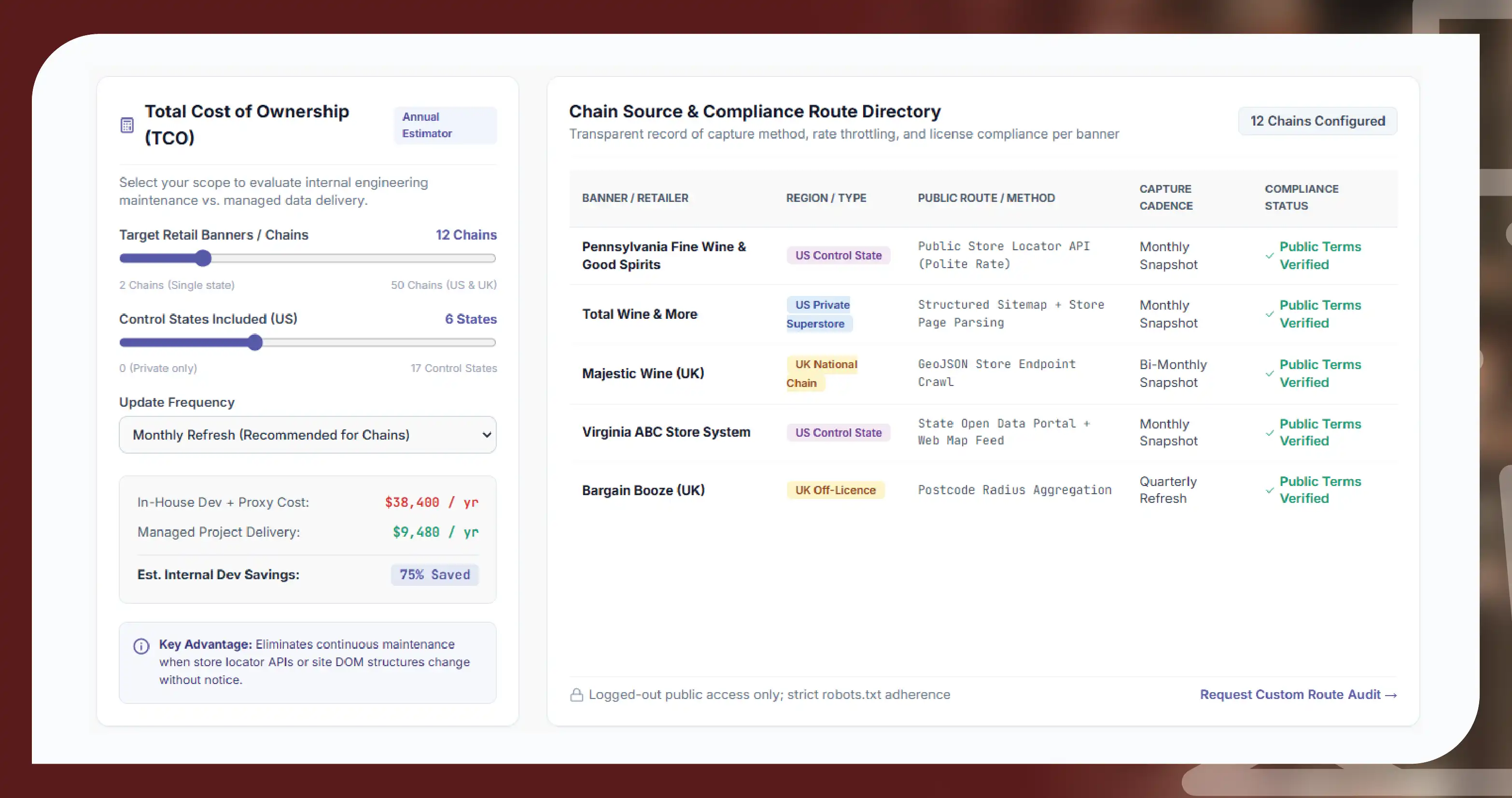
If you need one chain once, its public locator may be enough. If you need several banners, two countries, control-state stores and monthly change tracking, the work of normalising, geocoding and checking terms adds up fast.
Ask any provider for a sample covering your banners, a written note of the source and route used for each chain, the refresh cadence, and how they handle sites whose terms restrict automated access. Food Data Scrape builds liquor store locations data per project, with one schema across chains and a capture date on every row. Coverage is scoped per project across the US and UK chains and states you name, rather than a fixed pre-built list.
Get a free sample dataset. Name the liquor chains and states or regions you need, and we will send a sample store file with addresses, coordinates, hours and services.
Questions
Frequently Asked Questions
Total Wine says it runs 303 superstores across 30 states and the District of Columbia, per its company page checked on 21 October 2026.
Store addresses and hours are public business data, but each website's terms still apply. Some chains forbid automated access, so sourcing must follow each site's terms and a legal check.
They are US states where the state runs or controls alcohol sales at some level. Virginia ABC and Pennsylvania's Fine Wine & Good Spirits are state-run store networks.
Yes. Chain store finders such as Majestic's list stores, and local premises licence registers can help confirm off-licence sites.
Monthly suits most sales and site-selection work. Quarterly is fine for slow-changing chains; weekly suits fast-growing banners or delivery apps.
Get a Free Food Data Sample in 48 Hours.
Tell us your platforms, target markets and required fields — we'll map exactly what's possible with food data scraping, recommend the right approach, and send a working sample so you can verify quality before any commitment.
Request a strategy call
Thanks — our data team will reach out within 48 hours with your sample.