The Client
The client was a grocery market intelligence and retail analytics company supporting retailers, consumer brands, distributors, and e-commerce businesses. Its primary objective was to understand how grocery products were priced, displayed, rated, and delivered across different online shopping locations. The client wanted to Extract Grocery Prices Pack Sizes And Ratings From Amazon Fresh to establish reliable comparisons between product variants, brands, and delivery regions. Its existing research process relied heavily on manual browsing, spreadsheets, and periodic observations, which limited coverage and delayed reporting. The company needed consistent Grocery SKU Data Extraction to identify products using brand names, product titles, pack quantities, and available identifiers. It also required ZIP Code-Level Grocery Price Comparison to understand regional pricing differences and location-specific assortment variations. The client partnered with Food Data Scrape to establish a repeatable data collection process capable of supporting price benchmarking, promotional analysis, product availability tracking, customer review analysis, and ongoing grocery market research across selected delivery locations.
Key Challenges
-
Limited Grocery Market Intelligence
The client struggled to develop comprehensive Grocery Market Intelligence because product listings, promotional prices, pack sizes, and availability changed frequently. Manual collection created inconsistencies, delayed comparisons, and incomplete historical records, making it difficult to identify meaningful competitive trends or reliable pricing patterns. -
Location-Based Availability Variations
Implementing Location-Specific Grocery Product Data Monitoring was challenging because Amazon Fresh listings and delivery eligibility could vary by delivery address or ZIP code. The client needed consistent location-level observations to distinguish genuine price changes from assortment differences, temporary stockouts, and location-specific promotions. -
Complex Product Data Standardization
The client required dependable Grocery Data Scraping across numerous grocery categories, brands, package configurations, and product variants. Inconsistent titles, duplicated listings, changing identifiers, and incomplete attributes complicated product matching, while ratings and review counts required regular updates for meaningful comparisons.
Key Solutions
-
Structured Grocery Dataset Development
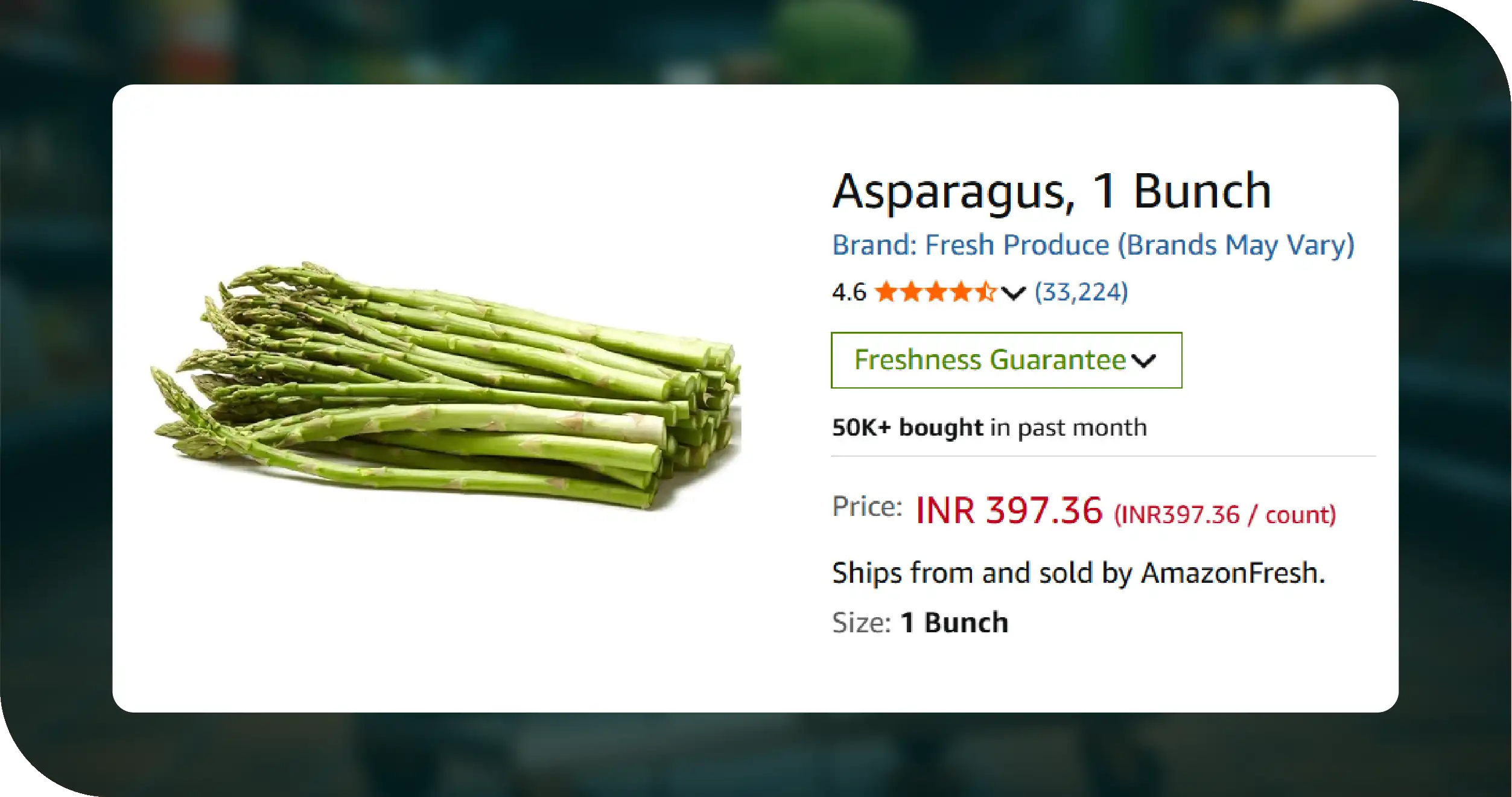
Food Data Scrape developed an Amazon Fresh Grocery Delivery Dataset containing standardized product names, brands, categories, pack sizes, listed prices, discounts, ratings, review counts, and availability observations. Structured fields enabled repeatable analysis, product matching, and comparisons across selected delivery locations. -
Multi-Location Product Collection
We created organized Grocery Store Datasets covering selected grocery categories and delivery locations. The collection process captured available listing attributes and location-specific observations, enabling the client to compare comparable products, identify assortment gaps, and evaluate pricing differences without relying on fragmented manual research. -
Automated Data Processing
Our workflow combined scheduled collection, validation, duplicate detection, normalization, and export-ready formatting. This improved the client's ability to maintain consistent datasets, track changes over time, and integrate grocery information into dashboards and analytical systems for more effective retail planning and competitive monitoring.
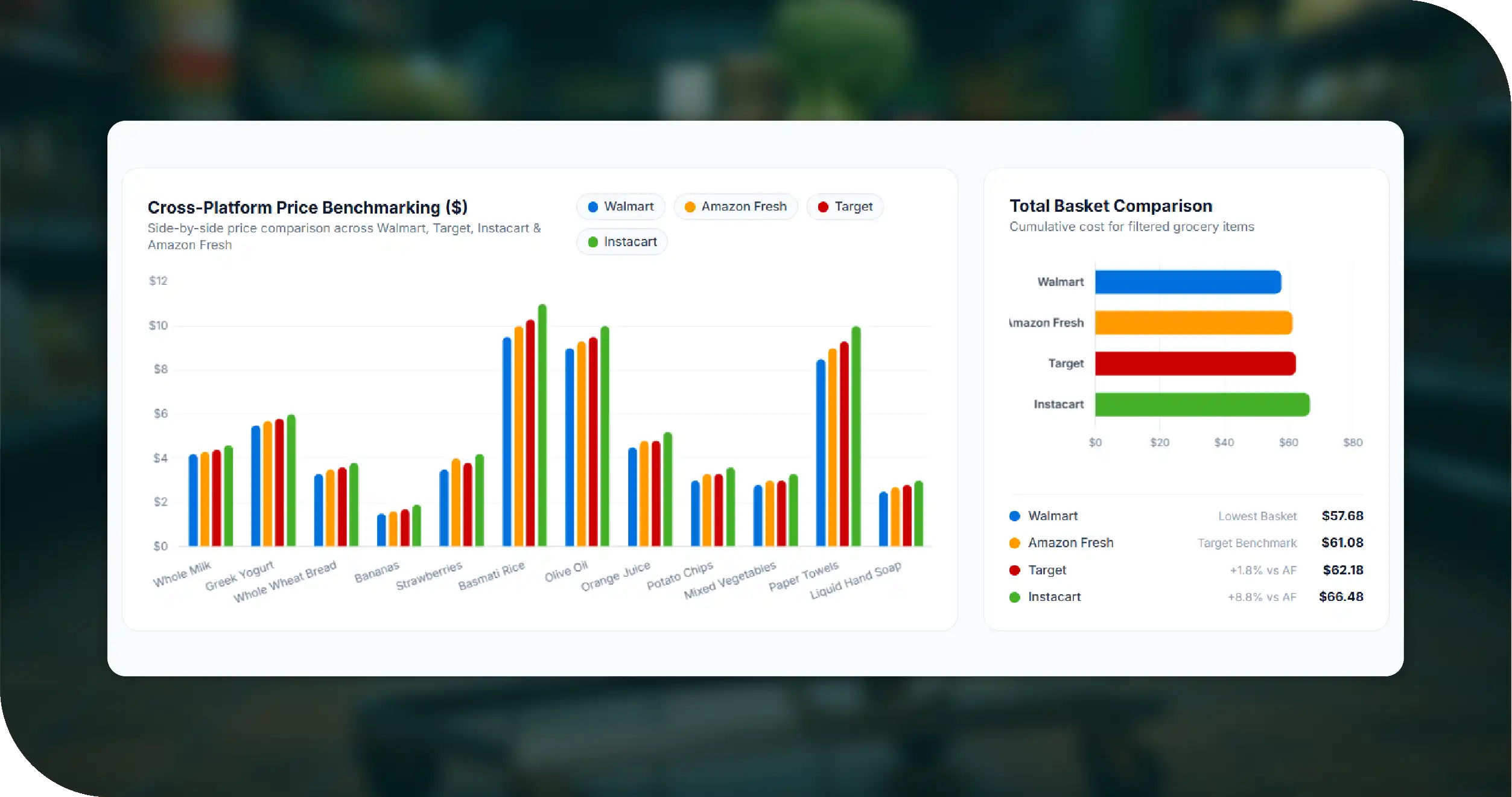
Illustrative Grocery Benchmark Dataset
Illustrative dataset for competitive benchmarking. The three comparison sites are Walmart, Target, and Instacart.
| Product Category | Product Name | Pack Size | ZIP Code | Walmart Price ($) | Target Price ($) | Instacart Price ($) | Amazon Fresh Price ($) | Amazon Fresh Rating (/5) |
|---|---|---|---|---|---|---|---|---|
| Dairy | Whole Milk | 1 gallon | 10001 | 4.19 | 4.39 | 4.59 | 4.29 | 4.6 |
| Dairy | Greek Yogurt | 32 oz | 10001 | 5.49 | 5.79 | 5.99 | 5.69 | 4.5 |
| Bakery | Whole Wheat Bread | 20 oz | 10001 | 3.29 | 3.59 | 3.79 | 3.49 | 4.4 |
| Produce | Bananas | 2 lb | 10001 | 1.49 | 1.69 | 1.89 | 1.59 | 4.5 |
| Produce | Strawberries | 1 lb | 10001 | 3.49 | 3.79 | 4.19 | 3.99 | 4.3 |
| Pantry | Basmati Rice | 5 lb | 10001 | 9.49 | 10.29 | 10.99 | 9.99 | 4.7 |
| Pantry | Olive Oil | 16.9 fl oz | 10001 | 8.99 | 9.49 | 9.99 | 9.29 | 4.6 |
| Beverages | Orange Juice | 52 fl oz | 10001 | 4.49 | 4.79 | 5.19 | 4.79 | 4.3 |
| Snacks | Potato Chips | 8 oz | 10001 | 2.99 | 3.29 | 3.59 | 3.29 | 4.2 |
| Frozen | Mixed Vegetables | 16 oz | 10001 | 2.79 | 2.99 | 3.29 | 2.99 | 4.5 |
| Household | Paper Towels | 6 rolls | 10001 | 8.49 | 9.29 | 9.99 | 8.99 | 4.6 |
| Personal Care | Liquid Hand Soap | 12 fl oz | 10001 | 2.49 | 2.79 | 2.99 | 2.69 | 4.4 |
Suggested additional columns for the full location-specific dataset: comparison ZIP code, brand, product identifier, discount percentage, review count, availability status, unit price, collection timestamp, and product URL. These fields help standardize products and compare equivalent pack sizes across all four platforms.
Methodologies We Used
-
Source and Category Mapping
We identified relevant Amazon Fresh product categories, listing structures, searchable attributes, and selected delivery locations. This mapping established collection priorities, clarified required fields, and helped ensure that the dataset represented the client's grocery research objectives without unnecessarily duplicating product records. -
Automated Product Data Collection
We implemented automated collection workflows to retrieve accessible product listing information from selected categories. Depending on availability, records included product titles, brands, prices, pack sizes, ratings, review counts, discounts, and availability indicators, subject to platform restrictions and permitted access methods. -
Location-Based Data Sampling
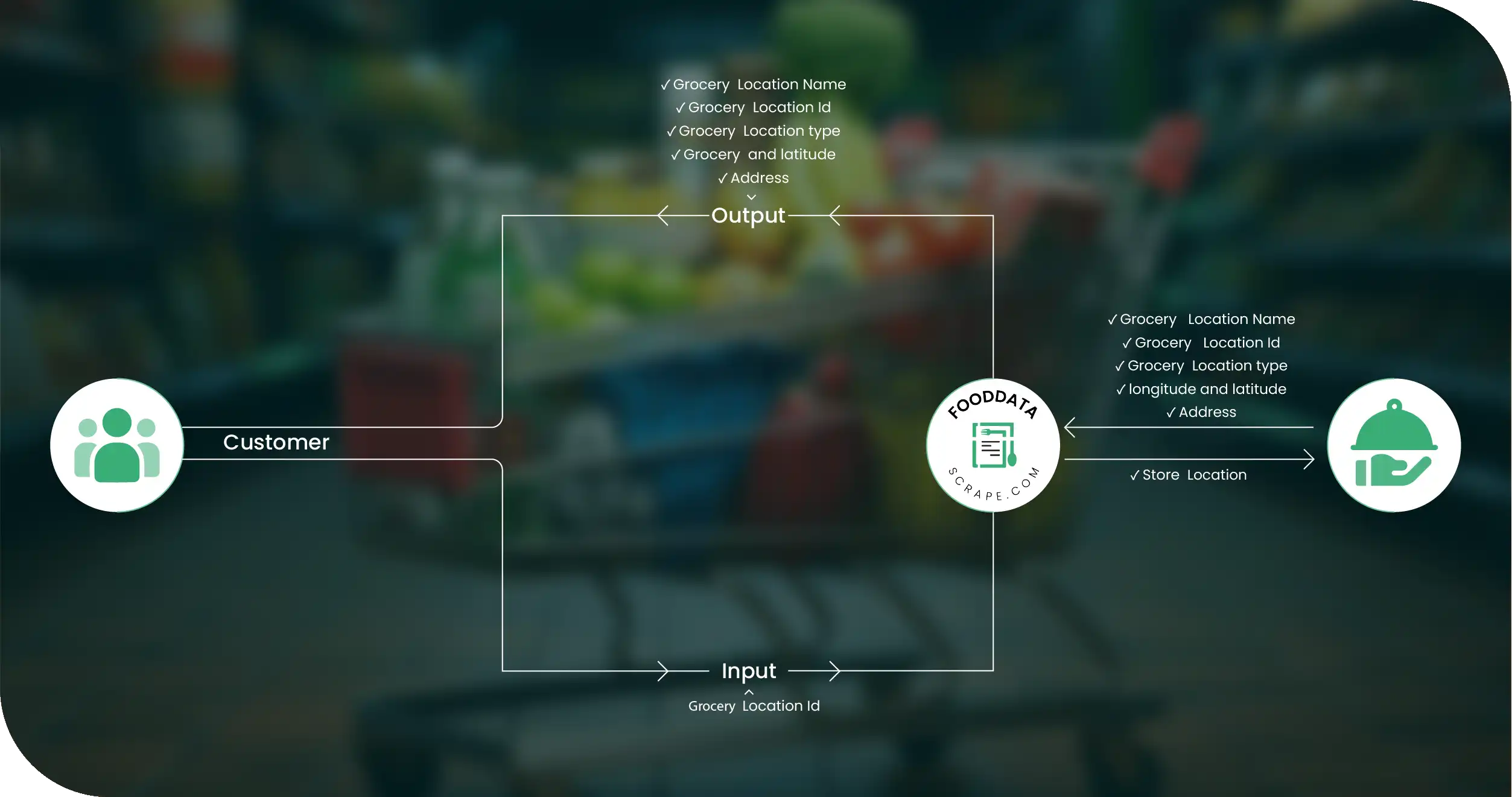
We configured collection around selected ZIP codes and delivery locations to compare available listings. Each observation was associated with its collection location and timestamp, helping analysts distinguish regional differences from changes occurring over time. Results reflected the locations and listings accessible during collection. -
Data Cleaning and Validation
We standardized product names, normalized package quantities, checked numerical fields, and removed duplicate records using available product identifiers and matching attributes. Validation rules highlighted missing prices, inconsistent units, and unusual values before the data was delivered for further analysis. -
Dataset Delivery and Refresh
We organized validated records into structured tables and client-ready exports. Where recurring collection was required, refresh schedules supported subsequent comparisons between observations. Historical snapshots helped reveal price movements and availability changes while preserving the distinction between newly collected data and earlier records.
Advantages of Collecting Data Using Food Data Scrape
-
Improved Pricing Transparency
Structured grocery datasets help businesses compare listed prices across products and delivery locations. Retail analysts can identify price differences, assess promotional activity, and establish more consistent benchmarks, supporting informed pricing decisions without depending entirely on manual marketplace checks. -
Better Product Assortment Planning
Product-level datasets reveal which brands, pack sizes, and categories appear in selected locations. Retailers and suppliers can use these observations to identify assortment gaps, evaluate product representation, and prioritize further research into regional shopping preferences and merchandising opportunities. -
Efficient Competitive Monitoring
Automated collection reduces repetitive browsing and organizes grocery information into consistent formats. Businesses can compare competitors' accessible listings, monitor changes across collection periods, and generate analytical reports more efficiently, freeing research teams to focus on interpretation and commercial decision-making. -
Stronger Customer Sentiment Analysis
Ratings and review counts provide useful indicators of customer engagement and perceived product quality. When collected consistently, these attributes help analysts compare products, identify highly rated alternatives, and prioritize products for deeper review analysis alongside pricing, availability, and assortment information. -
Scalable Data-Driven Decisions
A standardized collection framework can expand across additional product categories and supported delivery locations. With reliable validation and repeatable refresh processes, businesses can build historical datasets, support dashboards, and develop evidence-based strategies for pricing, merchandising, assortment management, and marketplace research.
Client's Testimonial
"Food Data Scrape helped us establish a more structured approach to Amazon Fresh grocery market research. Previously, comparing product prices, pack sizes, ratings, and availability across different delivery locations required considerable manual effort. The delivered dataset gave our team a consistent foundation for analyzing grocery listings and identifying location-level pricing differences. We particularly appreciated the attention given to product standardization, duplicate detection, and data validation. The organized output also made it easier to prepare internal reports and support discussions around competitive positioning. This project has strengthened our research workflow and created opportunities for more systematic grocery market monitoring."
—Head of Retail Analytics
Final Outcome
The project established a structured foundation for monitoring grocery product listings, comparing prices, and analyzing location-level assortment variations across selected Amazon Fresh delivery areas. Standardized product attributes improved consistency, while location and timestamp fields supported comparisons between collection periods. The client gained a clearer view of listed prices, package sizes, discounts, ratings, review counts, and observed availability, subject to accessible listings and collection coverage. With AI Grocery Intelligence, these datasets can support analytical models for price anomaly detection, assortment comparisons, and promotional evaluation. The ability to Scrape Amazon Fresh data through repeatable workflows also reduced dependence on manual research. Where integration requirements permit, an Amazon Fresh Grocery Delivery Scraping API can support automated delivery into internal dashboards and analytics pipelines. Overall, the solution improved research organization and provided a scalable foundation for grocery pricing intelligence and competitive analysis.