
This report provides a comprehensive analysis of the Mercato Grocery Data Insights API ecosystem, focusing on how API-driven data collection is transforming modern grocery intelligence. It examines structured methods for capturing real-time pricing, inventory updates, and SKU-level variations across multiple grocery categories such as dairy, bakery, beverages, and fresh produce. The study highlights how Mercato’s data systems enable retailers to monitor competitor pricing, analyze demand patterns, and optimize pricing strategies dynamically. It also explores the integration of automated extraction pipelines, real-time APIs, and analytics dashboards that convert raw grocery data into actionable business intelligence. Special attention is given to demand fluctuations, promotional tracking, and regional price variations that influence consumer purchasing behavior. By combining structured datasets with predictive analytics, the Mercato ecosystem supports smarter retail decisions and improved supply chain efficiency. Overall, the report emphasizes the growing importance of API-based grocery intelligence in driving data-centric retail transformation.

Real-Time Monitoring
Enables continuous tracking of grocery
prices, availability, and promotional changes across multiple categories.
SKU Intelligence
Provides detailed SKU-level insights for
optimizing pricing, demand, and inventory planning decisions effectively.
Competitive Benchmarking
Compares Mercato pricing against
competitors to maintain market alignment and pricing competitiveness.
API Integration
Uses structured APIs for seamless extraction,
synchronization, and transformation of grocery data streams.
Demand Analytics
Analyzes purchasing patterns and seasonal demand
shifts to improve forecasting and retail efficiency.

Modern grocery ecosystems are rapidly shifting toward API-driven intelligence systems where real-time pricing, demand, and inventory signals are captured and analyzed at scale. The Mercato Grocery Data Insights API enables structured access to grocery product data, helping retailers and analysts monitor SKU-level price changes, availability shifts, and category performance across digital grocery platforms.
The rise of the Mercato Grocery Price Monitoring API has significantly improved the ability of businesses to track live pricing updates, promotional activity, and competitor pricing strategies across multiple store networks in real time.
With increasing demand for predictive retail intelligence, the Mercato Grocery Market Insights framework plays a crucial role in transforming raw grocery data into actionable insights for pricing optimization, demand forecasting, and supply chain efficiency.
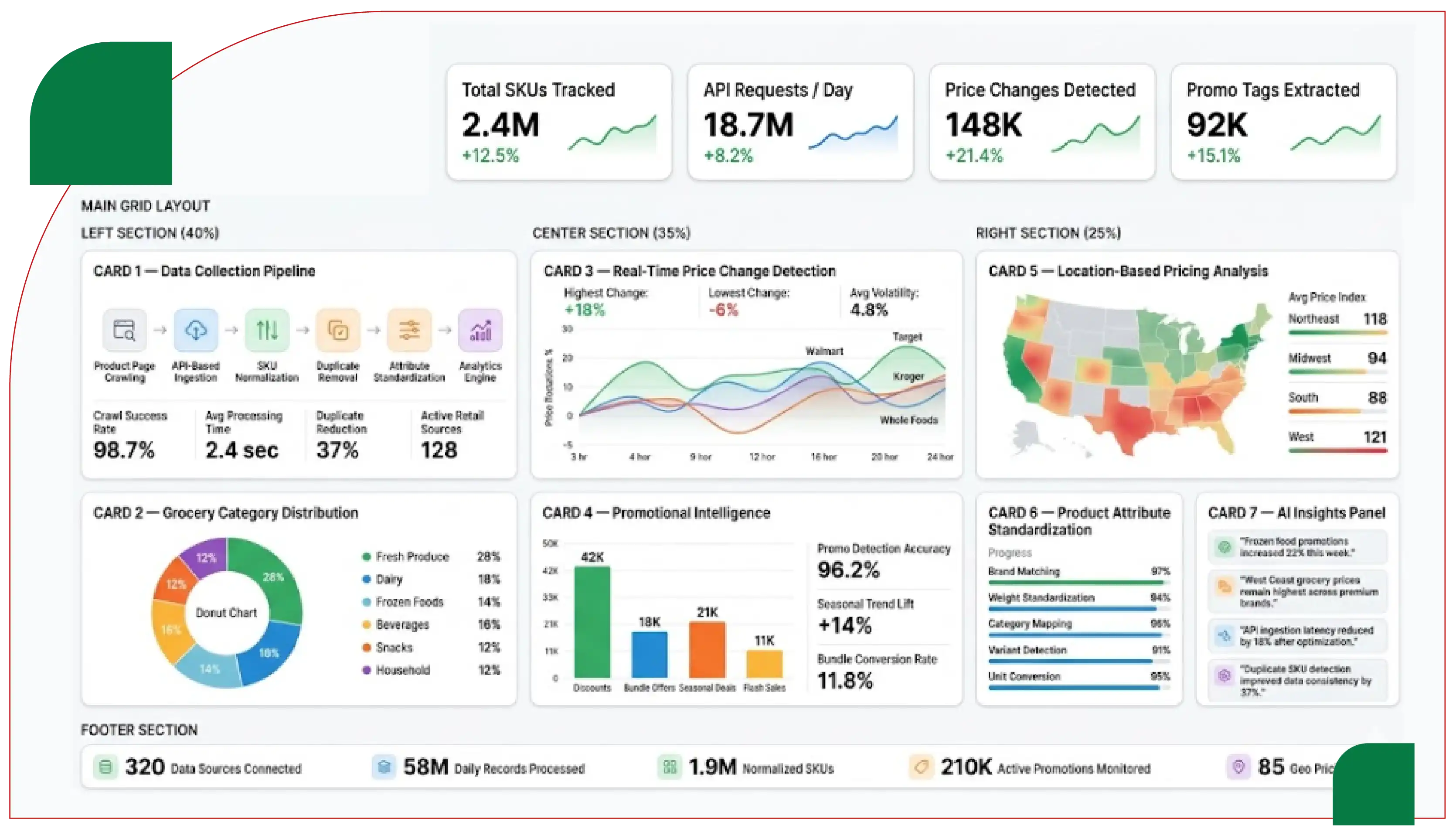
The Mercato grocery intelligence system integrates multiple layers of data extraction, transformation, and analytics. Key techniques include:
These workflows are often powered by Web Scraping Grocery Data pipelines combined with API connectors that ensure continuous ingestion of structured grocery datasets.
Advanced filtering systems remove duplicates and standardize product attributes such as weight, brand, and category for consistent analytics output.
| SKU ID | Product Name | Category | Store Location | Base Price ($) | Discount (%) | Final Price ($) | Stock Status | Last Updated |
|---|---|---|---|---|---|---|---|---|
| MR-101 | Organic Milk 1L | Dairy | Mercato NYC | 4.29 | 6% | 4.03 | In Stock | 2026-05-25 |
| MR-102 | Whole Wheat Bread | Bakery | Mercato Brooklyn | 3.19 | 10% | 2.87 | In Stock | 2026-05-26 |
| MR-103 | Basmati Rice 2kg | Grains | Mercato Queens | 9.99 | 8% | 9.19 | Limited | 2026-05-24 |
| MR-104 | Olive Oil Extra Virgin | Pantry | Mercato NYC | 12.49 | 12% | 10.99 | In Stock | 2026-05-26 |
| MR-105 | Chicken Breast 1kg | Meat | Mercato Bronx | 8.99 | 7% | 8.36 | In Stock | 2026-05-25 |
| MR-106 | Apples Red 1kg | Fruits | Mercato Brooklyn | 4.59 | 15% | 3.90 | In Stock | 2026-05-26 |
| MR-107 | Tomato Sauce 500ml | Condiments | Mercato Queens | 3.29 | 5% | 3.12 | In Stock | 2026-05-24 |
| MR-108 | Eggs 12 Pack | Dairy | Mercato NYC | 5.79 | 9% | 5.27 | Low Stock | 2026-05-26 |
| MR-109 | Cheddar Cheese 500g | Dairy | Mercato Bronx | 7.49 | 11% | 6.67 | In Stock | 2026-05-25 |
| MR-110 | Orange Juice 1L | Beverages | Mercato Brooklyn | 5.29 | 8% | 4.87 | In Stock | 2026-05-26 |
The dataset highlights strong promotional activity in dairy and fresh produce categories, indicating price-sensitive demand behavior. Fresh goods show higher discount frequency compared to pantry items, reflecting perishability-driven pricing strategies.
The Mercato Grocery Demand Analytics framework reveals strong correlations between seasonal demand cycles and pricing fluctuations. Categories such as fruits, vegetables, and beverages show higher volatility due to weather and holiday-driven consumption patterns.
Staple goods such as rice, bread, and milk remain relatively stable in pricing, indicating low elasticity and consistent demand. Retailers use this insight to maintain baseline pricing while adjusting promotional intensity for high-variance categories.
| SKU ID | Product | Mercato Price ($) | Competitor A ($) | Competitor B ($) | Price Gap (%) | Market Position | Demand Score |
|---|---|---|---|---|---|---|---|
| MR-201 | Milk 1L | 4.03 | 4.15 | 4.30 | -3% | Competitive | High |
| MR-202 | Bread | 2.87 | 2.75 | 3.10 | +4% | Slightly High | Medium |
| MR-203 | Rice 2kg | 9.19 | 9.50 | 9.30 | -2% | Competitive | High |
| MR-204 | Olive Oil | 10.99 | 11.49 | 11.20 | -4% | Competitive | High |
| MR-205 | Chicken 1kg | 8.36 | 8.60 | 8.45 | -3% | Competitive | High |
| MR-206 | Apples 1kg | 3.90 | 4.10 | 4.25 | -8% | Strong Value | High |
| MR-207 | Eggs 12 pack | 5.27 | 5.35 | 5.60 | -2% | Competitive | Medium |
| MR-208 | Cheese 500g | 6.67 | 6.40 | 6.80 | +4% | Slightly High | Medium |
| MR-209 | Juice 1L | 4.87 | 5.10 | 5.25 | -5% | Competitive | High |
| MR-210 | Sauce 500ml | 3.12 | 3.25 | 3.40 | -6% | Competitive | Medium |
Mercato demonstrates strong competitive positioning in fresh produce and beverages, while marginal price variations exist in bakery and dairy categories due to regional supplier differences.
The integration of Mercato Real-Time Grocery Data API enables continuous monitoring of price fluctuations and inventory changes. These systems are designed to process thousands of SKU updates per minute, ensuring that pricing decisions are based on the latest available data.
Similarly, Mercato Grocery Pricing Data Extraction methods allow structured collection of product attributes, including discounts, availability, and store-level variations.
These systems are essential for dynamic pricing engines and retail optimization tools.
Modern grocery intelligence platforms rely heavily on API-driven architectures. The Grocery Delivery Extraction API enables seamless synchronization between delivery platforms and analytics engines, ensuring real-time visibility of product availability and pricing.
Such APIs are often integrated with machine learning models for forecasting demand and optimizing stock distribution across warehouses and stores.
Retailers increasingly depend on centralized dashboards to interpret grocery data effectively. A Grocery Price Dashboard provides real-time insights into pricing changes, competitor comparisons, and category performance metrics.
A more advanced Grocery Price Tracking Dashboard integrates historical trends, predictive analytics, and alert systems for sudden price changes or stock shortages, enabling proactive decision-making.
The evolution of grocery intelligence systems is heavily influenced by API-driven architectures and real-time data pipelines. Mercato’s data ecosystem demonstrates how structured grocery data can be transformed into actionable insights for pricing, inventory, and demand optimization.
By leveraging automated extraction systems, retailers gain the ability to respond dynamically to market fluctuations and competitive pressures.
Ultimately, Grocery Data Intelligence frameworks provide the foundation for modern retail analytics, while structured Grocery Datasets empower advanced forecasting models and strategic decision-making. The continued development of these systems will further enhance efficiency, transparency, and profitability in grocery retail ecosystems.
Are you in need of high-class scraping services? Food Data Scrape should be your first point of call. We are undoubtedly the best in Food Data Aggregator and Mobile Grocery App Scraping service and we render impeccable data insights and analytics for strategic decision-making. With a legacy of excellence as our backbone, we help companies become data-driven, fueling their development. Please take advantage of our tailored solutions that will add value to your business. Contact us today to unlock the value of your data.