Introduction
The restaurant industry is becoming increasingly global, with customers discovering cuisines, comparing prices, and ordering meals across different languages and regions. Restaurants, food delivery platforms, market researchers, and hospitality businesses need accurate menu information to understand consumer preferences, evaluate competitors, and identify emerging opportunities. However, collecting restaurant menu information across multiple languages presents challenges involving inconsistent formats, regional terminology, translation differences, currencies, and frequently changing prices.
Multilingual Restaurant Menu Data Scraping enables businesses to collect restaurant menus, dish descriptions, prices, ingredients, categories, and availability information from relevant online sources. This information creates a structured foundation for monitoring restaurant offerings across markets. Through Multilingual Food Menu Data Intelligence, organizations can examine regional cuisine preferences, compare similar dishes, and understand how restaurants position their offerings for different audiences.
Businesses can Extract Multilingual restaurant menu data from restaurant websites, food delivery platforms, digital menus, and other accessible sources. By combining automated collection with language processing and data validation, companies can transform scattered menu information into reliable, analysis-ready datasets that support international expansion, pricing decisions, customer experience improvements, and competitive research.
Understanding Multilingual Restaurant Menu Data Capture
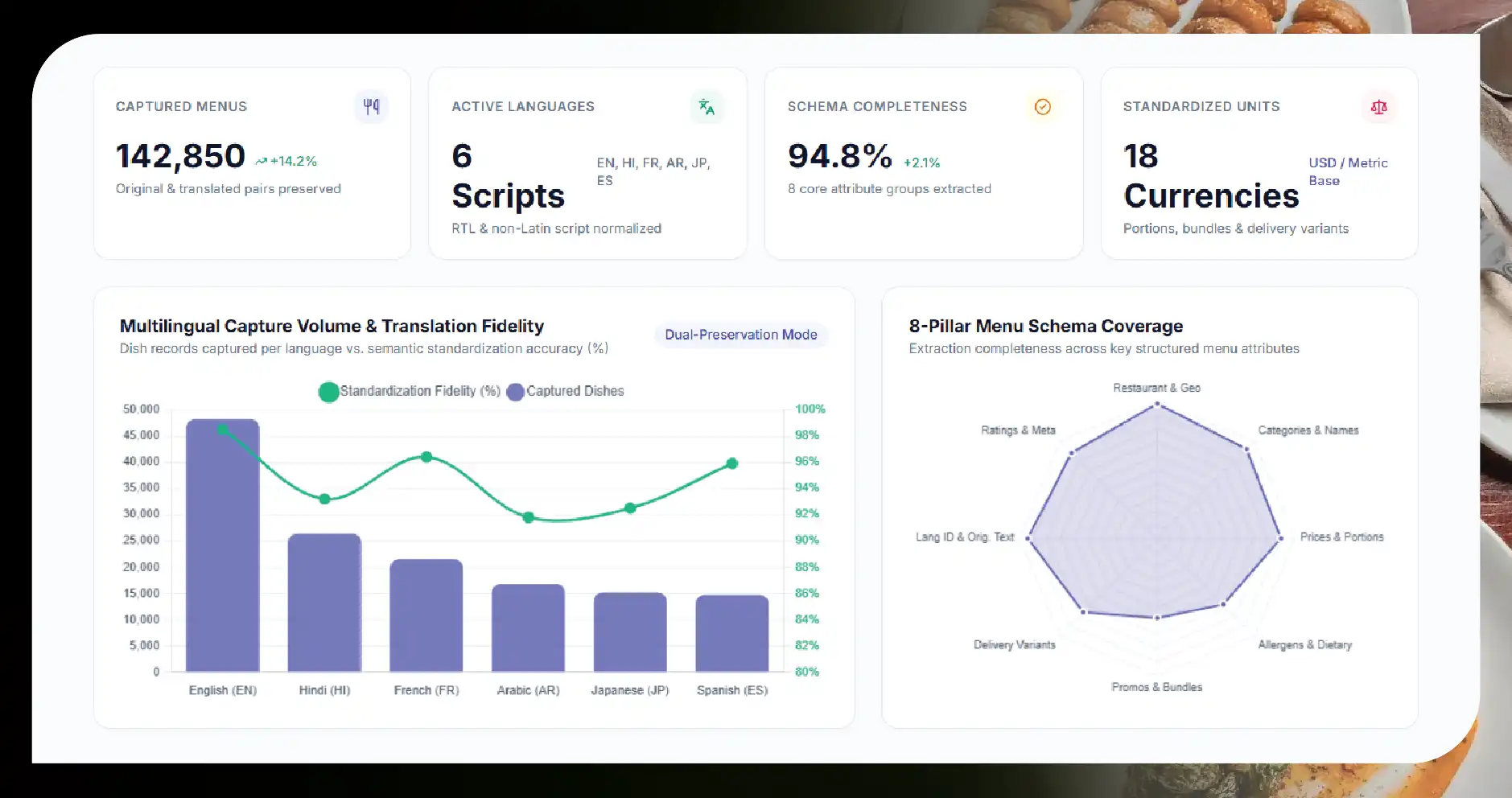
Multilingual restaurant menu data capture involves collecting, interpreting, standardizing, and organizing menu information published in different languages. Unlike conventional menu collection, this process must account for linguistic variations, regional naming conventions, scripts, measurement units, and market-specific presentation styles.
For example, a restaurant operating in India might publish menu information in English and Hindi, while an international restaurant group could maintain separate menus in English, French, Arabic, Japanese, and Spanish. Although these menus may describe similar dishes, their names, ingredient descriptions, portion sizes, and prices may differ according to local preferences.
A comprehensive collection process can capture:
- Restaurant names, locations, addresses, and cuisine types.
- Menu categories, dish names, and descriptions.
- Prices, currencies, portion sizes, and meal combinations.
- Ingredients, dietary labels, allergens, and customization options when published.
- Promotional offers, discounts, and meal bundles.
- Availability indicators and delivery-specific menu variations.
- Language identifiers and original-language descriptions.
- Restaurant ratings and other relevant publicly available attributes.
Capturing these fields consistently allows businesses to compare menus across locations without losing important regional details. The original language should generally be preserved alongside standardized translations to maintain accuracy and enable verification.
Why Multilingual Menu Data Matters for Restaurants?
1. Supporting International Market Expansion
Restaurant brands entering foreign markets need to understand local dining habits, competitor offerings, and acceptable price ranges. Menu information provides practical evidence of how cuisines are presented and adapted across regions.
Businesses can examine which dishes appear frequently, how restaurants describe unfamiliar ingredients, and whether local menus emphasize vegetarian options, family meals, or regional specialties. These findings help brands adapt menus to customer expectations rather than relying exclusively on broad market assumptions.
2. Improving Competitive Price Monitoring
Restaurant pricing differs according to location, cuisine, customer segment, operating costs, and delivery platform. A dish with similar ingredients may carry different prices across cities or countries.
Collecting menu prices allows analysts to compare equivalent products, identify premium positioning, monitor promotional changes, and investigate market-level price differences. Currency conversion, portion normalization, and clear identification of dine-in versus delivery prices are essential for meaningful comparisons.
3. Enhancing Digital Customer Experiences
Food delivery applications and restaurant discovery platforms depend on clear, consistent menu information. Poor translations, duplicated dishes, incomplete descriptions, and inconsistent dietary labels can confuse customers and affect ordering decisions.
Multilingual data capture helps platforms maintain more consistent menu records, improve search relevance, and make restaurant information easier to discover. Human review remains valuable for culturally sensitive descriptions, ambiguous ingredient names, and terms that do not translate directly between languages.
Major Challenges in Capturing Multilingual Restaurant Menus
Language and Translation Variations
A dish may have several names across languages, regions, or restaurant brands. Direct translations can also distort culinary meaning. For example, a regional dish may have a recognized local name that is more informative than its literal English translation.
A reliable system should retain original text, identify the source language, and use appropriate translation methods without automatically treating every translated name as a separate dish.
Different Website and Menu Formats
Restaurant information may appear on HTML pages, downloadable PDFs, digital menu boards, images, or interactive ordering interfaces. Each format requires an appropriate extraction approach.
Optical character recognition can help process menu images, while document parsing can capture text from supported PDFs. Structured web extraction can handle accessible webpage content. Combining these methods improves coverage, although complex layouts may still require manual verification.
Inconsistent Pricing and Currency Formats
Prices may use decimal commas, decimal points, currency symbols, local numerals, or different tax conventions. Some menus display prices per item, while others include portion choices or add-on charges.
Standardization must preserve the original displayed value while storing normalized numeric prices and currency codes separately. Analysts should also record relevant serving sizes, taxes, and pricing conditions when available.
Frequent Menu Changes
Restaurants regularly introduce seasonal dishes, modify prices, remove products, and change promotions. A dataset that was accurate last month may no longer reflect current offerings.
Scheduled collection, change detection, timestamps, and validation rules help keep information current. The appropriate refresh frequency depends on how quickly the target menus change and how the resulting data will be used.
Building a Reliable Multilingual Restaurant Menu Dataset
A high-quality Multilingual Restaurant Menu Dataset should combine linguistic context with standardized business fields. This makes the information suitable for comparison, reporting, search, and machine learning.
The development process typically begins by identifying relevant restaurant websites, delivery platforms, geographic markets, languages, and menu categories. Collection rules are then designed around the available source structures and permitted access methods.
Next, the extraction system captures menu fields while preserving original wording and source references. Language identification, translation, entity matching, and normalization are applied where appropriate. Duplicate records are identified using combinations of restaurant identifiers, dish names, variants, locations, and other attributes.
Quality checks should flag missing prices, implausible values, conflicting translations, inconsistent currencies, and duplicated dishes. Records that fail automated checks can be directed for additional review.
A useful dataset may contain the following fields:
| Data Field | Purpose |
|---|---|
| Restaurant ID | Identifies the restaurant consistently |
| Restaurant Name | Stores the original or published business name |
| Location and Market | Supports geographic comparisons |
| Source Language | Identifies the language of the original menu |
| Original Dish Name | Preserves the restaurant's wording |
| Standardized Dish Name | Supports cross-language matching |
| Dish Description | Captures published ingredients and preparation details |
| Menu Category | Organizes dishes into comparable groups |
| Displayed Price | Retains the source's original price |
| Normalized Price and Currency | Enables structured price analysis |
| Portion or Variant | Distinguishes sizes and customization options |
| Availability Status | Records published availability information |
| Collection Timestamp | Shows when the information was collected |
Not every source provides all these fields. Missing information should be recorded appropriately rather than inferred without evidence.
The Role of Restaurant Menu Price Data Scraping
Restaurant Menu Price Data Scraping helps businesses understand pricing differences across restaurant chains, cuisines, cities, and digital ordering platforms. When multilingual menus are collected consistently, analysts can compare prices even when the same dish is presented under different local names.
Consider a restaurant group selling a comparable rice bowl in India, the United Arab Emirates, and Singapore. Its menus may use different languages, currencies, serving sizes, and descriptions. A well-designed collection system can preserve these differences while enabling analysts to compare standardized dish categories and normalized prices.
Important applications include:
- Monitoring competitor price changes across geographic markets.
- Measuring the price differences between delivery and dine-in menus.
- Tracking discounts, combo offers, and promotional campaigns.
- Identifying premium-priced categories and affordable alternatives.
- Comparing regional price positioning within restaurant chains.
- Examining price movements alongside menu availability and assortment changes.
Fair comparisons require context. Currency conversion alone does not establish purchasing-power equivalence, and similarly named dishes may contain different ingredients or portion sizes. Reliable analysis should account for these limitations before drawing conclusions.
Turning Menu Records Into Actionable Insights
Once data has been collected and standardized, Multilingual Restaurant Data Analytics can reveal patterns that are difficult to identify through manual browsing.
Restaurant operators can compare their menu coverage with competitors, identify underrepresented categories, and evaluate whether certain dishes are positioned differently across markets. Delivery platforms can assess menu completeness, detect inconsistent descriptions, and identify potential improvements to search and categorization.
Market researchers can study cuisine distribution, menu diversity, and the adoption of dietary preferences across regions. Food brands can use these insights to identify restaurant segments that may be interested in new ingredients, packaged products, or supply partnerships.
Useful analytical measures include average listed price by category, price dispersion across locations, frequency of menu updates, assortment overlap, promotional frequency, and the availability of selected dietary options.
These metrics should be calculated using clearly defined comparison groups. For example, an average price across all dishes may be misleading when one market has many premium seafood restaurants and another contains mostly quick-service outlets.
Automation, APIs, and AI-Powered Menu Intelligence
Automated Restaurant Menu Data Scraping provides a repeatable way to collect menu information from supported online sources. Instead of manually copying hundreds of menus, businesses can use structured extraction pipelines to process large volumes of records.
A typical workflow includes source discovery, data collection, language detection, field extraction, normalization, validation, duplicate resolution, and delivery into databases or analytical platforms. APIs can support downstream integration where access is available and authorized.
Artificial intelligence can further assist with recognizing dish categories, matching equivalent menu items across languages, summarizing descriptions, and detecting unusual price movements. Image recognition and optical character recognition may help extract text from menu images, while language models can support translation and semantic matching.
However, AI-generated interpretations should not replace source evidence. Automated systems may confuse similar dishes, misinterpret regional expressions, or incorrectly infer ingredients and allergens. Confidence scores, validation rules, original text retention, and human review are particularly important when menu data informs customer-facing information.
AI Restaurant Intelligence becomes more valuable when menu data is combined with additional relevant information, such as restaurant locations, customer ratings, opening hours, and published promotional details. This broader view can help businesses identify competitive patterns and emerging opportunities without assuming that menu information alone explains customer demand.
Data Quality, Compliance, and Responsible Collection
Reliable menu intelligence depends on both technical accuracy and responsible collection practices. Businesses should respect website terms, applicable copyright and database rights, privacy requirements, and platform access restrictions. Public accessibility does not automatically mean that content can be collected or reused without limitations.
Collection systems should avoid unnecessary personal information and focus on relevant restaurant and menu attributes. Where APIs or licensed datasets are available, they may offer a more stable and clearly governed source of information.
Data quality programs should also monitor translation accuracy, field completeness, duplicate records, price anomalies, and source availability. Each record should retain a collection timestamp and, where practical, a source reference that supports verification.
Ongoing maintenance is equally important. Restaurants may close, relocate, change suppliers, or discontinue menu items. Regular validation and transparent treatment of unavailable or uncertain records help prevent outdated information from influencing business decisions.
How Food Data Scrape Can Help You?
Food Data Scrape can help businesses collect, organize, and analyze multilingual restaurant menu information through structured data workflows tailored to their market research and competitive intelligence needs.
1. Automated Multilingual Menu Collection
Food Data Scrape can help collect accessible restaurant menus across supported languages and markets, organizing dish names, descriptions, categories, prices, and available attributes into structured records for analysis.
2. Competitor Pricing Intelligence
Businesses can compare menu prices across restaurants, cities, and delivery platforms. Consistent currency handling, dish matching, and historical records help identify price differences, promotional changes, and competitive positioning opportunities.
3. Menu Standardization and Translation Support
Food Data Scrape can help organize original-language descriptions alongside standardized translations, normalized categories, and matching identifiers, making multilingual menu information easier to search, compare, validate, and integrate.
4. Customized Restaurant Data Delivery
Structured outputs can be prepared for compatible databases, dashboards, analytical tools, and business applications. Field selection and delivery formats can be aligned with operational requirements and available source information.
5. Ongoing Data Monitoring
Scheduled collection and validation workflows can help businesses track menu updates, changing prices, new dishes, and availability changes. Refresh schedules can be configured according to source access and monitoring requirements.
Conclusion
Multilingual restaurant menu data capture gives restaurants, food delivery platforms, hospitality groups, and market researchers a practical foundation for understanding food offerings across languages and regions. By combining automated collection, translation support, data normalization, and quality validation, businesses can transform scattered menu information into structured intelligence that supports pricing decisions, market expansion, competitor monitoring, and improved digital experiences.
A well-maintained Menu Pricing Dataset can help organizations compare regional price differences, evaluate promotions, and monitor changing menu strategies. Integrating relevant sources through a method to Scrape Food Delivery API can further support compatible analytics pipelines and business applications, subject to source availability and authorized access.
For organizations seeking scalable, structured, and market-specific solutions, Food Data Scraping Services can help streamline menu collection, improve data consistency, and deliver actionable information for restaurant market intelligence. The strongest results come from preserving original menu context, validating translations, maintaining reliable refresh schedules, and applying analytical methods that account for regional differences. With these foundations, multilingual menu data becomes more than a collection of dishes and prices: it becomes a valuable resource for informed decisions in an increasingly connected food industry.
If you are seeking for a reliable data scraping services, Food Data Scrape is at your service. We hold prominence in Food Data Aggregator and Mobile Restaurant App Scraping with impeccable data analysis for strategic decision-making.
Get a Free Food Data Sample in 48 Hours.
Tell us your platforms, target markets and required fields — we'll map exactly what's possible with food data scraping, recommend the right approach, and send a working sample so you can verify quality before any commitment.