Introduction
The modern grocery marketplace is overflowing with information. Every online supermarket listing can contain product names, nutrition panels, ingredient statements, allergen declarations, serving sizes, dietary claims, and health-related attributes. Yet this information is often scattered across thousands of product pages, categories, brands, and retailer websites.
Nutrition & Ingredient Data from Grocery Listings scraping helps businesses transform these fragmented listings into structured, searchable, and analysis-ready datasets.
For retailers, food brands, health applications, researchers, nutrition platforms, and market intelligence teams, structured food information can reveal far more than simply what products are available. It can help identify nutritional trends, compare competing products, monitor reformulation, evaluate ingredient patterns, and understand how food products differ across markets.
Extracting nutrition data from grocery listings makes it possible to collect values such as calories, total fat, saturated fat, carbohydrates, sugars, protein, fiber, sodium, vitamins, minerals, serving sizes, and other nutritional attributes at scale.
At the same time, ingredient data from grocery listings scraping captures ingredient statements that can be analyzed for additives, preservatives, sweeteners, oils, allergens, artificial ingredients, and dietary characteristics.
Together, these datasets create a powerful foundation for food intelligence.
Why Grocery Nutrition and Ingredient Data Matters?
Consumers are increasingly interested in what goes into the foods they purchase. They compare sugar levels, protein content, calories, sodium, ingredients, allergens, and dietary suitability before making purchasing decisions.
For businesses, this creates a valuable data opportunity.
A structured nutrition and ingredient dataset can help organizations compare thousands of products across brands and retailers. Instead of manually opening individual product pages, analysts can evaluate nutritional characteristics across an entire category.
For example, a company studying breakfast cereals could compare:
- Calories per serving
- Sugar and added sugar
- Protein and fiber
- Sodium
- Whole-grain claims
- Artificial additives
- Sweetener types
- Allergen information
- Serving sizes
The same approach can be applied to snacks, beverages, dairy products, frozen foods, bakery items, ready meals, sauces, baby foods, and packaged grocery products.
What Data Can Be Scraped from Grocery Listings?
A comprehensive extraction process can capture both nutritional and contextual product information.
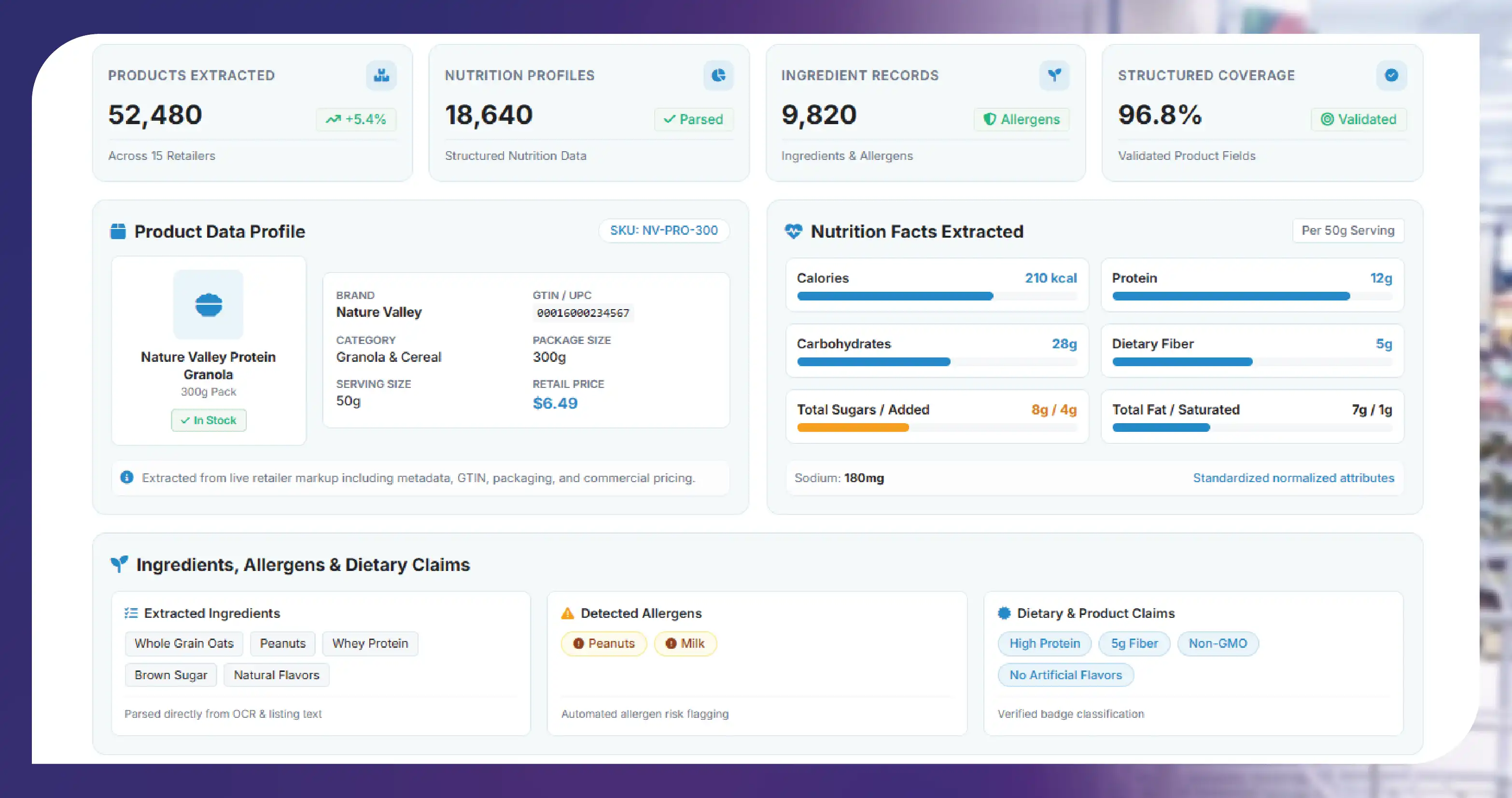
Typical fields include product name, brand, SKU, UPC or GTIN, category, package size, serving size, calories, protein, carbohydrates, dietary fiber, total sugars, added sugars, total fat, saturated fat, trans fat, cholesterol, sodium, vitamins, minerals, ingredients, allergens, dietary labels, certifications, product claims, price, availability, retailer, and product URL.
This information can be organized into a grocery product nutrition & ingredient dataset that supports analytics, comparison, recommendation engines, and research.
The value increases when nutrition information is connected with commercial attributes. For instance, analysts can investigate whether high-protein products command higher prices, whether clean-label products receive premium positioning, or whether healthier products are more frequently promoted.
Supermarket Data Creates a Broader View
Individual product analysis is useful, but supermarket-level coverage provides a much wider perspective.
A supermarket nutrition & ingredient data scrape can collect information across multiple categories, brands, stores, regions, and retailers. This makes it possible to benchmark product portfolios instead of analyzing isolated listings.
Consider a beverage category. A business could examine thousands of products and identify average sugar levels, calorie ranges, sweetener usage, package sizes, and pricing across competing retailers.
Researchers could then compare those findings by geography, brand segment, or product type.
The same dataset can also reveal product gaps. If a retailer has many high-sugar beverages but comparatively few low-sugar alternatives, the data can highlight an opportunity for assortment expansion.
Understanding Ingredients at Scale
Ingredients are often more difficult to analyze than standardized nutrition values because ingredient statements vary considerably.
One product might list an ingredient using a technical name, while another may use a common consumer-facing term. Ingredients can also appear in different orders, include sub-ingredients, or use multiple names for related compounds.
Ingredient scraping therefore benefits from normalization and classification.
A robust pipeline can separate individual ingredients, standardize naming conventions, identify ingredient groups, and categorize components such as preservatives, emulsifiers, colors, sweeteners, oils, starches, flavoring agents, and raising agents.
This creates Nutrition & Ingredient supermarket product intelligence that goes beyond basic data collection.
For food manufacturers, such intelligence can support competitive product research. For retailers, it can help identify assortment trends. For researchers, it can provide structured evidence for studying food composition.
Supporting Food Product Analytics
Once nutritional and ingredient information is standardized, businesses can perform deeper comparisons.
Nutrition & Ingredient food product analytics can identify nutritional patterns across thousands of grocery products.
For example, analysts can calculate average calories per serving within a category, compare protein levels among competing brands, detect products with unusually high sodium, or measure how frequently specific additives appear.
Ingredient-level analytics can uncover broader market trends as well.
A business might discover increasing use of plant-based proteins, reduced-sugar formulations, alternative sweeteners, natural colors, or allergen-free positioning. These insights can inform product development and marketing strategies.
Building a Nutrition & Allergen Dataset
Allergen information is another important dimension of grocery intelligence.
A Nutrition & Allergen Dataset can combine nutritional information, ingredient statements, allergen declarations, dietary claims, and product metadata into one structured resource.
This can support applications that help consumers identify products matching specific dietary requirements.
Businesses can also use allergen data for catalog enrichment, product filtering, compliance workflows, and consumer-facing search experiences.
Because allergen declarations may differ across retailers, normalization is especially important. A structured dataset can make it easier to identify common allergens and connect them with standardized product records.
Nutrition Data for Competitive Intelligence
Food manufacturers operate in highly competitive categories where even small formulation differences can influence positioning.
Suppose three competing protein bars have similar prices but different nutritional profiles. One may have higher protein, another lower sugar, and another higher fiber.
Structured grocery data enables companies to compare these attributes systematically.
Competitive teams can monitor product launches, reformulations, nutritional improvements, packaging claims, and ingredient changes over time.
Historical collection is particularly valuable because it transforms a static product catalog into a time-series intelligence resource. Businesses can determine how product formulations evolve and how competitors respond to consumer trends.
Detecting Product Reformulation
Food products frequently change formulas.
Brands may reduce sugar, replace ingredients, modify serving sizes, introduce new sweeteners, increase protein, remove artificial colors, or update allergen statements.
A recurring scraping workflow can capture product information periodically and compare new records with previous versions.
This makes it possible to detect changes that may otherwise be difficult to identify manually.
For example, an analyst could compare two versions of a product and identify a reduction in sodium, an increase in protein, or the replacement of one ingredient with another.
Such monitoring can support competitive research and category intelligence.
Improving Grocery Search and Recommendation Engines
Nutrition and ingredient data can also improve digital grocery experiences.
A grocery application can use structured information to allow consumers to search for products using nutritional preferences. Instead of searching only by product name, users could filter products by protein, calories, sugar, sodium, dietary characteristics, allergens, or ingredients.
Recommendation engines can use these attributes to suggest alternatives.
For example, if a customer is browsing a high-sugar cereal, the platform could identify comparable products with lower sugar and similar package sizes.
This creates a more informative shopping experience while helping retailers make their product catalogs more useful.
Challenges in Grocery Nutrition Data Scraping
Despite its value, collecting this information at scale is not always straightforward.
Retail websites can use dynamic page structures, JavaScript-rendered content, changing URLs, location-specific catalogs, login requirements, varying product templates, and inconsistent nutritional formats.
Some products may have complete nutrition panels while others provide limited information.
Ingredient descriptions can also contain complex nested statements.
Successful extraction therefore requires careful parsing, validation, normalization, deduplication, and monitoring.
Product identifiers such as UPC, EAN, GTIN, or retailer-specific SKUs can help connect records across sources. Automated validation can identify missing nutrition fields, unexpected values, duplicate products, or formatting changes.
Turning Scraped Data into Business Intelligence
Raw scraping is only the first stage.
The real value comes from transforming collected information into usable intelligence. Data pipelines can clean product records, standardize units, normalize ingredient names, classify nutritional attributes, match products across retailers, and store historical snapshots.
The resulting dataset can feed dashboards, analytics platforms, recommendation systems, research models, or internal databases.
Businesses can create dashboards showing nutrition trends by category, brand, retailer, region, or time period. They can also combine nutrition data with price and availability to understand the commercial relationship between product composition and market positioning.
How Food Data Scrape Can Help You?
1. Nutrition Benchmarking
Food Data Scrape can collect and normalize nutrition panels across retailers, enabling brands to benchmark calories, sugar, protein, sodium, fat, fiber, and other attributes against competitors.
2. Ingredient Intelligence
Structured ingredient collection helps identify additives, preservatives, sweeteners, allergens, oils, and formulation patterns, giving businesses clearer visibility into changing product composition across categories.
3. Competitive Product Analysis
Scraped nutrition and ingredient records allow businesses to compare competing products systematically, uncover formulation advantages, monitor category trends, and identify opportunities for differentiated product development.
4. Allergen Monitoring
Automated collection can consolidate allergen declarations and ingredient information across grocery listings, helping businesses maintain searchable datasets and identify products requiring specific dietary or allergen considerations.
5. Historical Food Intelligence
Recurring grocery data collection creates historical snapshots that reveal reformulations, nutritional changes, ingredient substitutions, new product launches, and evolving consumer-focused positioning across retailers and brands.
Conclusion
Grocery listings contain a wealth of nutritional and ingredient information that can become highly valuable when collected, standardized, and analyzed systematically. From competitive benchmarking and reformulation monitoring to allergen intelligence and personalized product discovery, structured grocery data can support a wide range of applications.
Web Scraping Grocery Product Nutritional Data provides the foundation for collecting nutrition attributes across large product catalogs, while Nutritional Information Mining transforms those records into actionable nutritional insights.
Similarly, Food Ingredient Data Scraping enables businesses to analyze ingredient composition, identify formulation trends, compare products, and build richer food intelligence systems.
When nutrition, ingredients, allergens, prices, availability, product identifiers, and historical records are combined, grocery data becomes more than a collection of product listings. It becomes a strategic intelligence asset for understanding what food products contain, how they are changing, and how they compete.
Ready to turn grocery listings into structured nutrition and ingredient intelligence? Partner with a reliable food data scraping solution to build customized, scalable datasets tailored to your business needs.
Are you in need of high-class scraping services? Food Data Scrape should be your first point of call. We are undoubtedly the best in Food Data Aggregator and Mobile Grocery App Scraping service and we render impeccable data insights and analytics for strategic decision-making. With a legacy of excellence as our backbone, we help companies become data-driven, fueling their development. Please take advantage of our tailored solutions that will add value to your business. Contact us today to unlock the value of your data.
Get a Free Food Data Sample in 48 Hours.
Tell us your platforms, target markets and required fields — we'll map exactly what's possible with food data scraping, recommend the right approach, and send a working sample so you can verify quality before any commitment.
Request a strategy call
Thanks — our data team will reach out within 48 hours with your sample.