Introduction
India's foodservice industry is rapidly evolving as consumers become more conscious of nutrition, ingredients, calories, dietary preferences, and healthier meal choices. Restaurants, cafés, cloud kitchens, meal-prep brands, and specialty food businesses are responding by expanding menus around high-protein, low-calorie, vegan, vegetarian, keto, gluten-free, organic, and functional foods.
Pan-India Healthy Restaurant, Café, and Cloud Kitchen Data Scraping enables businesses to systematically collect structured information from restaurant websites, food delivery platforms, ordering applications, digital menus, and other online sources. Instead of relying on manually collected information, organizations can build continuously refreshed datasets covering restaurants, dishes, prices, nutrition information, dietary tags, locations, ratings, availability, and other attributes.
For businesses seeking to understand this rapidly changing market, the ability to Scrape Pan-India Healthy Restaurant Data can provide a broader view of how healthy food offerings differ across cities, neighborhoods, cuisines, and customer segments.
Why Healthy Food Data Has Become Strategically Important?
Healthy food is no longer limited to a small group of specialty restaurants. Mainstream restaurants and cafés are increasingly adding healthier alternatives to conventional meals.
Menus may now contain:
- High-protein meals
- Low-calorie dishes
- Vegan and plant-based options
- Keto-friendly meals
- Gluten-free products
- Sugar-free beverages
- Protein shakes
- Salads and grain bowls
- Healthy breakfast options
- Functional beverages
- Diet-specific meal plans
- Organic and minimally processed foods
However, identifying these offerings across thousands of businesses is difficult when information is distributed across multiple digital platforms.
A structured dataset can help organizations analyze these offerings consistently. Instead of reviewing individual menus manually, businesses can compare dishes, prices, nutritional information, ratings, locations, cuisines, and dietary attributes at scale.
Building a Pan-India Healthy Food Dataset
India's regional diversity makes nationwide food intelligence particularly valuable.
Healthy food demand can differ considerably between Mumbai, Delhi, Bengaluru, Hyderabad, Chennai, Pune, Kolkata, Ahmedabad, Jaipur, Chandigarh, Lucknow, Patna, and other cities.
A nationwide dataset can capture these differences and provide a market-level perspective.
The dataset can include restaurant names, business categories, addresses, geographic coordinates, cuisine types, menu items, descriptions, prices, discounts, ratings, reviews, delivery information, dietary labels, and operating status.
Organizations can then segment the information according to city, cuisine, business model, price range, dietary preference, or restaurant category.
This approach makes it easier to identify where healthy food concepts are concentrated and where potential market gaps may exist.
Capturing Nutrition and Ingredient Information
One of the most valuable components of this research is nutrition information.
Healthy Restaurant Nutrition Data Scraping can collect publicly available nutritional attributes such as calories, protein, carbohydrates, fats, fiber, sugar, sodium, serving size, and other available nutritional values.
Ingredient-level information can provide another layer of analysis.
For example, a business may want to identify dishes containing:
- Chicken breast
- Tofu
- Paneer
- Quinoa
- Brown rice
- Avocado
- Greek yogurt
- Nuts and seeds
- Plant-based proteins
- Whole grains
Combining ingredient information with nutrition data allows businesses to understand not only what is being sold but also how meals are positioned within different health and dietary categories.
Creating a Pan-India Restaurant Nutrition Database
A structured Pan India Restaurant Nutrition Database can become a valuable resource for food companies, health-focused platforms, nutrition applications, restaurant groups, researchers, and market intelligence teams.
The database can organize information around standardized fields such as:
| Data Category | Examples |
|---|---|
| Restaurant | Name, brand, category |
| Location | City, neighborhood, address |
| Menu | Item, description, category |
| Nutrition | Calories, protein, carbs, fat |
| Dietary Tags | Vegan, keto, gluten-free |
| Ingredients | Primary ingredients and allergens |
| Pricing | Listed price, discounts |
| Customer Signals | Ratings and reviews |
| Availability | Listed or unavailable items |
| Business Model | Restaurant, café, cloud kitchen |
Standardization is important because online food information is often presented differently across platforms.
A structured schema makes comparison, filtering, analysis, and downstream integration significantly easier.
Understanding Healthy Food Competitive Intelligence
Restaurants need to understand how competitors position their healthy offerings.
Healthy Food Competitive Intelligence can help businesses monitor competitor menus, pricing, portion descriptions, dietary categories, promotional offers, ratings, and new product launches.
For example, a restaurant group could monitor how competing brands price high-protein bowls across several cities.
Another company could examine how frequently competitors introduce vegan dishes or protein-focused meal combinations.
Pricing intelligence can also reveal differences between premium health-focused restaurants and mainstream restaurants offering healthier menu sections.
This information can support menu planning, pricing research, product development, and market monitoring.
Unlock smarter food market intelligence with Pan-India healthy restaurant, café, and cloud kitchen data. Contact Food Data Scrape today to build customized datasets for nutrition, pricing, locations, menus, and competitive analysis.
Cloud Kitchens Are Changing the Healthy Food Landscape
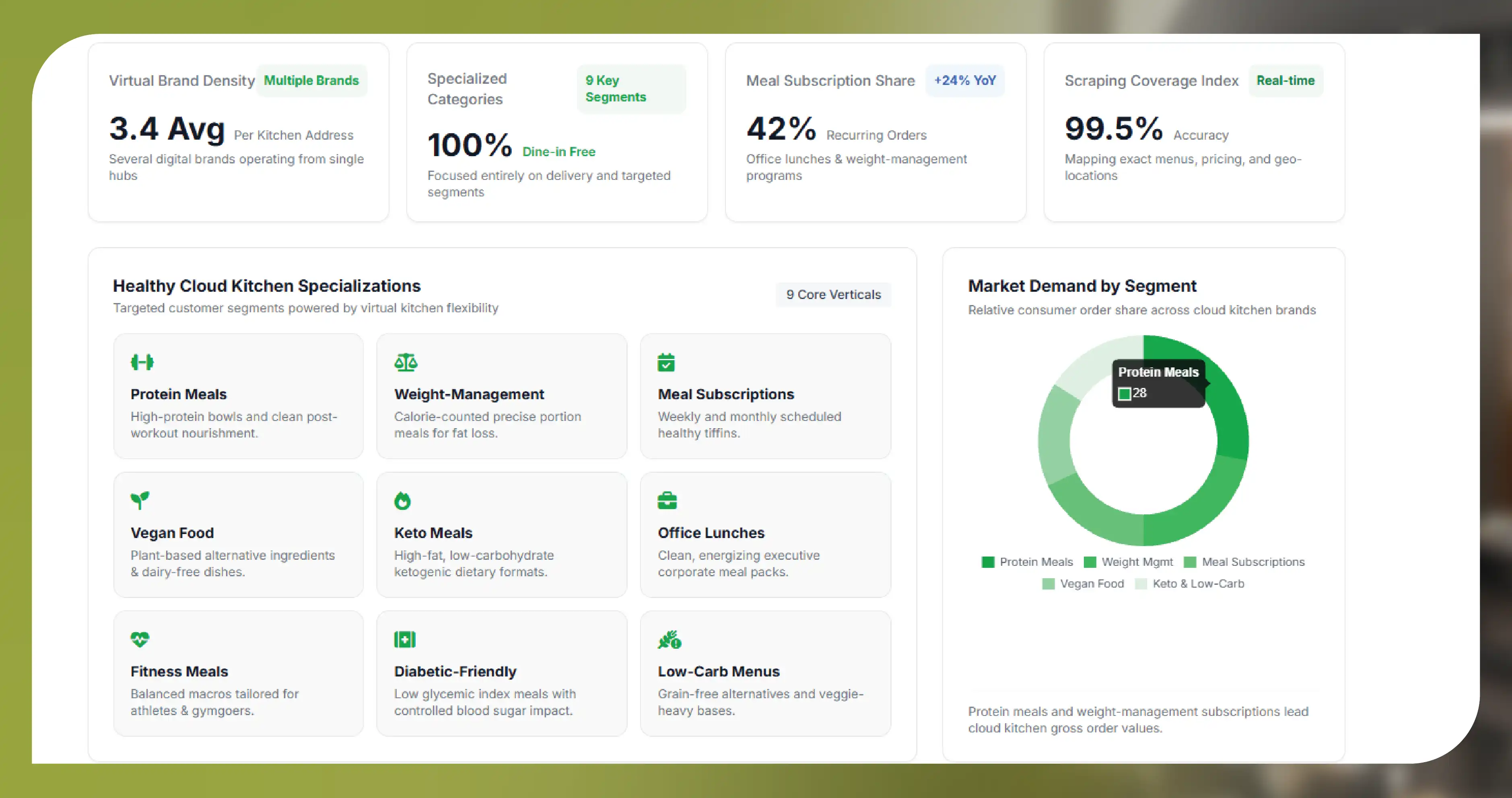
Cloud kitchens have significantly expanded the possibilities for specialized food concepts.
Unlike traditional restaurants, cloud kitchens can operate without a prominent dine-in location and may focus on specific customer segments.
Healthy cloud kitchens can specialize in:
- Protein meals
- Weight-management meals
- Meal subscriptions
- Vegan food
- Keto meals
- Office lunches
- Fitness meals
- Diabetic-friendly food
- Low-carb menus
Because several digital brands may operate from the same kitchen location, identifying these businesses requires specialized location and menu analysis.
Cloud Kitchen Location Data Scraping can help organizations identify operating locations, delivery coverage, cuisine concepts, menu categories, ratings, pricing, and brand relationships where such information is publicly available.
Mapping Healthy Food Availability by City
Geographic analysis can reveal significant differences in healthy food availability.
A business might discover that Bengaluru has a strong concentration of protein-focused meal brands, while another city has more vegetarian health-focused cafés.
Similarly, premium neighborhoods may contain a larger concentration of specialty cafés, organic restaurants, and meal-prep services than other parts of the same city.
Mapping these businesses by location can support expansion research.
Companies can evaluate factors such as restaurant density, competitive concentration, average menu pricing, cuisine diversity, and availability of specific dietary categories.
This makes geographic intelligence an important component of Food Data Scraping in India.
Tracking Specialty Diet Trends
Consumer dietary preferences are continually evolving.
Veganism, plant-based eating, high-protein diets, keto, gluten-free eating, low-carb diets, clean eating, and functional nutrition can all influence restaurant menus.
Health & Specialty Diet Data Scraping can help businesses track how these categories appear across digital menus and foodservice platforms.
For example, organizations can monitor the number of restaurants offering vegan meals in selected cities or compare the average price of keto meals across different locations.
Over time, repeated data collection can reveal whether certain dietary categories are expanding, contracting, or changing in positioning.
Monitoring Menu Pricing and Promotions
Healthy food has historically been associated with premium pricing in many markets, making price intelligence particularly useful.
A structured dataset can track listed prices for comparable products across restaurants and cities.
Businesses can compare:
- Protein bowls
- Salads
- Smoothies
- Healthy wraps
- Meal-prep boxes
- Protein shakes
- Vegan burgers
- Low-carb meals
Promotional information can add another dimension.
Discounts, combo offers, subscription plans, introductory prices, and free-delivery promotions can influence the effective price customers pay.
Tracking these changes over time helps businesses distinguish standard menu prices from promotional pricing.
Identifying New Healthy Food Concepts
Digital menus can also act as an early signal for emerging concepts.
A growing number of restaurants introducing similar products may indicate increasing consumer interest in a particular category.
For example, repeated appearances of high-protein breakfast bowls, functional drinks, plant-based desserts, or specialized meal plans can indicate evolving menu strategies.
By collecting menu information continuously, companies can identify new concepts earlier than they might through occasional manual research.
This can support product innovation, competitive monitoring, and category strategy.
Supporting Restaurant Expansion Decisions
Location intelligence can help restaurant groups evaluate potential expansion opportunities.
Suppose a healthy restaurant brand wants to enter several Indian cities. It could analyze existing competitors, healthy food density, average prices, cuisine preferences, customer ratings, and neighborhood-level availability.
Combining these factors creates a more detailed market picture than simply looking at population size.
The same approach can support cloud kitchen expansion.
Brands can examine delivery-oriented locations, competitor density, cuisine gaps, and existing healthy food availability before evaluating potential operating areas.
From Raw Data to Actionable Intelligence
Collecting information is only the first step.
The real value comes from transforming raw online information into standardized datasets that can be analyzed consistently.
A typical workflow can include:
- Identifying relevant public data sources.
- Collecting restaurant and menu information.
- Extracting nutrition and dietary attributes.
- Standardizing names, categories, and measurements.
- Removing duplicate records.
- Validating selected fields.
- Structuring geographic information.
- Creating recurring data updates.
- Delivering the information through CSV, JSON, APIs, or dashboards.
This process allows businesses to move from fragmented online information toward a reusable intelligence asset.
How Food Data Scrape Can Help You?
1. Pan-India Market Coverage
Food Data Scrape can collect structured restaurant, café, and cloud kitchen information across multiple Indian cities, helping businesses examine healthy food supply, pricing, cuisines, and dietary trends.
2. Nutrition Intelligence
Nutrition-focused datasets can organize available calorie, protein, carbohydrate, fat, ingredient, and dietary information, enabling businesses to compare healthy menu positioning across competing food brands.
3. Competitor Monitoring
Regular data collection can track competitor menus, prices, ratings, promotions, new dishes, and dietary categories, helping food businesses maintain an updated view of changing market conditions.
4. Cloud Kitchen Insights
Location and menu datasets can help businesses monitor cloud kitchen concepts, delivery-oriented brands, cuisine categories, operating areas, and pricing patterns across selected Indian markets.
5. Custom Data Delivery
Businesses can receive structured datasets according to their analytical requirements, supporting dashboards, market research, competitive analysis, pricing studies, location intelligence, and internal data applications.
Conclusion
The growth of health-conscious dining is creating a complex digital food ecosystem spanning restaurants, cafés, specialty brands, delivery platforms, and cloud kitchens. Businesses that want to understand this ecosystem need more than occasional menu research—they need structured, scalable, and consistently refreshed information.
Cloud & Dark Kitchen Tracking can provide visibility into specialized food concepts, operating locations, menu categories, pricing structures, and competitive activity across digital food markets.
Similarly, Nutrition & Allergen Compliance data can help organizations organize publicly available information around ingredients, dietary attributes, nutrition fields, and allergen-related menu disclosures for analytical purposes.
For companies building food intelligence platforms, monitoring competitors, evaluating new markets, or developing nutrition-focused products, Food Data Scraping Services can transform fragmented online restaurant information into structured datasets suitable for research and analysis.
Ultimately, Pan-India healthy restaurant and cloud kitchen data scraping provides a scalable foundation for understanding where healthy food is available, what consumers are being offered, how products are priced, and how the competitive landscape is evolving across India's diverse foodservice markets.
If you are seeking for a reliable data scraping services, Food Data Scrape is at your service. We hold prominence in Food Data Aggregator and Mobile Restaurant App Scraping with impeccable data analysis for strategic decision-making.
Get a Free Food Data Sample in 48 Hours.
Tell us your platforms, target markets and required fields — we'll map exactly what's possible with food data scraping, recommend the right approach, and send a working sample so you can verify quality before any commitment.
Request a strategy call
Thanks — our data team will reach out within 48 hours with your sample.