
QSR Value Pricing: Most value menu items and meal offers fall within the $3–$8 range in 2026.
Leading Chains: Report covers McDonald’s, Burger King, Wendy’s, and Taco Bell value platforms.
Delivery Price Gaps: DoorDash, Uber Eats, and Grubhub may list higher menu prices and additional fees.
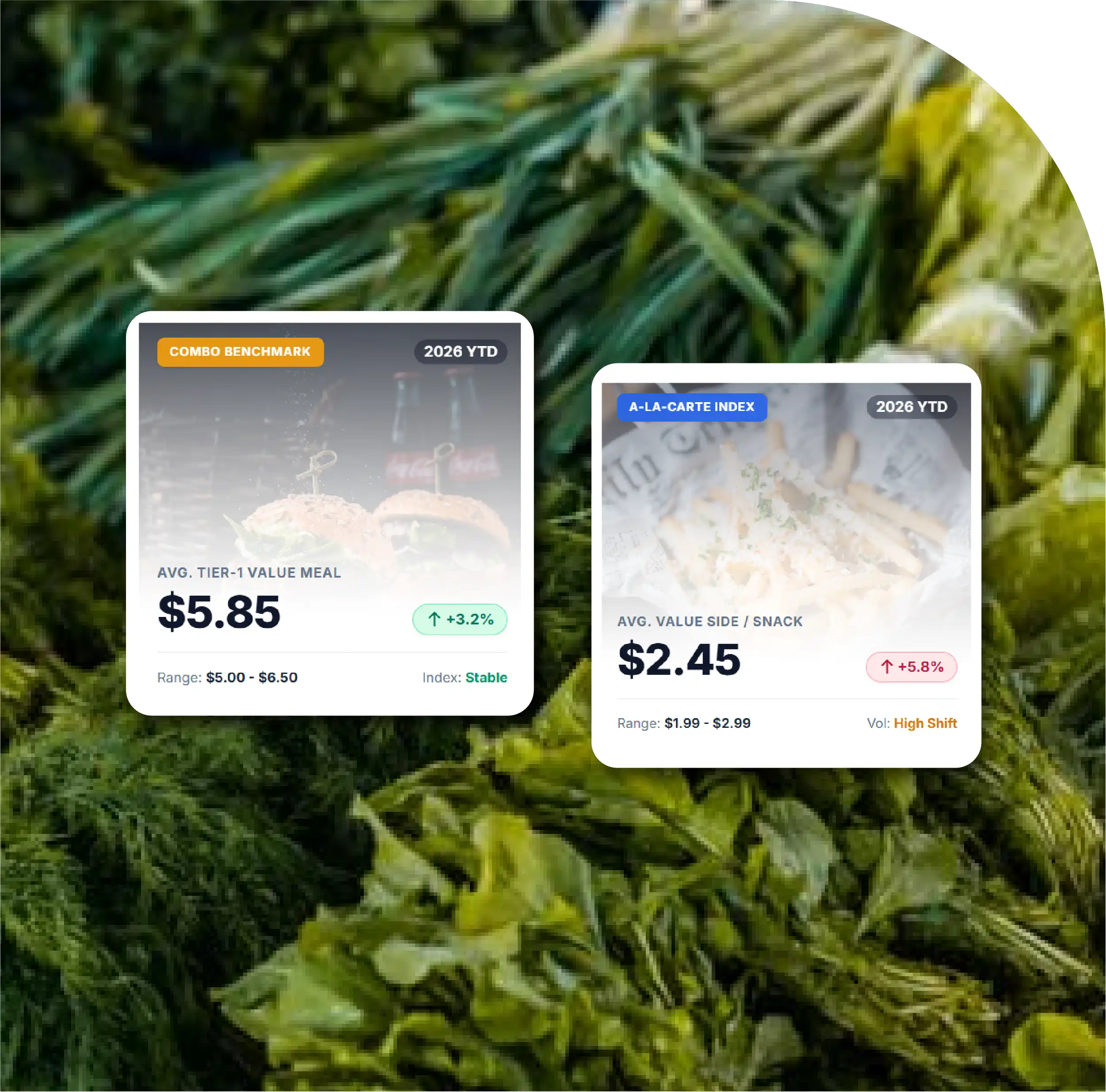
Restaurant Inflation: Limited-service meal prices increased by 3.2% in the 12 months to August 2026.
Regional Price Variations: Franchise pricing creates differences across stores, cities, and ZIP codes.
Data Attributes: Records include item prices, bundle details, promotions, delivery fees, availability, ratings, and timestamps.

QSR value menu prices in the US now sit mostly in a $3 to $8 band. McDonald's moved its McValue menu to items under $3 in April 2026, Wendy's Biggie Deals run from $4 to $8, and Taco Bell's Luxe Value Menu caps items at $3. Limited-service meal prices rose 3.2% in the year to August 2026, so value tiers carry real weight.
That headline hides a lot of variation. Franchisees set many local prices, delivery apps often list higher prices than the counter, and chains change bundles every few months. A single national 'value price' rarely matches what a customer in Dallas or Seattle sees on their phone.
This report pulls together the latest public figures – BLS consumer price data, USDA forecasts, chain announcements and dated delivery-markup studies – and shows where a structured menu dataset fills the gaps. It reflects the questions US brands and analysts have asked our team about DoorDash and Uber Eats value pricing in September and October 2026.
Value menus are not new. Wendy's says it introduced the first QSR value menu concept in 1989 and launched the Biggie Bag in 2019, according to QSR Magazine. What has changed is the price level and the speed of change.
Restaurant inflation spiked after 2021. USDA's Economic Research Service reports food-away-from-home prices rose 7.1% in 2023, 4.1% in 2024 and 3.8% in 2025, and it forecasts 3.5% for 2026 – right on the 20-year average of 3.5% (USDA ERS, updated 25 September 2026).
Guests noticed. The Food Institute notes that McDonald's own data shows its average menu item price rose roughly 40% between 2019 and 2024, and that chains have moved from $5 bundles in 2024 toward individual items near $3 (Food Institute, April 2026). That shift makes item-level price tracking more useful than ever.
| Year | US food-away-from-home price change (USDA ERS) | Limited-service meals, 12-month change (BLS CPI) | Value-menu entry price points announced (cited) |
|---|---|---|---|
| 2023 | 7.1% | 5.9% (December 2022 to December 2023) BLS CPI release, Jan 2024 | Wendy's 4 for $4 and $5 Biggie Bag; Taco Bell $5 Cravings Box and $2 burritos on Cravings Value Menu East Oregonian, 6 Jul 2023 |
| 2024 | 4.1% | 3.7% (December 2023 to December 2024) BLS CPI release, Jan 2025 | Burger King $5 Your Way Meal FOX 5 DC, 24 May 2024; McDonald's $5 Meal Deal from 25 Jun QSR Web; Taco Bell $7 Luxe Cravings Box Scripps News, 28 Jun 2024 |
| 2025 | 3.8% | 3.3% (December 2024 to December 2025) BLS CPI release, Jan 2026 | McDonald's McValue from 7 Jan: $5 Meal Deal plus Buy One, Add One for $1 McDonald's press release; Taco Bell Luxe Cravings Boxes $5 / $7 / $9; Burger King $5 and $7 trio deals Fortune, 8 Jan 2025 |
| 2026 | 3.5% forecast (range 3.3%–3.8%) | 3.2% (August 2025 to August 2026) | McDonald's McValue items under $3 WTAP / AP, 2 Apr 2026; Wendy's Biggie Deals from $4 QSR Magazine, 14 Jan 2026; Taco Bell Luxe Value Menu, items $3 or less AOL, Jan 2026 |
Sources: USDA ERS Food Price Outlook (updated 25 September 2026); BLS CPI Table 2, August 2026. Limited-service figures for 2023–2025 are December-to-December changes (not seasonally adjusted) from the January BLS CPI releases. Entry price points are national offers as announced or reported; local and app prices vary.
The Bureau of Labor Statistics splits restaurant prices into full-service and limited-service meals. Limited-service is the closest official proxy for fast food. In the August 2026 release, limited-service meals and snacks were up 3.2% over 12 months, slightly below full-service at 3.5% (BLS CPI Table 2).
Restaurant prices are still rising faster than grocery prices. Food at home rose 2.2% over the same 12 months, while food away from home rose 3.4%. That gap is the core of the value story: a home meal keeps getting relatively cheaper, so chains lean on low entry prices to protect traffic.
Month-to-month, limited-service prices were flat in August 2026 (0.0% seasonally adjusted) after a 0.4% rise in July. One flat month is not a trend, but it fits a market where value platforms are pulling the average down.
| BLS CPI category (US city average) | 12-month change, Aug 2025–Aug 2026 | 1-month change, Jul–Aug 2026 (seasonally adjusted) |
|---|---|---|
| Food | 2.7% | 0.1% |
| Food at home | 2.2% | 0.0% |
| Food away from home | 3.4% | 0.3% |
| Full service meals and snacks | 3.5% | 0.4% |
| Limited service meals and snacks | 3.2% | 0.0% |
Source: BLS CPI news release, Table 2, August 2026. The September 2026 CPI had not been released at the time of writing; update this table when it is.
Each of the four chains in this report uses a different value structure. Some sell single items under a price cap, some sell bundles, and some do both. To compare them fairly, a dataset needs the platform name, the price tier, the items allowed in each tier and the date the offer was seen.
McDonald's relaunched McValue on 21 April 2026 with 10 items priced under $3 – half of them breakfast items – plus a $4 Breakfast Meal Deal, according to WTAP / Associated Press reporting. The same report notes that franchisees run about 95% of US restaurants and set their own prices, so the cap is a guide, not a guarantee.
Wendy's launched Biggie Deals nationwide on 14 January 2026, with $4 Biggie Bites, a $6 Biggie Bag and an $8 Biggie Bundle. Taco Bell launched a 10-item Luxe Value Menu with every item at $3 or less on 22 January 2026 (AOL). We did not find a dated 2026 source for Burger King's current national value platform.
| Chain | Value platform (as reported) | Entry price point | Bundle / top tier | Source and date | Status for publishing |
|---|---|---|---|---|---|
| McDonald's | McValue menu (relaunched) | Items under $3 | $4 Breakfast Meal Deal; Extra Value Meals about 15% off vs items bought separately | WTAP / AP, 2 Apr 2026; NACS, 13 Mar 2026 | Reported Apr 2026 – live per source |
| Wendy's | Biggie Deals | $4 Biggie Bites | $6 Biggie Bag; $8 Biggie Bundle | QSR Magazine, 14 Jan 2026 | Reported Jan 2026 – live per source |
| Taco Bell | Luxe Value Menu | All 10 items $3 or less | Luxe Cravings Boxes reported at $5 / $7 / $9 in Jan 2025 | AOL, Jan 2026; NRN, 7 Jan 2025 | Reported Jan 2026 – live per source |
| Burger King | $5 Your Way Meal | $5 meal (Whopper Jr., Chicken Jr. or Bacon Cheeseburger + nuggets, fries, drink) | No 2026 value-tier announcement found | Tasting Table, 26 May 2024 | Last dated report May 2024 – older offer |
Note: national list prices are as announced by the chains or reported by trade press. Local and delivery-app prices may differ. Re-check every row on the chain app the week this report is published.
The same McValue item or Biggie Bag can show a different price on each delivery app. Restaurants often raise third-party menu prices to cover commissions, and the apps then add service and delivery fees on top. For a value menu, that markup can wipe out most of the saving.
Public studies on this are few and quickly go out of date, so treat them as indicative only. A Spring 2023 study by Gordon Haskett Research Advisors found an average third-party menu premium of 19% across 25 brands, with quick-service brands at 26%; McDonald's was at 27% and Wendy's at 29% (Food On Demand, 19 April 2023).
A December 2024 FinanceBuzz comparison, reported by Audacy, measured total delivered cost including fees, which is a different measure. It found a McDonald's combo at $11.91 for pickup cost $16.81 to $19.96 delivered, depending on the app. Neither study tracked 2026 value menus specifically, which is the gap a current dataset fills.
| Study (indicative only) | Date of data | What it measured | Headline finding | Use in 2026 |
|---|---|---|---|---|
| Gordon Haskett Research Advisors via Food On Demand | March 2023 | Menu-price premium on DoorDash, Grubhub and/or Uber Eats vs in-restaurant, 3–5 items at 25 brands | Average 19%; quick-service 26%; McDonald's 27%; Wendy's 29% | Indicative baseline only – re-measure |
| FinanceBuzz via Audacy | December 2024 | Total delivered cost incl. fees vs regular menu price | Platform markups 69% (Uber Eats) to 83% (DoorDash); Grubhub 80% | Indicative only – method not published |
For pricing teams, the useful split is menu-price premium versus fees. Menu prices and listed fees are public on the app storefront. Actual order volumes are not public, so any analysis of sales impact should use labelled proxies such as rating counts, 'most liked' or bestseller badges and item availability.
Because franchisees set their own prices, QSR value menu prices can vary by city, and even by store within a city. Rent, wages and local taxes all play a part. National averages from the CPI cannot show this; a store-level menu dataset can.
A practical approach is to sample a fixed set of stores in each region, capture the same value items on the chain app and on each delivery app on the same day, and repeat on a weekly cadence. That gives a clean panel for comparing regions and spotting stores that drift above the national price cap.
Food Data Scrape can build this regional panel (for example New York, Chicago, Dallas and Los Angeles, chain app versus DoorDash, Uber Eats and Grubhub) for your chains on a free pilot.
Value is the main reason many people visit a QSR. A YouGov survey reported by Nation's Restaurant News (April 2026) found 66% of weekly QSR diners are motivated by value or discount menus, and cited Circana data showing nearly 30% of restaurant visits are tied to a deal.
At the same time, value is not a guaranteed fix. McDonald's reported US comparable sales of +0.8% in Q2 2026, versus +2.5% a year earlier, with positive check growth partly offset by lower guest counts (McDonald's Q2 2026 results, 4 August 2026). Teams need to see how competitors adjust QSR value menu prices, store by store, week by week.
The fields below turn raw menu pages into a dataset that answers those questions. All of them come from public menu and storefront pages.
| Field | Description | Example question it answers |
|---|---|---|
| chain_name / store_id | Chain and public store identifier with address and ZIP | Which stores price above the national cap? |
| platform | Chain app, DoorDash, Uber Eats or Grubhub | How big is the delivery premium on each app? |
| value_platform_name | Name of the value menu or deal (e.g. McValue, Biggie Deals) | Which platform is live in this store today? |
| item_name / bundle_components | Item or bundle and its allowed choices | Did the bundle contents change this week? |
| list_price / promo_price | Shown price and any strike-through or promo price | Is the item really under $3 here? |
| service_fee / delivery_fee | Fees shown on the storefront before checkout, where visible | What does the guest pay in total? |
| availability_flag | Whether the item is orderable or sold out | Is a value item being hidden on delivery? |
| rating_count / badge | Public rating count and 'popular' badges as demand proxies | Which value items attract attention? |
| captured_at | Date and time of capture | When did a price move start? |
1. Store-level value menu tracking. We collect value items and bundles for McDonald's, Burger King, Wendy's and Taco Bell from public chain and delivery storefronts. See our McDonald's and Burger King DoorDash menu page.
2. Cross-platform price matching. The same store and item are matched across DoorDash, Uber Eats and Grubhub, so the delivery premium is measured, not guessed. Related: Uber Eats weekly menu data in the USA and the Grubhub food dataset.
3. Ready-made chain datasets. Start with existing chain files such as the Wendy's menu and price dataset or the Taco Bell menu and price dataset, then add a weekly feed.
4. Flexible delivery. Data arrives as CSV, JSON, API or dashboard, on a daily or weekly schedule, with a captured_at stamp on every row. Coverage and turnaround are confirmed when we scope your request.
5. Responsible collection. We collect only publicly available business data, respect robots.txt, site terms and rate limits, and never collect personal data or bypass logins. Order and sales volumes are not public, so we offer labelled proxies instead.
In 2026, QSR value menu prices have settled around $3 entry items and $4 to $8 bundles, while limited-service prices still rise about 3% a year. The national story is simple; the store and app story is not. Franchise pricing and delivery premiums mean the 'value' a guest sees depends on where and how they order.
Pricing, strategy and investment teams that track value items at store level across DoorDash, Uber Eats, Grubhub and chain apps can see competitor moves early and test their own price caps with real data. Public studies help frame the question; a dated, current dataset answers it.
Want a free sample of US value menu price data? Talk to our data team about the chains, regions and platforms you need.
Questions
Most national value platforms start at about $3 to $4. McDonald's McValue items are priced under $3 and Wendy's Biggie Deals run from $4 to $8. Local and delivery-app prices can be higher, so check the store you plan to order from.
Restaurants often raise third-party menu prices to cover commissions, and apps add service and delivery fees. A 2023 study found quick-service menu premiums averaging 26%. Treat that as an indicative baseline and re-measure for current menus.
BLS data shows limited-service meals and snacks rose 3.2% in the 12 months to August 2026. USDA forecasts total food-away-from-home prices to rise 3.5% in 2026, in line with the 20-year average.
No. Franchisees run about 95% of US McDonald's restaurants and set their own prices, so value prices can differ by location. Store-level tracking is the only way to see those differences.
No. Restaurant order and sales volumes are not public. We provide labelled public proxies, such as rating counts, popular-item badges and availability, alongside prices.