Introduction
The quick commerce industry has transformed the way consumers purchase groceries, household essentials, personal care items, and daily-use products by enabling deliveries within minutes. As competition increases among quick commerce platforms, understanding customer demand patterns, product availability, pricing fluctuations, and supply limitations has become essential for businesses. Quick Commerce Demand Gap Analysis using Data Scraping helps brands identify opportunities by analyzing consumer needs, inventory gaps, location-based demand, and market inefficiencies.
Modern quick commerce businesses operate across thousands of micro-markets where demand varies significantly from one area to another. A product that performs exceptionally well in one neighborhood may experience slow movement in another location. By using advanced data collection methods, companies can Scrape Quick Commerce Demand & Supply Quick Pincode-Level Quick Commerce Data Scraping to understand local customer behavior, product shortages, delivery trends, and competitive positioning.
The growing importance of identifying underserved markets has increased the need for High-Demand Low-Supply Data Extraction. Businesses can analyze which products receive frequent searches, which categories face stock shortages, and where competitors fail to meet consumer expectations. This allows retailers, brands, and investors to make data-backed decisions for expansion, inventory planning, and operational improvements.
Understanding Quick Commerce Demand Gap Analysis
Quick commerce demand gap analysis refers to the process of comparing customer demand with available supply across different locations, products, and time periods. The objective is to identify situations where consumer demand exists but products, availability, pricing, or delivery capacity fail to satisfy expectations.
Unlike traditional retail analysis, quick commerce requires real-time visibility because inventory changes frequently. Customers expect instant availability, and even small delays or stock-outs can influence purchasing decisions. A demand gap may occur when a popular product is unavailable, when delivery coverage is limited, or when pricing does not match customer expectations.
Data scraping plays an important role in collecting large-scale information from quick commerce platforms. Businesses can gather product listings, categories, prices, discounts, availability status, delivery estimates, and location-specific information. This data creates a detailed market view that helps companies understand where demand is higher than supply.
Role of Data Scraping in Quick Commerce Intelligence
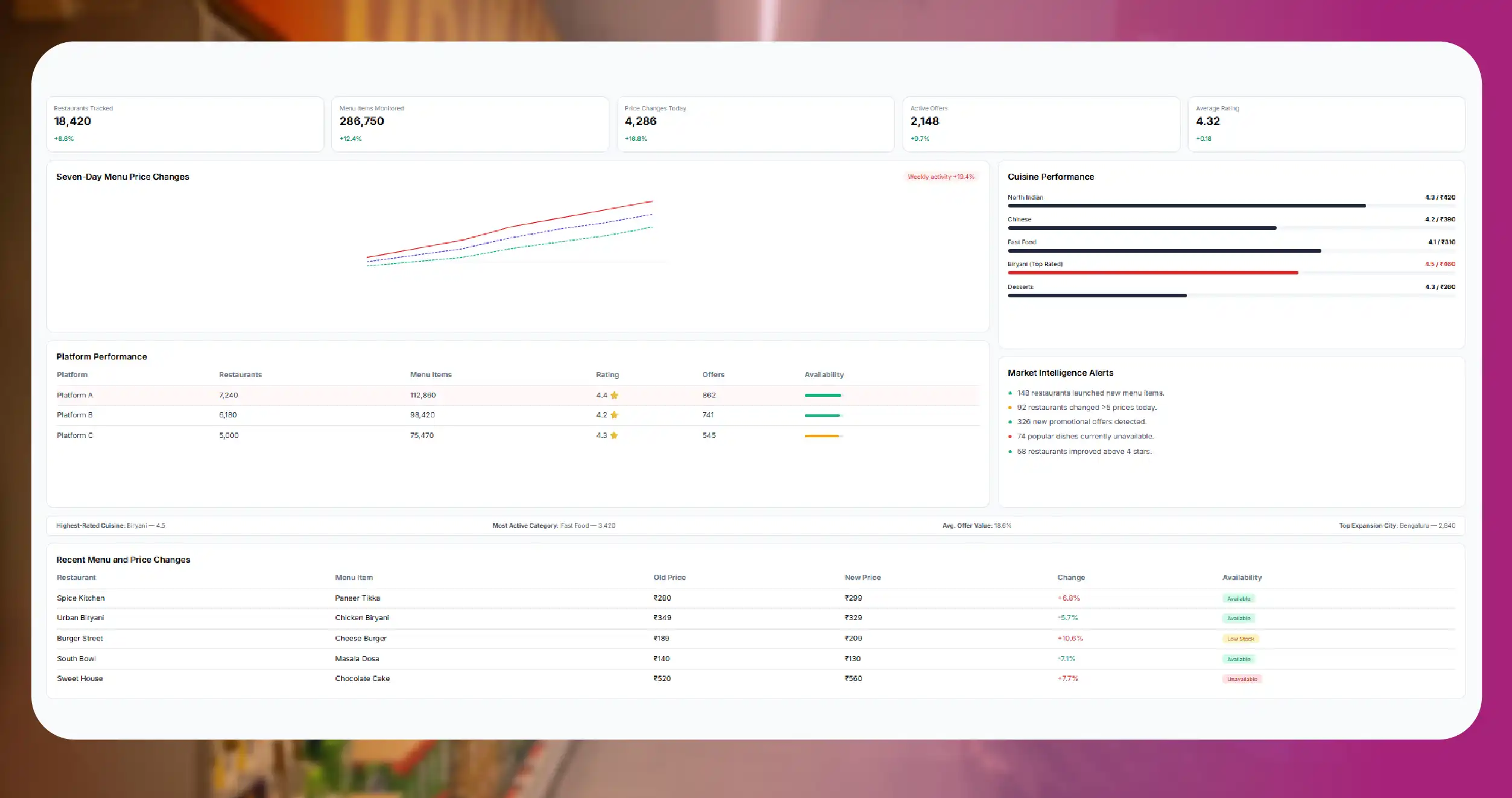
Data scraping enables businesses to collect structured information from multiple quick commerce sources and convert it into actionable insights. Instead of relying on limited internal sales records, companies can analyze broader market conditions through external data.
A comprehensive scraping system can monitor product availability across multiple locations, track price changes, identify frequently unavailable products, and compare competitor strategies. This provides a complete picture of customer demand and supply performance.
For example, if a specific category such as beverages, snacks, baby products, or household supplies repeatedly shows high customer interest but limited availability in certain areas, businesses can identify an opportunity to improve inventory placement. These insights support better warehouse planning, dark store optimization, and product assortment decisions.
With Real-Time Quick Commerce Demand Intelligence, businesses can continuously monitor market movements and respond quickly to changing consumer preferences. Real-time data helps companies detect emerging trends, seasonal demand changes, and sudden increases in product requirements.
Identifying Demand and Supply Gaps Through Data
One of the biggest challenges in quick commerce is maintaining the right balance between customer demand and inventory availability. Overstocking creates operational costs, while understocking results in lost revenue and customer dissatisfaction.
Data scraping helps businesses analyze several important factors, including:
Product availability across locations helps identify areas where customers frequently face stock shortages. Pricing information reveals whether competitors are attracting customers through discounts or better offers. Search trends and category popularity indicate what consumers are actively looking for.
Delivery time analysis also provides valuable insights. If customers in a particular area consistently experience longer delivery times, it may indicate insufficient inventory placement or operational limitations. Businesses can use this information to improve fulfillment strategies.
Through Quick Commerce Demand Forecasting, companies can predict future purchasing patterns by analyzing historical and real-time data. Forecasting allows businesses to prepare inventory, optimize supply chains, and reduce product shortages before they impact customers.
Importance of Pincode-Level Quick Commerce Data
Quick commerce operates on a hyperlocal model, making location-based data extremely valuable. Consumer behavior differs based on demographics, lifestyle patterns, income levels, and local preferences.
Pincode-level data scraping enables businesses to understand demand variations between neighborhoods. Companies can identify high-performing areas, emerging markets, and locations where competitors have limited presence.
For example, one location may show high demand for organic products, while another may have greater demand for ready-to-eat meals or household essentials. Without location-specific insights, businesses may struggle to optimize inventory and marketing strategies.
Analyzing pincode-level information also supports expansion decisions. Before launching a new dark store or delivery hub, companies can evaluate market potential, customer demand, competitor activity, and product availability patterns.
Quick Commerce Market Gap Analysis Using Web Scraping
The competitive nature of quick commerce requires businesses to continuously monitor market changes. Competitors frequently update prices, launch offers, expand categories, and modify delivery operations.
Quick Commerce Market Gap Analysis using Web Scraping allows companies to evaluate competitor performance and identify areas where customer expectations are not being fulfilled. This includes monitoring missing products, pricing differences, availability problems, and service limitations.
Brands can use these insights to improve product placement, optimize promotions, and develop better customer experiences. Investors and market researchers can also analyze industry trends, regional growth opportunities, and consumer behavior.
The collected information can be organized into dashboards and reports, enabling decision-makers to quickly understand market conditions. These insights help businesses reduce uncertainty and make strategic moves based on actual market data.
Building Valuable Quick Commerce Datasets
Reliable datasets are the foundation of effective demand analysis. Quick commerce datasets contain detailed information about products, categories, prices, availability, locations, competitors, and customer trends.
Businesses use these datasets for multiple purposes, including inventory optimization, pricing intelligence, demand prediction, and market research. A well-structured dataset helps identify patterns that may remain hidden in manual analysis.
By continuously updating datasets, companies can track market evolution and respond to consumer behavior changes. This is particularly important in industries where product demand changes daily due to promotions, weather conditions, festivals, and consumer trends.
Ready to identify demand gaps and unlock new opportunities in quick commerce? Contact us today.
Business Benefits of Quick Commerce Demand Gap Analysis
Demand gap analysis provides several strategic advantages for quick commerce companies. It improves inventory efficiency by ensuring products are available where customers need them most. Businesses can reduce wastage, increase sales opportunities, and improve customer satisfaction.
Data-driven insights also support better pricing strategies. Companies can understand competitor pricing, discount patterns, and customer sensitivity toward price changes.
Marketing teams can use demand insights to create targeted campaigns. Instead of promoting products randomly, businesses can focus on areas where customer demand is strong but competition is limited.
Operational teams benefit from improved supply chain planning. By understanding demand patterns, companies can optimize warehouse operations, delivery routes, and product distribution.
How Our Data Scraping Services Can Help You?
Real-Time Market Monitoring Solutions
Our data scraping services collect continuous quick commerce information from multiple
platforms, helping businesses monitor product availability, pricing changes, competitor
activities, and demand movements with accurate market visibility.
Advanced Demand Gap Identification
We analyze product-level and location-level information to discover supply shortages, customer
demand trends, and untapped opportunities that help businesses improve inventory and expansion
strategies.
Customized Quick Commerce Data Extraction
Our solutions deliver tailored datasets based on business requirements, including product
details, availability records, pricing information, category trends, and competitor intelligence
for better decision-making.
Competitive Intelligence Enhancement
We help brands track competitor offerings, promotions, assortment changes, and regional
performance patterns, enabling them to create stronger strategies and respond quickly to market
shifts.
Actionable Business Insights
Our extracted data is transformed into meaningful insights that support forecasting, operational
planning, pricing optimization, and improved customer experiences across quick commerce
ecosystems.
Conclusion
The quick commerce sector depends on speed, availability, and customer satisfaction. Businesses that understand demand patterns and supply limitations can gain a significant competitive advantage. Data scraping enables companies to collect large-scale market information and analyze consumer needs across different locations.
By adopting Web Scraping Quick Commerce Data, organizations can monitor product availability, identify customer demand trends, and improve operational efficiency. A structured approach powered by Quick Commerce Data Scraping API helps companies automate data collection and access accurate information for strategic decisions.
With advanced Quick Commerce Data Intelligence Services, businesses can transform raw market information into valuable insights, optimize inventory management, discover new opportunities, and build stronger quick commerce strategies for long-term growth.
Are you in need of high-class scraping services? Food Data Scrape should be your first point of call. We are undoubtedly the best in Food Data Aggregator and Mobile Grocery App Scraping service and we render impeccable data insights and analytics for strategic decision-making. With a legacy of excellence as our backbone, we help companies become data-driven, fueling their development. Please take advantage of our tailored solutions that will add value to your business. Contact us today to unlock the value of your data.