Introduction
Grocery prices change constantly. A product that costs $3.49 today may be $3.79 next week, while another retailer may offer the same item for $2.99. Promotions, loyalty programs, regional pricing, pack sizes, availability, and changing demand make grocery pricing one of the most dynamic areas of retail intelligence. For businesses, simply collecting prices is not enough. The real challenge is creating data that can be repeatedly collected, accurately matched, validated, and compared over time.
A Reproducible Grocery Price Dataset addresses this challenge by establishing a structured methodology for collecting grocery prices consistently. Instead of maintaining isolated snapshots, businesses can create datasets where the same products, retailers, locations, attributes, and pricing conditions can be tracked repeatedly.
This becomes particularly valuable for grocery product matching and price tracking, because identical-looking products can have different package sizes, SKUs, descriptions, brands, or regional listings. A reliable dataset connects these variations so analysts can understand genuine price movements rather than confusing product differences with pricing changes.
A well-designed historical grocery price dataset can reveal how prices evolve across days, weeks, months, seasons, retailers, and locations. It gives retailers, brands, analysts, and technology companies a foundation for measuring inflation, monitoring competitors, evaluating promotions, and understanding consumer-facing price movements.
What Is a Reproducible Grocery Price Dataset?
A reproducible grocery price dataset is a structured collection of grocery pricing records generated through a consistent and repeatable data-collection process.
The concept of reproducibility is important because grocery data can quickly become unreliable when collection methods change. If one week's data contains standard prices while the next week's data includes loyalty prices, the resulting comparison may be misleading.
A reproducible framework establishes rules for:
- Which retailers and stores are monitored
- Which products are included
- How products are identified
- How pack sizes are normalized
- How prices and discounts are captured
- How locations are recorded
- How timestamps are assigned
- How missing or unavailable products are handled
- How duplicate products are identified
- How historical records are preserved
This creates a consistent foundation for longitudinal grocery analysis.
Why Grocery Pricing Data Is Difficult to Reproduce?
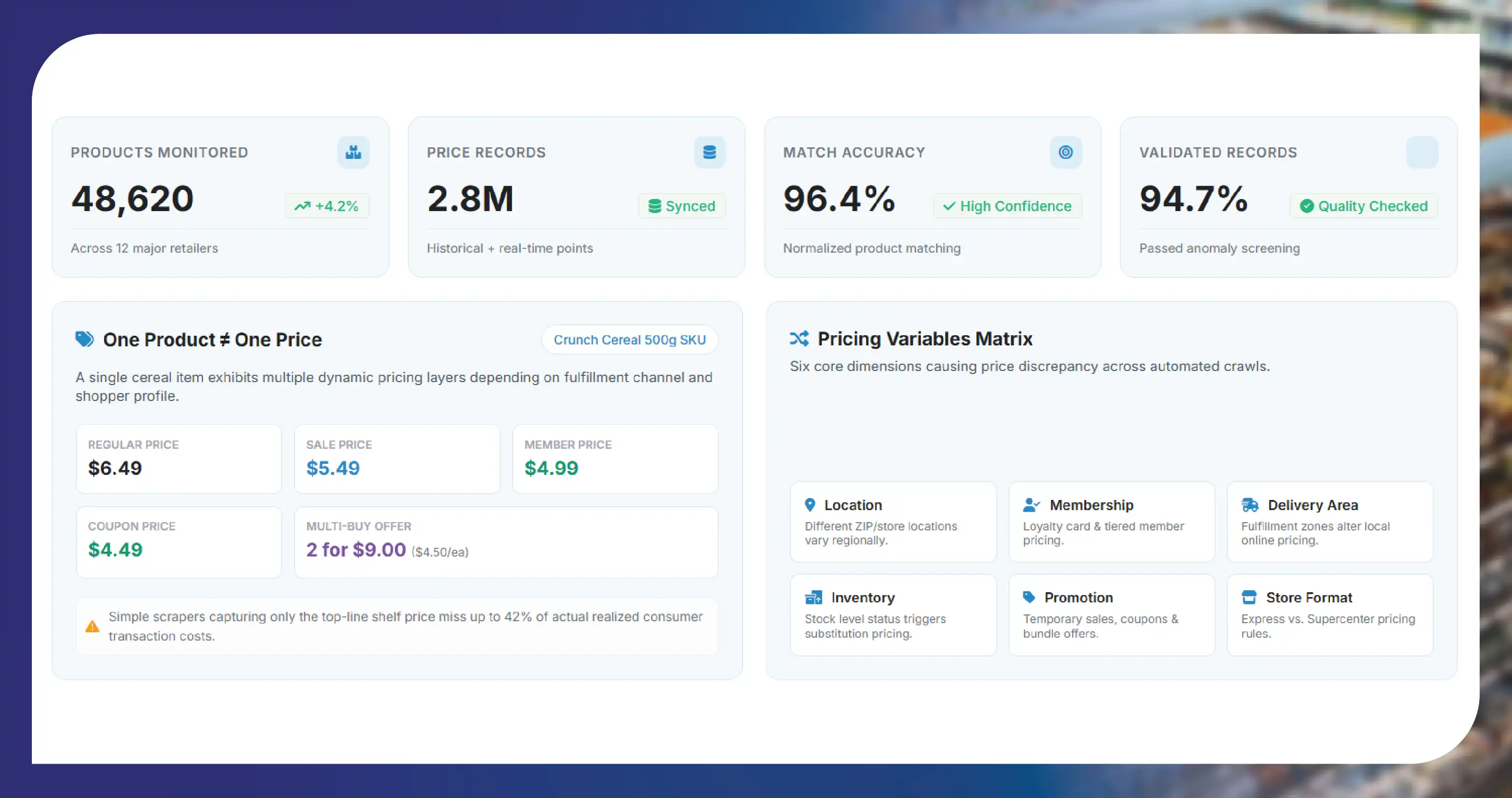
At first glance, collecting grocery prices seems straightforward. A scraper visits a product page, extracts the product name and price, and stores the result. In practice, grocery websites introduce numerous variables.
A retailer may display different prices depending on location, membership status, delivery area, inventory, promotional campaigns, or selected store. The same product may also appear under multiple URLs.
For example, a 500-gram cereal package and a 750-gram package may share almost identical names. A simple matching system could treat them as the same product and generate an inaccurate price comparison.
Another complication is promotions. A product can have a regular price, sale price, member price, coupon price, or multi-buy price. Capturing only the lowest visible price may therefore produce an incomplete picture of the retailer's pricing strategy.
This is why Reproducible grocery pricing intelligence depends on more than scraping. It requires standardized collection, product normalization, historical storage, validation, and clear pricing definitions.
The Core Components of a Reproducible Dataset
A strong dataset generally combines several layers of information.
Product Identity
Each product should have a stable identifier whenever possible, such as SKU, UPC, EAN, GTIN, product ID, or a retailer-specific identifier.
Product names, brands, categories, package sizes, quantities, and descriptions can supplement these identifiers.
Price Information
The dataset should distinguish between regular price, promotional price, loyalty price, discounted price, unit price, and other relevant price types.
This allows analysts to determine whether a price movement represents a genuine retail change or a temporary promotion.
Location
Store-level and regional pricing requires geographic context. A dataset may include store ID, city, postal code, region, delivery zone, or coordinates.
Location information is particularly useful when analyzing regional price differences within the same supermarket chain.
Timestamp
Every observation should include collection date and time. Without timestamps, historical comparison becomes difficult.
A timestamp makes it possible to reconstruct the price environment at a specific point in time.
Availability
Price without availability can be misleading. A product listed at an attractive price but unavailable for purchase should not necessarily be treated as a competitive offer.
Recording in-stock, out-of-stock, limited-stock, or unavailable states provides additional context.
Product Matching Makes Historical Comparison Possible
Product matching is arguably one of the most important components of reproducible grocery analytics.
Suppose Retailer A lists "Organic Whole Milk 1 Gallon" while Retailer B lists "1 Gal Organic Whole Milk." A basic text comparison may treat them as separate products.
A robust matching process can evaluate brand, product title, size, unit, UPC, GTIN, category, variant, and other attributes to determine whether the listings represent the same item.
Businesses can then normalize products into a common structure.
For example:
Brand: Example Foods
Product: Organic Whole Milk
Size: 1 gallon
Unit: gallon
GTIN: 123456789
Retailer: Retailer A
Price: $4.99
Timestamp: August 23, 2026
The same product can then be connected to observations from different retailers and dates.
This makes retail grocery price intelligence much more actionable because analysts can compare equivalent products instead of comparing loosely similar listings.
How Web Scraping Supports Reproducibility?
Web Scraping Grocery Product Pricing Data enables businesses to collect publicly available grocery information at scale from supermarket websites, online grocery stores, retailer catalogs, and digital shopping platforms.
A repeatable scraping workflow can collect product names, prices, promotional information, package sizes, availability, categories, ratings, product IDs, and location-specific information.
The key is consistency.
The same extraction logic should be applied during each collection cycle. If the scraper changes its interpretation of price fields every week, historical comparisons become unreliable.
Automated pipelines can therefore schedule data collection daily, weekly, or at another predefined frequency. Each collection creates a new observation rather than overwriting the previous record.
This turns individual price snapshots into a continuously expanding historical dataset.
Creating a Reliable Grocery Data Schema
A standardized schema makes the dataset easier to analyze and reproduce.
Typical fields may include:
- Retailer name
- Store ID
- Product ID
- Product name
- Brand
- Category
- Subcategory
- UPC/EAN/GTIN
- Package size
- Unit
- Regular price
- Sale price
- Loyalty price
- Unit price
- Promotion type
- Availability
- Product URL
- Location
- Collection timestamp
Additional metadata can document the scraping source, extraction version, matching methodology, and validation status.
This documentation is essential when multiple datasets are compared over time.
What Can Businesses Learn From Historical Grocery Prices?
A reproducible dataset can transform grocery pricing from isolated observations into measurable trends.
Retailers can identify competitors consistently undercutting specific categories. Brands can determine whether promotional activity is changing their market position. Analysts can measure category-level inflation and evaluate regional pricing differences.
Researchers can investigate seasonal patterns. For example, prices for certain products may behave differently during holidays, festivals, summer periods, or major promotional events.
Businesses can also calculate average prices, median prices, price ranges, discount percentages, retailer gaps, and price volatility.
A grocery market intelligence data platform built around these records can provide dashboards and automated reports for pricing teams, category managers, CPG brands, and market researchers.
Building a Product Matching and Pricing Platform
A dedicated method to scrape grocery product matching and pricing platform can combine collection, normalization, matching, storage, and analytics into a single workflow.
The platform can begin by collecting product records from multiple grocery retailers. It can then normalize units, identify duplicate listings, match equivalent products, classify price types, and store each observation with a timestamp.
Machine-learning-assisted matching can further improve accuracy when product titles differ significantly.
For example, "Coca-Cola Zero Sugar 6 x 330ml" and "Coke Zero 330ml Can Multipack — 6 Pack" may require semantic matching rather than exact text matching.
Once products are matched, the platform can calculate competitive price gaps and historical changes automatically.
Grocery Store Datasets and Competitive Research
Structured Grocery Store Datasets can support a wide range of business applications.
A retailer can compare its prices with competing supermarkets. A CPG company can monitor the shelf price of its products across locations. A meal-planning platform can identify the cheapest retailer for a shopping basket.
Investors and researchers can use historical datasets to examine grocery inflation and category trends.
Because the dataset preserves previous observations, analysts do not have to rely entirely on today's website information. They can examine what happened weeks or months earlier.
Quality Control Is Essential
Reproducibility does not mean collecting the same data repeatedly without checking its quality.
Automated validation should identify unusual price changes, missing fields, duplicate records, unexpected product removals, invalid package sizes, and suspicious matching results.
For example, if a product suddenly changes from $5.99 to $0.59, the system should flag the observation rather than automatically treating it as a legitimate 90% price reduction.
Quality-control rules can compare current observations against previous records and expected price ranges.
This improves confidence in downstream dashboards, reports, forecasting models, and competitive intelligence.
Turning Grocery Data Into Business Decisions
The ultimate value of reproducible grocery data is not the dataset itself. It is the decisions the dataset enables.
Pricing teams can identify where competitors have changed prices. Category managers can monitor price positioning. Brands can measure promotional execution. E-commerce companies can benchmark basket costs.
Businesses can also use historical observations to build forecasting models, detect emerging inflation, evaluate price elasticity, and identify recurring promotional patterns.
The more consistently the data is collected, the more valuable these analyses become.
How Food Data Scrape Can Help You?
1. Build Consistent Pricing Datasets
Food Data Scrape can collect grocery prices using standardized workflows, creating repeatable records that support reliable comparisons, historical analysis, competitive monitoring, and pricing strategy decisions.
2. Match Products Across Retailers
Product matching services can connect equivalent grocery items across supermarket websites, helping businesses compare identical products despite differences in naming, packaging descriptions, sizes, SKUs, and retailer structures.
3. Track Historical Price Changes
Continuous data collection creates historical pricing records that reveal trends, promotional cycles, regional differences, competitor movements, and category-level price changes across selected grocery retailers.
4. Support Competitive Intelligence
Structured grocery datasets can help retailers, brands, and analysts benchmark prices, monitor promotional activity, identify pricing gaps, evaluate market positioning, and respond faster to competitive changes.
5. Power Grocery Intelligence Platforms
Food Data Scrape can provide structured grocery datasets that feed dashboards, analytics systems, forecasting models, pricing engines, market research platforms, and automated competitive intelligence workflows.
Conclusion
A reproducible grocery price dataset provides something far more valuable than a collection of product prices: it creates a dependable historical foundation for understanding how grocery markets evolve.
When product identity, price type, location, availability, and timestamp are consistently captured, businesses can move beyond one-time price checks toward reliable longitudinal intelligence. Product matching makes retailer comparisons more meaningful, while historical storage reveals trends that isolated snapshots cannot show.
For organizations seeking scalable grocery intelligence, the method to Scrape Grocery Store Pricing can provide the structured observations needed to monitor changing market conditions.
Likewise, Scrape Grocery Price Data to help create the historical foundation required for competitive benchmarking, product matching, pricing analysis, and market research.
The next step is turning these records into Real-Time Grocery Price Intelligence that supports faster decisions, stronger pricing strategies, and clearer visibility into an increasingly dynamic grocery market.
Ready to build a reliable grocery pricing dataset? Partner with Food Data Scrape to collect, match, normalize, and monitor grocery pricing data at scale.
Are you in need of high-class scraping services? Food Data Scrape should be your first point of call. We are undoubtedly the best in Food Data Aggregator and Mobile Grocery App Scraping service and we render impeccable data insights and analytics for strategic decision-making. With a legacy of excellence as our backbone, we help companies become data-driven, fueling their development. Please take advantage of our tailored solutions that will add value to your business. Contact us today to unlock the value of your data.
Get a Free Food Data Sample in 48 Hours.
Tell us your platforms, target markets and required fields — we'll map exactly what's possible with food data scraping, recommend the right approach, and send a working sample so you can verify quality before any commitment.
Request a strategy call
Thanks — our data team will reach out within 48 hours with your sample.