Introduction
Modern grocery markets generate enormous amounts of public-facing data every day. Product pages change, prices move, promotions appear and disappear, private-label products expand, and availability fluctuates across retailers and locations. For researchers, this creates a valuable opportunity: online grocery platforms can serve as continuously changing sources of market evidence.
Researchers Use Scraped Grocery Data to transform these fragmented digital signals into structured datasets that can support economic studies, retail research, pricing analysis, consumer-market investigations, and competitive benchmarking. Instead of relying exclusively on occasional surveys or manually collected observations, research teams can analyze large volumes of grocery information captured repeatedly over time.
One particularly important application is grocery data for price index analysis, where researchers can monitor product prices across retailers, regions, categories, and time periods. At the same time, grocery promotion analysis using web data can reveal how discounts, multi-buy offers, loyalty pricing, and promotional intensity influence observed market prices.
This shift is making Grocery Data Scraping increasingly relevant to academic researchers, economists, consulting firms, consumer analysts, FMCG companies, and retail strategy teams.
Why Grocery Data Has Become Valuable Research Evidence?
Traditional grocery research often depends on surveys, retailer reports, point-of-sale datasets, syndicated research, or limited field observations. These sources remain useful, but digital grocery platforms provide another layer of evidence.
Online grocery websites expose information about product names, package sizes, brands, prices, promotional labels, ratings, availability, categories, and sometimes store-specific conditions. When collected consistently, these observations can create longitudinal datasets capable of revealing market movements.
For example, a researcher studying inflation might track the same basket of grocery products across several retailers for twelve months. Rather than looking at one price observation, the researcher can examine thousands of observations and identify when prices changed, how frequently they changed, and whether changes differed by retailer or geography.
This makes scraped grocery data particularly useful for studying price dynamics rather than simply documenting individual prices.
Building Better Grocery Price Indexes
Consumer price research depends heavily on reliable price observations. Grocery products are especially challenging because retailers frequently change prices, introduce promotions, modify pack sizes, and substitute products.
A structured scraping program can capture:
- Product name
- Brand
- Package size
- Regular price
- Promotional price
- Unit price
- Discount percentage
- Product category
- Availability
- Retailer
- Store or geographic location
- Collection timestamp
Researchers can then standardize products and compare prices across time.
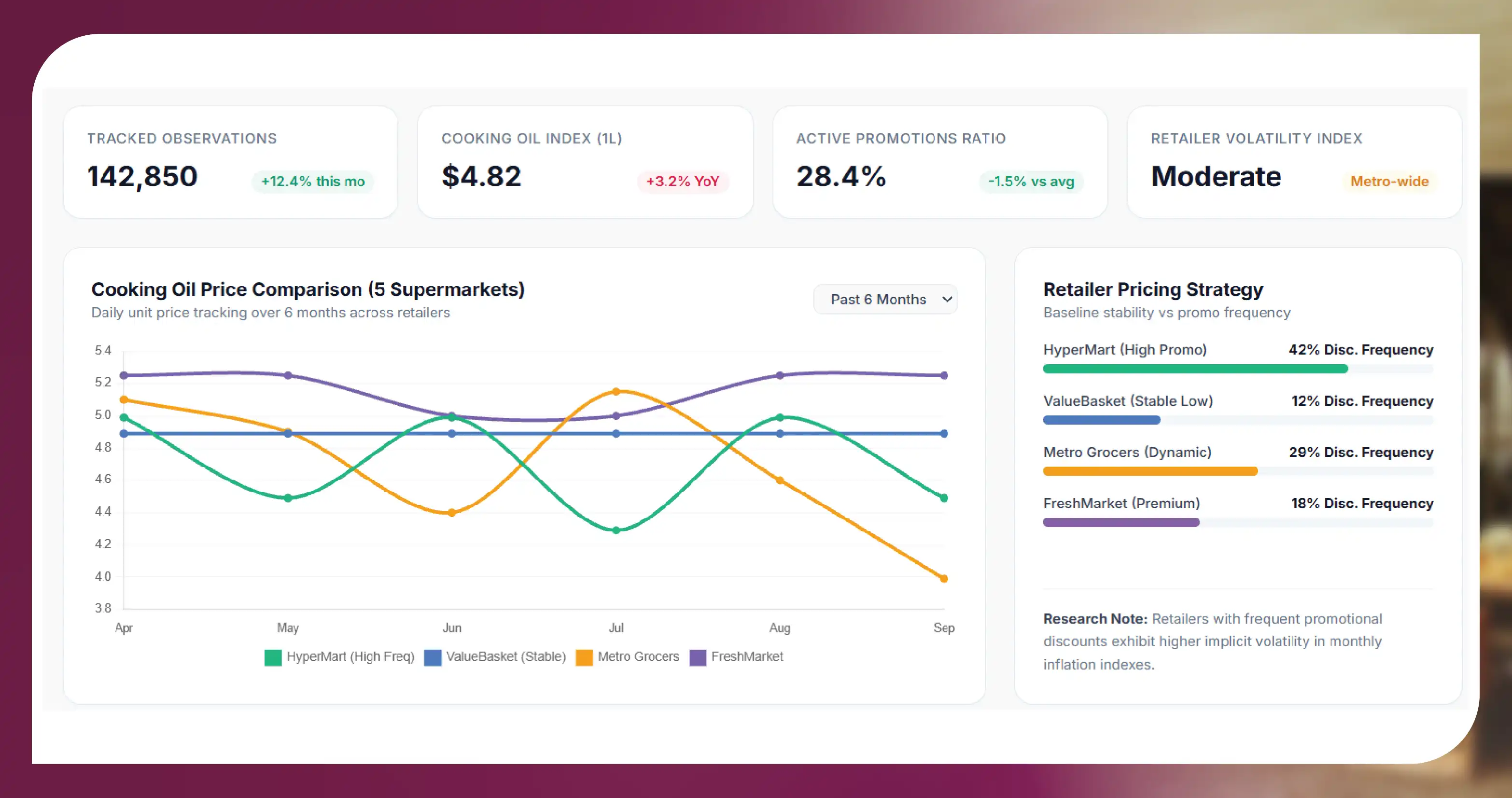
Consider a simple example involving cooking oil. A researcher could track the price of the same 1-liter product across five supermarket websites every day. Over several months, the dataset might reveal that one retailer changes prices frequently while another maintains stable pricing but uses more promotional discounts.
Such findings can produce a more nuanced picture of grocery inflation than a single monthly observation.
Understanding Promotions Through Digital Grocery Data
Promotions can make grocery price research complicated. A product listed at $5 may temporarily sell for $3, while another retailer might display a loyalty-member price that is unavailable to non-members.
Researchers can distinguish between regular prices, sale prices, loyalty prices, bundle offers, percentage discounts, coupons, and multi-buy promotions when these attributes are publicly displayed.
This creates opportunities to investigate questions such as:
- How frequently do retailers promote essential products?
- Which categories receive the greatest promotional attention?
- Do promotional prices differ significantly between competing retailers?
- Are discounts becoming deeper or simply more frequent?
- Do retailers use promotions strategically around holidays or seasonal events?
Historical scraped datasets allow researchers to answer these questions with observations collected consistently instead of relying on retrospective claims.
Grocery Market Structure Analysis
Pricing data becomes even more valuable when combined with retailer, brand, category, and geographic information.
Grocery market structure analysis can examine how concentrated different product categories are, how many brands compete within a category, how private labels compare with national brands, and whether price dispersion differs between retailers.
For example, researchers studying breakfast cereals could measure the number of competing brands, compare average prices, analyze package sizes, and determine how prominently private-label products appear.
A similar approach could be applied to dairy, snacks, beverages, frozen foods, household essentials, personal care products, and fresh food categories.
This allows researchers to move beyond individual products and study broader competitive structures.
Measuring Grocery Competitive Intelligence
Retail competition is increasingly visible online.
Grocery competitive intelligence data can help researchers understand how retailers respond to each other's prices, promotions, assortment changes, and availability patterns.
Suppose one retailer reduces the price of a popular branded product. A longitudinal dataset could show whether competing retailers respond immediately, gradually, or not at all.
Researchers can also investigate whether competitive responses differ by category. Highly price-sensitive staples may demonstrate rapid price matching, while niche products may show considerably greater price variation.
These patterns can provide evidence for research into retail competition, pricing strategies, market power, and consumer choice.
The Rise of Research-Grade Grocery Data Analytics
Raw scraped information is only the beginning. To become useful for research, grocery data must be cleaned, standardized, matched, and organized.
Grocery data analytics for research teams can involve product matching, duplicate removal, category normalization, price normalization, historical tracking, geographical segmentation, and statistical analysis.
Product matching is particularly important. A retailer may describe the same product using slightly different titles, abbreviations, or package descriptions. A research dataset must determine whether two observations represent identical products, equivalent products, or completely different items.
Researchers may also calculate unit prices to avoid misleading comparisons. A $4 package and a $6 package cannot be meaningfully compared without considering their respective sizes.
This transformation turns unstructured online information into a research-ready analytical resource.
Investigating Private Label Growth
Private-label products are another area where scraped grocery data can provide valuable evidence.
Private label grocery market intelligence allows researchers to measure how prominently retailer-owned brands appear across categories and how their prices compare with national brands.
A dataset collected over multiple periods can reveal whether private-label assortment is expanding, whether retailers are introducing premium private labels, and whether private-label products maintain a consistent price advantage.
Researchers could also investigate whether private-label pricing changes during inflationary periods. For example, if national-brand prices rise faster than private-label prices, the resulting price gap may influence consumer substitution.
Such evidence can support studies of consumer behavior, retailer strategy, brand competition, and market positioning.
Geographic Grocery Research
Location can dramatically influence grocery prices.
Researchers comparing cities, states, countries, or neighborhoods can use location-specific grocery data to study regional price differences.
A product may cost significantly more in one metropolitan area than another because of transportation expenses, local competition, taxes, demand patterns, store formats, or regional pricing strategies.
Scraping grocery websites at different geographic settings can help researchers construct regional datasets while maintaining product-level consistency.
The same methodology can support studies comparing urban and rural markets, high-income and low-income regions, or different retail formats.
Tracking Availability and Stockouts
Price is not the only market signal.
Availability data can reveal how frequently products become unavailable and whether stockouts are concentrated within particular categories or retailers.
A researcher investigating supply-chain disruptions could track whether products disappear from online catalogs during specific periods. Combined with pricing information, this can help identify relationships between scarcity and price movement.
For example, if a product's availability declines while its price increases, researchers can investigate whether the two events are connected.
Repeated observations are particularly valuable because a single stockout tells little about market conditions, whereas months of observations can reveal persistent patterns.
From Scraping to Research-Ready Datasets
A robust grocery data research pipeline generally includes several stages.
First, researchers identify relevant grocery websites and publicly available product information. Next, automated extraction captures product and pricing attributes at defined intervals.
The collected data is then cleaned and standardized. Product identifiers, brands, categories, package sizes, prices, promotional states, retailers, and locations are normalized.
Historical snapshots are preserved so that researchers can compare observations across time.
Advanced workflows may then combine grocery data with other datasets, including demographic statistics, inflation indicators, regional economic information, consumer research, or retail reports.
The result is a richer analytical environment in which online grocery observations become one component of a larger research framework.
Challenges Researchers Must Consider
Despite its potential, grocery scraping requires careful methodology.
Retail websites can change their layouts, product structures, URLs, and availability mechanisms. Some products may appear differently depending on location, store selection, login status, or shopping context.
Researchers must therefore maintain consistent collection methodologies and document how observations were obtained.
Data quality is equally important. Incorrect product matching, missing prices, duplicate records, changing package sizes, and temporary promotional states can distort results.
Ethical and legal considerations also matter. Research teams should respect website terms, applicable laws, access restrictions, and responsible data-collection practices. Publicly accessible information should be collected thoughtfully rather than treated as automatically unrestricted.
A transparent methodology improves the credibility and reproducibility of research findings.
How Food Data Scrape Can Help You?
1. Build Historical Grocery Datasets
Food Data Scrape can help research teams collect structured grocery observations repeatedly, creating historical datasets that support price trends, promotional research, assortment studies, and longitudinal market analysis.
2. Compare Retailers and Categories
Researchers can organize grocery information across retailers, brands, categories, products, and locations, enabling detailed comparisons that reveal competitive differences and changing market structures over time.
3. Monitor Pricing and Promotions
Structured price and promotion data can help identify regular pricing patterns, discount frequency, promotional depth, loyalty offers, and category-level changes for stronger quantitative research.
4. Strengthen Research-Ready Analytics
Food Data Scrape can support cleaned, standardized datasets with product attributes, prices, availability, retailers, timestamps, and categories, helping analysts reduce manual preparation before research.
5. Support Advanced Market Intelligence
Researchers can combine grocery datasets with economic and demographic information to investigate inflation, competition, private labels, consumer markets, regional differences, and evolving retail strategies.
Conclusion
Grocery websites have evolved into valuable sources of market information. When collected systematically, online product prices, promotions, assortment, availability, package sizes, brands, and retailer information can become powerful research inputs.
Data Extraction from Popular Grocery platforms can help researchers build historical datasets that reveal market movements rather than isolated observations. These datasets can support price index development, competitive studies, promotion research, private-label analysis, regional comparisons, and supply-chain investigations.
The next stage is even more sophisticated. AI Grocery Intelligence can help transform large grocery datasets into faster insights by identifying pricing patterns, anomalies, assortment changes, and emerging market signals.
The same analytical approach can extend beyond grocery retail. AI Grocery Intelligence can connect food-market research with restaurant pricing, menus, promotions, availability, and competitive positioning.
For researchers, the real opportunity is not simply collecting more grocery data. It is creating consistent, structured, historical evidence that can answer complex questions about how modern food markets operate.
Ready to turn grocery websites into research-ready market intelligence? Partner with Food Data Scrape to build structured, scalable grocery datasets tailored to your research and analytical goals.
Are you in need of high-class scraping services? Food Data Scrape should be your first point of call. We are undoubtedly the best in Food Data Aggregator and Mobile Grocery App Scraping service and we render impeccable data insights and analytics for strategic decision-making. With a legacy of excellence as our backbone, we help companies become data-driven, fueling their development. Please take advantage of our tailored solutions that will add value to your business. Contact us today to unlock the value of your data.
Get a Free Food Data Sample in 48 Hours.
Tell us your platforms, target markets and required fields — we'll map exactly what's possible with food data scraping, recommend the right approach, and send a working sample so you can verify quality before any commitment.
Request a strategy call
Thanks — our data team will reach out within 48 hours with your sample.