Introduction
Restaurants are no longer represented by a simple menu page. Their digital presence is spread across restaurant websites, food delivery marketplaces, mobile applications, ordering platforms, review portals, location pages, and aggregator networks. Prices change, menus rotate, restaurants open or close, delivery fees fluctuate, and availability can vary by location and time.
That makes Restaurant Data Pipeline scraping far more than collecting HTML pages once. A modern pipeline must continuously discover restaurant records, extract structured information, validate changing fields, handle different website architectures, and deliver clean datasets to analytics systems.
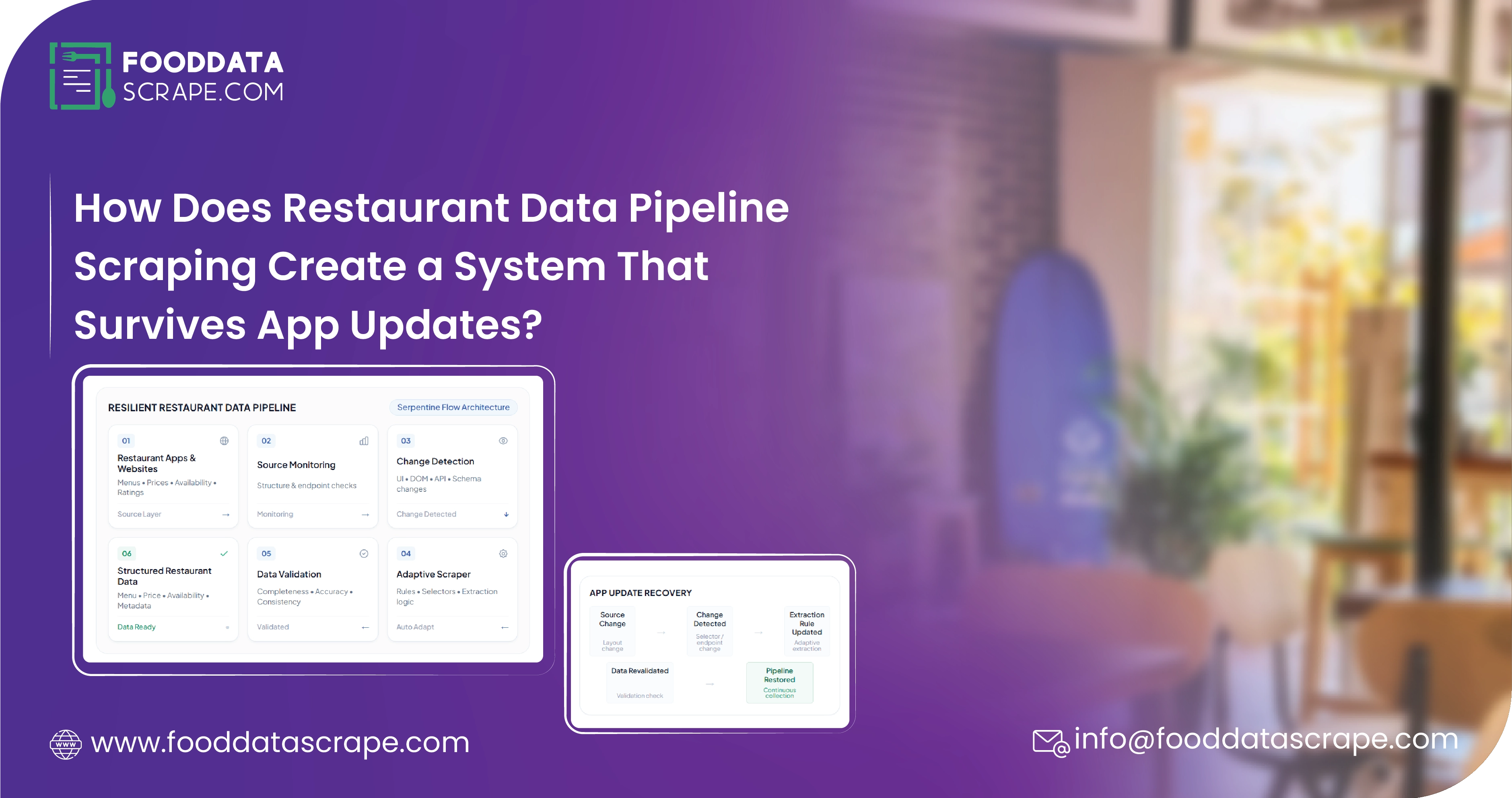
A well-designed restaurant data pipeline that survives website scrape challenges is built around adaptability. Instead of depending on a single selector or page layout, it uses modular extraction, monitoring, validation, retry mechanisms, and change detection to keep data flowing when websites evolve.
Similarly, a restaurant data pipeline for changing apps scraping must account for mobile-first interfaces, dynamic APIs, location-based menus, authentication layers, and frequently changing application structures.
What Is a Restaurant Data Pipeline?
A restaurant data pipeline is an organized system that moves restaurant information from multiple digital sources into a structured destination where businesses can analyze, monitor, and use it.
The process generally involves six stages: source discovery, data extraction, transformation, validation, storage, and delivery.
Instead of manually collecting restaurant information, organizations can automate the journey from source to database. The pipeline can collect restaurant names, addresses, cuisines, ratings, operating hours, menus, item prices, discounts, delivery charges, availability, restaurant categories, coordinates, and other attributes.
The real advantage is continuity. A one-time scrape provides a snapshot, while a pipeline creates a repeatable data stream.
Why Restaurant Scraping Needs a Pipeline?
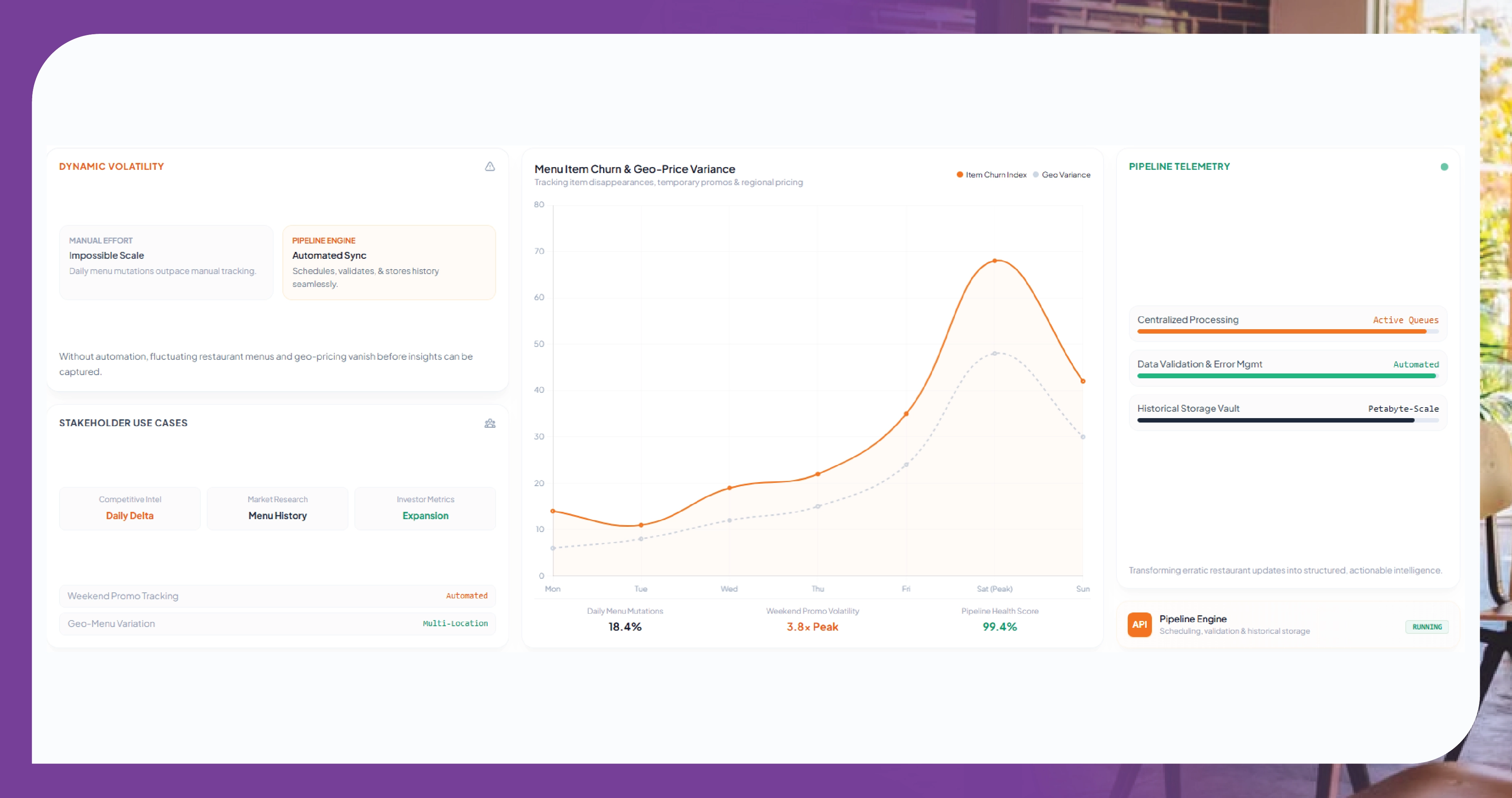
Restaurant information is exceptionally dynamic. A menu item that exists today may disappear tomorrow. A restaurant may introduce a promotional price for a weekend and restore the original price afterward. Delivery platforms can also display different menus and prices depending on geography.
This makes a reliable restaurant scraping pipeline essential for businesses that depend on current information.
For example, competitive intelligence teams may want to compare prices across hundreds of restaurants every day. Market researchers may need historical menu changes. Delivery platforms may want to monitor competing restaurants. Investors may analyze restaurant expansion patterns.
Without automation, these requirements quickly become impossible to manage manually.
A pipeline provides scheduling, centralized processing, error management, data validation, and historical storage, allowing businesses to transform constantly changing restaurant information into usable intelligence.
Core Components of a Restaurant Data Pipeline
A strong pipeline starts with source management. Different sources may require completely different extraction approaches. One website may expose structured information directly, while another may rely heavily on JavaScript.
The extraction layer should therefore support multiple methods, including HTTP requests, browser automation, structured endpoints, HTML parsing, and application-level data extraction where appropriate.
The next layer is normalization.
Suppose one source calls a category "Starters," another uses "Appetizers," and another uses "Small Plates." A normalization system can map these variations into standardized categories.
The same principle applies to currencies, restaurant names, addresses, cuisine labels, ratings, operating hours, and menu attributes.
Then comes validation. A pipeline should identify suspicious records rather than silently inserting incorrect information into the database. Unexpected price changes, missing restaurant names, duplicate listings, invalid addresses, or sudden drops in extracted fields can trigger validation rules.
Finally, the cleaned information is stored in formats such as relational databases, cloud storage, JSON, CSV, or analytics platforms.
Making the Pipeline Scalable
Small scraping projects can sometimes run from a single machine. Large restaurant datasets require a different architecture.
A scalable restaurant data pipeline scraping framework separates workloads into manageable components. Source discovery, extraction, transformation, validation, and storage can operate independently, allowing organizations to increase capacity as the number of restaurants grows.
For instance, collecting information from 500 restaurants is fundamentally different from monitoring 500,000 restaurant listings across several countries.
Scalability also requires queue management and workload distribution. Tasks can be placed into queues and processed by multiple workers. Failed jobs can be retried without restarting the entire extraction process.
Cloud infrastructure can further support elastic workloads. Processing capacity can increase during large extraction cycles and decrease when demand falls.
Handling Changing Websites and Apps
One of the biggest weaknesses of traditional scraping is dependency on fixed page structures.
A selector that works perfectly today can stop working after a website redesign. Mobile applications can introduce new layouts, change endpoints, or alter the way menu information is delivered.
A resilient architecture uses multiple signals rather than relying on one fragile selector.
Monitoring is equally important. If a scraper previously extracted 30 fields per restaurant and suddenly extracts only eight, the pipeline should detect the anomaly.
Change detection can monitor page structures, response patterns, field availability, extraction volumes, and data quality.
This turns scraping from a "run and hope" process into an observable data operation.
Recurring Extraction and Historical Intelligence
Restaurant data becomes much more valuable when collected repeatedly.
A restaurant data pipeline for recurring extraction can schedule hourly, daily, weekly, or custom collection cycles depending on the business requirement.
Frequent collection is useful for highly dynamic information such as menu availability, delivery fees, discounts, and prices. Less volatile information, such as restaurant addresses or cuisine categories, may only require periodic updates.
Historical snapshots also create opportunities that a single dataset cannot provide.
Businesses can identify when menu prices changed, how frequently restaurants introduced new items, which dishes disappeared, how promotions evolved, and how competitive pricing shifted over time.
This creates a historical restaurant intelligence layer rather than merely a directory of current listings.
Data Quality Should Be a First-Class Priority
Collecting millions of records is not useful if the information cannot be trusted.
Data quality should therefore be measured throughout the pipeline.
Useful checks include duplicate detection, missing-field analysis, price validation, restaurant identity matching, location verification, category normalization, timestamping, and freshness monitoring.
Entity matching is particularly important. The same restaurant can appear on multiple platforms under slightly different names.
A pipeline can combine restaurant name, address, coordinates, phone information, and other signals to identify whether records represent the same business.
This allows organizations to create a unified restaurant profile across multiple sources.
Where Restaurant Data Pipelines Create Business Value?
Restaurant pipelines can support a broad range of commercial applications.
- Competitive pricing teams can compare menu prices across restaurants and locations. Food delivery businesses can monitor competitors. Restaurant chains can benchmark their menus against local competitors.
- Market researchers can identify cuisine trends, restaurant density, new openings, closures, and geographical expansion.
- Investors can use restaurant datasets to understand market fragmentation and brand presence.
- Operations teams can monitor menu availability and identify inconsistencies across digital channels.
- Marketing teams can analyze promotions, discounts, customer ratings, and popular menu categories.
This is where scraping becomes a strategic intelligence capability rather than simply a technical extraction exercise.
The Role of Restaurant Scraping Services
Building and maintaining an enterprise-grade pipeline internally can require significant engineering resources.
Specialized website and app scraping services for restaurants can help businesses manage source discovery, extraction, infrastructure, proxy management, parsing, validation, monitoring, and structured delivery.
The ideal architecture should still be designed around the organization's actual requirements.
A company monitoring restaurant menus in one city may need a lightweight scheduled system. A global food marketplace may require distributed extraction, automated monitoring, multilingual normalization, geolocation handling, and large-scale historical storage.
The objective is not simply to scrape more pages. It is to create dependable information flows.
Ready to build a resilient restaurant data pipeline? Turn changing restaurant data into reliable, actionable intelligence today.
Building a Global Restaurant Database
A continuously maintained Global Restaurant Database can become the foundation for international restaurant intelligence.
Such a database can combine restaurant identities, locations, cuisines, menus, pricing, ratings, operating hours, availability, promotions, and platform presence.
With historical snapshots attached to these records, businesses can analyze restaurant markets across cities and countries.
For example, analysts can compare average menu prices between markets, identify cuisines gaining popularity, evaluate restaurant density, monitor chain expansion, and understand regional differences in menu structures.
The database becomes especially powerful when restaurant entities are standardized across multiple platforms.
Turning Data Into Restaurant Intelligence
A continuously refreshed dataset can power broader Restaurant Intelligence initiatives.
Instead of asking only "What restaurants exist?", businesses can ask more valuable questions:
- Which restaurants are increasing prices?
- Which menu categories are expanding?
- Where are competitors offering stronger promotions?
- Which brands are entering new markets?
- How quickly are menu prices changing?
- Which locations have the highest restaurant density?
- Which restaurant chains maintain consistent pricing across regions?
These questions demonstrate why the pipeline matters. Extraction is only the beginning. The ultimate goal is turning raw restaurant information into decisions.
How Food Data Scrape Can Help You?
Competitive Monitoring: Food data scrape helps businesses monitor competitor menus, prices, promotions, ratings, and availability, supporting faster competitive benchmarking and better pricing decisions across restaurant markets.
Price Intelligence: Automated food data collection reveals pricing movements, discounts, delivery charges, and regional differences, helping businesses identify opportunities and respond intelligently to changing market conditions.
Menu Analysis: Continuous restaurant data enables teams to track new dishes, discontinued items, category changes, portion information, and menu trends while supporting evidence-based product and menu strategies.
Market Research: Structured restaurant datasets help analysts evaluate restaurant density, cuisine popularity, brand expansion, local competition, and market gaps across cities, regions, and international markets.
Demand Insights: Historical restaurant datasets can reveal seasonal menu patterns, promotional behavior, pricing changes, and availability trends, helping businesses improve forecasting, planning, benchmarking, and strategic decision-making.
Conclusion
Restaurant data is changing too quickly for one-time extraction strategies to remain effective. Websites are redesigned, applications evolve, menus change, prices fluctuate, and restaurants continuously enter or leave digital marketplaces.
A modern restaurant pipeline addresses this complexity through automation, monitoring, validation, normalization, recurring extraction, and scalable infrastructure.
Businesses looking to Scrape Restaurant Menu Data can use pipeline-driven systems to transform fragmented restaurant information into structured, reusable datasets.
Organizations requiring Real-Time Restaurant Menu Data Scraping can build recurring workflows that monitor fast-changing prices, availability, promotions, and menu updates.
For businesses operating across multiple brands, Food Restaurant Chain Data Scraping can create a consistent view of menus, locations, pricing, and competitive positioning.
Ultimately, the strongest restaurant scraping strategy is not about collecting the largest number of pages. It is about building a dependable data pipeline that continuously converts changing restaurant information into accurate, timely, and actionable intelligence.
If you are seeking for a reliable data scraping services, Food Data Scrape is at your service. We hold prominence in Food Data Aggregator and Mobile Restaurant App Scraping with impeccable data analysis for strategic decision-making.