Introduction
Restaurant dynamic pricing is back on the agenda. Digital menu boards, delivery apps and kiosk ordering make it cheap to change a price by hour, channel or location. The hard part is no longer changing the price. It is knowing what the right price is.
In short, restaurant dynamic pricing means adjusting menu prices, fees or offers based on time, demand, channel or location. To do it well, you need your own sales data plus a steady feed of public competitor data: menu prices by daypart, delivery-app markups, service and busy fees, delivery times, promotions and ratings.
This guide explains the main pricing levers, real public examples, the data fields that matter, how to collect them on a schedule, and the trust and legal risks to plan for.
What is restaurant dynamic pricing, and what forms does it take?
Dynamic pricing is any price that changes with conditions rather than staying fixed on a printed menu. In restaurants it rarely looks like airline-style pricing. It usually takes one of five forms.
| Pricing lever | How it works | Where you can see it publicly |
|---|---|---|
| Daypart pricing | Different prices or bundles for breakfast, lunch, dinner or late night | Restaurant websites, ordering apps, delivery-app menus at different times |
| Off-peak discounts and happy hours | Lower prices in slow periods to shift demand | Promo tags, app banners, website offers |
| Demand-based price rises | Higher prices at peak times (rare and controversial for menu items) | Item price changes captured at repeat intervals |
| Channel pricing | Delivery-app prices set above in-store or own-website prices | Same item compared across apps and the restaurant's own site |
| Fees that move | Delivery, service, small-order, long-range or priority fees that vary by distance, basket size or courier supply | Checkout fee lines on delivery apps |
Most operators mix these levers. A quick-service chain may run a lunch bundle, a happy-hour drinks offer and a delivery-app markup at the same time. Each one is a pricing decision, and each one is visible to competitors.
What do real examples tell us?
Public examples show both the opportunity and the risk of restaurant dynamic pricing.
- Wendy's, February 2024. After its CEO told analysts about digital menu boards and tests of dynamic pricing and daypart offers, the chain faced a backlash over "surge pricing". Wendy's then said it would not raise prices at busy times and would use the boards to offer discounts and value deals in slower periods, as reported by TODAY via NBC. The lesson: customers react to the word "surge", not just the price.
- Delivery-app fees in the UK. Uber Eats publishes its UK fee rules, including a delivery fee that depends on location, the restaurant and courier availability, a small-order fee on low baskets, and optional priority and "skip the wait" fees when couriers are scarce, according to its fee explainer. The final price a customer pays already changes with conditions, even if the menu price does not.
- Channel gaps. Many restaurants price delivery-app items above their in-store menu to offset commission. These gaps are visible to anyone who compares the app menu with the restaurant's own site.
Together these show that dynamic pricing in food is mostly about offers, fees and channels, not raw price spikes. That shapes the data you need.
What data do you need to price dynamically?
Split your data into two groups. Internal data, such as POS sales, covers and food cost, stays inside your business and drives the decision. External public data shows the market you are pricing into. These are the external fields that matter most.
- Competitor menu prices by daypart. The same item's price captured at breakfast, lunch, dinner and late night, by store or postcode.
- Delivery versus in-store markup. App price compared with the restaurant's own website or ordering app for matched items.
- Fees at checkout. Delivery, service, small-order and distance or priority fees, plus free-delivery thresholds and minimum order values.
- Delivery times (ETAs). Quoted delivery time per store and time slot, a useful public signal of busy periods.
- Promotions and bundles. Promo tags, buy-one-get-one offers, meal deals and happy-hour items, with start and end dates seen.
- Ratings and review counts. Context for whether a higher price is backed by stronger customer perception.
- Availability. Items marked sold out or removed, and store open or closed status by hour.
- Location context. Address, postcode or ZIP and delivery zone, so prices compare like for like.
Note what is not on the list. Competitors' order volumes, sales and margins are not public. Treat rating counts, "popular" tags and ETAs as labelled proxies, never as sales figures. Our menu pricing dataset is built around these public fields.
How do you collect public menu and fee data at intervals?
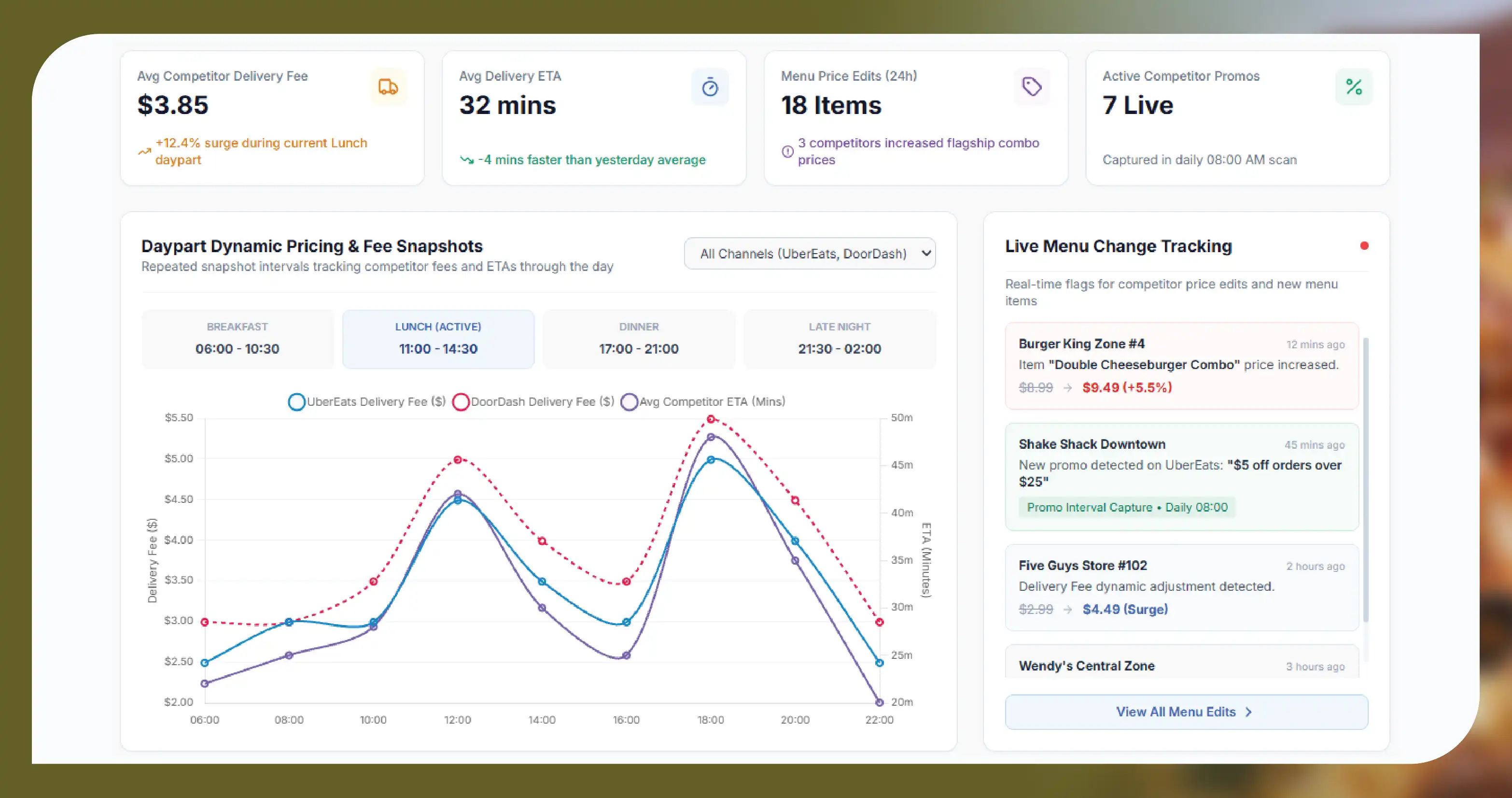
Dynamic pricing needs repeat snapshots, not a one-off scrape. A practical pipeline has five steps.
- Pick the competitive set. List the competitors, stores and delivery zones that matter for each of your locations.
- Set the capture schedule. Match intervals to the lever you study: several times a day for fees and ETAs, once per daypart for menu prices, daily for promotions.
- Capture the same basket. Use a fixed test basket per store so fees and thresholds are comparable over time.
- Match items across channels. Normalise item names, sizes and modifiers so a "large combo" on one app links to the same item elsewhere.
- Store with timestamps. Keep every record with capture time and location, then load it into a dashboard or your pricing model.
Collect only public, logged-out pages, respect each site's terms of service and robots.txt, and keep request rates modest. Our real-time price monitoring and delivery fee and ETA intelligence services run this kind of schedule, and live competitor menu change tracking flags new items and price edits as they appear.
Which strategy fits your restaurant type?
Restaurant dynamic pricing looks different for a burger chain and a fine-dining room. Use the table to match levers to your format.
| Restaurant type | Levers that usually fit | Key external data | Watch out for |
|---|---|---|---|
| Quick-service chain | Daypart bundles, app-only deals, delivery markup | Competitor combo prices by daypart, app vs in-store gaps | Backlash to anything that looks like peak-time surges |
| Fast casual | Off-peak offers, loyalty pricing, delivery markup | Bowl and salad prices by city, promo frequency | Menu creep across channels |
| Casual dining | Happy hours, early-bird menus, set menus | Competitor happy-hour times and drink prices | Discounts that train guests to visit only off-peak |
| Pizza and delivery-led | Fee and minimum-order tuning, bundle deals | Fees, thresholds and ETAs by zone | Fee changes that push price above rivals at checkout |
| Dark kitchens and virtual brands | Per-app pricing, brand-level bundles | Cuisine price bands per postcode, ratings | Too many brands at once diluting price signals |
| Bars and late-night venues | Happy hours, event-night pricing | Competitor drink offers and opening hours | Clear price display rules for alcohol and service charges |
What are the main use cases?
- Set delivery-app markups. Compare your app prices with competitors' app prices and their in-store menus before deciding how much markup the market accepts.
- Design off-peak offers. See when competitors run happy hours and bundles, then choose slots where your offer stands out.
- Watch fee competitiveness. Track total checkout cost for a standard basket, not just the menu price, because fees often decide the order.
- Spot price moves early. Get alerts when a nearby rival changes a core item price or launches a deal.
- Plan new locations. Use price bands and ratings by postcode or ZIP to set opening prices in a new area.
- Report to franchisees. Give franchise partners a shared, evidence-based view of local price positioning.
What are the risks for customer trust and consumer law?
The biggest risk is trust. The Wendy's episode showed that even a test can trigger headlines if customers think prices will rise when they are hungriest. Most operators frame changes as discounts in quiet hours, not premiums at peak.
The second risk is price display law. In the UK, the Digital Markets, Competition and Consumers Act 2024 gives the CMA direct enforcement powers. In November 2025 it opened its first investigations into online pricing practices, focused on drip pricing and mandatory fees left out of headline prices, published price transparency guidance, and noted fines of up to 10% of worldwide turnover.
- Show compulsory charges upfront. Mandatory service or booking charges belong in the headline price in the UK.
- Label time-limited prices clearly. State when a happy-hour or daypart price applies.
- Check local rules. In the US, fee disclosure rules vary by state and city, so review them with counsel.
- Keep your data clean too. Collect only public business data, never personal data of customers or staff.
Should you build or buy your pricing data?
Some teams build their own scrapers; others buy a managed feed. The choice depends on scale, skills and how long you need the data.
| Factor | Build in-house | Buy a managed feed |
|---|---|---|
| Setup time | Weeks to months per platform | Usually faster, using existing collectors |
| Maintenance | Your team fixes breaks when apps change layouts | Provider handles changes and QA |
| Item matching | You design matching rules | Matching and normalisation included or scoped |
| Coverage | Limited by internal capacity | Easier to add cities, apps and competitors |
| Best for | One or two platforms, strong data engineering team | Many platforms or markets, fast time to insight |
Whichever route you choose, start small: one city, one competitive set and one lever, such as delivery-app markups. Prove the decision value, then expand. For a ready-made view of surge and fee changes, see our dynamic and surge pricing data page.
Get a free sample dataset. See competitor menu prices, fees and ETAs for your market before you change a single price. Request your free sample.
Questions
Frequently Asked Questions
Generally yes, if prices are shown clearly and mandatory charges are included upfront. UK rules under the DMCC Act are strict on drip pricing, and US rules vary by state, so check with counsel.
They tend to accept off-peak discounts, happy hours and bundles more readily than peak-time increases, as the 2024 Wendy's reaction showed.
Once per daypart is enough for most menus. Fees and delivery times change faster, so capture them several times a day.
No. Those are not public. Use labelled proxies such as rating counts, popular tags, ETAs and availability instead.
A markup is a fixed channel gap between app and in-store prices. Dynamic pricing changes prices or fees over time based on demand, daypart or conditions.
Get a Free Food Data Sample in 48 Hours.
Tell us your platforms, target markets and required fields — we'll map exactly what's possible with food data scraping, recommend the right approach, and send a working sample so you can verify quality before any commitment.
Request a strategy call
Thanks — our data team will reach out within 48 hours with your sample.