Introduction
Every distributor, CPG brand and foodservice supplier faces the same structural problem: the customers they want to sell to are highly visible to consumers and almost invisible to sales teams.
A restaurant appears on Zomato, Uber Eats, DoorDash and Swiggy with a menu, a rating, an address and photographs. What it does not carry is a procurement contact, an estimated order volume, a cuisine-based ingredient profile, or any indication of whether it is expanding, contracting or about to close. Sales teams are therefore left cold-calling from stale directories, buying recycled lead lists that three competitors already own, or worst of all, sending representatives to physically walk commercial streets and note down signboards.
There is a better source, and it is hiding in plain sight. Delivery platforms are, functionally, the most complete and most current registry of active foodservice businesses on earth. They are updated continuously because restaurants have a commercial incentive to keep them updated. If a restaurant is trading, it is on a delivery platform. If it has closed, its listing goes dark within days.
Restaurant Lead Database Scraping is the process of converting that public listing layer into a structured, enriched, sales-ready prospect database. At FoodDataScrape, we crawl 220M+ pages of food data every week and turn them into verified restaurant prospect records for distributor, CPG and foodservice sales teams. This article explains exactly how that pipeline works, what fields it produces, and how to build a database that outperforms every purchased list on the market.
Why Traditional Restaurant Lead Sources Fail
Before building the solution, it is worth being precise about why the existing options underperform.
Purchased lead lists are stale and non-exclusive. A typical commercially available restaurant list is compiled once and resold indefinitely. Restaurant closure rates run high in most markets, which means a two-year-old list can carry a large share of dead records. Worse, your competitors bought the identical list.
Business directories are incomplete. They over-index on established, older businesses and systematically under-represent the fastest-growing segment: delivery-first and cloud kitchen operators, who often never register in a traditional directory at all.
Government or licensing registries are lagging. Licensing data is authoritative but slow, frequently reflects the registered entity rather than the trading brand, and rarely captures cuisine, menu or scale.
Manual field research does not scale. A representative can survey perhaps forty establishments a week. A national market has hundreds of thousands.
The common failure is the same in each case: none of these sources tell you what the restaurant actually sells right now . And for a supplier, that is the single most important qualifying signal there is.
The Core Insight The Menu Is the Qualification Signal
Here is the argument that changes how foodservice sales teams operate.
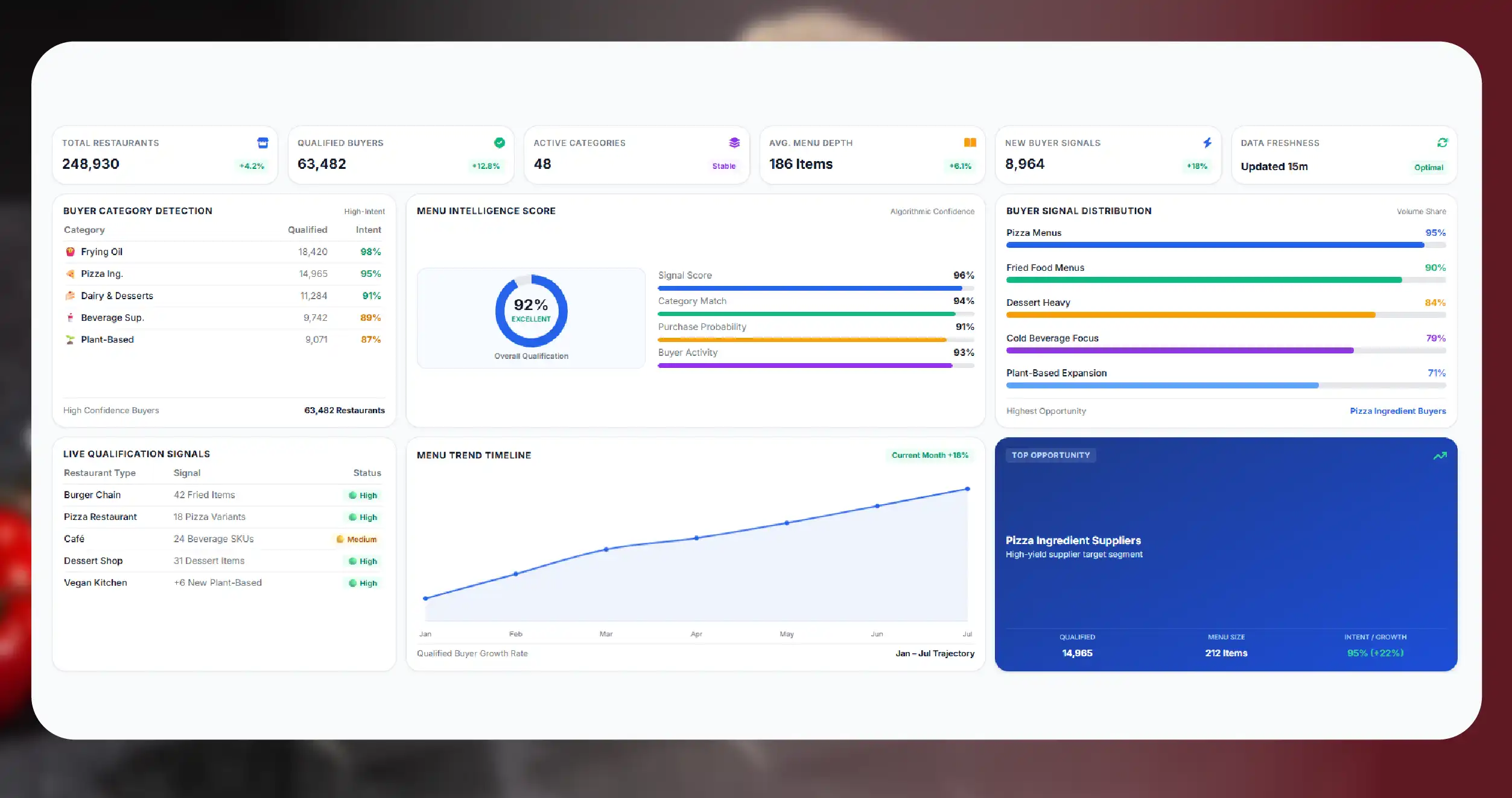
A restaurant's menu is a direct, real-time declaration of its purchasing behaviour.
- A menu with forty fried items declares a high-volume frying oil buyer.
- A menu with an extensive pizza section declares a mozzarella and flour buyer.
- A menu with twenty-two dessert SKUs declares a dairy, cream and sugar buyer.
- A menu with a large cold-beverage list declares a syrup, carbonation and packaging buyer.
- A menu that added six plant-based items in the last quarter declares a category buyer actively in market.
No firmographic database in the world gives you this. Menu data does — and menus are public, structured and continuously refreshed on delivery platforms.
This reframes restaurant prospect data extraction entirely. You are no longer building a list of restaurants. You are building a list of demonstrated buyers of your specific product category , ranked by demonstrated volume.
How the FoodDataScrape Pipeline Works
Stage 1 — Discovery. We enumerate active restaurant listings across delivery aggregators, mapping platforms and review sites within your target geography, at pin-code or postcode granularity. This produces the raw universe of trading establishments.
Stage 2 — Entity resolution. The same restaurant appears on multiple platforms, often with inconsistent names, addresses and spellings. We resolve these into a single canonical business entity, so that "Sharma's Kitchen", "Sharmas Kitchen Pvt Ltd" and "Sharma Kitchen — Andheri" become one record, not three. This step alone eliminates the duplicate inflation that plagues purchased lists.
Stage 3 — Menu extraction and normalisation. We extract every item, category, price, description, add-on and dietary tag, then normalise item names against a controlled taxonomy so that "Butter Chicken", "Murgh Makhani" and "Butter Chkn (Half)" map to a single canonical dish.
Stage 4 — Enrichment. We layer on cuisine classification, price band, estimated order volume derived from review velocity, outlet type, chain versus independent classification, and category-level ingredient inference.
Stage 5 — Contact resolution. Where publicly available, we resolve business phone numbers, business email addresses, official websites and social handles. We work with business contact information only.
Stage 6 — Validation and refresh. Records are re-verified on a recurring cycle. Closed restaurants are flagged and removed. New openings are appended. Your database stays alive rather than decaying.
Sample Data: A Verified Restaurant Prospect Record
The structure below reflects the field coverage of a standard FoodDataScrape prospect export. Values are illustrative.
{
  "record_id": "FDS-RST-IN-MUM-118204",
  "business_name": "Sharma's Kitchen",
  "outlet_type": "Independent — Dine-in + Delivery",
  "chain_status": "Independent",
  "city": "Mumbai",
  "locality": "Andheri West",
  "pin_code": "400058",
  "platforms_listed": ["Zomato", "Swiggy"],
  "cuisines": ["North Indian", "Mughlai", "Biryani"],
  "price_band": "Mid-Market",
  "avg_item_price_inr": 312,
  "menu_item_count": 87,
  "rating": 4.3,
  "rating_count": 6420,
  "review_velocity_monthly": 168,
  "estimated_order_volume_band": "High (1,500-3,000/month)",
  "business_phone": "+91-22-XXXXXXXX",
  "business_email": "orders@example-restaurant.in",
  "website": "https://www.example-restaurant.in",
  "years_active_on_platform": 4,
  "status": "Active"
}
Two fields carry disproportionate commercial weight.review_velocity_monthlyis the best publicly observable proxy for order volume — a restaurant collecting 168 reviews a month is transacting at a materially different scale from one collecting six. Andestimated_order_volume_bandconverts that into a field a sales team can actually filter on.
Sample Data: Category-Based Ingredient Qualification
This is where the database stops being a list and starts being a targeting engine.
| Restaurant | Fried Items | Dairy-Heavy Items | Bakery Items | Beverage SKUs | Best-Fit Supplier Category |
|---|---|---|---|---|---|
| Sharma's Kitchen | 34 | 22 | 3 | 8 | Frying oil, cream, spices |
| Coastal Grill House | 41 | 6 | 1 | 12 | Frying oil, seafood, beverages |
| Bake & Brew Café | 4 | 18 | 46 | 24 | Flour, butter, coffee, syrups |
| Green Bowl Kitchen | 2 | 3 | 0 | 9 | Fresh produce, plant proteins |
| Tandoor Junction | 12 | 29 | 5 | 6 | Dairy, cream, tandoor charcoal |
A frying-oil distributor filters forFried Items > 25. A dairy supplier filters forDairy-Heavy Items > 20. A coffee roaster filters forBeverage SKUs > 20 AND Bakery Items > 30.
Every one of these prospects has already publicly demonstrated that they buy the category. That is not a cold lead. That is a qualified lead with proof of purchase intent attached.
Sample Data: Territory Density for Sales Route Planning
| Locality | Active Restaurants | High-Volume (Est.) | Cloud Kitchens | Avg Price Band | Route Priority |
|---|---|---|---|---|---|
| Andheri West | 1,284 | 312 | 96 | Mid-Market | 1 |
| Lower Parel | 861 | 268 | 41 | Premium | 2 |
| Malad West | 1,102 | 194 | 88 | Value | 3 |
| Powai | 623 | 151 | 34 | Mid-Market | 4 |
| Ghatkopar East | 794 | 118 | 52 | Value | 5 |
A field sales team with this table plans a week of visits in twenty minutes instead of two days — and spends its time in the localities with the highest concentration of high-volume buyers rather than the ones closest to the office.
Who Buys Restaurant Lead Databases — And Why
Food and ingredient distributors. Build territory-mapped prospect lists filtered by cuisine, scale and ingredient profile. Replace cold calling with evidence-based targeting.
CPG and packaged food brands. Identify the restaurants and cloud kitchens most likely to adopt a new SKU, then measure adoption by tracking whether the SKU subsequently appears on their menus.
Kitchen equipment and packaging suppliers. Target by menu composition. Heavy fryer menus need fryers and oil filtration. High-delivery-volume kitchens need packaging at scale.
POS, delivery tech and restaurant SaaS vendors. Segment by platform presence, chain status and digital maturity. A restaurant on four platforms with 90 menu items has different software needs from a single-platform independent.
Beverage and alcohol distributors. Filter by beverage SKU count and price band.
Market research and private equity teams. Size a market by counting the actual trading universe, not by extrapolating from surveys.
Franchise development teams. Identify high-performing independents in target territories as acquisition or conversion candidates.
The Field Schema We Deliver
Business identity: canonical business name, trading name variants, outlet type, chain or independent status, parent group where identifiable
Location: full address, locality, city, state, pin code or postcode, coordinates, delivery polygons served
Platform presence: platforms listed, listing URLs, years active per platform, active or delisted status
Menu intelligence: full item catalogue, normalised item names, category counts, dietary tags, add-on structures, menu size
Pricing: item-level pricing, average price, price band classification, price change history
Performance proxies: rating, rating volume, review velocity, estimated order volume band, trend direction
Business contact: publicly listed business phone, business email, website, official social profiles
Category qualification: ingredient-category scores, best-fit supplier categories, adoption signals for new SKUs
Change tracking: new openings, closures, menu expansions, price movements, platform additions and exits
Delivered as CSV, JSON, Parquet, Excel, direct CRM push (Salesforce, HubSpot, Zoho) or REST API.
Data Quality, Compliance and Ethics
A lead database is worthless if it is not defensible. Our standards:
- Public business data only. We collect information published for public commercial visibility. We do not collect personal consumer data, and we do not scrape private or authenticated content.
- Business contacts, not personal ones. The phone number and email we resolve are the ones the restaurant itself publishes for customers to reach it.
- Deduplicated at the entity level , so you are never billed for the same restaurant three times because it appears on three platforms.
- Actively validated. Closed businesses are removed on the refresh cycle. This is the single biggest quality gap between a live feed and a purchased list.
- Rate-limited, respectful crawling that does not degrade the platforms we collect from.
- Regionally aware compliance aligned to the data protection framework of each market we operate in.
Measurable Impact
| Metric | Purchased List | FoodDataScrape Feed |
|---|---|---|
| Record accuracy at delivery | 55–70% | 90%+ verified active |
| Duplicate rate | 15–25% | Under 2% |
| Contains menu-level qualification | No | Yes |
| Refresh cadence | One-time | Weekly / custom |
| Exclusive to you | No | Yes, scoped to your spec |
| Sales rep time on list hygiene | 6–10 hrs/week | Near zero |
| Typical connect-rate improvement | Baseline | 2–3x reported |
The economics are straightforward. If a sales representative wastes 30% of their calling time on closed or duplicate records, you are funding a third of a headcount to dial disconnected numbers.
Conclusion
Restaurant sales has been running on bad data for a long time — stale lists, duplicate records, no qualification signal, and no way to tell a thriving kitchen from a closing one. Meanwhile, the most complete and most current registry of trading foodservice businesses updates itself, publicly, every single day.
Restaurant Lead Database Scraping is simply the discipline of collecting that registry properly: resolving entities, normalising menus, inferring category demand, validating continuously, and delivering it in a form your sales team can act on before lunch.
FoodDataScrape crawls 220M+ pages of food data every week to build exactly that. Your competitors are still buying the same list they bought last year.
Questions
Frequently Asked Questions
Scope depends on geography. A single major metro typically yields tens of thousands of active establishments; a national build across a large market runs into the hundreds of thousands. We scope to your target territory rather than selling volume for its own sake.
We provide publicly listed business contact information. We do not build personal profiles of individuals.
Standard refresh is weekly, with custom cadences available. Closure detection is one of the most valuable outputs of the refresh cycle.
Yes. Most clients do exactly this — they receive only the segment they can actually sell to, which reduces both cost and noise.
Yes. We support direct integration into major CRM platforms as well as API and flat-file delivery.
We collect publicly available business information in compliance with applicable data protection regulations in each operating market, and we do not handle personal consumer data.
Get a Free Food Data Sample in 48 Hours.
Tell us your platforms, target markets and required fields — we'll map exactly what's possible with food data scraping, recommend the right approach, and send a working sample so you can verify quality before any commitment.
Request a strategy call
Thanks — our data team will reach out within 48 hours with your sample.