Introduction
Restaurant nutrition data monitoring means checking published menus on a schedule and flagging any change to calories, kilojoules, allergens or diet tags. You collect the public figures from brand sites, menu PDFs and delivery apps, store each version, compare it with the last one and route real changes to the people who own menu compliance.
Menus change all the time. A new supplier, a smaller portion or a limited-time item can shift a calorie count or add an allergen. When that happens, the figure on the brand website, the nutrition PDF and the delivery app listing may not change on the same day.
This guide explains which rules shape restaurant nutrition data in the USA, UK and Australia, which sources to watch, which fields to capture, and how to build a change-tracking workflow that stays within public data and site terms.
Why does tracking menu nutrition changes matter?
Calorie and allergen figures are not just marketing copy. In many markets, larger chains must show them by law, and customers with allergies rely on them. A mismatch between channels is a quality issue at best and a compliance or safety issue at worst.
Online menus are a known weak spot. A Tufts University analysis published in Public Health Nutrition reviewed the top 75 US chains and found that 60 percent of menus on the restaurants' own websites or apps (43 of 72 chains) posted calories for every item reviewed. It reported that coverage on third-party platforms such as DoorDash, Uber Eats and Grubhub was even lower (Tufts Now, 13 September 2023).
Who uses restaurant nutrition data monitoring?
- Restaurant brands and franchise groups. Check that every channel shows the current, approved figure after a recipe or portion change.
- Compliance and food-safety teams. Keep a dated record of what was published, where and when.
- Nutrition and diet apps. Keep menu databases fresh for users who count calories or avoid allergens.
- Market and menu analysts. Track reformulation trends, such as lower-calorie launches or new plant-based options, across competitors.
- Delivery and ordering platforms. Spot listings where calorie or allergen fields are missing or out of date.
What do the rules require in the USA, UK and Australia?
Each market has its own threshold and wording. The table below summarises the official guidance we reviewed today. Always read the source page before you rely on it, because rules and guidance are updated.
| Market | Who is covered | What must be shown | Online and delivery menus | Official source |
|---|---|---|---|---|
| USA (FDA) | Chains with 20 or more locations, same name, substantially the same menu items | Calories for standard menu items; a 2,000-calorie daily intake statement; extra written nutrition info (fat, sodium, sugars, protein and more) on request | FDA's Edition 2 supplemental guidance (Dec 2023) discusses calorie display on third-party ordering platforms; FDA's guidance page still lists it as a draft, not for implementation (FDA, checked 14 Oct 2026) | FDA Menu Labeling Requirements |
| UK – England (DHSC) | Businesses with 250 or more employees selling non-prepacked food for immediate consumption | kcal per portion, the portion size, and the statement "adults need around 2000 kcal a day" at the point of choice | Covered: websites and apps, including third-party delivery apps, must show calorie information | GOV.UK implementation guidance |
| UK – allergens (FSA) | Businesses selling non-prepacked or loose food, in person or online | Best-practice guidance: written allergen information on the 14 allergens, plus a conversation with the customer | Applies to online sales as well as in person | FSA allergen guidance update |
| Australia – NSW | Standard food outlets with 20 or more locations in NSW, or 50 or more nationally | Average energy content in kilojoules and the statement "The average adult daily energy intake is 8700 kJ" | The NSW page we reviewed does not address online menus or delivery apps; a 2022 analysis found 5% or fewer large outlets had complete kJ information on delivery platforms (Obesity Evidence Hub) | NSW Food Authority – kJs on menus |
| Australia – other states | Mandatory kJ menu labelling in Victoria, Queensland, South Australia and the ACT (as well as NSW); no mandatory scheme in WA, Tasmania or the NT | kJ values on menus for large chains; thresholds and display rules differ by jurisdiction; a 2022 Ministerial Policy Guideline calls for all modes of sale to be covered | No binding national Food Standards Code measure yet; the 2022 guideline is non-binding (status as of 22 Jan 2026) | Obesity Evidence Hub and each state food regulator |
Two points stand out. First, the UK calorie rules explicitly reach delivery apps, so the app listing matters as much as the printed menu. Second, the FDA page focuses on calories and nutrients; it does not set menu allergen display rules, so allergen tracking in the US is usually driven by brand policy and customer safety. For Australian allergen declarations on restaurant menus, check the current FSANZ guidance before you set rules.
Which sources should you monitor?
Restaurant nutrition data is spread across several public surfaces. Each one changes at a different pace and needs a different collection method.
| Source | Typical nutrition content | How often it changes | Collection notes |
|---|---|---|---|
| Brand website menu pages | Calories or kJ per item, diet badges, allergen filters | With menu launches and seasonal updates | HTML pages; capture item IDs and portion sizes |
| Nutrition and allergen PDFs | Full nutrient tables and allergen matrices | Less often, but often lags the live menu | Needs PDF table extraction; scanned files need OCR – scope this with our team for your menus |
| Online ordering pages | Calories per item and per option | Often in step with the brand menu | Option-level calories (sizes, add-ons) matter |
| Delivery apps (Uber Eats, DoorDash, Grubhub, Deliveroo, Just Eat, Menulog) | Calories or kJ where the brand supplies them; allergen notes vary | Varies by store and platform | Public listing data only; respect terms and rate limits |
| In-store menu boards | Legally required figures at the point of choice | With physical menu refreshes | Not web data; compare against store photos supplied by the brand |
Which data fields should you capture?
Good change tracking starts with a stable schema. These are the fields we recommend capturing for every menu item and every snapshot.
- Item identity. Brand, store or outlet ID, item name, platform item ID and a normalised item key so the same burger matches across channels.
- Portion and variant. Size, serving weight, pieces, and option or add-on names, because calories often differ by size.
- Energy values. Calories (kcal) and, for Australia, kilojoules, stored with their original unit and a converted value.
- Core nutrients. Fat, saturated fat, sodium, carbohydrates, sugars, fibre and protein where published.
- Allergen declarations. Each declared allergen as a separate flag, plus "may contain" or cross-contact notes as free text.
- Diet tags. Vegan, vegetarian, gluten-free, halal and similar labels, normalised to one list.
- Required statements. Presence of the 2,000-calorie, 2000 kcal or 8700 kJ reference statement on the page.
- Source and time. Source URL, PDF file name or version date, platform, country and capture timestamp.
How do you collect, clean and compare the data?
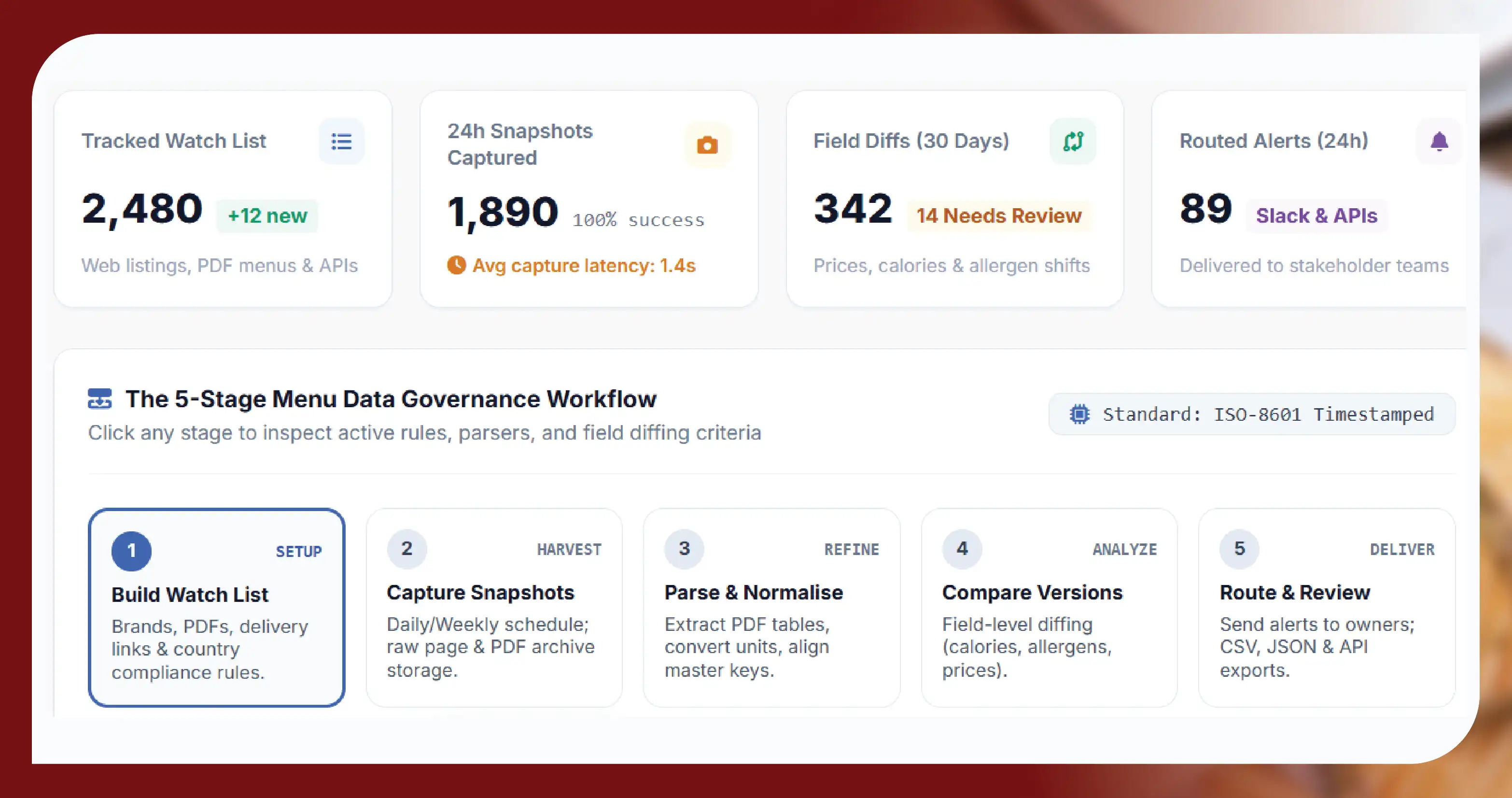
A practical workflow has five stages. It works whether you track ten outlets or several thousand.
- Build the watch list. List the brands, outlets, menu URLs, PDF links and delivery listings to track, with the country rule that applies to each.
- Capture snapshots on a schedule. Collect each source daily or weekly, depending on how often the menu changes. Store the raw page or PDF alongside the parsed fields.
- Parse and normalise. Extract tables from PDFs, convert units, standardise allergen names and map item names to one master key.
- Compare versions. Diff each new snapshot with the previous one at field level, so a calorie change, a new allergen or a missing statement shows up as a separate event.
- Route and review. Send change events to the owner team for review and keep the history for audit. FDS can deliver data as CSV, JSON or API feeds; how change alerts reach your team (for example Slack or a dashboard) is agreed when we scope the project.
What counts as a real change?
Not every difference matters. Rounding (for example 510 to 512 kcal), whitespace or a reordered table creates noise. Set clear rules before you start.
| Change type | Example | Suggested priority |
|---|---|---|
| New allergen declared | Sesame added to a sauce | High – review the same day |
| Allergen removed | Milk no longer listed for a bun | High – confirm with the recipe owner |
| Calorie or kJ shift beyond your threshold | Wrap moves from 480 to 560 kcal | Medium – check portion and recipe |
| Channel mismatch | Website shows 620 kcal, delivery app shows 580 kcal | Medium – find which source is current |
| Missing figure or statement | New item has no calories, or the reference statement is gone | Medium to high, depending on market |
| New or removed item | Limited-time item launched without nutrition data | Medium |
| Formatting only | Table layout or spacing changed | Low – log, do not alert |
The threshold for a "real" calorie change is a business choice, so agree it with your nutrition or compliance lead and record it in the project brief.
How does monitoring differ by country?
- USA. Focus on calories for standard menu items at chains with 20 or more locations, plus the written nutrition information many brands publish as PDFs. Track option-level calories in online ordering, where sizes and add-ons multiply the item count.
- UK. Watch kcal per portion and the portion size on websites and delivery apps, because the calorie rules cover online sales. Track the 14 allergens in written allergen information, following FSA best-practice guidance.
- Australia. Capture kJ values and the 8700 kJ statement for NSW outlets and check state-by-state differences: Victoria, Queensland, South Australia and the ACT also mandate kJ menu labelling, while WA, Tasmania and the NT do not. Delivery listings on Uber Eats, DoorDash and Menulog may show kJ, calories or nothing, so normalise units carefully.
For Australian projects, our Australia food data page explains local coverage; confirm the specific brands and apps in scope with our team before you start.
What are the main use cases?
- Cross-channel consistency checks. A multi-brand restaurant group compares its website, PDF and delivery app figures each week and fixes mismatches before customers see them.
- Reformulation tracking. A menu analyst records when competitors cut calories or add plant-based options, building a dated timeline of changes.
- Allergen change watch. A diet or allergy app flags any newly declared allergen so it can update its database and notify users.
- Coverage gap reports. A brand checks which delivery listings are missing calorie or kJ figures and sends fixes to each platform's partner portal.
- Competitive menu intelligence. Nutrition changes are tracked alongside prices and new items using live competitor menu change tracking.
Is it legal to monitor restaurant nutrition data?
Monitoring published menu figures uses public business information, not personal data. Even so, how you collect it matters.
- Public pages only. Collect what any visitor can see without logging in. Never bypass logins, CAPTCHAs or paywalls.
- Respect site rules. Follow robots.txt, each site's terms of service and sensible rate limits.
- No personal data. Do not collect reviewer names, customer details or staff contacts.
- Treat data as a check, not the source of truth. Scraped figures show what was published. The brand's approved recipe data remains the master record.
- Get advice where needed. Monitoring does not replace legal review of your own menu labelling.
Should you build or buy a monitoring solution?
A small in-house script can watch a few HTML menus. It gets harder once you add PDFs, many delivery apps, several countries and daily schedules.
- Build if you track a handful of brand pages, have developer time, and only need a weekly snapshot.
- Buy if you need many outlets, PDF parsing, unit normalisation, item matching across channels and a reliable history for audit.
- Ask any provider for sample fields, refresh frequency, how changes are detected, how PDFs are handled and what delivery formats are offered.
- Check the fit. Our nutrition and allergen compliance data service covers nutrition facts, allergen tags, diet flags and change tracking, delivered as CSV, JSON or API.
Food Data Scrape also collects public listing data from food delivery apps and health and specialty diet sources. Coverage of specific platforms and countries is confirmed for each project.
Get a free sample dataset. Want to see how calorie, kJ and allergen changes look across your brand site, menu PDFs and delivery apps? Tell us the brands, countries and sources you need, and we will share a sample of restaurant nutrition data fields.
Questions
Frequently Asked Questions
It is the published calorie, kilojoule, nutrient, allergen and diet information for restaurant menu items. It appears on brand websites, nutrition PDFs, online ordering pages and delivery apps.
Weekly suits most stable menus. Daily checks make sense during launches, limited-time offers or when you track many delivery listings that change independently.
In England, yes for qualifying businesses: GOV.UK guidance says calorie information must be shown on websites and apps, including third-party delivery apps. In the US, FDA's guidance on third-party apps was still listed as a draft on 14 October 2026.
Yes. Text-based PDFs can be parsed into tables, and scanned PDFs need OCR before parsing. Check the extracted values against the original file; talk to our team about PDF extraction for your menus.
They measure the same energy in different units. Australia uses kilojoules (1 kcal is about 4.184 kJ), while the US and UK use calories. Store both the original and the converted value.
Get a Free Food Data Sample in 48 Hours.
Tell us your platforms, target markets and required fields — we'll map exactly what's possible with food data scraping, recommend the right approach, and send a working sample so you can verify quality before any commitment.
Request a strategy call
Thanks — our data team will reach out within 48 hours with your sample.