Introduction
Restaurant promotions data shows which outlets are running deals, what kind of deal it is, when it runs and how much it really saves the diner. Happy hours, set menus, percentage discounts and free-delivery badges change every week, and they rarely sit in one place.
In short, restaurant promotions data is a structured feed of public deals collected from delivery apps, restaurant websites, Google Business posts and deal sites. Each offer is normalised into one format, with type, value, time window and conditions, so deal apps, restaurant groups and FMCG brands can compare promotions across outlets and countries.
This guide covers where deals appear, which fields to capture, how to normalise very different offer types, country differences across the UAE, India, the UK, the US and Thailand, and the compliance basics, including why social media posts need a different route.
Why restaurant deals and promotions matter now
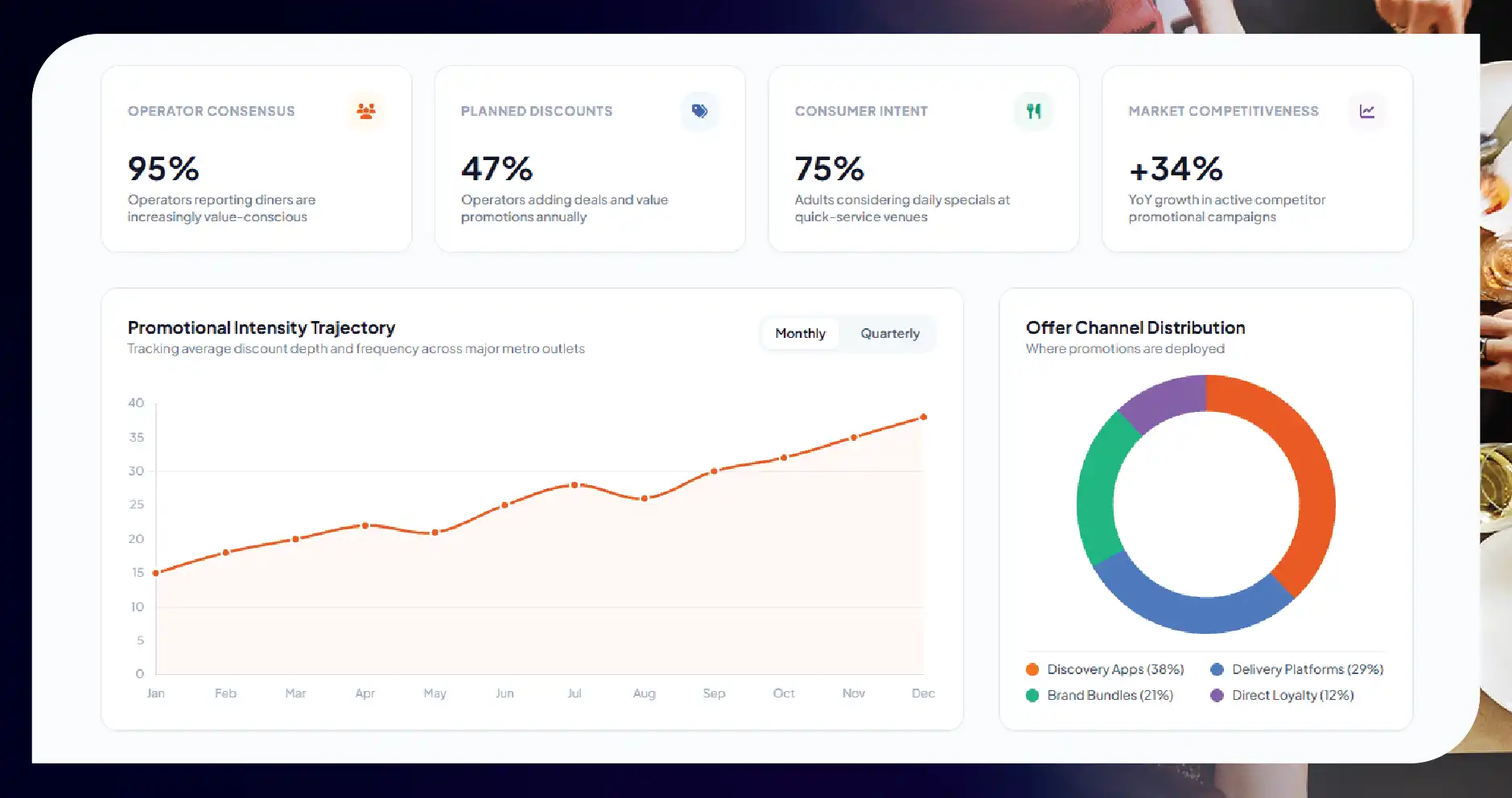
Value is front of mind for diners and operators. In the National Restaurant Association's State of the Restaurant Industry 2025 report, 95% of operators said diners are more value-conscious, and 47% planned to add discounts, deals or value promotions that year (Restaurant Dive). The same report found 75% of adults would consider a daily special, discount or value promotion at a quick-service venue.
When so many outlets compete on deals, a single snapshot is not enough. Teams need to know how often a competitor runs an offer, how deep it goes, at what times and on which channel.
- Deal and discovery apps need fresh, accurate listings of happy hours and set menus to show users.
- Restaurant groups benchmark their promotion depth and timing against nearby competitors.
- FMCG and beverage brands track which partner outlets feature their products in bundles and combos.
- Delivery-market analysts watch how platform-funded and restaurant-funded offers shift over time.
Where restaurant deals appear: the 5 sources that matter
Promotions are spread across channels, and each one behaves differently. The table below summarises what each source shows and how to approach it responsibly.
| Source | What you typically see | Recommended route | Compliance note |
|---|---|---|---|
| Delivery apps (Talabat, Deliveroo, Uber Eats, Swiggy, Zomato, GrabFood) | Offer badges, % off, flat discounts, free delivery, item-level deals | Logged-out collection of public listing pages by location | Respect robots.txt, terms and rate limits; no customer accounts |
| Restaurant and chain websites | Happy-hour times, set menus, lunch deals, seasonal menus | Public pages and PDF menus on a schedule | Business content only; do not republish photos |
| Google Business Profile posts | Offer and event posts with dates, codes and terms | Owner API for your own locations; careful public collection otherwise | Follow Google terms; capture business posts only |
| Public social pages (Facebook, Instagram) | Promo posts, happy-hour flyers, event specials | Official tools, manual review or partner feeds | Meta terms restrict automated collection without permission |
| Deal-aggregator and booking sites | Curated discounts, set menus, table-booking offers | Check for partner or affiliate feeds first | Respect terms; many aggregators license their listings |
A note on social media promotions
Many restaurants, especially in Thailand and South-East Asia, post deals first on Facebook pages or groups. Meta's Automated Data Collection terms say its Platform APIs are "the only allowable means to access data programmatically" without prior written permission (Meta for Developers). We therefore recommend official Meta tools, manual curation of public business posts, or a partner route. Group posts by individuals are personal content and should stay out of scope.
The 12 data fields every promotions feed needs
A good schema lets you compare a Dubai lunch set menu with a London happy hour without guesswork. These are the fields we recommend.
- restaurant_id and name – a stable ID matched across sources, plus the brand or chain.
- location – address, city, area or pincode and latitude/longitude where public.
- source and channel – which app, website or post type the offer came from, with the page URL.
- offer_title_raw – the badge or headline exactly as shown, in the original language.
- offer_type – a normalised category such as percent_off, flat_off, bogo, set_menu, happy_hour or free_delivery.
- discount_value – the percentage, fixed amount or bundle price, with currency.
- cap_and_minimum – maximum discount and minimum order value, where shown.
- eligible_items – whole menu, a category or named items.
- time_window – days of week and start/end times, especially for happy hours and lunch deals.
- valid_from and valid_to – the published start and end dates, if any.
- conditions – dine-in only, delivery only, new users only, code required or subscription required.
- first_seen and last_seen – collection timestamps that show how long a deal actually ran.
How to normalise offer types
Offer badges are written for diners, not analysts. "50% off up to 100", "2 for 1 cocktails 5-7pm" and "3-course lunch 99" all need to land in the same structure. Normalisation turns raw text into comparable values.
| Offer type | Raw example | Normalised fields | How to compare |
|---|---|---|---|
| Percentage off | 50% off up to AED 20, min order AED 40 | percent=50, cap=20, min_order=40 | Effective discount = min(percent × basket, cap) ÷ basket |
| Flat / fixed amount | Flat ₹100 off on orders above ₹399 | flat=100, min_order=399 | Express as % of a reference basket |
| BOGO / 2-for-1 | Buy 1 get 1 free on selected pizzas | bogo=true, eligible_items=[...] | Treat as up to 50% off the eligible items |
| Set menu / bundle | 2-course lunch £15 | bundle_price=15, courses=2 | Compare with the sum of à la carte prices |
| Happy hour | Half-price drinks Mon–Fri 5–7pm | percent=50, days=Mon–Fri, start=17:00, end=19:00 | Store as recurring time windows in local time |
| Free delivery | Free delivery over $15 | delivery_fee=0, min_order=15 | Compare against the usual fee at that address |
Two habits make a big difference. First, keep the raw text alongside every normalised field so analysts can audit the parsing. Second, store time windows in the outlet's local time zone, because a 5–7pm happy hour means nothing without it.
How to collect, clean and match restaurant promotions data
- Define scope – cities, areas, cuisines, outlet lists and which channels matter for your use case.
- Pick the cadence – delivery-app badges can change daily, while website set menus may change monthly; schedule each source accordingly.
- Collect public pages responsibly – stay logged out, check robots.txt and terms, pace requests and never bypass CAPTCHAs or logins.
- Parse and normalise – convert badges into offer_type, values, caps and windows, keeping offer_title_raw.
- Match outlets across sources – use name, address and coordinates to link the same restaurant on apps, websites and Google.
- Track change over time – compare runs to set first_seen and last_seen and flag new, changed or expired offers.
- Deliver – CSV, JSON, API or dashboard, with a data dictionary and QA notes.
One caution: promotions data shows what is offered, not how much it sells. Order and sales volumes are not public. Where teams need a demand signal, use clearly labelled public proxies such as rating counts or bestseller badges.
Restaurant promotions data by country
Offer formats, platforms and rules differ by market. The table below is a starting point for scoping; always confirm local rules for your use case.
| Country / region | Main channels | Common offer formats | Watch-outs |
|---|---|---|---|
| UAE | Talabat, Deliveroo, Careem, Noon Food, restaurant sites | % off with caps, free delivery, subscription perks, business-lunch set menus | Arabic and English badges; alcohol offers only at licensed venues |
| India | Swiggy, Zomato, restaurant sites, dine-in booking platforms | Flat ₹ off above a minimum, % off up to a cap, bank-card offers | Many offers are bank- or code-specific; record conditions |
| UK | Deliveroo, Uber Eats, Just Eat, chain websites, Google posts | Set lunch menus, 2-for-1, happy hours, spend-and-save | Offers often differ by postcode; capture location |
| US | DoorDash, Uber Eats, Grubhub, chain apps and websites | Happy hours, value meals, BOGO, membership-only deals | App-only and loyalty deals may sit behind logins – out of scope |
| Thailand / SEA | GrabFood, LINE MAN, restaurant sites, public Facebook pages | % off, set menus, buffet deals, happy hours | Thai law tightly restricts alcohol marketing; social posts need official or manual routes |
Thailand deserves a special mention. Its Alcoholic Beverage Control Act amendment, in force from 8 November 2025, defines marketing communication broadly to include sales promotions, and sale hours remain restricted (Tilleke & Gibbins). If you collect drinks-led happy-hour offers there, treat them as research data and take local advice before reusing them in marketing.
Use cases for restaurant promotions data
- Deal apps and city guides – populate happy-hour and set-menu listings with times, prices and conditions, refreshed on a schedule.
- Restaurant groups – benchmark discount depth, frequency and timing against competitors in each delivery zone.
- FMCG and beverage brands – see which outlets feature your products in combos or bundles, and how often.
- Delivery-market research – compare how often outlets run offers by city, cuisine or platform.
- Revenue and pricing teams – test whether competitors shift from % off to bundles or free delivery during slow periods.
Our earlier work on live delivery offers in the Gulf and delivery promotions in Latin America shows the same pattern: the value comes from consistent normalisation and change tracking, not from one-off scrapes.
Legal and compliance basics
Restaurant promotions are business information, so most fields carry low privacy risk. Keep it that way with a few rules.
- Public business data only – collect offers shown to logged-out visitors; skip loyalty, member or merchant-portal content.
- Respect site rules – follow robots.txt, terms of service and sensible rate limits; never bypass logins, CAPTCHAs or anti-bot measures.
- No personal data – exclude reviewer names, individuals' social posts and customer details.
- Use official routes where they exist – Meta's Platform APIs, Google's Business Profile API for your own locations (Google Developers), or partner and affiliate feeds.
- Do not republish creative content – store offer facts, not restaurant photos or flyer artwork.
This is general information, not legal advice. See our FAQ for how we handle compliance, and consult counsel for your specific project.
Get a free sample dataset. Tell us your cities, outlets and channels, and we will share a sample of normalised restaurant promotions data with offer types, values and time windows.
Questions
Frequently Asked Questions
It is structured information about public restaurant deals, such as discounts, happy hours, set menus, BOGO offers and free delivery. Each record links an outlet to an offer type, value, time window, conditions and source, so you can compare promotions across restaurants, platforms and cities.
Delivery-app offers can change daily, so daily or several-times-a-week collection suits competitive tracking. Website set menus and happy hours change less often, so weekly checks are usually enough. Match the cadence to how fast decisions are made.
We do not recommend it. Meta's terms restrict automated collection without permission, and group posts are often personal content. Use official Meta tools, manual curation of public business pages, or a partner feed instead.
Convert both into an effective discount against a reference basket. A percentage offer uses the percent, cap and minimum order; a set menu is compared with the sum of the same dishes at à la carte prices. Keeping the raw badge text makes the result auditable.
No. Order and sales volumes are not public. Promotions data shows what was offered and for how long. Public proxies such as rating counts or bestseller badges can add context, but they should be labelled as proxies.
Get a Free Food Data Sample in 48 Hours.
Tell us your platforms, target markets and required fields — we'll map exactly what's possible with food data scraping, recommend the right approach, and send a working sample so you can verify quality before any commitment.