Introduction
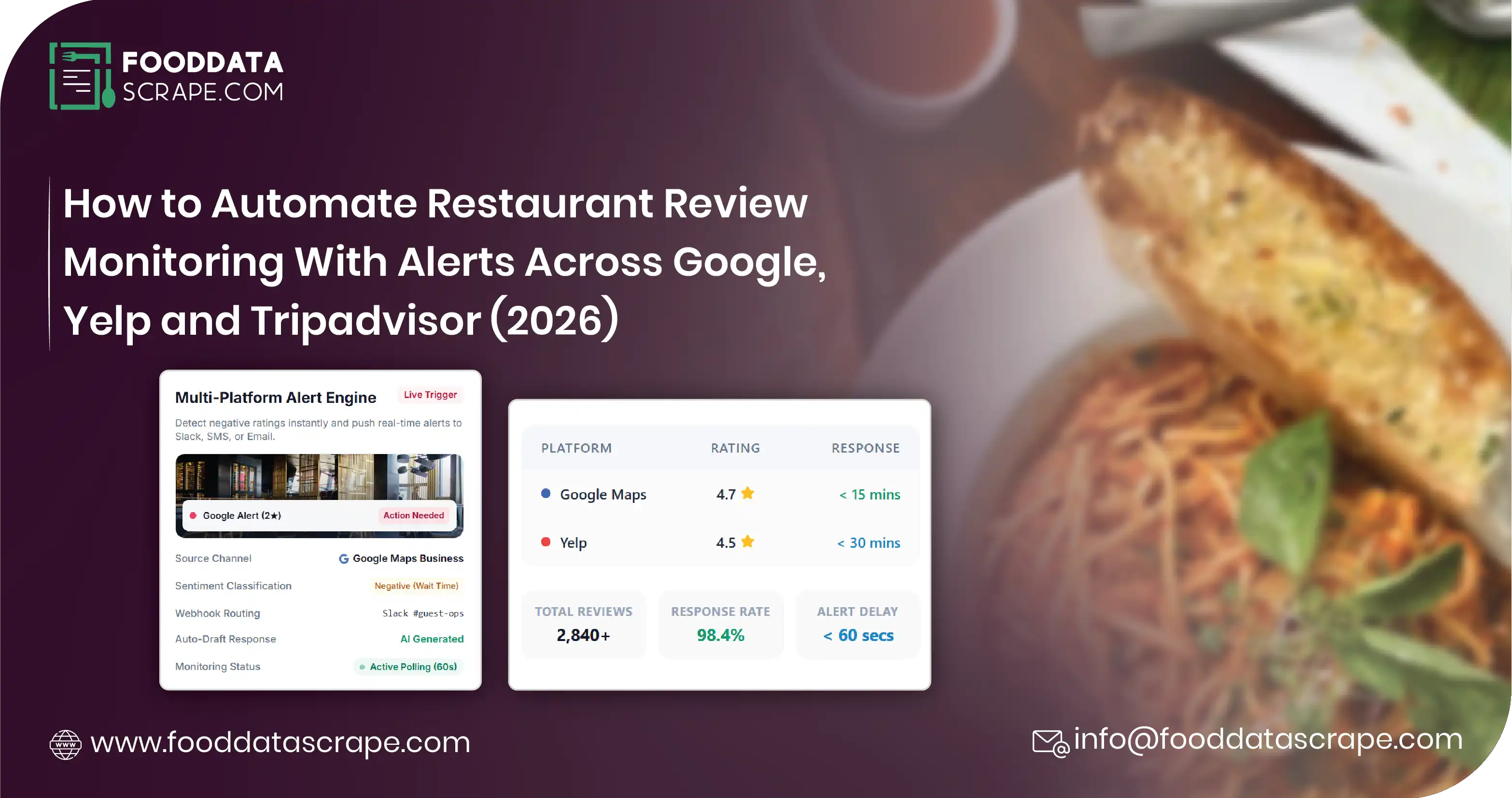
Restaurant review monitoring means collecting new public reviews and ratings from Google, Yelp and Tripadvisor on a schedule, standardising them into one dataset, and firing alerts when something changes, such as a rating drop, a burst of one-star reviews or a repeated complaint about one dish or one site.
Speed matters because diners read fresh reviews. BrightLocal's Local Consumer Review Survey 2026 (1,002 US consumers, published February 2026) found that 74% only consider reviews from the last three months, and 32% look for reviews from the last two weeks.
This guide shows how to automate the whole loop: which platforms to cover, which fields to capture, how to design alert rules that people actually act on, and how to stay within platform terms and UK and US rules. It is written for multi-site operators, franchise teams, agencies and food-brand analysts.
Why does restaurant review monitoring matter in 2026?
Reviews are now a live signal of operations, not just marketing. A cold-food complaint at one branch on Friday night can show up as a rating dip by Monday. Teams that see it early can fix the kitchen issue and reply before it spreads.
The same BrightLocal survey (US sample) reports some clear expectations from diners and other local-business customers:
- Reading is near universal. 97% of consumers read reviews for local businesses, and 41% say they always do.
- Replies are expected. 89% expect owners to respond to reviews, and 19% expect a same-day reply.
- Thresholds are rising. 31% will only use a business rated 4.5 stars or higher, up from 17% in 2025.
- Platform mix is shifting. Google's share as a review source fell from 83% to 71% year on year, so Yelp and Tripadvisor still deserve coverage.
Manual checks across dozens of listings cannot keep pace with a same-day reply expectation. Automated restaurant review monitoring closes that gap by turning scattered listings into one feed with clear triggers.
Who uses automated review alerts?
- Multi-site operators and QSR chains tracking every branch against a brand-wide baseline.
- Franchise and operations teams spotting which sites need a visit or retraining.
- Hospitality and marketing agencies reporting reputation trends for several restaurant clients.
- Food brands and CPG analysts watching how dishes or ingredients are discussed across venues.
- Investors and market researchers comparing public sentiment across cuisines, cities or concepts.
The 3 platforms that matter and how they differ
Google, Yelp and Tripadvisor each reach a different diner and expose data in a different way. Official APIs are useful but limited, so most teams combine them with compliant collection of public listing pages.
| Platform | Main audience | Official access route | Practical limit to plan for | Best used for |
|---|---|---|---|---|
| Google (Maps / Business Profile) | Broadest local-search audience in the US and UK | Business Profile API for locations you own and manage | API covers your own verified locations only; competitor data needs public-listing collection | Volume, recency and rating trend per branch |
| Yelp | Strong in US cities, especially full-service and independent dining | Yelp Fusion API (plan-gated review access) | Returns a small number of review excerpts per business, not full history | US competitive benchmarking and complaint themes |
| Tripadvisor | Tourists and travellers; strong in UK and destination cities | Tripadvisor Content API | The location reviews endpoint returns up to 5 of the most recent reviews per location | Tourist-area sites, UK coverage, cuisine and price-band context |
Because each API returns only a slice, a robust restaurant review monitoring setup usually merges API data with scheduled collection of publicly visible listing data, done in line with each site's robots.txt, terms of service and rate limits.
The 10 data fields that power useful alerts
Good alerts depend on clean, consistent fields. Capture these for every review and every listing snapshot. Note that reviewer names are never stored or shown; each review is linked to a non-reversible hashed ID only for de-duplication.
- Platform and listing ID. The source (Google, Yelp, Tripadvisor) plus its native place or business ID.
- Internal location ID. Your own branch code, so one restaurant maps across all three platforms.
- Review ID (hashed). A pseudonymised key to spot duplicates and edits, with no reviewer identity kept.
- Star rating. The 1–5 score for each review, normalised to one scale.
- Review date and capture time. When the review was posted and when you collected it, to measure alert latency.
- Review text and language. Public text for theme and sentiment analysis; translate for UK tourist sites with mixed languages.
- Owner response flag and response date. Whether and when the business replied, to track reply speed.
- Listing aggregates. Overall rating and total review count at each snapshot, the basis for trend lines.
- Theme tags. AI-assigned topics such as food quality, wait time, staff, cleanliness, delivery or value.
- Sentiment score. A per-review score from negative to positive, with a confidence value for review queues.
| Field | Example format | Why it matters |
|---|---|---|
| platform | google | yelp | tripadvisor | Splits trends by channel |
| location_id | UK-LDN-014 | Rolls up every platform to one branch |
| review_hash | sha256 string | De-duplicates without storing identity |
| rating | 1–5 integer | Drives low-star alerts |
| posted_at / captured_at | ISO 8601 timestamps | Measures freshness and alert lag |
| owner_replied | true / false + date | Tracks reply-time targets |
| listing_rating / review_count | 4.3 / 1,284 | Feeds rolling-average and velocity rules |
| themes / sentiment | ['wait_time'] / -0.62 | Powers complaint-cluster alerts |
How to collect, clean and match the data
Automation is a pipeline with five stages. Each stage can be built in-house or handed to a provider.
- Build a location master. List every branch with address, postcode or ZIP and coordinates, then match each to its Google, Yelp and Tripadvisor listing. Our guides to Google Maps restaurant data and Tripadvisor city listings explain how listing discovery works.
- Schedule collection. Pull new reviews and listing snapshots on a fixed cadence, for example every few hours for flagship sites and daily for the rest. Respect robots.txt, terms and rate limits.
- Clean and de-duplicate. Normalise ratings and dates, strip reviewer identity, hash review keys and drop repeats or edited copies.
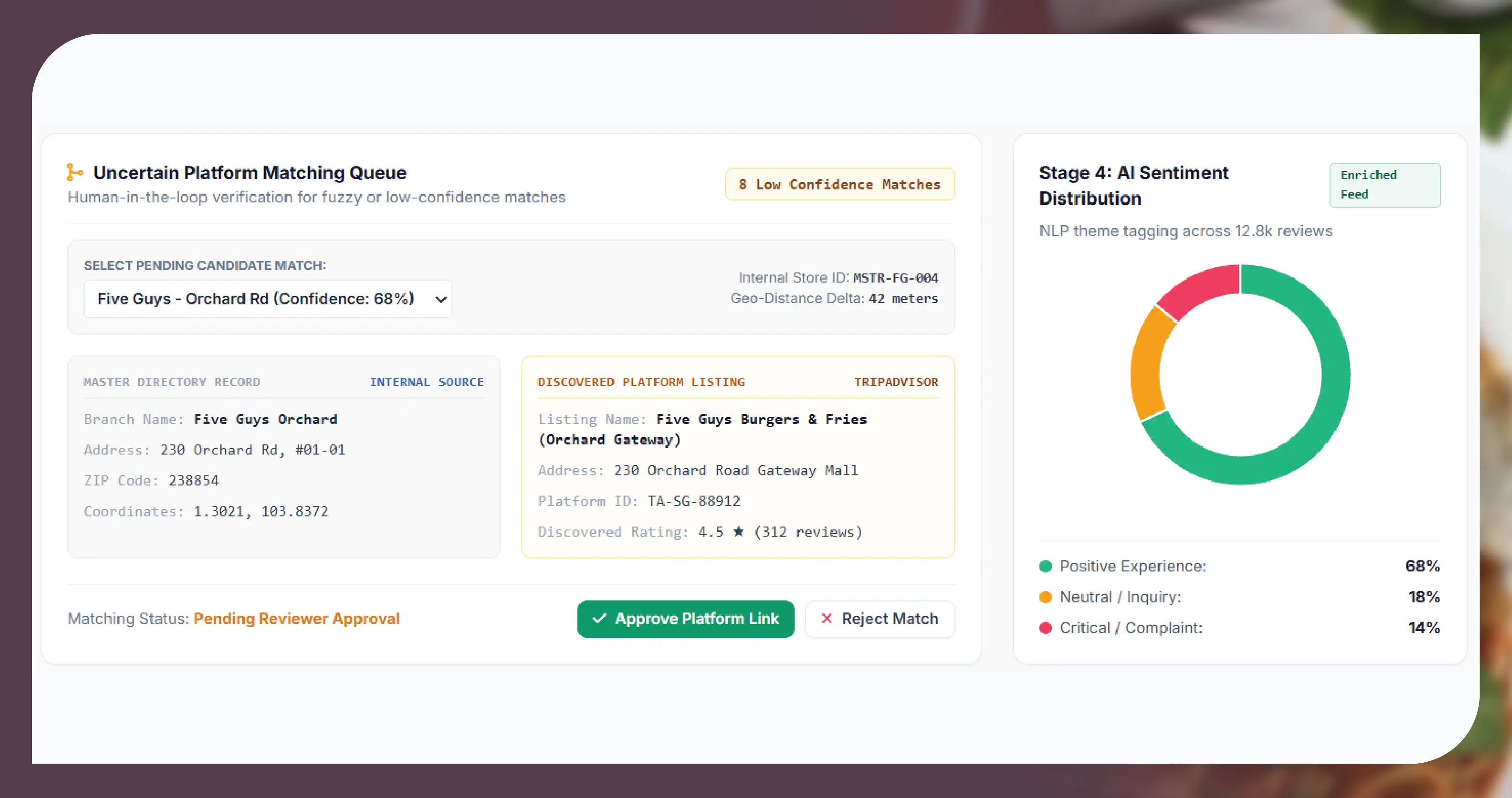
- Enrich with AI. Detect language, tag themes and score sentiment. Keep a human check for low-confidence results.
- Route alerts. Compare each new batch with your rules and send hits to email, Slack, Microsoft Teams or a ticketing tool, with a link back to the public review.
The matching step is where most DIY projects struggle. A restaurant may have a slightly different name or address on each platform, and branches close or move. Keep a review queue for uncertain matches rather than forcing them.
Which alert rules should you set up?
Too many alerts and teams ignore them; too few and problems slip through. Start with a small set of rules, tune thresholds for a month, then add more. The thresholds below are suggested starting points, not industry benchmarks.
| Alert rule | Example trigger (starting point) | Who receives it | Suggested response |
|---|---|---|---|
| New low-star review | Any 1- or 2-star review at any branch | Site manager | Reply within the same business day |
| Rating drop | 30-day rolling average falls 0.2 stars below the branch's 90-day average | Area or ops manager | Check recent shifts, menu changes and staffing |
| Complaint cluster | 3+ reviews tagging the same theme (e.g. 'cold food') in 7 days | Ops and kitchen lead | Root-cause review at the site |
| Review velocity spike | Daily review count far above the branch's normal range | Brand or marketing team | Check for a viral post, event or suspicious activity |
| Unanswered review | No owner response after 48 hours | Customer-experience team | Escalate reply |
| Competitor shift | A tracked nearby competitor gains or loses rating sharply | Strategy team | Review pricing, menu and local offer |
Velocity spikes deserve care. A sudden wave of very similar five-star or one-star reviews can signal review manipulation, which matters for compliance as well as reputation (see the legal section below).
Restaurant review monitoring by country: USA vs UK
Priorities differ by market. The table below summarises how to weight platforms and alerts in the two markets this guide covers. Rollup values are left as dataset placeholders until filled from a live Food Data Scrape sample.
| Factor | USA | UK |
|---|---|---|
| Platforms to prioritise | Google first, then Yelp; Tripadvisor for tourist cities | Google first, then Tripadvisor; Yelp has a lighter UK footprint |
| Key regulation to note | FTC rule on fake reviews and testimonials (federal) | DMCC Act 2024 and CMA fake-review guidance |
| Typical alert focus | Rating drops, Yelp complaint themes, reply speed | Tripadvisor tourist-site sentiment, fake-review patterns, reply speed |
Illustrative rollup for a multi-site group
A monthly rollup gives leadership one view across platforms. The template below shows what each cell of that rollup measures, platform by platform.
| Dashboard metric (last 30 days) | Yelp | Tripadvisor | |
|---|---|---|---|
| New reviews collected | Count of new public reviews captured for each branch | Count of new Yelp reviews per branch | Count of new Tripadvisor reviews per branch |
| Average star rating | Mean star rating of new reviews vs the previous 30 days | Same, on Yelp's 1–5 scale | Same, on Tripadvisor's 1–5 bubble scale |
| Low-star alerts fired | Reviews at or below your alert threshold (e.g. 1–2 stars) sent to the team | Same rule, Yelp | Same rule, Tripadvisor |
| Median hours to owner reply | Hours between review time and public owner reply, median per branch | Same, where Yelp shows the owner reply | Same, where Tripadvisor shows the management response |
| Top complaint theme | Most frequent complaint topic from text tagging (e.g. wait time, cold food) | Same tagging model, Yelp text | Same tagging model, Tripadvisor text |
Use cases for automated review alerts
- Branch quality control. Ops teams spot a site whose wait-time complaints are rising and act before the rating slips.
- Menu decisions. Theme tags show which dishes earn praise or complaints; see our guide to review data for menu analysis.
- Competitive benchmarking. Track nearby rivals' ratings and themes to understand why diners choose them.
- Agency reporting. Agencies send each restaurant client a weekly digest instead of screenshots.
- UK tourist-site datasets. Teams that need a UK Tripadvisor restaurant reviews dataset can receive it as a scheduled feed with names removed and themes added.
Legal and compliance basics
Restaurant review monitoring should use only publicly available business data, and it should follow each platform's terms of service, robots.txt and rate limits. Never bypass logins, CAPTCHAs or paywalls, and prefer official APIs where they meet your needs.
- No personal data by design. Reviewer names, profile links and photos are not collected or displayed. Reviews are stored with a hashed key and analysed in aggregate.
- UK fake-review rules. The CMA's fake reviews guidance (CMA208) explains what businesses that publish reviews must do under consumer law reformed by the DMCC Act 2024. Monitoring helps spot suspicious patterns; it must never be used to post, buy or suppress reviews.
- US rules. The FTC's 2024 final rule on consumer reviews and testimonials bans fake reviews and paying for reviews that must express a set sentiment, so treat monitoring as detection, not manipulation.
- Display and attribution. If you show review text in a dashboard, follow each platform's display and attribution terms.
- Data retention. Keep raw review text only as long as needed for analysis, then keep aggregates.
Build vs buy: choosing a review monitoring provider
A small team can wire up a basic monitor with official APIs and a workflow tool. The challenge comes with scale: many locations, three platforms, matching, theme tagging and alert tuning.
| Question | Build in-house | Use a data provider |
|---|---|---|
| Setup time | Weeks of engineering plus ongoing fixes | Days to agree fields, cadence and delivery |
| Platform changes | Your team maintains collectors | Provider maintains collectors |
| Location matching | Manual or custom logic | Delivered with a location master |
| AI themes and sentiment | Build or license a model | Included as enriched fields |
| Best fit | 1–10 sites, one platform | Multi-site groups, agencies, analysts |
When comparing providers, ask about refresh cadence, platform coverage, how they handle reviewer privacy, delivery formats (API, CSV, cloud bucket, dashboard) and how alerts are tested. Avoid any vendor that promises "100% accuracy" or complete review history from APIs that do not offer it. Learn more about our restaurant reviews and rating data service.
Get a free sample dataset. See what automated restaurant review monitoring looks like for your own branches. We can prepare a sample feed with ratings, review counts, theme tags and sentiment across Google, Yelp and Tripadvisor.
Questions
Frequently Asked Questions
It is the ongoing collection of public reviews and ratings for your restaurants, and often competitors, from platforms such as Google, Yelp and Tripadvisor. The data is cleaned into one dataset and checked against rules that trigger alerts for low ratings, complaint clusters or rating drops.
For busy or flagship sites, every few hours is reasonable; daily works for most others. Since 19% of US consumers in BrightLocal's 2026 survey expect a same-day reply, a daily check is the minimum if you aim to respond quickly.
No. Each official API returns only part of the picture. For example, Tripadvisor's Content API returns up to five recent reviews per location, and Google's Business Profile API covers only locations you manage. Many teams add compliant collection of public listing pages.
Monitoring public business reviews is common, but you must respect platform terms, robots.txt and rate limits, avoid collecting personal data, and follow consumer law. In the UK, the CMA's fake-review guidance applies; in the US, the FTC rule on reviews does. Take legal advice for your use case.
AI tags each review with themes such as wait time or food quality and gives it a sentiment score. That lets you alert on patterns, like three cold-food complaints in a week, rather than on single star ratings alone.
Get a Free Food Data Sample in 48 Hours.
Tell us your platforms, target markets and required fields — we'll map exactly what's possible with food data scraping, recommend the right approach, and send a working sample so you can verify quality before any commitment.
Request a strategy call
Thanks — our data team will reach out within 48 hours with your sample.