Introduction
The modern retail landscape is evolving at an unprecedented pace. Consumer preferences shift rapidly, competitors adjust pricing several times a day, and product availability changes in real time. Businesses that rely solely on traditional reports or historical sales data often struggle to respond quickly to these market dynamics. To remain competitive, retailers, brands, manufacturers, and market research firms require continuous access to accurate and actionable retail intelligence.
Retail Analytics Data Scraping has become one of the most effective methods for gathering large-scale retail information from eCommerce websites, grocery platforms, online marketplaces, and retail catalogs. It enables businesses to monitor thousands of products simultaneously while collecting valuable insights about pricing, promotions, inventory, consumer reviews, and assortment changes.
Real-Time Retail Analytics Data Extraction empowers organizations to transform constantly changing online retail information into structured datasets that support strategic planning, competitive analysis, and data-driven decision-making.
Retail Pricing Data Intelligence further strengthens business operations by providing continuous visibility into competitor pricing, promotional strategies, regional variations, and customer purchasing behavior, allowing companies to make informed pricing and merchandising decisions with confidence.
Rather than reacting to market changes after they occur, businesses can proactively identify opportunities, optimize pricing strategies, improve product assortments, and strengthen category management using automated retail analytics. As retail competition becomes increasingly digital and data-centric, organizations that leverage automated data collection gain a measurable advantage in understanding consumer demand before competitors do.
Understanding Retail Analytics Data Scraping
Retail analytics data scraping refers to the automated process of extracting publicly available information from retail websites, grocery delivery platforms, online marketplaces, and digital product catalogs. Instead of manually collecting information from thousands of product pages, businesses use intelligent scraping technologies that continuously gather structured data for analysis.
The collected information typically includes product names, brand details, SKU numbers, pricing, discounted prices, stock availability, product descriptions, customer ratings, reviews, category classifications, delivery options, images, and promotional offers. Once organized into centralized databases, this information becomes a valuable resource for pricing analysis, demand forecasting, inventory planning, and competitive benchmarking.
Unlike conventional market research that often depends on periodic reports, retail analytics data scraping provides businesses with continuously updated information that reflects actual market conditions as they evolve.
Why Retail Analytics Has Become Essential for Modern Retailers?
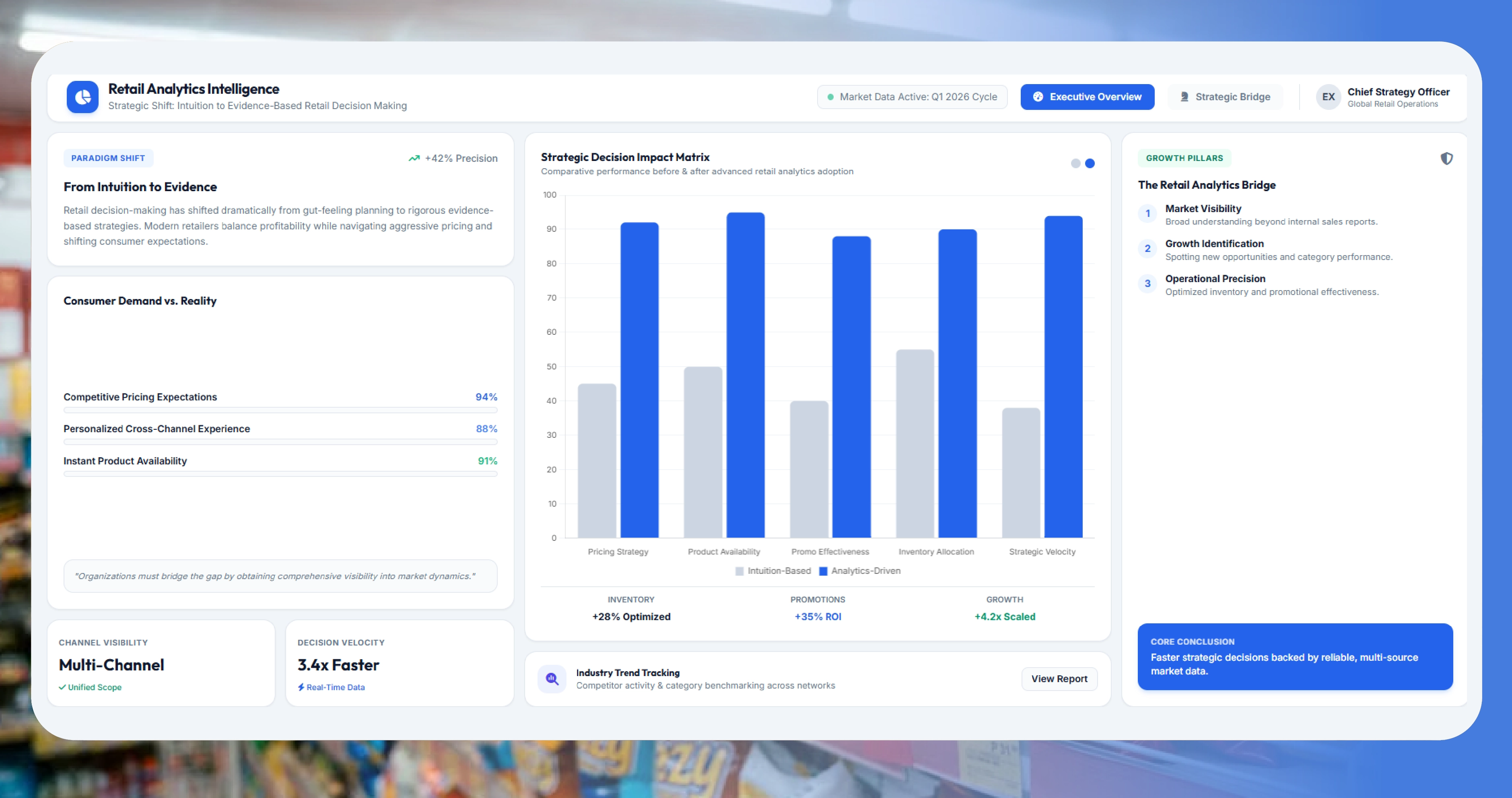
Retail decision-making has shifted dramatically from intuition-based planning to evidence-based strategies. Consumers expect competitive pricing, better product availability, and personalized shopping experiences across every retail channel. Meanwhile, retailers must balance profitability while responding to aggressive competitive pricing and changing consumer behavior.
Retail analytics bridges this gap by providing comprehensive visibility into market performance. Instead of relying only on internal sales reports, businesses gain a broader understanding of industry trends, competitor activities, customer preferences, and category performance across multiple retailers.
This broader market perspective enables organizations to identify new growth opportunities, improve promotional effectiveness, optimize inventory allocation, and make faster strategic decisions backed by reliable data.
Turn real-time retail data into smarter business decisions with our customized data scraping solutions—contact us today to unlock actionable market intelligence.
Retail Analytics Data Collection for Market Research
Retail Analytics Data Collection for Market Research enables businesses to study real-world consumer behavior through actual retail activity rather than relying exclusively on surveys or limited sample groups. By collecting data from numerous retail sources, organizations develop a more comprehensive understanding of changing market conditions.
Market researchers can evaluate product assortment, promotional strategies, pricing patterns, customer engagement, regional demand differences, and category performance over time. These insights help organizations identify emerging product opportunities while validating investment decisions with measurable market evidence.
Retail analytics also enables longitudinal studies that reveal how consumer preferences evolve throughout seasonal cycles, economic fluctuations, and competitive market shifts. Such continuous monitoring significantly improves forecasting accuracy and strategic planning.
Understanding Consumer Behavior Through Retail Analytics
Consumer buying decisions are influenced by numerous factors including pricing, product availability, brand perception, promotional offers, convenience, and customer experience. Retail analytics helps businesses understand these purchasing behaviors using continuously updated retail data.
Retail Consumer Trend Analytics allows organizations to detect emerging shopping patterns before they become mainstream. Businesses can observe growing interest in healthier food products, sustainable packaging, premium grocery items, plant-based alternatives, regional specialties, and seasonal purchasing behavior through measurable retail activity.
Understanding these trends enables product development teams to align innovation with actual consumer demand instead of assumptions. Marketing teams also benefit by creating campaigns that reflect current purchasing motivations and regional preferences.
As consumer expectations continue evolving, businesses equipped with real-time retail intelligence remain better positioned to adapt their product portfolios accordingly.
Retail Competitor Data Scraping Strengthens Competitive Intelligence
Competition within retail markets has become increasingly dynamic. Pricing adjustments, promotional campaigns, assortment expansions, and product launches occur continuously across online platforms. Businesses that monitor competitors manually often struggle to maintain accurate competitive visibility.
Retail Competitor Data Scraping automates this monitoring process by continuously collecting competitor pricing, inventory availability, promotional campaigns, product introductions, discontinued items, customer ratings, review volumes, and category changes across multiple retail websites.
This intelligence allows organizations to compare their own market position against competitors while identifying pricing opportunities, assortment gaps, promotional advantages, and emerging competitive threats. Rather than reacting weeks after competitors make strategic moves, businesses receive timely insights that support faster responses and stronger market positioning.
Continuous competitor monitoring also helps manufacturers improve retailer negotiations by presenting data-backed category recommendations supported by measurable market evidence.
Improving Pricing Strategies with Real-Time Monitoring
Pricing remains one of the most influential factors affecting consumer purchasing decisions. Small pricing differences can significantly impact market share, conversion rates, and customer loyalty. Consequently, businesses require accurate visibility into constantly changing retail prices.
Real-Time Price Monitoring enables retailers and brands to observe pricing fluctuations across numerous online stores without manual effort. Automated systems detect price reductions, promotional campaigns, competitor discounts, dynamic pricing adjustments, and regional price variations as they occur.
This continuous monitoring allows pricing teams to optimize promotional timing, protect profit margins, maintain pricing consistency, and respond more effectively to competitive pricing activity. Historical pricing datasets further support trend analysis, helping organizations understand long-term pricing behavior across multiple retail channels.
Retail Analytics Supports Better Category Management
Successful category management requires understanding consumer demand before it becomes obvious through traditional sales reporting. Retail analytics provides category managers with detailed visibility into changing product performance, emerging market opportunities, and evolving customer preferences.
By analyzing pricing, inventory, promotions, customer reviews, and assortment changes together, businesses identify underserved market segments and category whitespace opportunities. These insights support stronger assortment planning while improving retailer discussions during category reviews and shelf planning initiatives.
Rather than presenting assumptions during buyer meetings, brands can support recommendations using measurable evidence collected directly from retail marketplaces.
Product Innovation Backed by Retail Intelligence
Innovation becomes considerably more successful when supported by comprehensive market intelligence. Retail analytics enables research and development teams to monitor rapidly changing consumer interests while evaluating competitor innovation activities across multiple categories.
Businesses can identify growing demand for new ingredients, packaging formats, dietary preferences, convenience-focused products, premium offerings, and sustainable alternatives through continuous retail monitoring. These insights reduce uncertainty during product development while increasing the likelihood of successful market launches.
Retail intelligence also shortens innovation cycles by providing faster feedback regarding consumer acceptance, allowing organizations to refine product strategies before large-scale investments are made.
Inventory Optimization Through Retail Analytics
Inventory management has become increasingly complex as consumer demand fluctuates more frequently across regions and product categories. Retail analytics helps businesses maintain better inventory visibility by monitoring stock availability across multiple retailers simultaneously.
Organizations can identify recurring stock shortages, replenishment delays, regional demand spikes, and inventory inconsistencies before they significantly impact customer satisfaction. This information supports more accurate forecasting while reducing lost sales resulting from stockouts.
Supply chain teams also benefit from improved visibility into market-wide inventory conditions, enabling more effective procurement planning and distribution strategies.
Regional Retail Intelligence Creates Better Market Strategies
National averages often conceal important regional differences in consumer behavior. Retail analytics enables businesses to understand how product demand, pricing, promotions, and purchasing patterns vary across cities, states, and countries.
Regional intelligence helps organizations determine the most suitable markets for new product launches while optimizing localized pricing strategies and promotional campaigns. Retailers serving geographically concentrated markets particularly benefit from understanding regional demand variations rather than relying solely on nationwide performance indicators.
Localized retail intelligence ultimately supports more personalized merchandising strategies while improving customer satisfaction through region-specific product offerings.
AI is Shaping the Future of Retail Analytics
Artificial intelligence has significantly enhanced retail analytics by automating data processing, identifying hidden patterns, and generating predictive insights from continuously collected retail information. Rather than manually reviewing thousands of products and pricing records, AI systems detect unusual pricing behavior, forecast demand fluctuations, identify emerging trends, and recommend strategic actions based on changing market conditions.
As machine learning models continue improving, businesses will increasingly transition from descriptive reporting toward predictive retail intelligence that enables proactive decision-making. Organizations adopting AI-powered retail analytics today are positioning themselves for greater agility, improved operational efficiency, and stronger long-term competitiveness.
How Food Data Scrape Can Help You?
Comprehensive Retail Data Collection
We collect accurate retail data from leading eCommerce platforms, grocery stores, marketplaces, and retailer websites, delivering structured datasets that support pricing analysis, assortment optimization, category management, and business intelligence initiatives.
Real-Time Competitor Monitoring
Our automated scraping solutions continuously monitor competitor prices, promotions, inventory availability, product launches, and assortment changes, helping businesses respond quickly to evolving market conditions and maintain competitive advantage.
Custom Retail Analytics Solutions
We provide customized retail data extraction tailored to your industry, target retailers, product categories, geographic markets, and reporting requirements, ensuring actionable insights aligned with your business objectives.
Scalable Data Delivery
Our services deliver clean, validated retail datasets in CSV, JSON, Excel, API, cloud storage, or database formats, enabling seamless integration with BI dashboards, analytics platforms, and enterprise systems.
Actionable Market Intelligence
We transform raw retail data into meaningful business insights that support pricing optimization, demand forecasting, inventory planning, consumer trend analysis, and strategic decision-making for sustainable business growth.
Conclusion
Retail businesses can no longer depend solely on historical reports or periodic market studies to remain competitive. Continuous retail intelligence has become essential for pricing optimization, category management, consumer understanding, inventory planning, competitive benchmarking, and product innovation. Automated retail analytics data scraping provides organizations with timely, structured, and actionable information that supports faster, more informed business decisions across every stage of the retail value chain.
By integrating Sales & Demand Trends into strategic planning, businesses gain deeper visibility into evolving consumer behavior while improving forecasting accuracy and market responsiveness. Combined with Grocery Data Intelligence, organizations can better understand pricing dynamics, assortment shifts, promotional effectiveness, and regional purchasing patterns across modern grocery ecosystems. Leveraging comprehensive Grocery Datasets further empowers retailers, brands, and market researchers to develop data-driven strategies that improve operational performance, strengthen competitive positioning, and support sustainable growth in an increasingly digital retail marketplace.
Are you in need of high-class scraping services? Food Data Scrape should be your first point of call. We are undoubtedly the best in Food Data Aggregator and Mobile Grocery App Scraping service and we render impeccable data insights and analytics for strategic decision-making. With a legacy of excellence as our backbone, we help companies become data-driven, fueling their development. Please take advantage of our tailored solutions that will add value to your business. Contact us today to unlock the value of your data.