Introduction
Short answer: To compare Saudi food delivery fees fairly, check the same dishes from the same restaurant, delivered to the same address, at the same time, on every app. Then add dish price, delivery fee, service fee and any small-order fee into one basket total, and record the promised ETA next to it.
That sounds simple. In practice, Saudi food delivery fees change by restaurant, distance, time of day and promotion. A headline "free delivery" offer can hide a higher dish price. A low delivery fee can come with a service fee or a longer wait.
This guide is for price-comparison apps, restaurant groups and delivery-market entrants in Saudi Arabia. It covers the fee types to capture, how Jahez, HungerStation, Keeta and ToYou differ, how to build a basket total, and how to schedule and match data across Riyadh, Jeddah and Dammam.
Why do Saudi food delivery fees matter, and who uses the data?
The market is large and still growing. The Transport General Authority (TGA) reported more than 124 million delivery orders in Q4 2025, up 60% year on year.
Competition is also pushing Saudi food delivery fees down. An Argaam special report in January 2026 found that total delivery orders rose from 228 million in 2023 to 408 million in 2025. It also noted that the General Authority for Competition (GAC) is watching pricing practices in the sector.
Listed operators feel the pressure too. Jahez reported 36.4 million orders in Q2 2026, up 26.5%, but said gross margin fell partly because of "lower delivery-fee economics". Keeta, owned by Meituan, launched in Al Kharj in September 2024 with free delivery on orders above SAR 25.
Teams that track Saudi food delivery fees usually fall into four groups:
- Price-comparison apps: show users the cheapest app for the same order, including fees, not just dish prices.
- Restaurant groups: check how their menu prices and promotions look on each app versus their own app.
- Delivery-app launch teams: size fee levels, free-delivery thresholds and ETAs before entering a city.
- Analysts and investors: follow fee and promotion intensity as a signal of competition.
How do Jahez, HungerStation, Keeta and ToYou differ on fees?
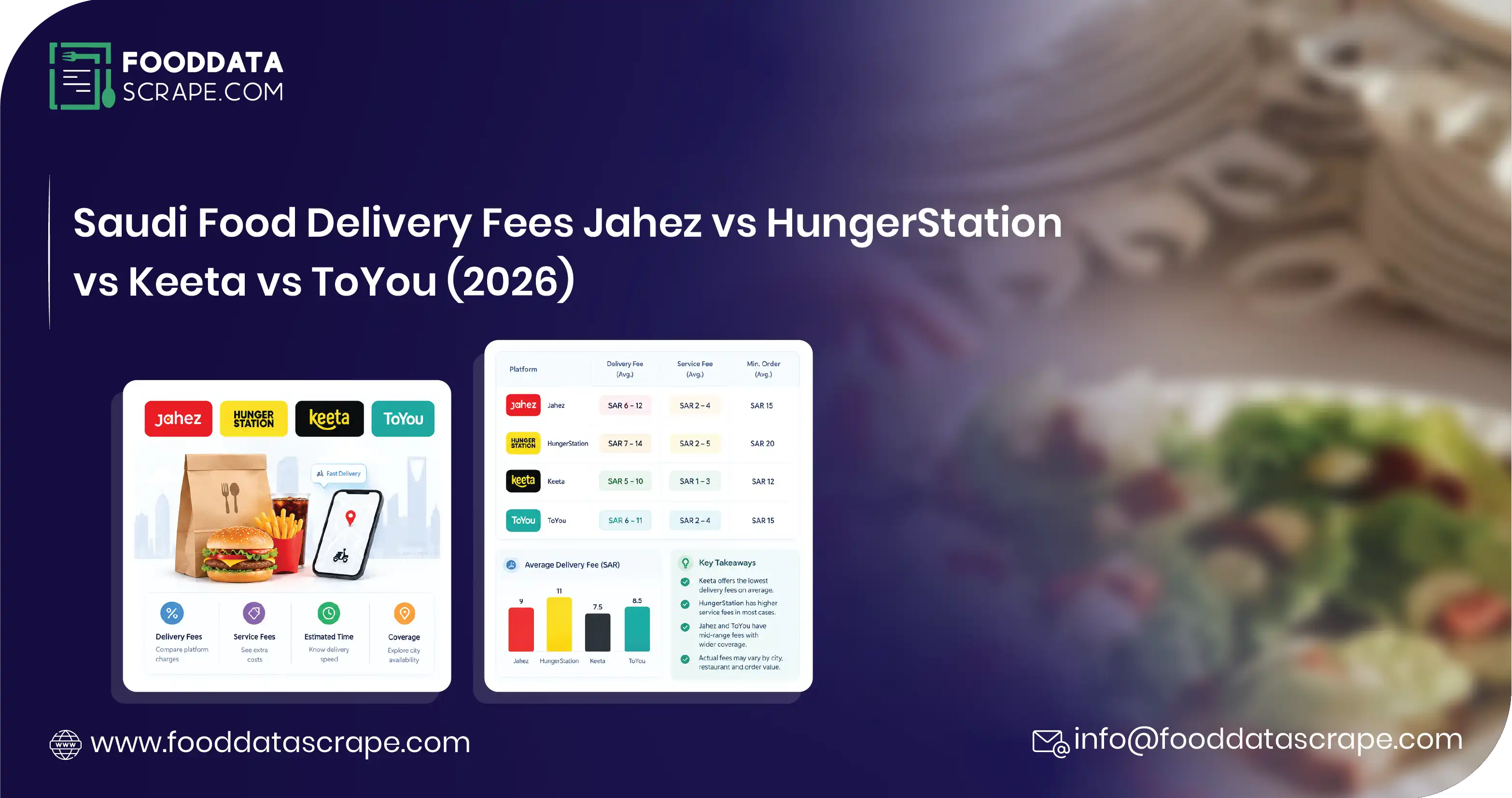
Saudi food delivery fees are structured differently on each app. The table below uses the only public cross-app figures we found: Argaam's January 2026 price check, whose average delivery fees include service charges. Treat these as a one-time snapshot, not current prices. Fees change by restaurant, distance and promotion.
| Platform | Average delivery fee (Argaam, Jan 2026) | Service fee (Argaam, Jan 2026) | What to capture in your own data |
|---|---|---|---|
| Jahez | SAR 15 | None reported | Delivery fee per restaurant, promotions, minimum order, ETA |
| HungerStation | SAR 15.66 | 2% of order value (min SAR 0.5, max SAR 2) | Delivery fee, service fee, small-order fee, exclusive deals, ETA |
| Keeta | SAR 11.91 | 2% of order value (min SAR 0.5, max SAR 2) | Free-delivery thresholds, launch promotions, service fee, ETA |
| ToYou | Not covered in the study | Not covered in the study | Delivery fee, service fee, subscription and free-delivery offers, ETA (no public fee benchmark found) |
| Ninja (reference) | SAR 11.89 | None reported | Useful benchmark for low-fee positioning |
The same report found that most meals carried the same dish price across the delivery apps. However, some exclusive restaurant deals were 20% to 30% cheaper on one app, and delivery-app prices could be 20% to over 80% higher than a restaurant's own app on some orders. Some apps waived or cut delivery fees above SAR 30 to 35, but only at certain restaurants. This is why dish price alone is not enough.
The 12 data fields you need for a fair comparison
A useful dataset of Saudi food delivery fees records every part of the price a customer sees at checkout, plus the context that explains it. These are the fields we recommend:
- Platform and restaurant ID: the app name, the restaurant's listing ID and branch name, so you can join records over time.
- Dish name and price: item name in Arabic and English, size or variant, and listed price before promotions.
- Delivery fee: the fee shown for the test address, as displayed before checkout.
- Service fee: percentage or fixed amount, including any minimum and maximum caps.
- Small-order fee: any extra charge when the basket is below a set value.
- Minimum order: the lowest basket value the restaurant accepts on that app.
- Promotion and free-delivery threshold: discount type, value, the basket value that unlocks free delivery, and any end date shown.
- Subscription flag: whether the fee shown changes for subscribers to a paid programme, where an app offers one and shows it publicly.
- Promised ETA: the delivery time window the app displays, such as 25 to 35 minutes.
- Distance or zone: the distance between the restaurant and the test address, or the zone or district name.
- Peak or busy flag: any visible surge, busy or high-demand label, and whether the listing is open or paused.
- Timestamp and city: capture date, local time and city, so you can compare like with like.
How to collect, normalise and match the data
1. Use the same address on every app
Saudi food delivery fees and ETAs depend on location. Pick fixed test addresses for each district you care about, such as one central and one outer district per city. Use the same coordinates on every app, every time. Without this step, a fee gap may just be a distance gap.
2. Normalise to a basket total
Define a standard basket, for example one main dish and one drink from the same chain branch. Then add every charge the customer would pay. The basket total is the number you compare, not the delivery fee on its own. The worked example below uses one public data point to show the method.
| Basket component (illustrative example) | Jahez | HungerStation | Keeta | ToYou |
|---|---|---|---|---|
| Dish price: Al Baik 4 chicken pieces (Argaam, Jan 2026) | SAR 22 | SAR 22 | SAR 22 | Not in study |
| Average delivery fee incl. service charges (Argaam) | SAR 15.00 | SAR 15.66 | SAR 11.91 | Not in study |
| Service fee shown separately | Included in average above | Included in average above | Included in average above | Capture live |
| Small-order fee | Not reported | Not reported | Not reported | Capture live |
| Promotion applied | None (list prices) | None (list prices) | None (list prices) | Capture live |
| Illustrative basket total | ~SAR 37.00 | ~SAR 37.66 | ~SAR 33.91 | Not estimated |
| Promised ETA | Capture per run | Capture per run | Capture per run | Capture per run |
This is an illustrative worked example, not a live capture. Totals simply add Argaam's January 2026 dish price to its average app delivery fee; they are not counts or prices from a live Food Data Scrape dataset. The same meal cost SAR 18 on the restaurant's own app.
Keep promotions in a separate column from Saudi food delivery fees. That way you can report both the regular basket total and the promoted one. Users of a comparison app want the promoted price. A restaurant group often wants the regular one.
3. Schedule captures around peak hours
Saudi food delivery fees and ETAs can move during busy periods. Capture at fixed times each day: a quiet mid-afternoon slot, the lunch peak and the late-evening dinner peak. During Ramadan, add slots around iftar and suhoor. Run the same schedule on every app so the timing is identical.
4. Match restaurants and dishes across apps
The same branch can have different names, spellings and menu layouts on each app. Match branches using the brand name, district and location, then confirm with a manual review of uncertain pairs. For dishes, match on the Arabic and English names plus size, and flag combos that differ in content. Requests we receive from Saudi restaurant groups often start with a fixed list of competitor branches, which makes this step easier.
Saudi food delivery fees by city: Riyadh, Jeddah and Dammam
Demand is concentrated in three regions, so most projects comparing Saudi food delivery fees start there. TGA's Q4 2025 bulletin gives the regional split of delivery orders.
| City (region) | Share of Q4 2025 delivery orders (TGA) | What to watch | Suggested sample design |
|---|---|---|---|
| Riyadh (Riyadh region) | 44.45% | Most apps and promotions; wide city, so distance drives fees | 4 to 6 test addresses across districts |
| Jeddah (Makkah region) | 22.17% | Strong local chains; seasonal peaks around religious travel periods | 3 to 4 test addresses |
| Dammam / Khobar (Eastern Province) | 15.90% | Cross-city delivery zones between Dammam, Khobar and Dhahran | 3 test addresses, one per city |
The regional shares are for all delivery orders, not just food. We found no public figures for Saudi food delivery fees by city, so this guide does not estimate them. Fees vary by district, distance and time slot, and are best tracked per run at fixed test addresses.
Use cases
- Price-comparison apps: show a ranked list of basket totals and ETAs for the same order across apps.
- Restaurant pricing teams: check whether app prices and fees put the brand above or below rivals in each district.
- Promotion tracking: see how Saudi food delivery fees shift when an app runs free-delivery or discount campaigns, at which threshold, and for how long.
- Market entry planning: set launch fees and minimum orders based on what customers already pay.
- Service-level benchmarking: compare promised ETAs by hour and district to spot slow zones.
- Competition research: follow fee and promotion intensity over months as a market signal.
Legal and compliance basics
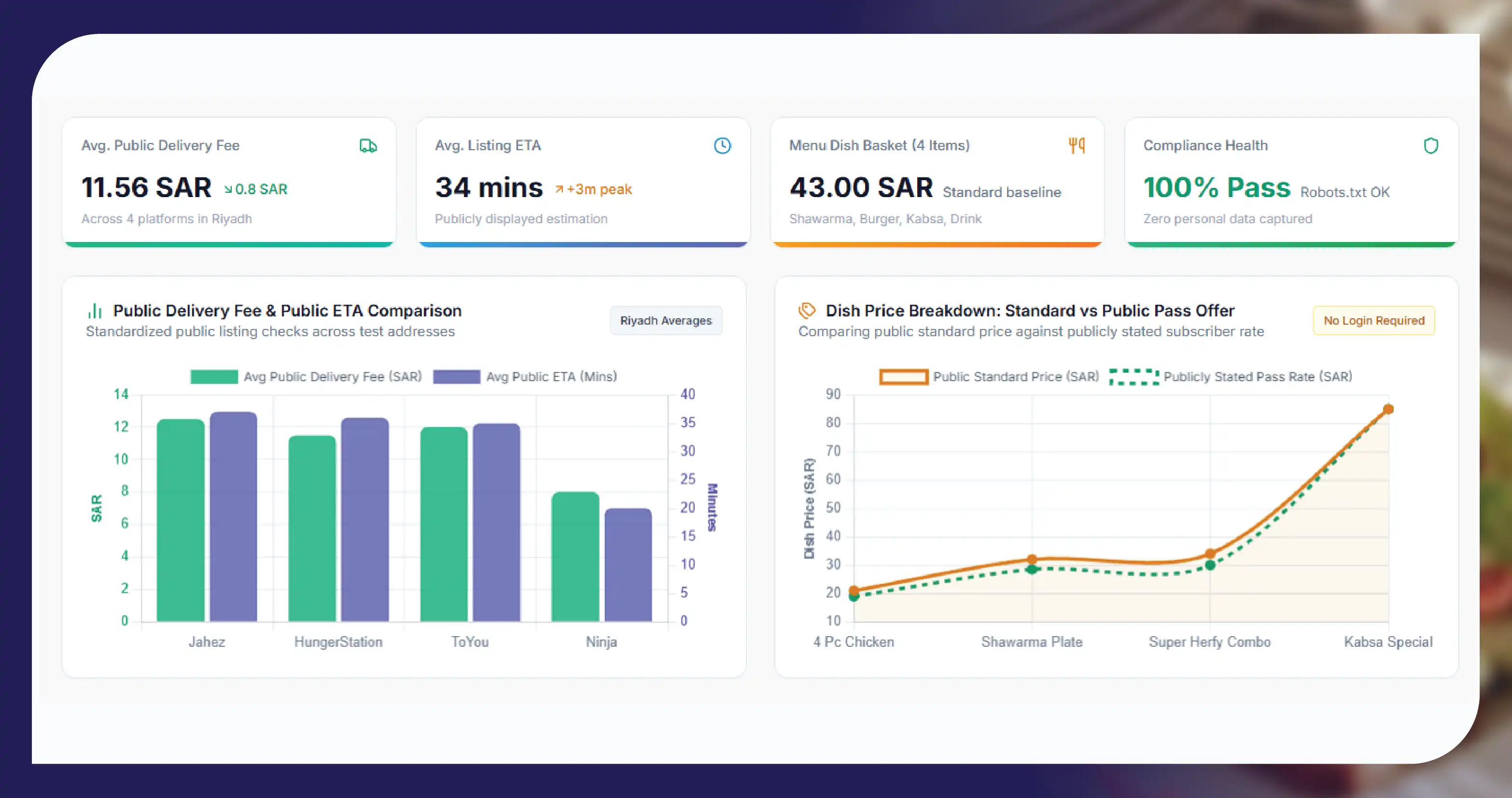
- Public data only: collect dish prices, Saudi food delivery fees and ETAs that any visitor can see for a public restaurant listing.
- No personal data: never collect rider or customer names, phone numbers, order histories or account details.
- Respect site rules: follow each platform's terms of service and robots.txt, and keep request rates low.
- No bypassing: do not get around logins, CAPTCHAs or other access controls. Subscriber-only prices are recorded only where they are shown publicly.
- Business-level listings: keep restaurant data at public listing level, such as name, branch, district and menu.
- Fair presentation: label snapshot dates and test addresses clearly when you publish comparisons.
Build vs buy: choosing a data provider
You can build a tracker for Saudi food delivery fees in-house. Expect to maintain address setups, schedules, bilingual matching and quality checks for four or more apps, and to update collectors when an app changes its layout.
A managed feed makes sense when you need several cities, frequent captures or matched restaurants from day one. When you compare providers, ask:
- Coverage: which apps and cities are included, and is ToYou covered alongside Jahez, HungerStation and Keeta?
- Fee detail: are delivery, service and small-order fees captured separately, with minimum orders and thresholds?
- Matching: how are branches and Arabic and English dish names matched, and how are uncertain matches reviewed?
- Cadence: can captures run at fixed peak and off-peak times, with a Ramadan schedule?
- Delivery: formats such as CSV, JSON or API, and how history is stored.
- Compliance: a clear public-data-only policy with no personal data.
Food Data Scrape builds these feeds through Delivery Fee & ETA Intelligence. Coverage is set per project across the apps and cities you need – ask for the current list.
Get a free sample dataset. See a sample basket-total comparison for Jahez, HungerStation, Keeta and ToYou at your chosen addresses in Riyadh, Jeddah or Dammam. Fields include dish price, delivery fee, service fee, small-order fee, minimum order, promotions and promised ETA.
Questions
Frequently Asked Questions
It depends on the restaurant, distance and time. In Argaam's January 2026 check, Ninja and Keeta had the lowest average delivery fees, but that was a single snapshot. For a current answer, compare Saudi food delivery fees as full basket totals at the same address.
Some do. Argaam reported that HungerStation and Keeta added a 2% service fee (minimum SAR 0.5, maximum SAR 2) and that Jahez and Ninja did not. Check current checkout screens, as Saudi food delivery fees and policies change.
For a comparison app, daily captures at peak and off-peak times work well. For restaurant benchmarking, weekly or biweekly captures are often enough, with extra captures during Ramadan and major promotions.
Public data shows the promised ETA the app displays. Actual delivery times are not public, so treat ETAs as the customer-facing promise.
Collecting publicly visible business data is common, but you must follow each platform's terms of service, robots.txt and local law, avoid personal data and never bypass access controls. Get legal advice for your specific use.
Get a Free Food Data Sample in 48 Hours.
Tell us your platforms, target markets and required fields — we'll map exactly what's possible with food data scraping, recommend the right approach, and send a working sample so you can verify quality before any commitment.
Request a strategy call
Thanks — our data team will reach out within 48 hours with your sample.