Introduction
Coffee is no longer a single-category beverage market. Consumers are moving between traditional brewed coffee, espresso-based beverages, cold coffee, specialty roasts, flavored drinks, and ready-to-drink formats. This shift makes beverage-level data increasingly valuable for cafes, coffee chains, roasters, retailers, foodservice operators, and market intelligence teams.
Scrape Americano vs Coffee Trends Data to provide a structured way to understand how Americano consumption compares with broader coffee preferences, particularly across menus, prices, locations, ratings, product formats, and customer behavior. At the same time, Coffee Trends Data Scraping can help businesses continuously monitor product availability, menu changes, consumer preferences, promotions, and competitive positioning.
The opportunity is particularly relevant because coffee remains deeply embedded in consumer routines. According to the National Coffee Association's Spring 2026 data, 66% of American adults consumed coffee in the past day and 73% consumed it in the past week. Espresso-based beverage consumption has also increased, rising from 40% in 2022 to 45% in 2026 on a past-week basis.
This makes Americano Consumer Demand Data especially useful for businesses trying to understand whether consumers are choosing a straightforward espresso-and-water beverage because of taste, convenience, price, caffeine expectations, or specialty-coffee positioning.
Why Compare Americano With Regular Coffee?
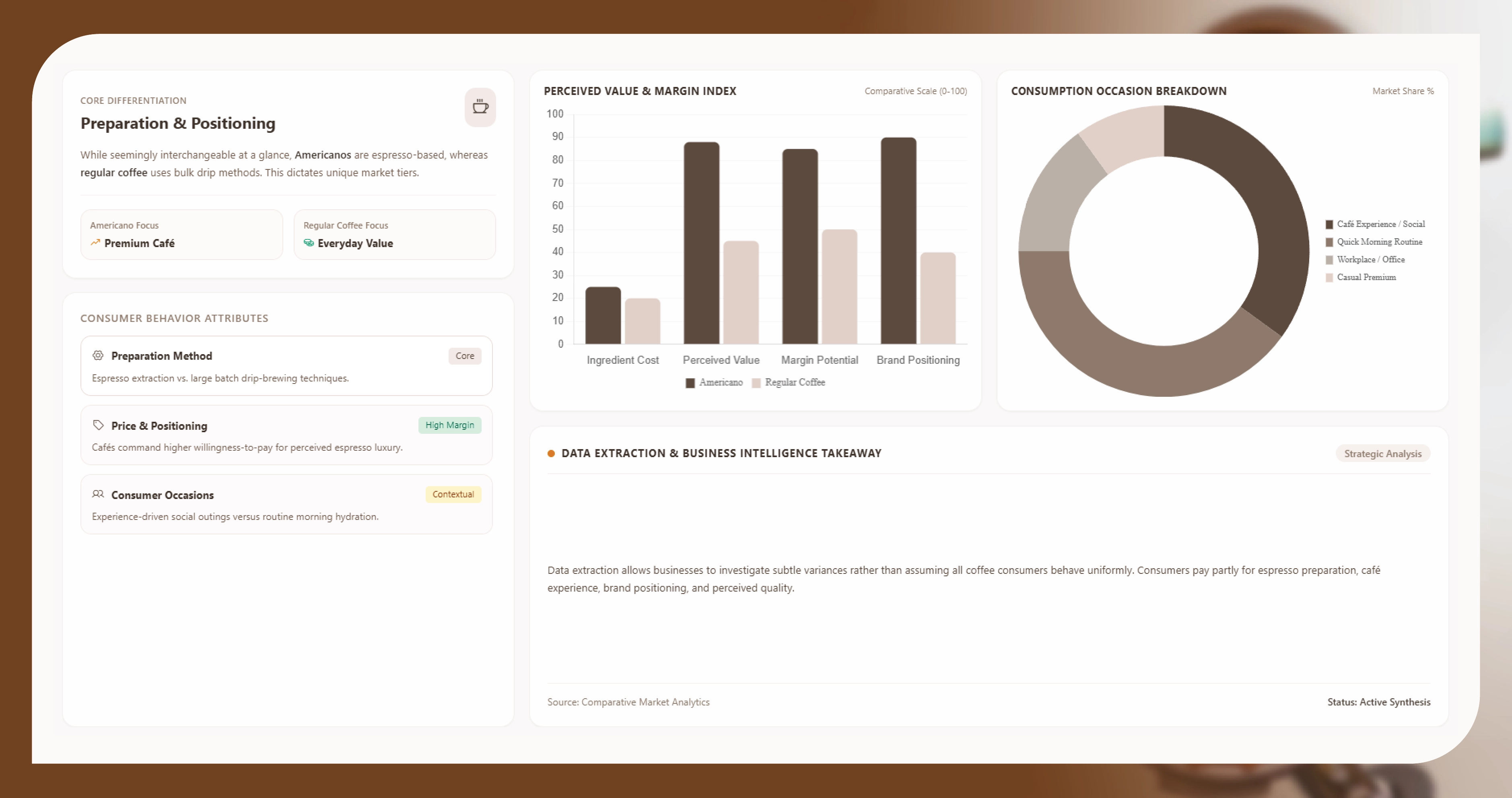
At first glance, an Americano and regular brewed coffee may appear interchangeable. Both are typically consumed without the milk-heavy formulation associated with lattes or cappuccinos, and both can serve consumers seeking a relatively straightforward coffee experience.
However, their preparation, flavor profile, pricing, positioning, and consumer occasions can differ substantially.
An Americano is espresso-based. Regular coffee generally refers to brewed coffee prepared through methods such as drip brewing. These differences create separate opportunities for data analysis.
For example, an Americano may be positioned as a premium café beverage, while brewed coffee may occupy an everyday value position. A café could charge more for an Americano despite using a relatively simple ingredient combination because consumers are paying partly for espresso preparation, café experience, brand positioning, and perceived quality.
Data extraction allows businesses to investigate these differences rather than assuming that all coffee consumers behave similarly.
What Data Should Businesses Track?
A comprehensive coffee dataset can combine product, pricing, menu, location, customer, and competitive information.
Important fields can include:
- Beverage name and category
- Americano size and variants
- Regular coffee size and roast
- Hot and iced availability
- Listed price
- Promotional price
- Add-ons and customization
- Café or retailer location
- Brand and store type
- Customer ratings
- Review counts
- Review sentiment
- Menu placement
- Availability status
- Product descriptions
- Flavor notes
- Roast information
- Ordering channel
- Time-based price changes
Combining these attributes creates a much stronger analytical foundation than collecting beverage names alone.
Using Coffee Pricing Data to Understand Positioning
Coffee Pricing Data Scraping can reveal how businesses position Americanos against brewed coffee across markets.
For instance, analysts can compare the price gap between a standard brewed coffee and an Americano across cities, café formats, store sizes, and brands. A consistently higher Americano price could indicate that businesses place greater value on espresso preparation or premium café positioning.
Pricing analysis can also reveal geographic patterns.
A beverage that appears inexpensive in one market may command a substantial premium in another because of rent, labor, competition, local purchasing power, brand positioning, or customer demographics.
Tracking prices over time can uncover additional patterns. Promotional pricing, seasonal campaigns, loyalty discounts, bundle offers, and menu restructuring can all influence consumer demand.
This makes historical pricing datasets particularly valuable for revenue managers and café operators.
Americano vs Regular Coffee Data Extraction
Americano vs Regular Coffee Data Extraction enables businesses to create a direct comparison between two important beverage formats.
The analysis can examine several dimensions.
Product Positioning
Americanos are commonly associated with espresso culture and specialty cafes, while regular coffee often represents convenience and routine consumption.
This distinction can help brands identify where each beverage fits within their portfolio.
Consumer Occasion
Regular coffee may be strongly connected with morning routines and home preparation. Americano consumption may have stronger associations with cafes, workplaces, commuting, and specialty coffee occasions.
The broader 2026 NCDT data supports the importance of location: 82% of past-day coffee drinkers had coffee prepared at home, while 28% had coffee prepared away from home.
Menu Strategy
A cafe can analyze whether Americanos attract a different customer segment than brewed coffee. This becomes especially valuable when deciding menu placement, size options, pricing, and promotional strategy.
Temperature Preferences
Businesses can compare hot and iced Americanos against hot and iced brewed coffee. This can reveal seasonal demand patterns and help operators optimize menus during warmer months.
Coffee Beverage Market Intelligence
Coffee Beverage Market Intelligence turns raw product observations into actionable business insights.
Instead of simply knowing that an Americano is available, businesses can investigate:
- Which cities have the highest menu penetration?
- Which brands offer the most Americano variations?
- How does Americano pricing differ by market?
- Are iced Americanos expanding faster than hot versions?
- Which roast profiles appear most frequently?
- Which cafés emphasize specialty origins?
- How do customer ratings compare?
- Which beverage categories are being added or removed?
- What promotions are being used?
- Which competitors are positioned at premium prices?
These questions help businesses understand the competitive landscape.
The importance of this approach is reinforced by the current specialty coffee market. In 2026, 47% of American adults reported drinking specialty coffee in the past day, compared with 42% for traditional coffee. Among adults aged 25-39, 69% had consumed specialty coffee during the past week.
That suggests that espresso-based beverages such as Americanos deserve attention within broader specialty coffee analysis.
Ready to unlock deeper coffee market insights? Start scraping Americano and coffee trends data today to make smarter, data-driven decisions.
Tracking Consumer Preferences and Menu Evolution
Consumer preferences are not static.
Coffee businesses continuously introduce new sizes, flavors, roast profiles, seasonal beverages, cold formats, and specialty offerings. Tracking these changes can help analysts detect emerging demand before it becomes obvious through conventional market reports.
For example, an increasing number of cafés offering iced Americanos could signal changing consumer preferences. Similarly, growing emphasis on single-origin espresso, lighter roasts, or premium beans could indicate that Americano consumption is becoming connected with specialty-coffee discovery.
Flavor trends are also important. The 2026 specialty coffee report identifies chocolate, caramel, brown sugar, vanilla, nutty, and fruity profiles among popular flavor preferences.
These observations can be combined with menu data to determine which flavors and coffee characteristics are being commercialized.
Coffee & Beverage Data Scraping for Competitive Analysis
Coffee & Beverage Data Scraping can create a continuously updated view of competitive offerings.
Businesses can monitor café websites, digital menus, online ordering platforms, grocery listings, delivery marketplaces, and other publicly available sources where permitted.
The goal is not simply to collect information once. Continuous collection allows businesses to identify changes.
A competitor may increase Americano prices, introduce a larger size, add an iced option, launch a seasonal promotion, or discontinue a regular coffee product. Historical snapshots make these changes measurable.
For coffee chains, this can support competitive benchmarking. For roasters, it can reveal which beverage formats cafes are prioritizing. For retailers, it can identify changing packaged-coffee preferences. For investors and market researchers, it can provide additional signals about category momentum.
From Raw Data to Coffee Consumer Trend Analytics
Coffee Consumer Trend Analytics transforms collected information into measurable patterns.
Businesses can calculate average Americano prices, price gaps, product counts, geographic availability, menu penetration, promotional frequency, rating distributions, and product growth rates.
Sentiment analysis can add another layer.
Customer reviews may reveal whether consumers value an Americano for strength, smoothness, espresso flavor, customization, convenience, or perceived value. Negative reviews can identify recurring problems such as inconsistent espresso, temperature issues, excessive bitterness, weak flavor, or pricing concerns.
When analyzed over time, these signals can reveal changes in customer expectations.
This is particularly valuable because specialty coffee consumption is increasingly connected with younger consumers and out-of-home preparation. In 2026, 36% of past-day specialty coffee drinkers had their coffee prepared away from home, compared with 23% of traditional coffee drinkers.
Business Applications of Americano Data
Americano-focused datasets can support multiple commercial applications.
- Cafe operators can benchmark pricing and menu assortment.
- Coffee chains can identify regional differences in demand and competitive positioning.
- Roasters can determine which espresso profiles and roast characteristics are being promoted.
- Foodservice businesses can identify opportunities for new beverage formats.
- Retailers can compare specialty and traditional coffee positioning.
- Market researchers can track category development and consumer behavior.
- Investors can use menu, pricing, and product signals as supplementary indicators when evaluating coffee-market opportunities.
The biggest advantage is the ability to connect several datasets rather than analyzing price, demand, and product information independently.
Building a Valuable Coffee Dataset
A useful coffee intelligence system should capture both current and historical information.
The dataset can be organized around beverages, brands, locations, prices, menus, customer feedback, and time periods.
Historical records are particularly important. Without them, analysts can see what a cafe offers today but cannot easily determine what changed six months ago.
With historical snapshots, businesses can measure:
- New product launches
- Menu removals
- Price increases
- Promotional cycles
- Seasonal availability
- Store-level differences
- Geographic expansion
- Customer-rating changes
- Category growth
- Competitive repositioning
This converts basic menu monitoring into a broader market intelligence capability.
How Food Data Scraping Can Help You
1. Track Competitor Pricing
Monitor food prices across restaurants, delivery platforms, retailers, and grocery stores to identify pricing changes, discounts, premium positioning, and opportunities for competitive pricing strategies.
2. Understand Consumer Demand
Analyze product availability, ratings, reviews, ordering patterns, and menu popularity to identify changing preferences and understand which food categories attract stronger consumer demand.
3. Discover Market Trends
Collect food product and menu information continuously to identify emerging ingredients, cuisines, beverages, dietary preferences, seasonal products, and fast-growing food categories before competitors.
4. Improve Product Strategy
Compare competitors' products, ingredients, portion sizes, descriptions, prices, and promotions to identify market gaps and develop food offerings that better match consumer expectations.
5. Build Food Market Intelligence
Combine pricing, product, restaurant, consumer, and competitor information into structured datasets that support forecasting, benchmarking, demand analysis, expansion planning, and data-driven food business decisions.
Conclusion
Americano and regular coffee represent two different paths through the broader coffee ecosystem. Regular coffee remains deeply associated with everyday consumption, while espresso-based beverages are increasingly important within specialty coffee. Current NCA research shows that espresso-based beverage consumption has been a significant contributor to specialty coffee growth, making beverage-level analysis increasingly valuable.
A comprehensive Beverage Dataset can bring together prices, products, menus, ratings, locations, promotions, and consumer signals, creating a foundation for deeper market analysis.
When this information is monitored continuously, businesses can identify Sales & Demand Trends across Americano and regular coffee categories, compare regional pricing, discover competitive gaps, and understand how beverage preferences evolve.
Most importantly, businesses can use these insights to Extract Specialty Coffee Trends Data and connect individual beverage-level observations with larger consumer movements.
The future of coffee intelligence is therefore not simply about tracking how much coffee people drink. It is about understanding which coffee they choose, where they buy it, what they pay, why they prefer it, and how those choices change over time.
If you are seeking for a reliable data scraping services, Food Data Scrape is at your service. We hold prominence in Food Data Aggregator and Mobile Restaurant App Scraping with impeccable data analysis for strategic decision-making.
Get a Free Food Data Sample in 48 Hours.
Tell us your platforms, target markets and required fields — we'll map exactly what's possible with food data scraping, recommend the right approach, and send a working sample so you can verify quality before any commitment.
Request a strategy call
Thanks — our data team will reach out within 48 hours with your sample.