Introduction
The rapid growth of quick commerce has transformed how Indian consumers purchase groceries and daily essentials. With platforms delivering products within minutes, customers increasingly compare prices, discounts, availability, and delivery options before placing orders. Price comparison applications require accurate and frequently updated product information from multiple platforms to provide reliable recommendations.
Scrape Blinkit, Zepto & Instamart Price Data for Price Comparison Apps to collect product prices, promotional offers, inventory details, and category information from leading quick commerce platforms. By analyzing this data, comparison apps can help users identify the best deals while enabling brands and retailers to understand pricing movements.
Quick Commerce Price Data Scraping for India has become an important solution for companies looking to monitor grocery prices across different cities, locations, and customer segments. Since prices and availability often change based on demand, location, and time, automated data collection helps maintain updated market insights.
Grocery Price Data Scraping for Indian Q-Commerce Apps supports businesses in tracking thousands of grocery products across categories such as beverages, dairy, snacks, household supplies, personal care, and fresh produce. This data creates opportunities for smarter pricing strategies, competitive analysis, and consumer-focused applications.
Growth of Quick Commerce and Need for Price Intelligence
India’s quick commerce industry has experienced significant expansion due to changing consumer behavior, smartphone adoption, and increasing demand for convenience. Platforms like Blinkit, Zepto, and Instamart have created a highly competitive environment where pricing plays a major role in customer acquisition and retention.
For price comparison apps, manual monitoring of product prices is inefficient because quick commerce platforms frequently update their catalogs. Discounts, limited-time offers, and location-based pricing can change multiple times throughout the day. Businesses need automated solutions that can continuously capture pricing information and transform it into useful insights.
Price intelligence helps applications answer important consumer questions:
- Which platform offers the lowest price?
- Where are the best discounts available?
- Which products are currently out of stock?
- How do prices vary across different cities?
By collecting structured data from multiple sources, comparison platforms can provide users with transparent and accurate recommendations.
Ready to unlock smarter price comparison with accurate Blinkit, Zepto, and Instamart data? Partner with our data scraping experts today.
What Data Can Be Extracted from Blinkit, Zepto, and Instamart?
Quick commerce data extraction involves collecting detailed product-level information from online grocery platforms. The collected datasets can include product names, brands, categories, pack sizes, prices, discounts, availability status, and delivery-related details.
A typical dataset may contain:
| Data Field | Description |
|---|---|
| Product Name | Name of grocery or household item |
| Brand | Product manufacturer or brand |
| Category | Grocery, beverage, dairy, personal care, etc. |
| Current Price | Latest selling price |
| Original Price | Listed price before discount |
| Discount | Percentage or promotional offer |
| Availability | In-stock or unavailable status |
| Pack Size | Quantity or measurement details |
| Location | City or delivery area |
| Timestamp | Time of data collection |
This structured information allows businesses to compare prices across platforms and identify market trends.
Real-Time Grocery Price Tracking for Better Comparisons
Real-Time Grocery Price Tracking Using Blinkit & Zepto Data helps price comparison applications deliver updated recommendations to users. Since quick commerce platforms operate on dynamic pricing models, real-time tracking ensures that customers receive accurate information before making purchasing decisions.
For example, the price of a popular grocery item may differ between Blinkit, Zepto, and Instamart due to location-based pricing, seller strategies, inventory levels, or promotional campaigns. A comparison application using fresh data can instantly display these differences and improve user experience.
Real-time monitoring also benefits businesses by helping them analyze competitor pricing strategies. Retailers can identify products with frequent price changes, monitor discount patterns, and understand consumer demand.
Role of Automated Data Collection in Quick Commerce
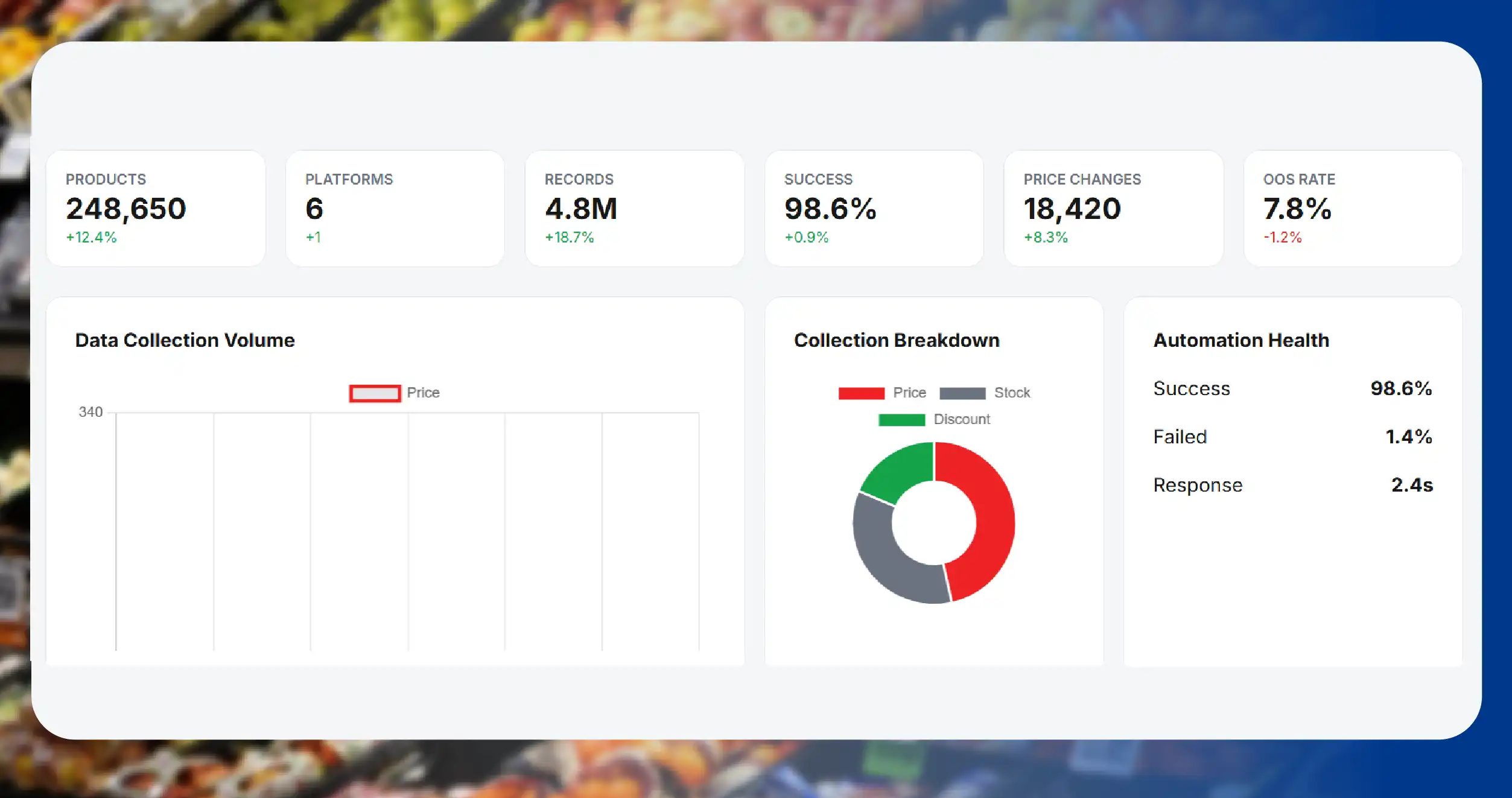
Automated Quick Commerce Data Scraping allows companies to collect large volumes of product information without manual intervention. Advanced scraping systems can monitor multiple platforms simultaneously, organize extracted information, and deliver structured datasets for analysis.
Automation reduces operational costs and improves accuracy. Instead of manually checking thousands of products, businesses can use automated solutions to gather updated information regularly.
These systems can support:
- Competitive price monitoring
- Product availability analysis
- Discount tracking
- Market trend research
- Consumer behavior analysis
Automation is especially valuable for applications managing large product databases where freshness and accuracy directly impact user satisfaction.
Benefits for Price Comparison Applications
Price comparison apps depend on reliable information to attract and retain users. Quick commerce datasets provide the foundation for building powerful comparison features.
When applications integrate grocery pricing data from multiple platforms, they can offer:
- Side-by-side price comparisons
- Best deal recommendations
- Historical price trends
- Discount alerts
- Product availability updates
Users benefit from saving time and money, while businesses gain insights into customer preferences and market movements.
Beyond consumer applications, brands can use this data to understand competitor positioning and optimize their own pricing strategies.
Understanding Quick Commerce Market Intelligence
Quick commerce market intelligence enables companies to analyze the fast-changing grocery delivery ecosystem. By studying pricing patterns, product movements, and customer demand signals, businesses can make informed decisions.
Market intelligence collected from quick commerce platforms helps identify:
- High-demand products
- Seasonal purchasing trends
- Regional pricing differences
- Competitive advantages
- Emerging consumer preferences
For FMCG companies, this information supports better planning of promotions, inventory management, and distribution strategies.
Building Valuable Quick Commerce Datasets
Quick commerce datasets provide businesses with organized and analysis-ready information collected from various grocery platforms. These datasets can be used for dashboards, analytics systems, machine learning models, and business intelligence applications.
A well-structured dataset enables companies to compare thousands of products over time. Historical pricing records help identify patterns such as price fluctuations, discount cycles, and consumer demand changes.
Businesses can combine quick commerce datasets with sales data, customer feedback, and market research to create comprehensive retail intelligence solutions.
Challenges in Quick Commerce Data Collection
Although quick commerce data provides valuable insights, collecting it requires handling several challenges. Product catalogs are constantly changing, and websites or applications may update their layouts frequently.
Common challenges include:
- Dynamic Pricing: Prices may vary based on location, demand, and availability.
- Large Product Volumes: Grocery platforms contain thousands of products requiring scalable collection methods.
- Data Accuracy: Extracted information must be validated to ensure reliability.
- Frequent Updates: Regular monitoring is required to maintain fresh datasets.
Overcoming these challenges requires advanced extraction technologies, data validation processes, and scalable infrastructure.
How Businesses Use Extracted Grocery Data?
Brands, retailers, analytics companies, and technology providers use quick commerce data for multiple purposes.
Retailers use pricing insights to adjust their own offers and remain competitive. FMCG companies monitor competitor activities and understand how products perform across different platforms.
Analytics platforms use grocery datasets to create dashboards that display market trends, pricing movements, and consumer demand. Investors and researchers can also use this information to study the growth of India’s digital grocery ecosystem.
Future of Quick Commerce Price Comparison
The future of grocery shopping will increasingly depend on data-driven experiences. As quick commerce platforms expand into more cities, price comparison applications will require deeper and more frequent data updates.
Artificial intelligence and machine learning will further enhance comparison tools by predicting price changes, recommending products, and identifying the best purchasing opportunities.
With growing competition among quick commerce platforms, accurate pricing intelligence will become a major differentiator for businesses operating in the digital grocery space.
How Food Data Scrape Can Help You?
Real-Time Price Monitoring
Our data scraping services help you monitor Blinkit, Zepto, and Instamart prices in real time.
We collect updated product details, discounts, availability, and offers, allowing price
comparison apps to deliver accurate recommendations and improve customer shopping experiences.
Competitive Market Analysis
Our solutions enable businesses to analyze competitor pricing strategies across multiple quick
commerce platforms. By extracting product-level insights, brands can understand market
movements, track price fluctuations, identify opportunities, and make informed decisions for
better positioning.
Scalable Grocery Data Collection
We provide scalable scraping solutions to collect thousands of grocery product records from
quick commerce platforms. Our services capture categories, brands, pack sizes, prices, and stock
information, creating structured datasets for advanced retail analytics.
Enhanced Price Comparison Applications
Our data scraping services empower price comparison apps with fresh and reliable grocery
information. We help integrate accurate product data, allowing users to compare prices, discover
better deals, and choose the most affordable purchasing options.
Actionable Retail Intelligence
Our extracted quick commerce data supports powerful retail intelligence solutions by revealing
pricing trends, consumer demand patterns, and product performance insights. Businesses can
optimize promotions, improve inventory planning, and gain a competitive advantage.
Conclusion
Quick commerce has created a highly competitive grocery market where accurate pricing information is essential. Applications that provide real-time comparisons need reliable methods to collect and analyze product information from multiple platforms.
Web Scraping Quick Commerce Data helps businesses gather structured information from grocery delivery platforms and convert it into actionable insights. With continuous monitoring, companies can improve price comparison experiences, track market movements, and deliver better customer value.
Quick Commerce Data Scraping API enables seamless integration of updated grocery information into applications, dashboards, and analytics systems. These solutions support scalable data collection while maintaining consistency and accuracy.
Quick Commerce Data Intelligence Services empower brands and technology companies with deeper visibility into pricing trends, competitor strategies, and consumer behavior. As India’s quick commerce ecosystem continues to grow, data-driven solutions will play a crucial role in shaping smarter retail decisions.
Are you in need of high-class scraping services? Food Data Scrape should be your first point of call. We are undoubtedly the best in Food Data Aggregator and Mobile Grocery App Scraping service and we render impeccable data insights and analytics for strategic decision-making. With a legacy of excellence as our backbone, we help companies become data-driven, fueling their development. Please take advantage of our tailored solutions that will add value to your business. Contact us today to unlock the value of your data.