Introduction
The fast-food industry is constantly evolving as consumers experiment with flavors, formats, ingredients, prices, and dining experiences. Among the most recognizable fast-food products, burgers and hotdogs continue to compete for consumer attention across restaurants, food-delivery platforms, quick-service chains, convenience stores, and food trucks. Understanding which product consumers prefer—and why—can help restaurants, food brands, retailers, and investors identify emerging opportunities.
Scrape Burger vs Hotdog Consumer Trend Data to understand consumer demand by collecting information about menus, prices, flavors, ratings, reviews, promotions, locations, and purchasing patterns. At the same time, Fast Food Consumer Trends Data Scraping can help businesses monitor broader changes across fast-food categories and identify how consumer behavior is shifting.
By combining these insights with Hotdog & Burger Consumer Demand Data, businesses can compare product popularity, pricing strategies, flavor preferences, and customer sentiment to understand where the strongest opportunities exist.
Why Compare Burgers and Hotdogs?
Burgers and hotdogs occupy similar fast-food occasions, but they offer distinctly different consumer experiences.
Burgers are often positioned as complete meals, with multiple customization options including cheese, sauces, vegetables, proteins, toppings, and premium ingredients. Hotdogs, on the other hand, are generally associated with convenience, portability, affordability, sporting events, street food, and casual snacking.
The comparison becomes particularly valuable because consumer preference is not determined by product popularity alone. Price, portion size, ingredients, convenience, brand reputation, promotions, location, and occasion can all influence purchasing decisions.
For example, a consumer may choose a burger for lunch because it provides a more substantial meal, while the same consumer might purchase a hotdog at a stadium or food truck because of convenience and familiarity.
Analyzing both categories simultaneously therefore provides a more complete picture of fast-food demand.
What Consumer Trend Data Can Reveal?
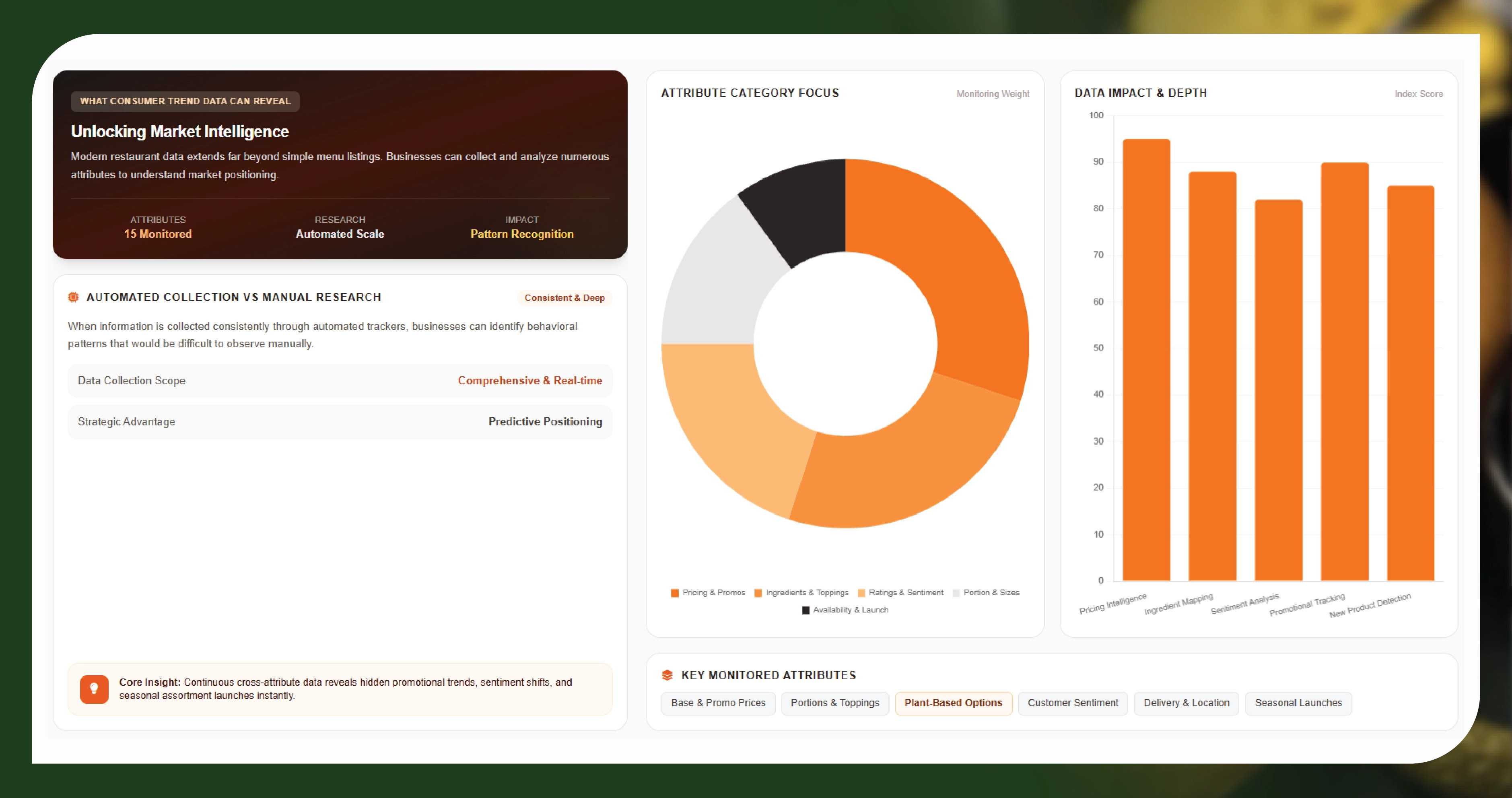
Modern restaurant data extends far beyond menu listings. Businesses can collect and analyze numerous attributes to understand how burgers and hotdogs are positioned in the marketplace.
These attributes may include:
- Product names and descriptions
- Base prices and promotional prices
- Portion sizes
- Ingredients and toppings
- Cheese and sauce varieties
- Vegetarian and plant-based options
- Customer ratings
- Review volumes
- Consumer sentiment
- Restaurant locations
- Delivery availability
- Discounts and promotional offers
- Seasonal products
- New product launches
- Menu availability
When this information is collected consistently, businesses can identify patterns that would be difficult to observe through manual research.
Burger vs Hotdog: Consumer Preference Comparison
The most important comparison is consumer preference.
Burgers generally provide greater customization. Consumers can select different patties, cheeses, sauces, buns, toppings, and cooking styles. This creates opportunities for restaurants to develop premium, gourmet, regional, and specialty burger products.
Hotdogs typically have a simpler product structure, but their simplicity can become an advantage. Consumers can quickly understand the product, customize toppings, and purchase it as an inexpensive meal or snack.
Burger demand may therefore be stronger among consumers seeking variety and meal value, while hotdog demand can be particularly attractive in convenience-focused environments.
However, these patterns can vary significantly by geography and consumer segment.
A restaurant operating near universities may find strong demand for affordable burgers and hotdogs, while an entertainment district may show greater demand for premium loaded versions. Comparing demand at the local level can help businesses avoid making decisions based solely on national averages.
Pricing: A Critical Competitive Factor
Price is one of the strongest variables influencing fast-food purchasing behavior.
Burger prices can vary dramatically depending on ingredients, restaurant positioning, and portion size. A basic burger may compete directly on affordability, while premium burgers can command significantly higher prices because of specialty meats, artisan buns, imported cheeses, or distinctive toppings.
Hotdogs often operate within a lower price range, making them attractive to price-sensitive consumers. However, premium hotdogs are also becoming an opportunity for restaurants seeking higher margins through specialty sausages, gourmet toppings, and innovative sauces.
Continuous pricing analysis enables businesses to compare average prices, promotional discounts, product bundles, and price changes across competing restaurants.
This is where Real-Time Price Monitoring becomes particularly useful for businesses seeking to understand how competitors respond to demand, inflation, seasonal events, and promotional campaigns.
Flavor and Ingredient Trends
Flavor analysis can reveal what consumers are actually seeking.
Burger menus increasingly feature combinations involving spicy sauces, jalapeños, smoked cheeses, caramelized onions, crispy toppings, barbecue flavors, and regional ingredients. Limited-edition burgers can also create significant attention by introducing unusual combinations.
Hotdogs offer their own flavor innovation. Restaurants may experiment with chili, cheese, onions, pickles, jalapeños, mustard variations, specialty sausages, and international-inspired toppings.
Analyzing menu descriptions and customer reviews can help identify recurring ingredients and flavor combinations.
For example, if spicy toppings repeatedly appear in new burger and hotdog products while consumers mention spicy flavors positively in reviews, businesses may identify a broader demand signal rather than an isolated menu trend.
Extracting Competitive Market Signals
Businesses can Extract Burger vs Hotdog Consumer Trend Data to create a structured dataset for competitive analysis.
The objective is not simply to count burgers and hotdogs. More valuable insights emerge when multiple variables are connected.
A business could compare:
- Average burger price versus average hotdog price
- Premium product frequency
- Consumer rating differences
- Review sentiment
- Popular toppings
- Product launch frequency
- Discount frequency
- Menu size
- Geographic availability
- Delivery presence
- Seasonal promotions
These comparisons can reveal where brands are competing aggressively and where market gaps may exist.
For instance, if burger menus are highly competitive in a particular location while premium hotdog offerings remain limited, a restaurant may have an opportunity to differentiate through specialty hotdogs.
Ready to turn burger and hotdog consumer trends into actionable market intelligence? Start collecting, comparing, and analyzing food data today to uncover demand, pricing, and growth opportunities.
Burger And Hotdog Market Intelligence
Burger And Hotdog Market Intelligence enables businesses to move from basic product observation toward strategic decision-making.
Restaurant chains can use this intelligence to evaluate competitors before entering new markets. Food manufacturers can study ingredient trends and product positioning. Delivery platforms can analyze category performance across locations. Investors can examine restaurant expansion and consumer demand signals.
Market intelligence can also support menu optimization.
Suppose data shows that consumers consistently prefer burgers containing spicy sauces and crispy toppings. A restaurant could test new products built around these combinations. If hotdog reviews demonstrate increasing interest in specialty sausages and premium toppings, restaurants can develop products accordingly.
This approach reduces reliance on assumptions and supports decisions based on observable market signals.
The Role of Consumer Reviews
Reviews provide another important layer of consumer intelligence.
Menu data can tell businesses what restaurants are selling, but reviews can help reveal what customers actually think about those products.
Consumers frequently mention:
- Taste
- Portion size
- Value for money
- Freshness
- Ingredient quality
- Sauce quantity
- Meat quality
- Presentation
- Customization
- Delivery experience
Sentiment analysis can categorize these comments into positive, neutral, and negative themes.
A restaurant may discover that its burger receives high ratings for flavor but frequent complaints about portion size. Another may find that its hotdog is considered affordable but receives negative comments about topping quality.
Such insights can guide product improvements more effectively than ratings alone.
Burger vs Hotdog Consumer Preference Analytics
Burger vs Hotdog Consumer Preference Analytics can bring all these signals together.
Rather than asking simply, "Which product is more popular?" businesses can investigate more meaningful questions:
- Why are consumers choosing burgers?
- When do consumers choose hotdogs?
- Which price points generate the most interest?
- Which toppings receive the strongest engagement?
- Which restaurants are gaining consumer attention?
- How do preferences vary across locations?
- Which products receive the highest ratings?
- Are premium products gaining traction?
Answering these questions provides a deeper understanding of consumer behavior.
Opportunities for Data-Driven Restaurants
The growing importance of digital menus, delivery platforms, online reviews, and restaurant marketplaces creates significant opportunities for automated data collection.
Food Data Scraping Services can help businesses collect structured restaurant information from multiple digital sources and transform scattered information into datasets suitable for analysis.
For example, businesses can monitor thousands of restaurant listings to identify changes in product availability, pricing, promotions, ingredients, and ratings.
This can support competitive benchmarking without relying solely on periodic manual research.
Using Data for Menu Strategy
One of the strongest applications of burger-versus-hotdog analysis is menu development.
Restaurants can identify products with strong consumer engagement and compare them with underrepresented categories. They can also identify combinations that appear frequently across successful competitors.
For burgers, analysis may focus on patty types, cheese, sauces, buns, toppings, and portion sizes.
For hotdogs, analysis may focus on sausage varieties, preparation methods, toppings, sauces, and regional combinations.
The goal is not necessarily to copy competitors. Instead, the data can identify market patterns that inspire differentiated products.
Geographic and Seasonal Differences
Consumer behavior can change considerably by location.
A burger that performs strongly in one city may not have the same appeal elsewhere. Local tastes, demographics, weather, cultural influences, income levels, and restaurant density can affect demand.
Seasonality can also influence purchasing patterns. Outdoor events, sports seasons, holidays, festivals, and warmer weather may increase demand for portable food products such as hotdogs.
Burgers may maintain stronger year-round meal demand, but specialty burgers can also experience seasonal spikes.
Tracking these changes over time allows restaurants to develop location-specific and seasonal strategies.
Future of Burger and Hotdog Trend Intelligence
The future of fast-food competition will increasingly depend on real-time data.
Restaurants can combine menu data, pricing information, reviews, location intelligence, promotions, and consumer sentiment to understand competitive changes faster.
Artificial intelligence can further support this process by identifying emerging flavors, categorizing reviews, detecting price movements, and forecasting demand.
The result is a shift from reactive restaurant management toward proactive decision-making.
Instead of waiting for quarterly reports or occasional surveys, businesses can continuously monitor what competitors are offering and how consumers are responding.
How Food Data Scrape Can Help You?
1. Track Competitor Pricing
Food data scraping helps monitor burger and hotdog prices, discounts, bundles, and promotions across restaurants, enabling businesses to benchmark competitors and optimize their own pricing strategies.
2. Understand Consumer Preferences
Analyze ratings, reviews, menu choices, and popular ingredients to identify consumer preferences, helping restaurants discover which burger flavors, hotdog toppings, and product combinations generate stronger demand.
3. Discover Emerging Food Trends
Scraped menu and consumer data can reveal emerging flavors, ingredients, portion formats, and product concepts, allowing businesses to identify fast-growing trends before competitors and respond strategically.
4. Optimize Restaurant Menus
Compare competing menus to identify product gaps, pricing opportunities, popular categories, and underrepresented offerings, helping restaurants develop differentiated menus that better match changing consumer expectations.
5. Strengthen Market Intelligence
Consolidated food datasets provide actionable market intelligence across locations, restaurants, prices, products, and reviews, supporting expansion decisions, competitive benchmarking, demand forecasting, and data-driven business strategies.
Conclusion
Burger and hotdog competition provides a fascinating window into changing fast-food consumer behavior. Burgers generally offer extensive customization, premium positioning, and meal-oriented appeal, while hotdogs benefit from affordability, portability, simplicity, and strong associations with casual eating and events.
The most valuable strategy is not simply determining which product wins. Instead, businesses should examine where, when, why, and at what price consumers choose each product.
By combining Restaurant Menu Data Scraping with review analysis, pricing intelligence, geographic monitoring, and product-level comparisons, businesses can build stronger Restaurant Intelligence strategies.
Ultimately, tracking Burger Flavors & Ingredient Insights can help restaurants identify emerging preferences, develop differentiated menus, optimize pricing, and respond faster to changing consumer expectations.
As fast-food competition becomes increasingly data-driven, the ability to compare burgers and hotdogs through structured consumer trend analysis can transform everyday menu information into a valuable source of competitive advantage.
If you are seeking for a reliable data scraping services, Food Data Scrape is at your service. We hold prominence in Food Data Aggregator and Mobile Restaurant App Scraping with impeccable data analysis for strategic decision-making.
Get a Free Food Data Sample in 48 Hours.
Tell us your platforms, target markets and required fields — we'll map exactly what's possible with food data scraping, recommend the right approach, and send a working sample so you can verify quality before any commitment.
Request a strategy call
Thanks — our data team will reach out within 48 hours with your sample.