Introduction
Supermarket price comparison applications are transforming how consumers discover affordable groceries and how retailers understand competitive pricing. By bringing product prices, package sizes, promotional offers, and store-level availability together, these platforms help shoppers make informed purchasing decisions while enabling businesses to evaluate market movements.
Economarket, as a supermarket price comparison platform, provides a useful context for understanding how structured grocery pricing information can support retail research, competitor benchmarking, and price transparency. Businesses can Scrape Economarket Price Comparison Data to examine product listings, compare prices across available supermarkets, and identify differences between standard and promotional rates. Similarly, companies can Extract Supermarket Price Comparison Data to organize product information into consistent datasets that support reliable comparisons across retailers, locations, and product categories.
Effective Supermarket Price Data Analytics goes beyond collecting displayed prices. It involves identifying comparable products, tracking price changes, evaluating discounts, and examining how assortment and availability influence purchasing decisions. When collected responsibly and analyzed systematically, supermarket comparison data helps retailers, consumer brands, grocery technology companies, and market researchers understand pricing patterns and discover opportunities to improve their strategies.
Understanding Economarket and Supermarket Price Comparison Data
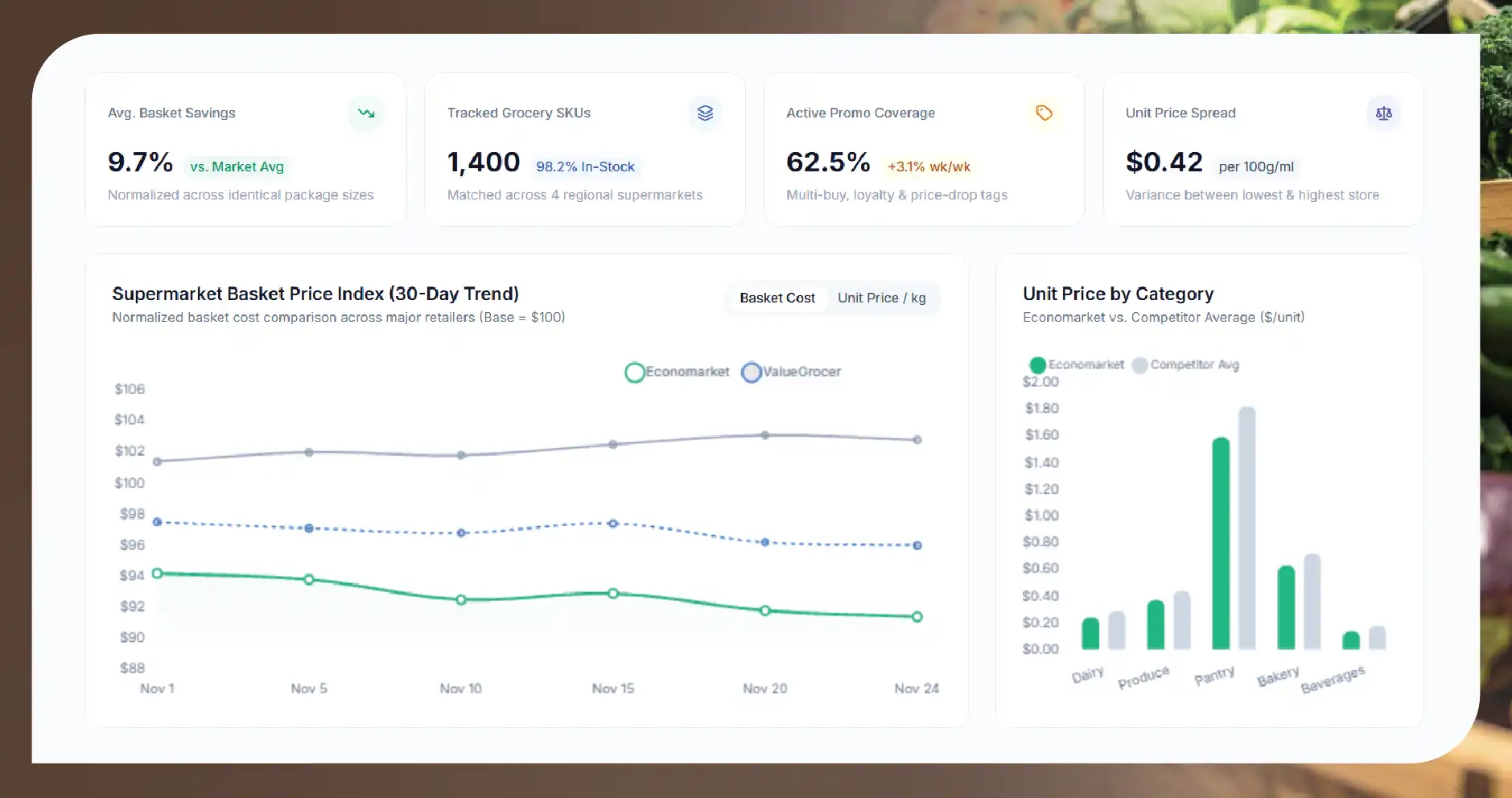
A supermarket price comparison application helps consumers evaluate grocery products and identify potentially better-value purchasing options. Depending on the platform's coverage, users may compare products from multiple supermarkets, review displayed prices, examine offers, and understand differences between package sizes or product variants.
For businesses, this information offers a broader perspective on the competitive grocery market. Instead of manually checking individual supermarket websites or applications, analysts can organize available information into structured datasets and evaluate pricing across multiple product categories.
The quality of this analysis depends on the fields available through the platform. Useful information may include product names, brands, package quantities, listed prices, unit prices, promotional details, retailer names, product categories, and availability indicators. Actual fields and coverage depend on Economarket's accessible features and data collection permissions.
A structured approach to Grocery Pricing Intelligence Data helps organizations transform individual product listings into meaningful market observations. Retailers can compare their prices with competing offers, while manufacturers can evaluate how their products are positioned across stores. Grocery technology providers can also use such information to improve price discovery and consumer-facing comparison experiences.
Important Data Points to Collect from Price Comparison Applications
A useful Grocery Price Comparison App Data should capture more than a product's displayed price. Each field contributes to a more accurate understanding of the grocery market.
- Product identification: Product names, brands, categories, pack sizes, product variants, and available identifiers help analysts recognize comparable items.
- Retailer information: Supermarket names, store locations, and available delivery or collection options help establish the context behind each price.
- Pricing information: Current displayed prices, unit prices, original prices where available, and promotional prices support meaningful comparisons.
- Offer details: Discounts, multibuy promotions, loyalty offers, and campaign dates help explain differences in the effective purchase price.
- Availability indicators: In-stock status or unavailable-product flags help distinguish competitive pricing from products that customers cannot currently purchase.
- Collection timestamps: Dates and times establish when information was observed and help analysts identify changes between collection cycles.
These fields should be standardized before analysis. For example, comparing a 500-gram product with a one-kilogram pack using only the displayed selling price can lead to misleading conclusions. Converting prices into a common unit, such as price per kilogram or litre, makes comparisons more meaningful.
Why SKU-Level Price Comparison Matters?
Stock keeping units, commonly known as SKUs, help businesses distinguish individual products and their specific variants. A supermarket may sell the same brand of cooking oil in 500 ml, one-litre, and five-litre containers. Although these products belong to the same category, their prices and unit economics differ significantly.
Businesses that can build detailed comparisons for individual products, making it easier to identify pricing gaps and changes in competitive positioning. Accurate SKU matching is essential because similar product names do not always represent identical items. Brand, weight, flavour, formulation, and packaging should be considered before comparing prices.
This process also supports private-label analysis. Retailers can examine whether their own-brand products offer a competitive price advantage against established manufacturers. FMCG companies can compare their branded products with competing alternatives and understand how packaging sizes, promotional discounts, and retail placement influence perceived value.
A reliable matching system should distinguish exact matches from approximate alternatives. Uncertain matches can be flagged for manual verification instead of being treated as identical products.
Major Business Applications of Supermarket Comparison Data
1. Competitor Price Benchmarking
Retailers need to understand how their prices compare with competing supermarkets. Structured comparison data helps category managers examine prices across staple foods, beverages, dairy products, household essentials, snacks, and personal care products.
With Grocery Price Comparison App Data, businesses can identify products priced above or below competitor levels, evaluate category-wide price differences, and determine where adjustments may improve competitiveness. Comparisons become more meaningful when products are matched correctly and prices are recorded for comparable locations and periods.
2. Promotion and Discount Analysis
Promotions can significantly influence shopping decisions. Temporary discounts, multibuy offers, loyalty incentives, and seasonal campaigns may change the apparent competitiveness of individual products.
Tracking promotional information helps businesses measure discount frequency, compare advertised savings, and evaluate whether price reductions are sustained or temporary. Historical observations also reveal which categories frequently receive discounts and when competing supermarkets intensify promotional activity.
3. Basket-Level Price Comparison
Consumers rarely purchase only one product. They buy collections of essentials, making basket-level comparisons especially valuable for grocery retailers and price comparison platforms.
Businesses can construct standardized shopping baskets containing products such as milk, rice, bread, eggs, cooking oil, fruit, and cleaning supplies. They can then compare the total cost across supermarkets, provided the products and quantities are equivalent.
The analysis must account for missing products, different pack sizes, delivery fees, and applicable service charges. Otherwise, a supermarket may appear cheaper simply because its basket excludes unavailable items or additional costs.
4. Regional Pricing and Availability
Grocery prices and availability may vary by store, delivery zone, or postcode. Local competition, distribution costs, promotions, and inventory conditions can all influence the price customers encounter.
Regional comparisons help businesses identify geographic pricing differences and evaluate whether promotional strategies perform consistently across markets. However, location-level insights are only reliable when collection locations are recorded accurately and compared on a like-for-like basis.
Building a Grocery Price Comparison Dashboard
A well-designed Grocery Price Comparison Dashboard converts collected records into practical business insights. Instead of manually reviewing large spreadsheets, teams can monitor price differences, promotional activity, assortment changes, and historical trends through interactive reports.
Useful dashboard components include:
- Price comparison views: Compare equivalent products across supermarkets, highlighting the lowest listed price and the price difference between retailers.
- Price history charts: Track changes over time to distinguish temporary discounts from longer-term pricing movements.
- Category performance: Compare average unit prices across categories such as dairy, packaged foods, beverages, and fresh produce.
- Promotion tracking: Measure discount depth, promotional frequency, and changes in advertised offers.
- Availability monitoring: Identify products that become unavailable or disappear from a retailer's assortment.
- Regional filters: Review differences by location, store, or supported delivery area.
- Data freshness indicators: Display collection timestamps and flag records that have not been refreshed within the expected interval.
For dependable reporting, the dashboard should display clear definitions for every metric. Average prices, for example, should not combine unrelated package sizes or treat missing prices as zero. These safeguards help analysts interpret results accurately and avoid misleading conclusions.
Data Collection, Accuracy, and Operational Best Practices
Collecting supermarket comparison information requires a consistent and responsible process. Businesses should use authorized data access methods, follow applicable platform terms, respect privacy requirements, and avoid collecting personal or account-specific information that is unnecessary for pricing analysis.
The collection workflow typically includes identifying permitted sources, capturing relevant product fields, standardizing currencies and measurements, matching product variants, validating records, and storing timestamped observations.
Data quality deserves particular attention. A price may be displayed differently across product pages, search results, and promotional banners. Some offers may depend on eligibility conditions, minimum basket values, or loyalty membership. These conditions should be retained whenever available instead of presenting every advertised discount as universally applicable.
Refresh frequency should reflect business needs and observed price volatility. Frequently changing products may require more frequent checks than stable categories. Businesses should also monitor missing records, unexpected price movements, duplicate products, and collection failures.
Most importantly, Economarket Price Comparison App Data should be interpreted within its actual coverage. An application may not represent every supermarket, store, product, or promotional condition in a market. Findings should therefore describe the observed retailers and collection period rather than claim complete coverage without evidence.
How Food Data Scrape Can Help You?
1. Automated Grocery Price Collection
Food Data Scrape collects permitted supermarket pricing information systematically, reducing manual research and organizing product prices, package sizes, discounts, and availability into structured datasets for consistent competitive analysis.
2. Competitor Price Monitoring
Businesses can compare equivalent grocery products across supermarkets, identify pricing gaps, and evaluate competitor promotions. These insights support informed pricing decisions while helping retailers maintain competitiveness across important product categories.
3. SKU-Level Product Intelligence
Food Data Scrape organizes product-level information to support accurate comparisons across brands, sizes, and variants. This helps analysts evaluate unit prices, identify assortment differences, and uncover product positioning opportunities.
4. Historical Pricing and Promotion Analysis
Timestamped records help businesses examine price movements, discount patterns, and seasonal promotions. Historical comparisons reveal recurring trends, support promotional planning, and provide context for evaluating changes in competitive pricing strategies.
5. Dashboard-Ready Data Integration
Structured datasets can feed business intelligence dashboards, spreadsheets, and supported API workflows. Teams can transform collected grocery information into accessible reports for category management, retail benchmarking, and strategic decision-making.
Conclusion
Supermarket price comparison application data provides valuable opportunities for retailers, FMCG manufacturers, market researchers, and grocery technology businesses. By collecting and organizing product prices, unit measurements, promotional offers, and availability indicators, organizations can better understand competitive positioning and changing consumer value propositions.
Reliable Grocery Store Datasets help businesses compare products consistently, identify market gaps, and strengthen pricing strategies across categories and locations. Combining accurate collection processes with effective validation and historical analysis creates a stronger foundation for actionable Grocery Intelligence.
Furthermore, Real-Time Grocery Price Monitoring Data can help businesses identify relevant price changes sooner, subject to source accessibility and collection frequency. When supported by accurate SKU matching, transparent reporting, and well-designed dashboards, Economarket-related comparison data can turn scattered supermarket listings into useful market intelligence. The result is a more informed approach to price benchmarking, promotional evaluation, assortment planning, and grocery market research.
Ultimately, the value of supermarket comparison data depends not simply on how much information is collected, but on how accurately it is interpreted and applied to real business decisions.
Are you in need of high-class scraping services? Food Data Scrape should be your first point of call. We are undoubtedly the best in Food Data Aggregator and Mobile Grocery App Scraping service and we render impeccable data insights and analytics for strategic decision-making. With a legacy of excellence as our backbone, we help companies become data-driven, fueling their development. Please take advantage of our tailored solutions that will add value to your business. Contact us today to unlock the value of your data.
Get a Free Food Data Sample in 48 Hours.
Tell us your platforms, target markets and required fields — we'll map exactly what's possible with food data scraping, recommend the right approach, and send a working sample so you can verify quality before any commitment.