Introduction
The U.S. food industry is entering a transformative phase in 2026, where shifting consumer expectations, inflation-driven purchasing decisions, sustainability priorities, and digital commerce are redefining how brands compete. Companies are no longer relying solely on historical sales reports. Instead, they are investing in real-time data intelligence, AI-powered forecasting, and large-scale food data collection to understand rapidly changing consumer behavior.
Businesses looking to stay competitive increasingly Scrape Food Trends USA 2026 to monitor pricing movements, product launches, restaurant menus, grocery assortments, and consumer preferences across multiple digital platforms.
At the same time, a comprehensive USA food market intelligence report 2026 enables manufacturers, retailers, restaurant chains, and investors to evaluate evolving demand patterns across regions and demographic segments.
Modern analytics powered by US consumer food demand forecasting help organizations anticipate buying trends before they become mainstream, allowing businesses to optimize pricing, inventory, marketing, and product innovation.
Why Food Trends Matter More Than Ever?
The U.S. food marketplace has become increasingly dynamic. Consumers now encounter thousands of food options every day through grocery shopping apps, restaurant delivery services, social media recommendations, and direct-to-consumer food brands.
Unlike earlier years, when purchasing behavior remained relatively consistent, 2026 is witnessing rapid market shifts driven by health consciousness, affordability, convenience, sustainability, and personalized nutrition preferences.
Businesses that recognize these changing consumer preferences gain valuable competitive advantages by:
- Introducing products that match emerging consumer demand
- Adapting more quickly to changing pricing trends
- Strengthening promotional and marketing strategies
- Improving supply chain efficiency and planning
- Increasing customer loyalty and retention
- Discovering profitable opportunities in underserved markets
Rather than depending solely on quarterly market reports, organizations now track food trends continuously through advanced market intelligence platforms that deliver regularly updated business insights.
Major Consumer Trends Reshaping the USA Food Industry
One of the most significant shifts in the industry is the increasing demand for healthier food choices. Consumers are paying closer attention to product ingredients, nutritional content, sugar levels, protein content, and functional health benefits before making purchasing decisions.
Protein-rich snacks, plant-based food alternatives, reduced-sugar beverages, fermented products, and gut-friendly foods continue gaining popularity among a broader consumer base beyond traditional health-focused shoppers.
Convenience remains a major purchasing factor. Fast-paced lifestyles continue driving demand for ready-to-cook meals, meal kits, premium frozen foods, and grocery delivery services that save time while maintaining product freshness and quality.
Sustainability has become a stronger influence on buying behavior than ever before. Consumers increasingly prefer brands that promote recyclable packaging, responsible sourcing, locally produced ingredients, and environmentally sustainable manufacturing practices.
At the same time, value-driven shopping has become a long-term consumer behavior. Even affluent households routinely compare prices across multiple retailers before completing their purchases.
Technology is Driving Market Intelligence
Food businesses are increasingly integrating artificial intelligence, automation, and large-scale digital monitoring to understand consumer behavior more accurately than conventional market research methods.
Rather than relying on annual surveys involving only a limited number of consumers, organizations now analyze millions of digital interactions every day across:
- Online grocery platforms
- Restaurant delivery services
- Retail eCommerce websites
- Mobile apps
- Customer reviews
- Social media conversations
- Loyalty and rewards programs
- Digital coupons and promotions
These diverse data sources provide businesses with near real-time insights into evolving consumer preferences and purchasing behavior.
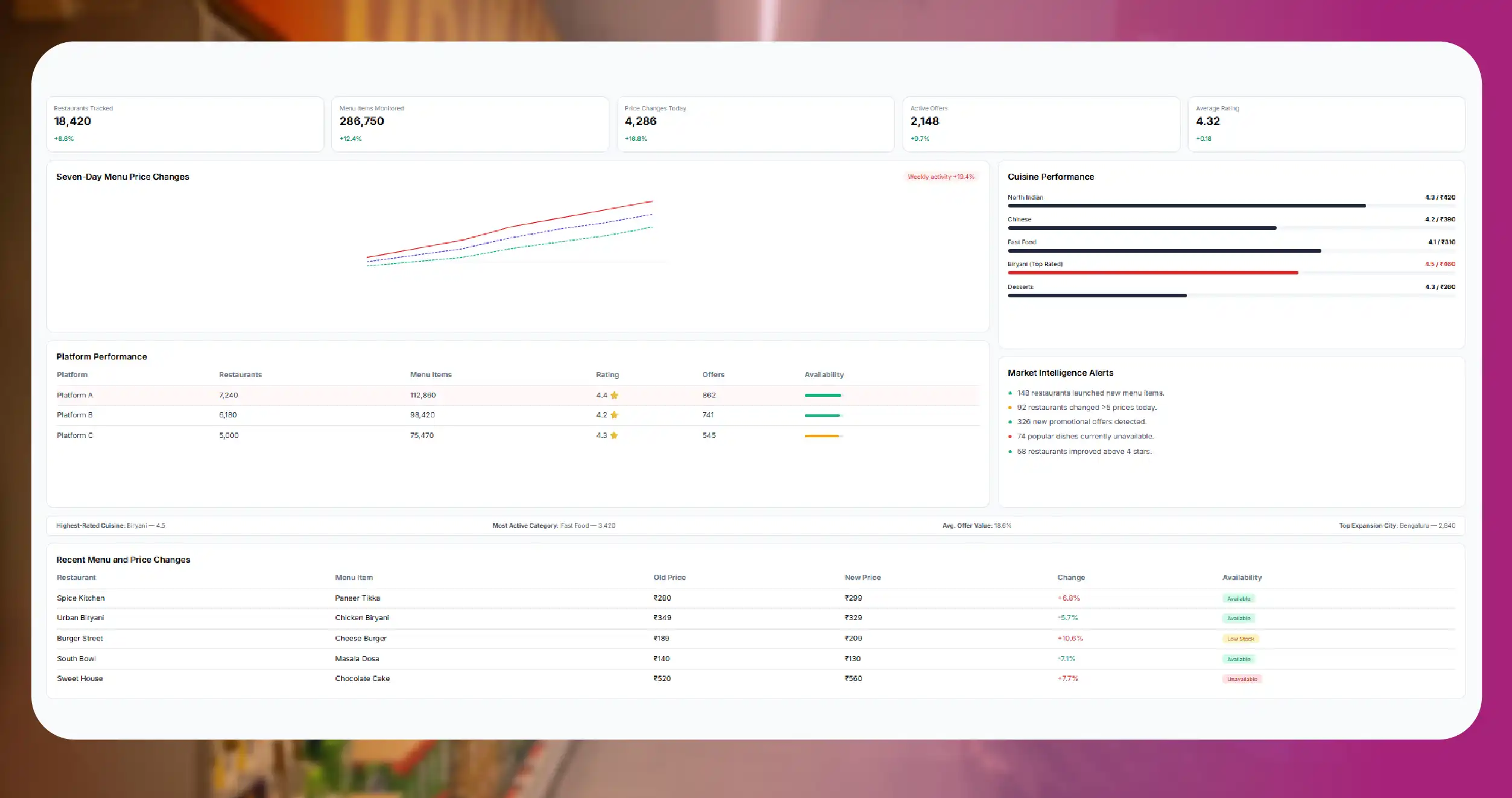
Many companies now depend on a centralized US food retail competitive dashboard to monitor pricing, product assortment, promotional activities, inventory availability, customer ratings, and competitor performance across multiple retail channels at the same time.
Grocery Retail is Becoming Increasingly Data-Driven
U.S. grocery retailers continue strengthening omnichannel shopping experiences by seamlessly connecting physical stores, online ordering, curbside pickup, and home delivery into a unified customer journey.
Advanced pricing strategies are becoming more intelligent as retailers frequently update product prices based on:
- Available inventory levels
- Regional buying demand
- Seasonal market trends
- Competitor pricing strategies
- Supplier and procurement costs
- Consumer purchasing patterns
- Weather-related conditions
- Holiday shopping demand
Retailers now assess thousands of products several times throughout the day to remain competitive while protecting profit margins.
As a result, automated food market intelligence has become increasingly essential for making faster and more informed pricing decisions.
Restaurant Industry Evolution
The restaurant industry is experiencing significant transformation throughout 2026 as consumer expectations continue to evolve.
Customers increasingly demand personalized dining experiences, digital ordering solutions, subscription-based meal programs, and loyalty rewards that are seamlessly integrated into mobile applications.
Restaurant operators analyze large volumes of customer data to optimize:
- Menu pricing strategies
- Recipe profitability
- Best-selling menu items
- Customer retention rates
- Delivery efficiency
- Peak ordering periods
- Location-based demand
- Seasonal menu planning
These valuable insights allow restaurant brands to make informed operational decisions based on data rather than depending solely on experience or intuition.
Consumer Behavior Has Become More Complex
Today's food purchasing decisions are influenced by much more than pricing alone.
Consumers now assess products using several important factors, including:
- Health and wellness benefits
- Brand credibility and reputation
- Convenience and accessibility
- Environmental sustainability
- Customer ratings and reviews
- Product availability
- Discounts and promotional offers
- Delivery speed
- Nutritional transparency
- Country or region of origin
These evolving buying habits require businesses to monitor consumer signals continuously rather than depending on outdated market research.
Advanced US food market trends and consumer insights enable organizations to identify fast-growing product categories while recognizing declining market segments before they impact overall business performance.
Inflation Continues Influencing Buying Decisions
Although inflation has eased compared to recent years, consumers continue to remain highly conscious of product pricing.
Many shoppers actively compare prices across supermarkets, warehouse clubs, discount stores, and grocery delivery platforms before making their final purchase decisions.
Private-label brands continue expanding their market share as consumers search for budget-friendly alternatives without compromising on product quality.
Retailers are increasingly leveraging promotional pricing, personalized discounts, loyalty programs, and AI-powered pricing optimization to strengthen customer retention and encourage repeat purchases.
As a result, continuous pricing intelligence has become a critical component of decision-making throughout the food industry.
Artificial Intelligence is Transforming Food Analytics
Artificial intelligence has become a core technology for analyzing vast volumes of food industry data.
Rather than manually examining spreadsheets, businesses use machine learning algorithms to automatically detect:
- Changing demand patterns
- Emerging product trends
- Pricing irregularities
- Consumer sentiment
- Regional buying preferences
- New sales opportunities
- Inventory-related risks
- Competitive market threats
These predictive capabilities strengthen business planning while minimizing uncertainty throughout the supply chain.
Modern food industry analytics for consumer behavior help organizations transform raw market data into actionable business intelligence, enabling faster and more informed strategic decision-making.
Regional Preferences Continue to Shape Demand
- Consumer preferences differ significantly throughout the United States.
- Urban markets frequently prioritize convenience, premium food products, and international cuisines.
- Suburban households prioritize family-sized packaging, affordability, and grocery delivery services.
- Rural consumers commonly focus on value, bulk purchasing, and locally produced products.
- Climate, culture, income levels, and demographics continue to influence food purchasing behavior.
Therefore, regional intelligence has become crucial for brands pursuing nationwide expansion.
Turn food market data into strategic growth—partner with us to unlock real-time insights, smarter decisions, and a lasting competitive advantage with our advanced data scraping solutions.
Digital Commerce Continues Expanding
E-commerce remains one of the fastest-growing food sales channels.
Consumers increasingly purchase groceries through:
- Retail mobile apps
- Online supermarkets
- Subscription services
- Quick commerce platforms
- Restaurant delivery applications
- Direct-to-consumer websites
- Voice assistants
- Smart home devices
Digital commerce generates enormous volumes of behavioral data that companies analyze to improve customer experiences.
The integration of AI with digital retail enables increasingly personalized recommendations that improve conversion rates while strengthening customer loyalty.
Competitive Intelligence is Becoming Essential
Food manufacturers no longer compete only on product quality.
Success increasingly depends on how quickly businesses detect competitive changes.
Organizations continuously monitor:
- Competitor pricing
- New product launches
- Packaging changes
- Retail distribution
- Promotional campaigns
- Customer ratings
- Menu innovations
- Market expansion
These insights help businesses react faster than competitors while identifying new revenue opportunities.
Comprehensive US food industry outlook and market intelligence support long-term strategic planning by combining historical trends with predictive analytics.
Role of Data Collection in Food Intelligence
Large-scale digital data collection has become the backbone of modern food analytics.
Businesses collect information from grocery retailers, restaurant platforms, delivery applications, manufacturer websites, and digital marketplaces to build unified intelligence systems.
Through Food Data Scraping in the USA, organizations can monitor continuously evolving product catalogs, pricing, inventory, promotions, nutritional information, and consumer reviews much faster than traditional manual research methods.
This data supports forecasting models, competitive analysis, assortment planning, and optimization of customer experiences.
As datasets continue to expand, automated intelligence becomes increasingly valuable for both large enterprises and growing food brands.
How Food Data Scrape Can Help You?
1. Automated Data Collection
Eliminate manual research by automating the extraction of food prices, product catalogs,
restaurant menus, customer reviews, and inventory updates from multiple online sources with high
accuracy and regular data refreshes.
2. Demand Forecasting Support
Leverage continuously updated market data to identify purchasing patterns, seasonal demand
shifts, and emerging food categories, helping your business forecast demand and make smarter
inventory and procurement decisions.
3. Multi-Platform Coverage
Collect structured data from grocery websites, food delivery apps, restaurant platforms,
eCommerce marketplaces, and brand websites through a single solution, providing complete
visibility across the digital food ecosystem.
4. Custom Analytics Datasets
Receive tailored datasets based on your business objectives, including product attributes,
nutritional information, pricing history, availability, promotions, and category performance,
ready for analytics, dashboards, or machine learning models.
5. Faster Strategic Decisions
Transform raw market data into actionable intelligence that empowers pricing teams, category
managers, marketers, and executives to make faster, evidence-based decisions while staying ahead
in the evolving food industry.
Looking Ahead
The U.S. food market will continue advancing rapidly throughout 2026 and beyond.
Artificial intelligence, predictive analytics, automation, digital commerce, sustainability initiatives, and personalized nutrition will continue shaping consumer purchasing decisions.
Organizations that continuously monitor market changes will be better positioned to innovate, optimize pricing, improve operational efficiency, and respond quickly to evolving customer expectations.
Businesses investing in Food Data Scraping Services gain access to timely market intelligence that supports strategic decision-making across product development, merchandising, pricing, and competitive analysis.
Similarly, comprehensive Food Data APIs simplify access to structured datasets that power analytics platforms, forecasting systems, and business intelligence applications.
Modern Mobile App Scraping further expands visibility into consumer interactions across grocery delivery apps, restaurant ordering platforms, and digital food marketplaces, providing valuable insights into changing purchasing behavior.
Finally, maintaining an accurate USA Restaurant Database allows businesses to track restaurant expansion, menu evolution, pricing strategies, cuisine trends, and regional dining preferences, creating a comprehensive foundation for data-driven growth in the competitive U.S. food industry.
If you are seeking for a reliable data scraping services, Food Data Scrape is at your service. We hold prominence in Food Data Aggregator and Mobile Restaurant App Scraping with impeccable data analysis for strategic decision-making.