Introduction
Brazil's food delivery ecosystem has become a highly dynamic digital marketplace where restaurant availability, menu assortment, pricing, promotions, delivery fees, ratings, and customer demand can change throughout the day. For restaurants, aggregators, food-tech companies, market researchers, and investors, accessing structured marketplace information can turn scattered online listings into actionable business intelligence. Businesses looking to scrape iFood restaurant data Brazil can collect valuable information about restaurants, cuisines, menus, prices, locations, ratings, delivery options, and promotional activity to understand market movements at scale.
An effective iFood pricing data analysis strategy can reveal how restaurants position menu items, adjust prices, launch discounts, and respond to competitors across different Brazilian cities. When combined with iFood restaurant and delivery data scrape capabilities, organizations can develop a broader view of restaurant supply, consumer-facing pricing, delivery conditions, and marketplace competition.
The opportunity extends beyond simply collecting restaurant names. Structured data can support restaurant discovery, competitive benchmarking, geographic expansion, demand analysis, menu optimization, pricing intelligence, and automated monitoring. With Brazil's highly competitive delivery environment, timely data can become an important resource for businesses seeking to make faster and better-informed decisions.
What Restaurant Data Can Be Collected?
A comprehensive restaurant dataset can capture multiple dimensions of the iFood marketplace. Depending on the project requirements, businesses can structure collected information into restaurant-level, menu-level, location-level, pricing-level, and delivery-level datasets.
Typical restaurant fields can include restaurant name, restaurant ID, cuisine type, address, neighborhood, city, operating status, ratings, review counts, estimated delivery time, minimum order value, delivery fee, promotional offers, and service availability.
Menu-level information can include item names, descriptions, categories, prices, discounted prices, add-ons, sizes, meal combinations, images, availability, and customization options. Historical snapshots can also help identify how menu structures and prices evolve over time.
Geographic fields are particularly valuable in Brazil because restaurant supply and consumer behavior can vary significantly between metropolitan markets such as São Paulo, Rio de Janeiro, Brasília, Belo Horizonte, Salvador, Curitiba, Recife, and Porto Alegre.
Building iFood Restaurant Market Intelligence
iFood restaurant market intelligence becomes significantly more valuable when restaurant data is collected consistently rather than as a one-time snapshot. Historical datasets can show how restaurant density, cuisine availability, pricing, promotions, and delivery performance change across locations.
For example, analysts can compare the average price of pizza, burgers, sushi, Brazilian meals, desserts, or beverages across multiple cities. They can identify areas where premium restaurants dominate, where discount-led competition is strongest, or where particular cuisines have relatively low market penetration.
Restaurant intelligence can also support expansion decisions. A restaurant brand considering a new location can examine competitor density, average menu prices, ratings, delivery fees, and cuisine concentration before entering a market.
Understanding the Brazilian Delivery Landscape
A reliable Brazil food delivery market analysis requires more than estimating the number of restaurants available online. Marketplace-level data can reveal the structure of competition and how restaurants compete for digital visibility and customer orders.
Analysts can examine restaurant distribution by city, cuisine, price segment, rating, promotional strategy, and delivery range. Combining these dimensions can reveal market gaps that may not be obvious from conventional market research.
For example, a neighborhood may have numerous low-priced restaurants but relatively few premium establishments. Another area may show strong demand indicators for Asian cuisine while having limited restaurant availability. These patterns can help restaurant operators, delivery businesses, investors, and food-tech companies identify opportunities.
Why Restaurant Listings Data Matters?
iFood restaurant listings data scrape projects can create structured inventories of restaurants available across selected Brazilian markets. Instead of manually reviewing thousands of listings, businesses can organize restaurant information into searchable databases for automated analysis.
A structured listing dataset can contain restaurant identifiers, names, categories, cuisines, locations, ratings, delivery information, pricing indicators, promotional labels, and operating status. These records can then be matched against historical snapshots to detect new restaurant launches, closures, changes in ratings, and changes in marketplace positioning.
For location intelligence, listing data can also be mapped geographically. This allows businesses to evaluate restaurant concentration by city, neighborhood, postal area, or delivery zone where suitable location information is available.
How Pricing Intelligence Can Improve Decisions?
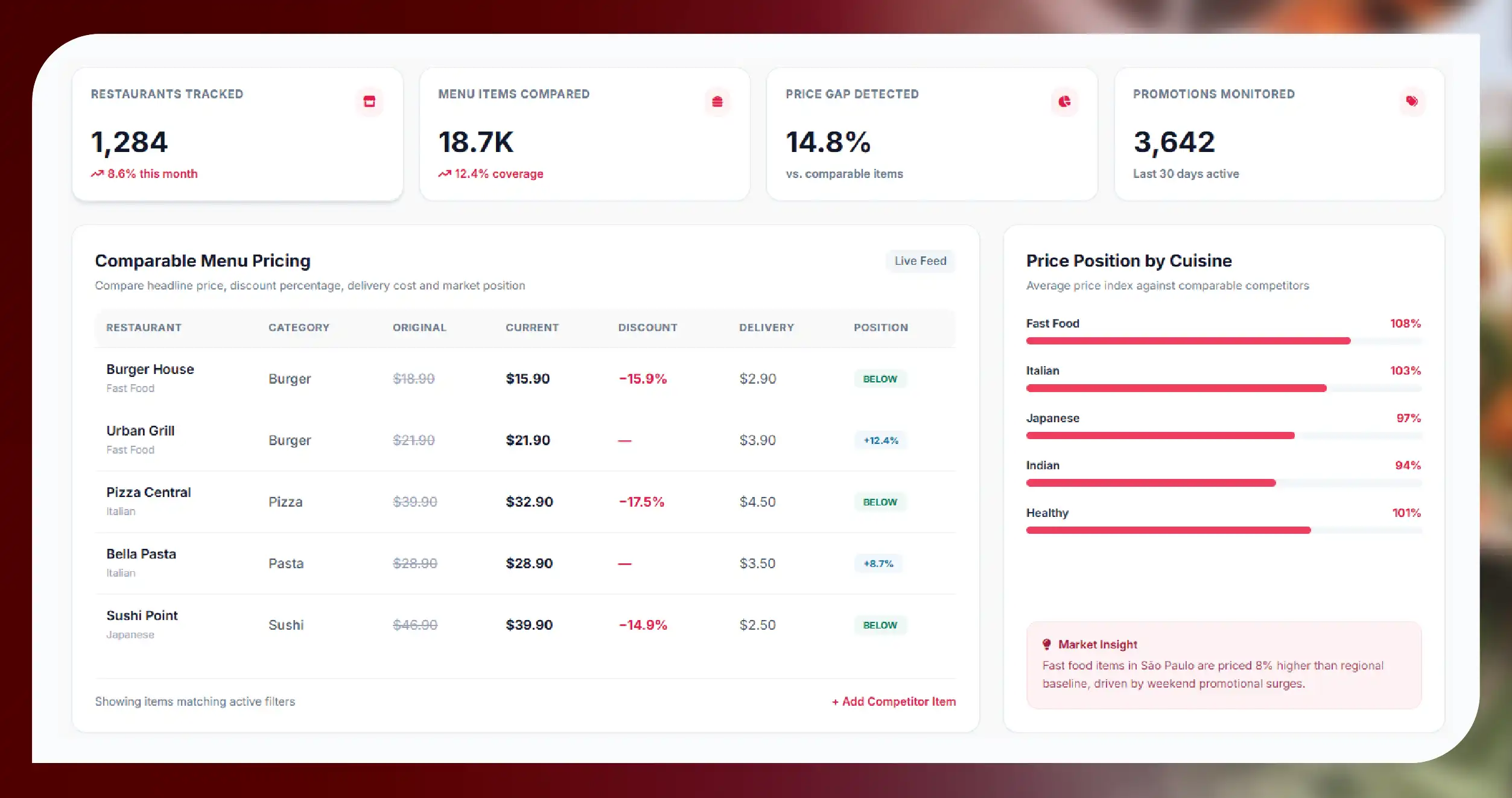
iFood competitive pricing intelligence helps businesses understand whether their prices are competitive within specific cuisine and geographic segments. A simple comparison of headline prices, however, is rarely enough.
A more useful pricing model can compare original prices, discounted prices, promotional percentages, meal sizes, add-ons, delivery charges, minimum order values, and comparable menu categories. This creates a more realistic picture of what consumers may encounter when choosing between restaurants.
Restaurants can use this intelligence to identify products priced significantly above or below comparable offerings. Brands can then evaluate whether their positioning reflects their intended market segment.
Pricing intelligence can also support promotional monitoring. If competitors repeatedly offer discounts during particular periods, businesses can track those patterns and evaluate how frequently promotions occur.
Monitoring Menus and Consumer-Facing Offers
Ifood Food Delivery App Data Scraping can help businesses monitor rapidly changing marketplace information. Menus are not static catalogs; restaurants regularly introduce seasonal items, modify recipes, change prices, remove products, and create new combinations.
Automated collection can make it easier to detect these changes. A historical comparison can identify when a menu item appeared, disappeared, changed price, or received a discount.
For restaurant chains, this capability can be used to benchmark menus across branches. Management teams can determine whether individual locations maintain consistent pricing and product availability or whether regional differences exist.
Food manufacturers and market researchers can also analyze menu trends to identify growing categories, ingredients, meal formats, and consumer-facing product concepts.
Creating an Automated Data Pipeline
Ifood Food Delivery Scraping API solutions can make collected information easier to integrate into existing analytics infrastructure. Instead of manually exporting datasets, an API-based architecture can support structured delivery of restaurant, menu, pricing, location, and availability information.
A scalable pipeline may include data collection, validation, normalization, deduplication, storage, transformation, and API delivery. Data can then be connected with business intelligence dashboards, internal databases, analytics platforms, or machine-learning workflows.
Automation is particularly useful when information needs to be refreshed frequently. Restaurants can change their operating status, prices, menus, delivery fees, and promotional offers throughout the day, making periodic monitoring more useful than isolated data collection.
Applications Across Food-Tech and Restaurant Businesses
The value of restaurant data extends across multiple business functions. Restaurant operators can use it for competitive benchmarking and menu optimization. Delivery platforms can analyze marketplace supply and identify underserved areas. Investors can evaluate restaurant market density and expansion opportunities.
Market researchers can use historical data to study pricing movements and cuisine trends. Advertising teams can evaluate restaurant positioning and promotional activity. Technology companies can build recommendation, benchmarking, and market-monitoring solutions around structured datasets.
Data can also contribute to predictive models. Historical prices, restaurant availability, ratings, cuisine categories, promotions, and delivery information can become useful variables for forecasting market trends and identifying emerging opportunities.
Ready to unlock smarter restaurant and pricing intelligence? Get in touch with our data scraping experts today and turn iFood data into actionable business insights.
Data Quality and Responsible Collection
Successful data projects depend on more than collection volume. Accuracy, consistency, freshness, and normalization are equally important. Restaurant names may vary across records, menu items can change frequently, and promotional prices may have limited validity.
A robust workflow should therefore validate records, remove duplicates, standardize currencies and categories, preserve timestamps, and maintain historical snapshots. Geographic information should also be normalized so that restaurants can be reliably compared across cities and regions.
Organizations should design collection systems responsibly and consider applicable website terms, privacy requirements, intellectual-property considerations, access controls, and relevant Brazilian regulations. Data should focus on publicly available business information and avoid unnecessary collection of personal information.
Turning Raw Data Into Actionable Insights
Raw restaurant records become significantly more valuable after analytical processing. Dashboards can display restaurant counts, average menu prices, cuisine distribution, promotional intensity, rating patterns, delivery fees, and geographic coverage.
A city-level dashboard, for instance, could compare hundreds or thousands of restaurants by cuisine and price segment. A pricing dashboard could track changes in selected menu categories over time. A competitive dashboard could compare restaurant brands across locations and identify changes in their digital positioning.
Machine-learning systems can take this further by detecting unusual price changes, identifying emerging cuisines, predicting competitive movements, or classifying restaurants into market segments.
How Food Data Scrape Can Help You?
Discover Untapped Market Opportunities
Our scraping solutions reveal restaurant density, cuisine popularity, pricing segments, and geographic gaps, helping businesses identify underserved locations and promising opportunities for expansion across Brazil's food delivery ecosystem.
Track Competitor Menu Strategies
We monitor competitor menus, new dishes, meal combinations, add-ons, descriptions, and pricing changes, enabling restaurants to understand product positioning and develop stronger, market-responsive menu strategies.
Analyze Promotions and Discounts
Our data captures promotional offers, discounted prices, deals, and campaign patterns, helping businesses evaluate competitor discounting behavior, measure market aggressiveness, and refine their promotional strategies.
Strengthen Location-Based Intelligence
We organize restaurant information by cities, neighborhoods, cuisines, and delivery areas, allowing businesses to compare local competition, evaluate market saturation, and prioritize high-potential geographic regions.
Build Historical Market Datasets
Our services continuously capture structured marketplace information, creating historical datasets that help organizations study restaurant growth, pricing evolution, menu changes, competitive movements, and long-term Brazilian market trends.
Conclusion
Brazil's food delivery ecosystem generates a continuous stream of restaurant, menu, pricing, location, promotion, rating, and delivery information. Converting this information into structured datasets gives businesses a stronger foundation for competitive research, market expansion, pricing strategy, and restaurant intelligence.
An iFood Grocery Delivery Scraping API can additionally support grocery-focused intelligence by capturing relevant product, pricing, availability, and delivery information where applicable, expanding analysis beyond prepared meals.
Similarly, Ifood Data Scraping can help organizations build historical datasets that reveal marketplace changes rather than relying only on isolated observations. Historical snapshots can make it easier to identify pricing trends, restaurant launches, menu changes, promotional cycles, and geographic shifts.
Finally, Scraping Restaurant and Menu Data from iFood can provide the structured foundation required for competitive benchmarking, restaurant discovery, menu intelligence, pricing analysis, and Brazil-focused food-tech research. When supported by reliable automation, data validation, historical storage, and analytical workflows, restaurant marketplace data can evolve from a collection of listings into a powerful strategic intelligence asset.
If you are seeking for a reliable data scraping services, Food Data Scrape is at your service. We hold prominence in Food Data Aggregator and Mobile Restaurant App Scraping with impeccable data analysis for strategic decision-making.