Introduction
India's B2B marketplace ecosystem has become increasingly data-driven, with businesses relying on supplier, product, pricing, location, and category intelligence to identify opportunities faster. IndiaMART has emerged as a major digital destination for connecting manufacturers, wholesalers, exporters, retailers, resellers, and business buyers across thousands of categories. Its current marketplace scale includes millions of suppliers and an extensive catalogue of products and services.
For businesses trying to understand this ecosystem, the need to Scrape IndiaMART Industry Leader Seller Data can provide structured intelligence around prominent suppliers, their product portfolios, operating locations, categories, and marketplace positioning.
At the same time, IndiaMART B2B Seller Data Extraction can help organizations transform publicly available marketplace information into structured datasets that are easier to analyze, compare, and integrate into business workflows.
The value becomes even greater when companies combine seller information with IndiaMART B2B Lead Generation Data, creating a broader view of potential suppliers, distributors, manufacturers, and commercial prospects.
Why IndiaMART Seller Data Matters for B2B Businesses?
Traditional B2B sourcing often depends on fragmented directories, trade exhibitions, referrals, cold calling, and manually maintained supplier lists. While these methods still have value, they can become inefficient when companies need to evaluate thousands of potential vendors across multiple regions.
IndiaMART brings together a broad ecosystem of products and suppliers in one marketplace. Its app describes millions of buyers and suppliers using the platform and provides product discovery, enquiries, quote comparison, and seller communication features.
A structured dataset built from relevant marketplace information can therefore support several commercial functions, including procurement research, competitor analysis, supplier discovery, sales prospecting, market mapping, and category intelligence.
Instead of asking sales or procurement teams to manually search hundreds of profiles, organizations can work with normalized records containing fields such as company name, product category, location, product description, pricing information where available, business type, and marketplace profile URL.
What Is IndiaMART Industry Leader Seller Data?
Industry leader seller data refers to information associated with prominent or strategically relevant sellers operating within specific product and industry categories.
The dataset can be organized around multiple dimensions:
| Data Category | Example Information | Business Application |
|---|---|---|
| Seller Information | Company name, seller type, location | Supplier discovery |
| Product Information | Product name, specifications, category | Product mapping |
| Pricing | Listed price, price range, unit | Price benchmarking |
| Geography | City, state, service area | Regional sourcing |
| Business Profile | Manufacturer, exporter, wholesaler | Supplier classification |
| Marketplace Signals | Ratings, verification indicators | Supplier evaluation |
| Contact Intelligence | Available business contact fields | Lead development |
| Category Data | Industry and product taxonomy | Market segmentation |
The exact availability of individual fields can vary by listing and marketplace presentation, so extraction projects should define their target schema before collection begins.
Building a Structured IndiaMART Seller Dataset
Effective B2B data extraction is more than copying information from individual pages. The objective is to create a clean, consistent, and analysis-ready database.
The first stage is usually category identification. Businesses determine which industries, products, cities, or supplier groups are relevant. For example, a food equipment distributor may focus on commercial ovens, refrigeration systems, bakery machinery, packaging equipment, and food-processing machinery.
The second stage involves collecting seller and product-level information from relevant marketplace pages.
The third stage focuses on normalization. Similar company names, duplicate product listings, inconsistent addresses, different units, and repeated supplier profiles need to be identified and standardized.
Finally, records can be enriched with classifications and analytical fields so that users can filter sellers by industry, geography, product category, supplier type, and other relevant attributes.
Key Fields to Extract From IndiaMART Sellers
A well-designed dataset can contain considerably more information than a simple company directory.
Potential fields include:
- Seller or company name
- Product name
- Product category
- Subcategory
- Manufacturer or supplier type
- City and state
- Business description
- Product specifications
- Listed price or price range
- Minimum order quantity, when displayed
- Product URL
- Seller profile URL
- Verification or trust indicators, where available
- Ratings or review information, where displayed
- Business experience or establishment information, where displayed
- Available business contact details
- Catalogue information
- Geographic service area
A project can be customized depending on whether the primary objective is supplier discovery, competitive intelligence, procurement, lead generation, or market research.
IndiaMART B2B Market Data Extraction
Businesses can use IndiaMART B2B Market Data Extraction to create category-level market intelligence rather than focusing only on individual sellers.
For example, a company entering the commercial refrigeration market could analyze the number of relevant suppliers across different cities, identify commonly listed product types, compare price ranges, and understand how supplier offerings differ geographically.
This approach can reveal market clusters that may otherwise remain difficult to identify manually.
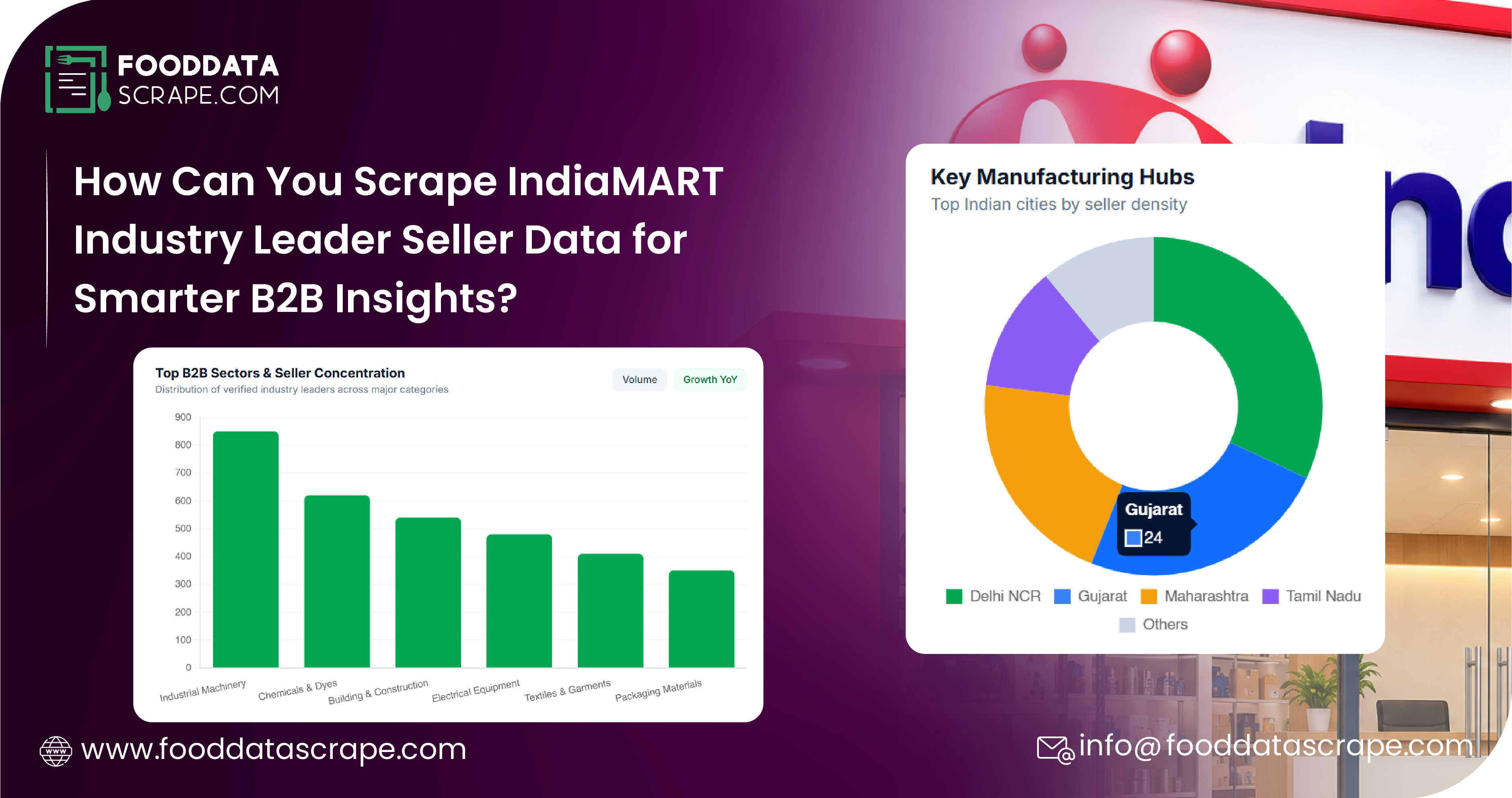
A location-based dataset can also help organizations identify industrial hubs and supplier concentrations. Companies may discover that certain products are heavily represented in particular manufacturing regions, helping procurement teams evaluate logistics, supplier density, and sourcing alternatives.
Scrape IndiaMART Product And Supplier Data
Combining product and supplier information creates a much stronger analytical framework than maintaining separate lists.
Scrape IndiaMART Product And Supplier Data to connect each product with the business offering it, enabling companies to answer questions such as:
- Which suppliers offer a particular product?
- Which cities have the highest supplier concentration?
- Which suppliers operate across multiple product categories?
- How do listed prices vary between suppliers?
- Which companies appear repeatedly across related searches?
- Which suppliers specialize in niche categories?
- Which product categories have a large or fragmented supplier base?
This product-to-supplier relationship can become the foundation for supplier intelligence dashboards, procurement databases, and market research systems.
Using Seller Data for Lead Generation
B2B lead generation becomes considerably more targeted when prospecting is based on business attributes rather than generic contact lists.
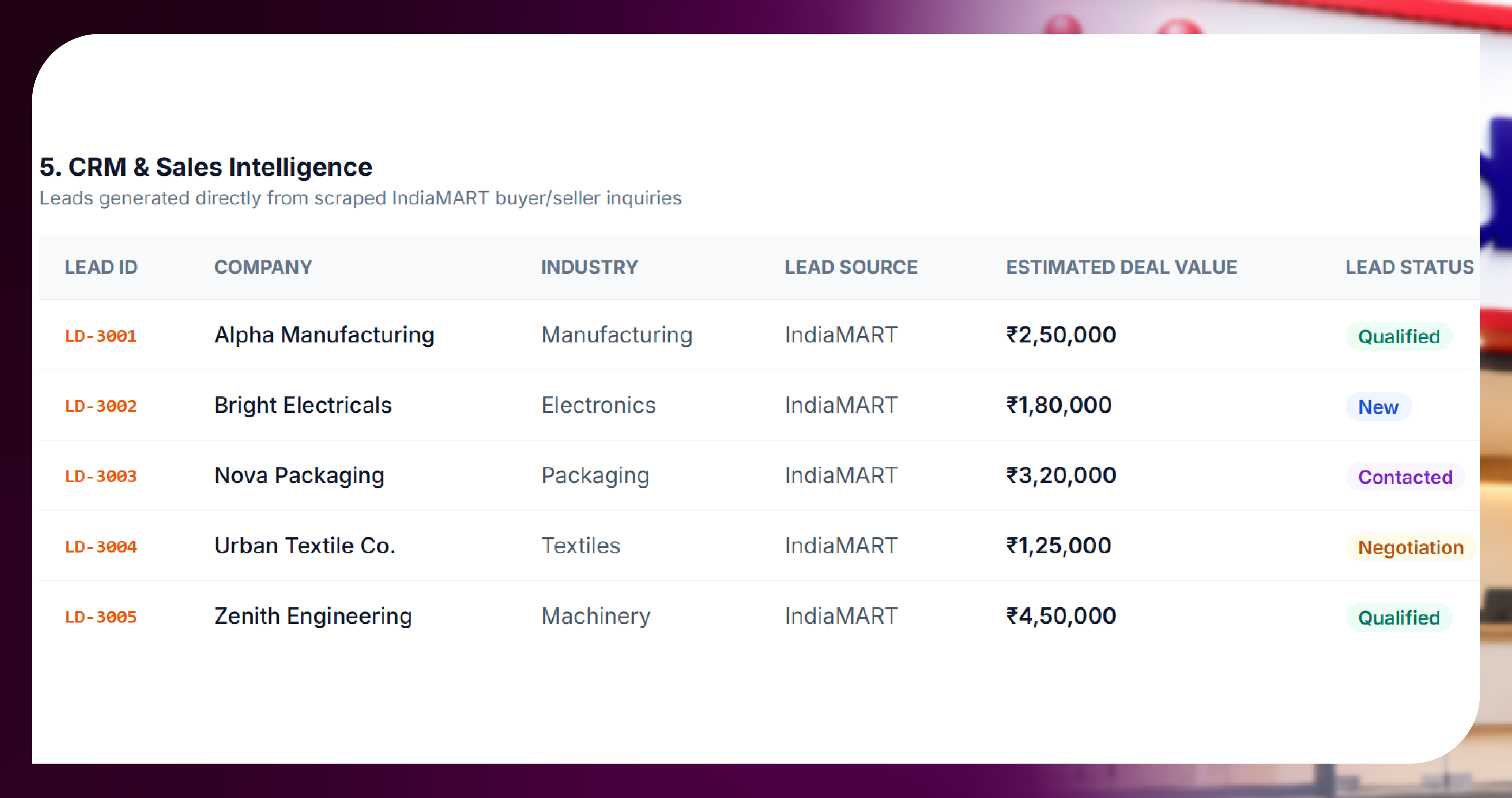
Extract IndiaMART B2B Lead Data to help businesses build segmented prospect pools based on product category, supplier type, geography, and other available marketplace signals.
For example, a distributor of commercial kitchen equipment could create separate prospect groups for restaurant equipment suppliers, hotel equipment manufacturers, bakery machinery companies, refrigeration suppliers, and food-processing equipment vendors.
Sales teams can then prioritize prospects according to their business objectives instead of contacting an undifferentiated database.
This also enables territory-based prospecting. A sales organization could segment suppliers by Maharashtra, Gujarat, Delhi NCR, Tamil Nadu, Karnataka, Telangana, or other regions and assign prospects to appropriate sales teams.
B2B Supplier Market Intelligence
B2B Supplier Market Intelligence converts raw marketplace records into strategic insights.
Companies can monitor supplier density, category competition, product availability, geographic expansion, and pricing patterns. Procurement teams can use these insights to identify alternative vendors, while sales teams can use the same data to identify businesses that may require complementary products or services.
Market intelligence can also support competitor monitoring. If multiple companies repeatedly appear across important categories, their product breadth and geographic presence can be compared over time.
The result is a more dynamic understanding of the market than a static supplier directory can provide.
Foodservice Applications of IndiaMART Data
IndiaMART covers industrial and commercial categories that can be particularly relevant to foodservice businesses. Its marketplace categories include areas such as food-processing equipment and dairy machinery alongside many other industrial products.
Restaurants, hotels, cloud kitchens, caterers, food manufacturers, distributors, and hospitality procurement teams can therefore use structured supplier intelligence to discover businesses offering equipment, packaging, ingredients, refrigeration systems, kitchen machinery, storage solutions, and other commercial requirements.
Foodservice Lead Intelligence can help organizations segment these businesses according to their product specialization, location, business type, and potential commercial relevance.
For a food equipment manufacturer, for instance, a dataset could support targeted outreach to restaurants, hotel suppliers, commercial kitchen companies, and food-processing businesses. For a distributor, it could identify manufacturers and wholesalers that complement its existing portfolio.
From Raw Data to Business Intelligence
The biggest advantage of scraping is not simply collecting more records. It is turning those records into an operational intelligence asset.
A structured IndiaMART dataset can feed into:
- CRM systems
- Supplier discovery platforms
- Procurement databases
- Sales intelligence tools
- Competitive monitoring dashboards
- Market research reports
- Business development workflows
- Pricing analysis systems
- Geographic supplier maps
- Category intelligence platforms
Data can also be delivered in formats such as CSV, Excel, JSON, database tables, or through customized API-ready structures depending on business requirements.
Data Quality and Deduplication Are Critical
Large marketplace datasets can contain duplicate products, repeated sellers, inconsistent naming conventions, incomplete fields, and variations in addresses.
For example, the same business may appear under slightly different company names across multiple product listings. Similarly, a product may be listed using different spellings, units, or descriptions.
A robust extraction workflow therefore needs validation and normalization processes.
Common quality-control steps include:
- Duplicate seller identification
- Product-name normalization
- Category standardization
- Location normalization
- Field validation
- Missing-value handling
- URL validation
- Record-level deduplication
- Periodic refreshes
- Dataset consistency checks
These processes help turn marketplace information into a dependable business resource.
Why Automated Extraction Beats Manual Research
Manual research becomes increasingly expensive as the number of categories and suppliers grows.
A researcher might collect a few dozen suppliers manually, but building a nationwide database across hundreds of categories requires significantly more time and repetitive effort.
Automated extraction can make recurring collection more scalable. Businesses can define categories, geographic filters, required fields, and update frequencies, then maintain a structured dataset that can be refreshed according to business needs.
Automation also improves consistency because the same extraction logic can be applied across large groups of records.
However, responsible data collection should respect applicable laws, website terms, technical restrictions, and privacy requirements. Organizations should focus on appropriate business information and avoid collecting sensitive personal information unnecessarily.
How Businesses Can Use IndiaMART Intelligence?
The applications extend across multiple departments.
- Procurement teams can discover alternative suppliers and compare product offerings.
- Sales teams can build targeted prospect lists around industries and locations.
- Marketing teams can identify high-density business segments for campaign planning.
- Market researchers can evaluate supplier concentration and category trends.
- Investors and consultants can use structured marketplace information as one input for market mapping and competitive analysis.
- Distributors can identify manufacturers and complementary product suppliers.
- Foodservice businesses can develop specialized supplier intelligence covering commercial kitchens, food processing, packaging, refrigeration, and related categories.
The Future of B2B Marketplace Intelligence
B2B marketplaces are increasingly becoming valuable sources of structured commercial signals. IndiaMART's scale makes it particularly relevant for organizations seeking to understand India's fragmented supplier ecosystem. Its current marketplace information highlights a large network of products, suppliers, buyers, and categories.
The next stage is combining marketplace datasets with analytics, machine learning, entity resolution, geographic intelligence, and automated classification.
Instead of simply asking, "Who sells this product?", businesses can begin asking more sophisticated questions:
- Which regions have the strongest supplier concentration?
- Which product categories are becoming more competitive?
- Which suppliers have the broadest portfolios?
- Where are potential sourcing gaps?
- Which businesses are the best-fit prospects?
- Which supplier segments should sales teams prioritize?
This transformation turns marketplace data into actionable intelligence.
How Food Data Scrape Can Help You?
1. Supplier Discovery
Food Data Scrape can help businesses build structured supplier datasets across categories, locations, and product segments, making vendor discovery faster, more organized, and easier to analyze.
2. Lead Generation
Customized extraction workflows can organize relevant seller information into segmented B2B prospect lists, helping sales teams prioritize suppliers according to geography, category, and commercial objectives.
3. Market Intelligence
Businesses can transform supplier and product records into competitive intelligence datasets that support category analysis, supplier benchmarking, geographic research, and strategic market expansion decisions.
4. Data Structuring
Food Data Scrape can normalize product, company, category, location, and pricing fields into consistent datasets, reducing duplicate records and making marketplace intelligence easier to integrate with business systems.
5. Custom Solutions
From recurring data collection to specialized foodservice research, customized datasets can be designed around specific categories, geographic markets, business requirements, delivery formats, and analytical objectives.
Conclusion
IndiaMART represents a substantial digital marketplace for discovering suppliers, products, manufacturers, wholesalers, exporters, and other B2B businesses. Its broad category coverage makes structured seller data useful for procurement, sales intelligence, market research, competitive analysis, and supplier discovery.
Organizations that IndiaMART Grocery Data Scraper solutions can use can create more targeted grocery supplier and product intelligence, particularly when category, location, and product-level information are combined.
With customized Grocery Data Scraping Services, businesses can build recurring datasets for supplier discovery, product intelligence, pricing analysis, and market monitoring.
The next opportunity lies in combining these datasets with AI Grocery Intelligence, enabling organizations to move beyond collecting marketplace records toward identifying patterns, opportunities, competitive gaps, and actionable business insights.
Ultimately, the objective is not simply to collect IndiaMART data. It is to create a structured intelligence layer that helps businesses understand suppliers, discover opportunities, improve prospecting, and make faster B2B decisions.
Are you in need of high-class scraping services? Food Data Scrape should be your first point of call. We are undoubtedly the best in Food Data Aggregator and Mobile Grocery App Scraping service and we render impeccable data insights and analytics for strategic decision-making. With a legacy of excellence as our backbone, we help companies become data-driven, fueling their development. Please take advantage of our tailored solutions that will add value to your business. Contact us today to unlock the value of your data.
Get a Free Food Data Sample in 48 Hours.
Tell us your platforms, target markets and required fields — we'll map exactly what's possible with food data scraping, recommend the right approach, and send a working sample so you can verify quality before any commitment.
Request a strategy call
Thanks — our data team will reach out within 48 hours with your sample.